



HCPCS code E0198: Water pressure pad billing guide
HCPCS code E0198 is a water pad for a standard mattress HCPCS code E0198 is the ...

Last Updated: Oct 13, 2026

CPT code 15835 covers excision of excessive skin and subcutaneous tissue of the buttock, including the lipectomy.
Medicare and most commercial plans treat the procedure as cosmetic until your chart documents functional impairment.
The diagnosis code carries the claim, so pair 15835 with a functional problem such as intertrigo.
A 90-day global period applies, so routine post-operative visits are already paid for in the surgical fee.
Keep photos, weight history, and conservative care notes in one client record before you request authorization.
A buttock skin excision can be textbook surgery and still come back denied. Most payers read CPT code 15835 as cosmetic before they read anything else. The claim then rests on your documentation rather than on how the operation went.
That puts the weight on the chart. Photos, weight history, and a note on what the skin stops the patient doing are what change that answer. Miss one piece and the payer keeps its default position.
None of it is guesswork. Coverage turns on a documented functional problem, a diagnosis code that names it, and an authorization packet sent before the surgery date. Start with the code itself, then build the evidence around it.
CPT code 15835 covers excision of excessive skin and subcutaneous tissue of the buttock, and the descriptor includes the lipectomy.
The official AMA CPT code set wording reads: Excision, excessive skin and subcutaneous tissue (includes lipectomy); buttock. It sits in the integumentary system section, next to the other codes surgeons use after major weight loss.
The descriptor also settles a bundling question. Because the lipectomy is part of the excision, you don’t report a separate suction-assisted lipectomy code for the same site in the same session.
Most coding errors in this family happen at the site. 15835 is the buttock code, and every neighboring area carries its own. Bill the site the surgeon operated on, then let the documentation explain why the skin had to come off.
Every code in the 15830-15839 range describes the same operation on a different part of the body.
Post-bariatric cases often need two or three of them in one operative report. When the surgeon also addresses the abdomen in that session, 15835 travels with 15830.
When several sites are treated in one session, report each site code and add modifier 51 to the secondary ones. 15847 is the exception twice over.
Add-on codes never take modifier 51, and 15847 only ever attaches to 15830. With the site settled, the diagnosis does the rest of the work.
Pairing 15835 with a vague diagnosis is the quickest route to a cosmetic denial. That code tells the payer whether you treated a symptom or improved an outline.
Choose the code that names the functional problem, then make sure the chart says the same thing.
Redundant skin on its own is a thin argument. Redundant buttock skin with recurring intertrigo is a much stronger one.
Photograph the fold, record the rash and every treatment tried, then send both with the authorization request.
A modifier is the short explanation the code itself cannot carry. Four of them turn up on 15835 claims regularly, and each one changes how a reviewer reads the line.
Modifier 22 carries the most audit risk. Payers want the operative report to name what made the case harder, whether that was dense scarring, adhesions, or an unusual tissue volume. A bare claim of complexity earns a denial on its own.
Modifier 59 gets read just as closely. Medicare now prefers the more specific X modifiers, XE, XS, XP, and XU, and its correct coding edits show which pairs need one at all.
Before you append modifier 22, write the complexity into the operative note with numbers. Excision weight, tissue dimensions, and added operating time all beat an adjective. Most payers want that narrative attached to the claim, not just the modifier on the line.
Medicare pays 15835 through relative value units, known as RVUs. Three components make up the total: work, practice expense, and malpractice.
Look up the current figures in the CMS physician fee schedule, since they change every year.
The national conversion factor changes each January 1. Multiply the geographically adjusted RVUs by that year’s factor and you have the Medicare allowed amount.
Commercial contracts are often written as a percentage of Medicare, so the same math sets your expectation there.
Keep your own rate sheet as well. Log what each payer allowed on 15835, then compare it against the contract every January. A payer paying below its own contracted percentage is a conversation, not a write-off.
Medicare’s default position is that buttock skin excision is cosmetic and therefore not covered. Local coverage determinations, written by each Medicare administrative contractor, set out what would change that answer.
They vary by region, and nearly all of them ask you to show a documented functional problem rather than an aesthetic concern.
In practice, that makes prior authorization the first billing task, not the last. Send the full packet rather than a summary.
Payers look for BMI history, the weight loss timeline, photographs, a record of conservative treatment, and a physician statement on function. One missing piece is enough for a denial before the claim even exists.
The same functional test governs neighboring integumentary codes, including 15822 and including 15822 and 15828. Coverage then splits by payer type.
Most 15835 denials trace back to thin documentation rather than a wrong code. A reviewer wants a story with dates. It should say how the redundant skin developed, what it stops the patient doing, and what was tried first.
Collect that story as you go, not the week before submission. A structured bariatric intake form captures weight history and symptoms at consultation.
If your own weight loss practice managed the earlier phase, most of it already sits in the patient’s file.
A 15835 claim travels six steps, from the first consultation to the remittance. Coding guides stop at the code, so here is the rest of that route on the CMS-1500 form.
Two fields catch people out. Box 24J carries the rendering surgeon’s individual number and Box 33 the group’s, so confirm which NPI type belongs where. The rest follows the standard medical billing cycle.
15835 carries a 90-day global surgical period, the standard window for major surgery.
The surgical fee already covers same-day pre-operative work, the procedure, and routine care for the 90 days after it. Bill a normal follow-up visit separately and the line will bounce, or worse, attract an audit.
Some services still stand on their own inside that window, as the CMS global surgery booklet sets out.
Tracking those 90 days by memory fails at volume. Before anyone codes a post-op visit, check the surgery date on the patient’s record and count forward.
Body contouring codes deny more often than average, and 15835 also carries the cosmetic presumption. Every pattern below is a paperwork failure rather than a surgical one, which is why each has a fix.
Sort your denials by reason code and the fix becomes obvious. CO-197 points at authorization, CO-50 at medical necessity, and CO-97 at the global period. Each one belongs to a different team member, so route them accordingly.
Run a denial review by code once a quarter. Pull every 15835 claim, group it by reason code, and count. If authorization codes dominate, the fix sits in scheduling rather than in coding.
The clinical work on a body contouring case is usually finished long before the paperwork is. Photos sit on a phone, weight history sits in a bariatric surgeon’s letter, consent sits in a scanned PDF, and the biller chases all three.
Practice management software like Pabau pulls that material into one place. Patient records hold the notes, letters, and authorization correspondence for each patient, and digital forms collect symptom and treatment history before the consultation starts.
The two items payers ask for most work the same way. Clinical photos save straight to the patient’s file instead of a camera roll. Measurements tracking keeps BMI and weight readings in a dated series you can show a reviewer.
So when the authorization packet is due, your team assembles it from one record rather than four systems. Esteem Life Medical Group describes that shift, and our plastic surgery EMR pages set out how surgical teams configure it.
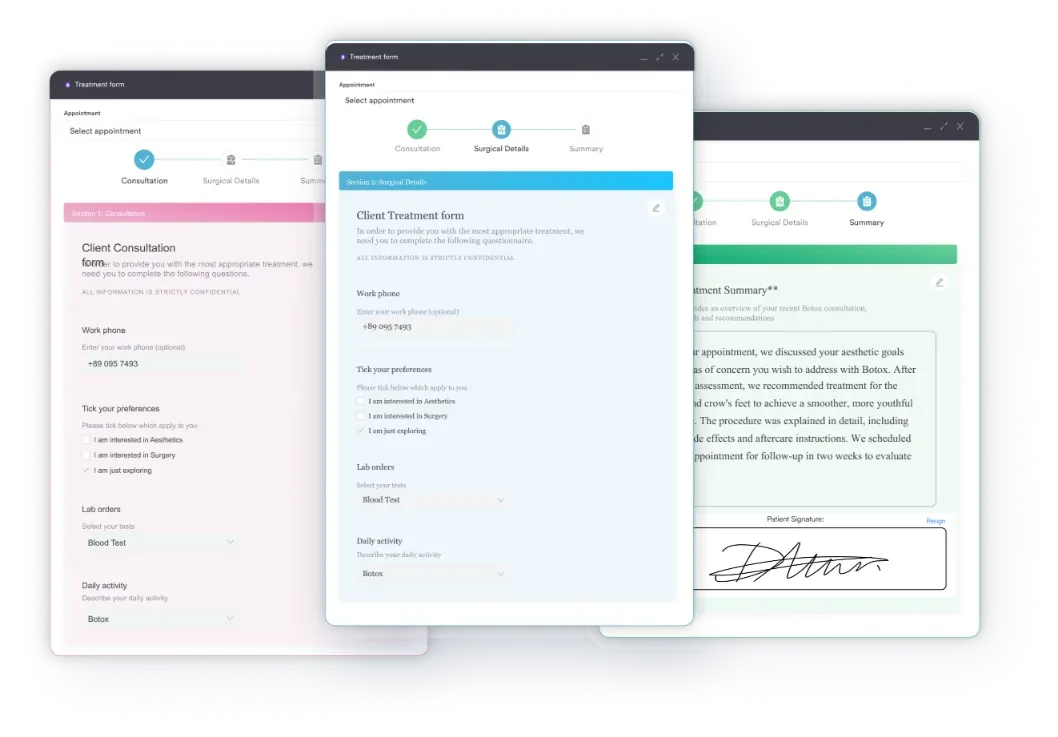

Pabau holds consultation notes, weight readings, clinical photos, and signed forms in a single patient file. Your team can assemble an authorization packet without hunting through four systems.

With 15835, the burden of proof sits with your practice. Payers assume cosmetic, and one absent photograph or undated note is enough to keep that assumption in place. The coding itself is the easy half.
So treat the documentation as part of the surgical plan. Decide at the first consultation which functional problem you will prove, then gather the evidence for it over the following months. Practices that work that way argue from a file rather than from memory, and their appeals get shorter. Most claim errors are structural rather than clinical, which is why scrubbing rules catch them. Payment posting from a remittance file is faster than manual entry and keeps the adjustment reasons attached.
The trade-off worth remembering is time. Front-loading the paperwork slows the first consultation and saves weeks at the authorization stage.
Book a demo to see how Pabau keeps 15835 photos, weight history, and consent in one patient record.

Coding a farsightedness diagnosis instead? Bilateral hypermetropia code guide explains the laterality-specific refraction findings that prevent H52.0x claim denials.
Billing the anesthesia side of the same operative session? 00802 covers how the anesthesia claim is built and documented.
Not sure which refraction code applies? Unspecified refraction disorder code explains when to use it and why payers scrutinize it more than specific refraction codes.
Documenting double vision as well? Diplopia diagnosis code guide covers how correct sequencing of this standalone or secondary code affects claim acceptance.
Coding a vision loss diagnosis instead? Unspecified visual loss code applies when the record lacks laterality or WHO-graded visual acuity detail.
The descriptor already includes the lipectomy performed as part of the excision. Do not report a separate suction-assisted lipectomy code for the same site in the same session. Check the correct coding edits before adding any second contouring code.
Yes. Cosmetic surgery is excluded by statute, so the patient carries the cost. An advance beneficiary notice is not required for excluded services, though a voluntary one records the conversation. For commercial plans, use the financial waiver your contract specifies.
Medicare’s first level is a redetermination, filed within 120 days of the initial determination notice. Commercial deadlines are set by contract, so check the plan’s provider manual. Send the operative note, the photographs, and the functional statement together.
Most cases go out with a hospital outpatient or ambulatory surgery center place of service, and inpatient where the stay requires it. The setting decides whether the facility or non-facility practice expense applies, so it changes the allowed amount.



