ICD-10 Code J20.9: Acute bronchitis, unspecified
ICD-10 Code J20.9: Definition and clinical description ICD-10 Code J20.9 is a bi...

Last Updated: Nov 9, 2026
Billable Code Specific Code
J02.9 is the billable ICD-10-CM code for acute pharyngitis, unspecified. It covers acute throat inflammation when the record confirms no causative organism.
It sits in the J02 category (Acute pharyngitis), within block J00–J06 of chapter J00–J99 (Diseases of the respiratory system). The most common error is keeping J02.9 when a positive rapid strep test in the chart points to J02.0.
Let Pabau's smart automation suggest the right codes, reduce claim denials, and keep your practice compliant—effortlessly.
Automate repetitive tasks and focus on what matters most—your patients.
Reduce coding errors and ensure compliance with the latest regulations.
Clean claims, fewer denials, and faster reimbursements.
Powerful insights and reporting to help your practice thrive.
HIPAA compliant SOC 2 certified GDPR-compliant Trusted by 4,000+ clinics worldwide

J02.9 is a valid, billable ICD-10-CM code for acute pharyngitis when the clinical record identifies no specific pathogen.
An Excludes1 note keeps J02.9 and J00 (acute nasopharyngitis) off the same claim, because the two conditions are mutually exclusive.
Billing J02.9 when a positive strep test is documented in the same encounter can trigger a payer audit or denial. J02.0 is the correct code there.
Pabau, the practice management platform we build, submits US claims through Claim.MD (837P) and supports real-time eligibility checks before the visit.
ICD-10 Code J02.9 is the billable ICD-10-CM code for acute pharyngitis, unspecified, meaning throat inflammation with no organism confirmed in the record.
It is valid for FY 2027 (October 1, 2026 to September 30, 2027). The table below summarizes the reference facts coders need before submitting a claim.
Per the CMS ICD-10 codes page, CMS and the National Center for Health Statistics (NCHS) maintain the code set jointly. It updates every October 1. Always verify J02.9 against the current FY tabular list before submitting claims. Pabau’s ICD-10-CM code library lists the neighboring J00–J06 codes for a side-by-side check.
Acute pharyngitis, unspecified refers to acute inflammation of the pharynx that is significant enough to document. The medical record confirms no causative agent. The pharynx in this context means the posterior throat, excluding the nasopharynx (upper throat behind the nose) and the tonsils as primary sites.
The “unspecified” qualifier tells the payer that the clinician either did not order diagnostic testing or that testing was inconclusive. J02.9 is the correct choice when the note reads like “viral sore throat” with no confirmed organism. The same applies to “pharyngeal erythema without exudate” or “acute throat infection, cause undetermined.”
J02.9 is one of three codes in the J02 category. Understanding the full block prevents selecting the wrong code when a more specific diagnosis is available.
The J02 category sits inside the J00-J06 block (Acute upper respiratory infections). Its neighbors J00 (acute nasopharyngitis) and J03 (acute tonsillitis) are the codes most often confused with J02.9 in clinical practice. Work through the questions below in order, and the first one the note answers “yes” to settles the code.
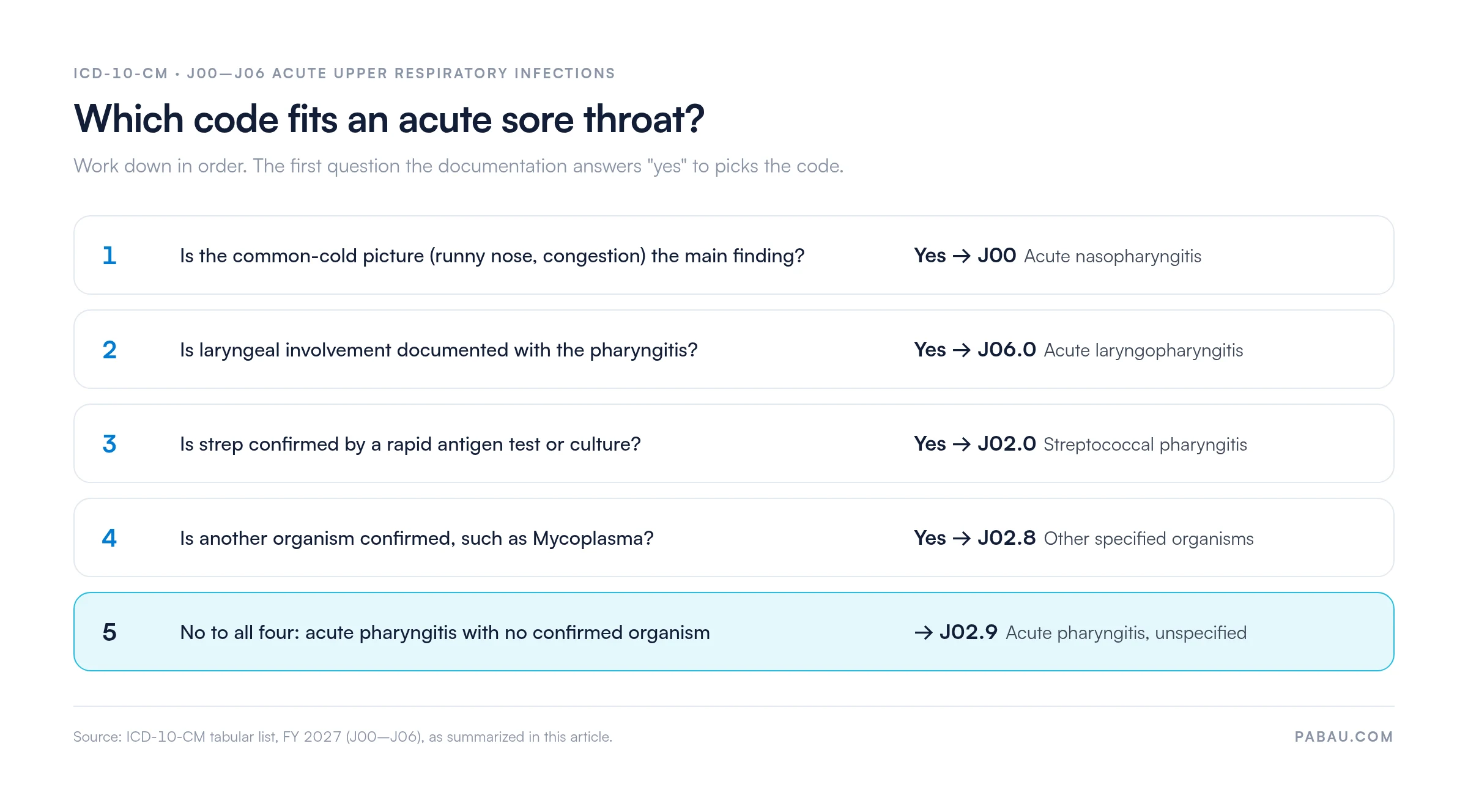
The J02 category carries four Excludes1 notes for conditions that are never coded with J02.9, plus one Excludes2 note. A reciprocal Excludes1 note at J00 also keeps the common cold off a J02.9 claim. Getting these wrong is a direct path to claim denial or payer audit.
An Excludes1 note means the two conditions are never reported together, because one rules out the other. An Excludes2 note means the excluded condition is not part of J02.9, but a patient can have both.
J02.0 is not an Excludes note at all. It is a sibling code in the same category, so use J02.0 instead of J02.9 when strep is confirmed.
J02.9 covers inflammation of the pharynx. J00 covers the nasopharynx and the common cold presentation. The anatomical distinction matters because the Excludes1 note makes them mutually exclusive.
A patient presenting with runny nose, nasal congestion, mild sore throat, and low-grade fever almost always maps to J00, not J02.9. Use J02.9 only when the pharynx is the primary site of documented inflammation and nasopharyngeal symptoms are absent or incidental.
J03 (acute tonsillitis) is a separate category from J02. Code both J02.9 and a J03 code only when the clinician documents both conditions separately.
If the note says only “sore throat with red tonsils” without a tonsillitis diagnosis, J02.9 is sufficient. Check the tabular list for any Excludes note before listing both codes, and query the treating provider when in doubt.
This distinction drives many of the claim corrections in the J02 category. If a positive rapid strep antigen test or throat culture is documented in the same encounter, J02.9 is the wrong code.
The “strep trap” is the highest-risk documentation scenario for this code. Some EHR systems auto-populate J02.9 as the default pharyngitis code. The clinician may order CPT 87880 (rapid strep antigen test), and the result may come back positive. The coder must then update the diagnosis to J02.0 before the claim leaves the practice.
A claim that bills CPT 87880 with a positive result but keeps J02.9 is internally inconsistent. Payer algorithms can flag it during automated review.
Run a monthly audit of claims where CPT 87880 (rapid strep test) and J02.9 appear together on the same date of service. A positive test result in the chart alongside J02.9 on the claim is a documentation mismatch that payers may treat as undercoding. Update the diagnosis to J02.0 before resubmission.
The physician’s note must support both the acute pharyngitis diagnosis and the absence of an identified organism. Payers reviewing unspecified codes look for evidence that the clinician actively assessed the patient rather than defaulting to the most convenient code. Good medical billing compliance starts with what the clinician writes before coding begins.
Some payers look harder at claims where the clinician prescribes antibiotics without a confirmed bacterial pathogen. They check whether J02.0 should have been used instead of J02.9. The note must justify the clinical decision.
Primary care practices submit J02.9 alongside a range of E&M and ancillary procedure codes. The CPT code determines the reimbursement amount, while J02.9 supplies the medical necessity. Review the diagnosis pointer on every CPT line in your claims management software before submission, so errors are caught before the clearinghouse sees them.
E&M level selection must be supported independently by documentation of medical decision making or total encounter time. J02.9 alone does not justify a high-complexity visit code. The complexity of the note has to do that work.
J02.9 does not trigger prior authorization under standard Medicare Part B or most commercial plans for routine outpatient E&M encounters. Prior auth is not a typical concern for straightforward pharyngitis visits. The payer issues that do arise relate to medical necessity and documentation adequacy, not pre-approval.
Run insurance eligibility verification before the encounter to confirm the patient’s plan covers outpatient primary care visits on the date of service. Some Medicaid managed care plans require referrals for specialists. For primary care, J02.9 encounters are generally straightforward.
Submit claims electronically through a compliant clearinghouse. Pabau’s US clearinghouse partner, Claim.MD, connects to thousands of US payers for real-time eligibility checks and 837P claim submission.
Pharyngitis claim denial patterns are predictable. Most stem from thin documentation, code-to-CPT mismatches, or the strep-trap scenario described earlier. A systematic denial management workflow catches these before they age into write-offs.
Clean claim submission depends on catching mismatches before the claim leaves the practice. Front-loading eligibility checks and code validation reduces denial rates for routine pharyngitis encounters.
ICD-9-CM code 462 (Acute pharyngitis) maps forward to J02.9. Related ICD-9-CM code 034.0 (Streptococcal sore throat) maps to J02.0. To reconcile pre-2015 records with current billing data, use the CMS General Equivalence Mapping (GEM) files or the AAPC ICD-10 crosswalk tool.
The five steps below trace J02.9 through a practice management system, from encounter to paid claim. Each one is a revenue cycle management checkpoint where a denial can be stopped.
Watch for one EHR pitfall. Some systems carry J02.9 forward as a “last used” default across pharyngitis visits, without prompting the coder to check the current note. Run a periodic audit of your top-five most-submitted diagnosis codes to catch repeated defaults that may not reflect accurate documentation.
In many practices, the strep result sits in the EHR while the claim is built in a separate billing tool. The biller codes from a superbill that may still read J02.9 after the lab came back positive.
Pabau keeps the appointment, the treatment note and the invoice in one patient record. US claims go out through Claim.MD as 837P files. The same connection runs real-time eligibility checks and returns ERA remittances to the practice.
The result is a shorter path from chart to claim. A biller who sees the rapid strep result next to the diagnosis can change a J02.9 to J02.0 before submission instead of after a denial.

Pabau submits US claims through Claim.MD (837P) and supports real-time eligibility checks, so your team can confirm coverage and correct the diagnosis first. See how the workflow fits a primary care or urgent care practice.

J02.9 is a safe code only when the chart supports it. Before a pharyngitis claim goes out, check whether a positive strep test sits in the record. Then check whether the note describes a cold instead.
Make those two checks part of every pre-submission review, and the two most common J02.9 denials get caught inside the practice. The cost is a few seconds per claim, against a resubmission cycle for every miss.
Pabau supports real-time eligibility checks through Claim.MD and submits US claims as 837P files, which helps your team catch a mismatched diagnosis before submission. Book a demo to see how the billing workflow fits your primary care or urgent care setup.

Need to understand how clearinghouse submission works end to end? Pabau’s Claim.MD clearinghouse guide walks through 837P submission, real-time eligibility, and ERA reconciliation in a single workflow.
Getting repeated CARC denial codes on respiratory claims? Denial codes in medical billing explains how to read remittance denial codes and what corrective action each one requires.
Looking to run a superbill for a pharyngitis encounter? Superbill guide for outpatient practices covers how to format and submit a compliant superbill with ICD-10 and CPT codes correctly paired.
ICD-10 Code J02.9 is the billable ICD-10-CM diagnosis code for acute pharyngitis, unspecified. Coders use it when pharyngeal inflammation is documented but no pathogen has been confirmed by laboratory testing. It is valid for FY 2027 (October 1, 2026 to September 30, 2027) in the CMS and NCHS tabular list.
No. When streptococcal pharyngitis is confirmed by a positive rapid antigen test or throat culture, J02.0 (Streptococcal pharyngitis) is the correct code. J02.9 applies only when no specific causative organism has been identified or documented. Using J02.9 when a positive strep result is in the chart can trigger a payer denial or audit.
Yes. J02.9 is a valid, billable ICD-10-CM code that can be reported as a primary diagnosis on outpatient claims. It is a complete code, so no further characters are needed.
J02.9 covers acute inflammation of the pharynx without a confirmed pathogen. J00 covers acute nasopharyngitis, commonly called the common cold. The two are mutually exclusive under the Excludes1 rule. A patient with classic cold symptoms (runny nose, nasal congestion, mild sore throat) maps to J00. A patient with pharyngeal erythema as the primary finding maps to J02.9.
The most common CPT pairings are E&M office visit codes (99202-99215), the rapid strep antigen test (87880), and throat culture (87070 or 87081). The E&M level is selected by medical decision making or time. If 87880 returns a positive result, change the diagnosis code from J02.9 to J02.0 before submitting the claim.
The most common reason is J02.9 billed alongside a positive rapid strep result, which requires J02.0 instead. Others are J02.9 and J00 on the same claim, against the Excludes1 rule, and thin medical-necessity documentation. An E&M level the note cannot support is the fourth common cause.
ICD-9-CM code 462 (Acute pharyngitis) maps forward to J02.9, while related ICD-9-CM code 034.0 maps to J02.0. Practices reconciling legacy records can use the CMS General Equivalence Mapping (GEM) files or the AAPC crosswalk tool for systematic conversion.