ICD-10 Code Z86.73: Personal history of TIA
ICD-10 Code Z86.73: Definition, descriptor, and code hierarchy ICD-10 Code Z86.7...

Last Updated: Nov 20, 2026
Billable Code Specific Code
J30.9 is the billable ICD-10-CM code for allergic rhinitis, unspecified. It applies when the note describes an allergic nasal condition, with congestion, sneezing, or rhinorrhea, but names no allergen, season, or trigger.
The code sits in category J30 (vasomotor and allergic rhinitis) in Chapter X of ICD-10-CM, and it maps to ICD-9-CM 477.9. Payers expect a more specific J30 subcode whenever the documentation supports one, such as J30.1 for pollen. J30.9 is correct only when the note stays unspecified.
Let Pabau's smart automation suggest the right codes, reduce claim denials, and keep your practice compliant—effortlessly.
Automate repetitive tasks and focus on what matters most—your patients.
Reduce coding errors and ensure compliance with the latest regulations.
Clean claims, fewer denials, and faster reimbursements.
Powerful insights and reporting to help your practice thrive.
HIPAA compliant SOC 2 certified GDPR-compliant Trusted by 4,000+ clinics worldwide

J30.9 (allergic rhinitis, unspecified) is billable for FY2027 when the note documents no specific allergen, trigger, or season.
Use J30.1, J30.2, J30.5, J30.81, or J30.89 instead whenever the physician note supports a more specific etiology.
Hay fever codes to J30.1, not J30.9, and J30 carries two Excludes1 notes for asthma (J45.909) and rhinitis NOS (J31.0).
Missing specificity is the most common denial trigger, because payers expect J30.1 or J30.2 when the note documents a seasonal pattern.
Pabau’s claims management software submits claims electronically through Claim.MD with eligibility checks and claim tracking.
ICD-10 Code J30.9 is the billable ICD-10-CM code for allergic rhinitis when the note confirms an allergic cause but names no allergen, season, or trigger. The CDC’s FY2027 ICD-10-CM tabular list carries it with the official descriptor “Allergic rhinitis, unspecified.” That code set runs from October 1, 2026 to September 30, 2027.
J30.9 became the United States standard on October 1, 2015, when CMS mandated the transition to ICD-10-CM. The FY2027 update made no change to it.
The code sits in Chapter X (J00-J99, Diseases of the respiratory system) and Block J30-J39 (Other diseases of upper respiratory tract). Its path then runs Category J30 (Vasomotor and allergic rhinitis) → J30.9. The neighboring codes in that chapter are listed in Pabau’s diagnostic code library.
The CDC’s ICD-10-CM web tool lists J30.9 as a valid FY2027 code. Check its status there before each fiscal year starts on October 1, because annual updates can revise or delete codes.
J30.9 covers allergic rhinitis where the clinical documentation does not identify the specific allergen, season, or trigger. It is the correct code when the physician describes an allergic nasal condition but the cause remains uncharacterized at the time of the encounter.
The tabular list gives J30.9 no inclusion terms of its own. In practice, it fits these documentation states:
The deciding factor is the state of the documentation. If the note says “allergic rhinitis” without naming pollen, dust mites, animal dander, a food, or a seasonal pattern, J30.9 is appropriate. Once the note names a trigger or a season, a more specific J30 subcode applies.
The J30 category carries two Excludes1 notes, one for allergic rhinitis with asthma (J45.909) and one for rhinitis NOS (J31.0). An Excludes1 note means the excluded condition is never coded with J30.9. It goes to the code named in the note instead.
The asthma exclusion has the biggest billing impact. Submitting J30.9 and J45.909 on the same claim may trigger an edit that returns the claim. When a patient has both conditions documented, code only the asthma or document treatment of each condition separately across encounters.
J30.9 is a last-resort code within the J30 family. Coders must assign the most precise code the documentation supports, so check this table before defaulting to J30.9.
Decision rule: If the note names a trigger or season, move up the specificity ladder. If it says only “allergic rhinitis,” J30.9 is correct. If it says only “rhinitis,” consider J31.0 first. The path below shows the order.
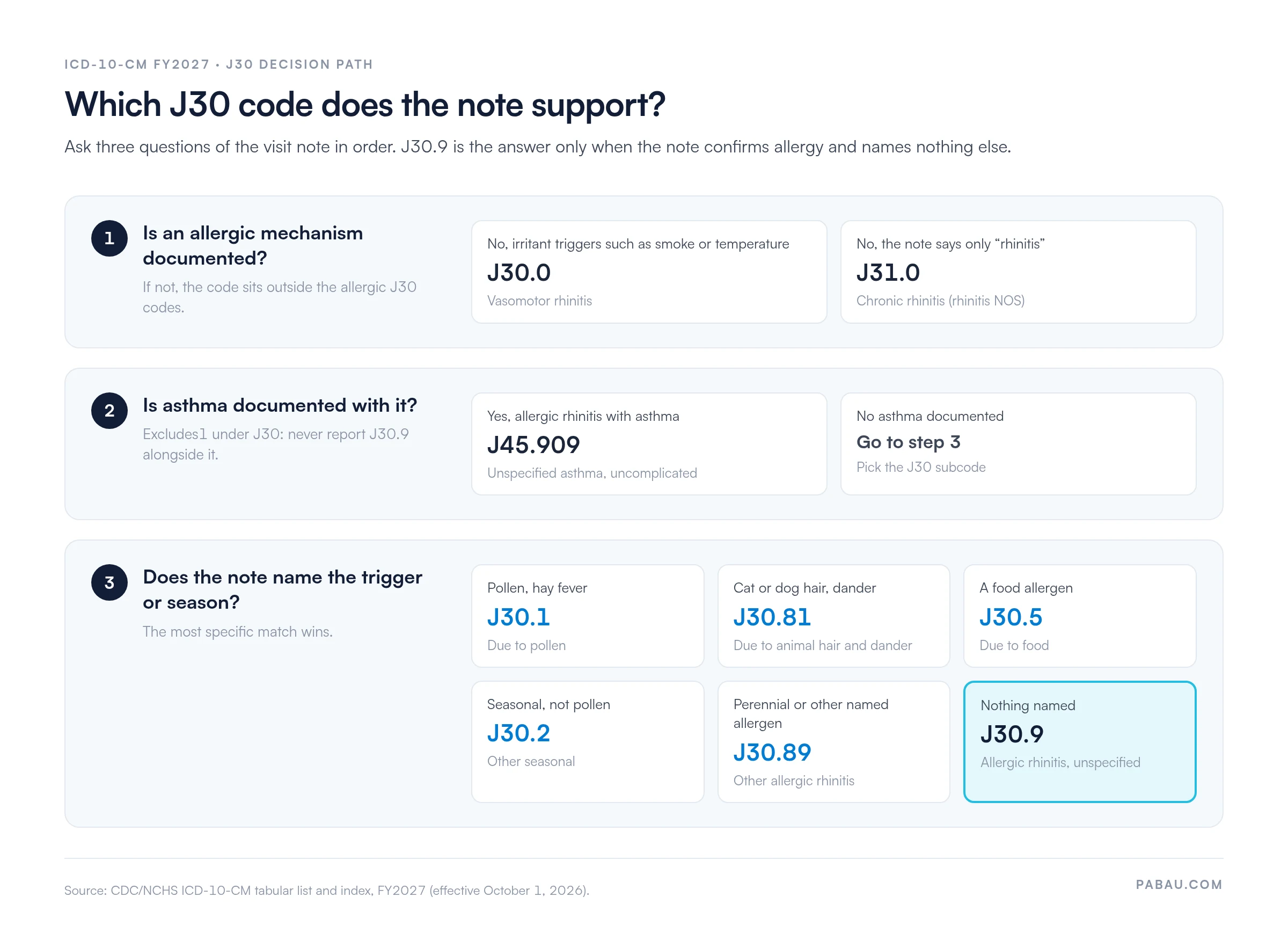
Run a documentation query before coding: search the visit note for the words pollen, seasonal, perennial, dust, dander, food, and mold. If any of these appear in the assessment or history, the note may support a more specific J30 subcode than J30.9. Catching this at coding time avoids a denial after submission.
J30.9 is not a shortcut code. CMS and most commercial payers expect documentation that (a) confirms an allergic mechanism and (b) shows why a more specific J30 code was not appropriate. Good medical billing compliance means the chart demonstrates the specificity decision as well as the diagnosis.
The physician note should include:
J30.9 often supports a claim for allergy testing (CPT 95004, 95024, 95044). Payers operating under a local coverage determination (LCD) may then request the chart note to confirm medical necessity. The note must show that an allergic etiology was clinically suspected even though the allergen had not yet been confirmed. That suspicion is the whole rationale for ordering testing in the first place.
J30.9 appears as the supporting diagnosis on a wide range of allergy and primary-care claims. The table below shows the CPT codes most commonly submitted alongside J30.9, with a note on payer acceptance. Refer to the AAPC ICD-10-CM code lookup for crosswalk guidance on each pairing.
Reimbursement for each CPT code varies by payer, MAC jurisdiction, and fee schedule year. Quote the payer’s current fee schedule rather than a fixed dollar figure in your documentation.
J30.9 is a fully billable code for Medicare, Medicaid, and most commercial payers. It is accepted in outpatient office, urgent care, and allergy practice settings. Getting the payer rules below right avoids the most predictable submission errors on rhinitis claims.
Key payer-facing rules:
With practice management software like Pabau, J30.9 claims go out through Pabau’s claims management software. It submits claims electronically through Claim.MD with eligibility checks and claim tracking, and routes each claim to the correct payer. For the paired testing and immunotherapy codes, prior-authorization details are tracked on the case, with a warning when one is missing.
Pairing J30.9 with clean-claim validation reduces the risk of a technical rejection before the payer ever reviews medical necessity. Auditing the workflow against clean claim standards catches missing fields and mismatched codes before the claim leaves the practice.
Denials on J30.9 claims follow predictable patterns. Each has a specific corrective action, and most can be caught before submission with a structured pre-billing audit. Understanding broader denial management workflows helps teams address root causes rather than resubmitting the same claim.
The specificity denial is the most common and the most preventable. A one-line documentation query asking the physician whether the allergen is known resolves the ambiguity before coding begins. Building this query into the practice’s post-visit workflow removes the most frequent source of J30.9 rework.
J30.9 is the designated ICD-10-CM forward map for ICD-9-CM 477.9 (Allergic rhinitis, cause unspecified). The General Equivalence Mapping (GEM) file published by CMS lists this as a one-to-one primary forward and backward mapping. One nuance remains, because 477.9 was a broader “not otherwise specified” bucket. It also captured some presentations now coded more precisely under J30.1, J30.2, or J30.89.
Any pre-2015 claim data using 477.9 should not be assumed to map exclusively to J30.9 without reviewing the original encounter documentation.
Practices performing data analytics or quality reporting on multi-year datasets should treat the 477.9-to-J30.9 crosswalk as an approximation rather than an exact match. For research or audit purposes, verify the original encounter note before assuming all 477.9 records represent the same clinical presentation as current J30.9 usage.
Check the WHO ICD-10 browser alongside the CMS ICD-10-CM tabular list when coding rhinitis for international payers or telemedicine encounters with cross-border billing. The international ICD-10 J30 structure differs slightly from the US clinical modification. J30.9 keeps the same code designation, but the surrounding subcode structure may vary.
Most J30.9 rework happens before the claim reaches a payer. A coder waits on the physician to confirm the allergen, a biller checks whether immunotherapy needs authorization, and the claim sits in a queue meanwhile.
Pabau keeps those steps on one patient record. Eligibility is checked before the visit, and prior-authorization details for allergy testing or immunotherapy are tracked on the case. A warning appears when an authorization is missing.
Claims go out through Claim.MD as CMS-1500/837P submissions, and remittances come back against the same record. The diagnosis code stays the coder’s call. A missing authorization or a failed eligibility check surfaces before submission instead of as a denial weeks later.

Pabau’s claims management submits allergic rhinitis claims through Claim.MD, checks eligibility first, and tracks each claim to remittance. Your team spends less time on rework and more time on patients.

J30.9 is a legitimate, payable code, but only when the physician note does not support a more specific J30 subcode. The most effective change a coding team can make is a one-line documentation query in the post-visit workflow. Does the note identify the allergen, season, or trigger? If yes, code more specifically. If no, J30.9 is correct.
Pabau’s claims management software submits claims electronically through Claim.MD with eligibility checks and claim tracking. That covers the submission end of revenue cycle management, while the specificity decision stays with the coder and the note. Book a demo to see how Pabau handles allergic rhinitis claims from the eligibility check to the remittance.

Need help managing ICD-10 claim denials? Denial codes in medical billing explains the most common CARC codes and how to respond to each one.
Looking to understand the full billing workflow? What is revenue cycle management walks through every stage from eligibility check to payment posting.
Want to submit cleaner ICD-10 claims first time? Claim.MD clearinghouse guide covers how electronic claims routing reduces manual rework and speeds up reimbursement.
ICD-10 Code J30.9 is the billable ICD-10-CM diagnosis code for allergic rhinitis, unspecified. The patient has allergic rhinitis, but the documentation does not identify the specific allergen, trigger, or seasonal pattern. It maps to ICD-9-CM 477.9 and belongs to the J30 category (vasomotor and allergic rhinitis) in Chapter X of ICD-10-CM.
Use J30.9 only when the physician note does not identify a specific allergen or seasonal pattern. If the note documents pollen as the trigger, use J30.1. If it documents a seasonal pattern that is not pollen-specific, use J30.2. J30.9 is the last-resort code within the J30 family, so always check the note before defaulting to it.
The most common reason is insufficient specificity. The physician note documents a seasonal pattern or named allergen, so the payer expects J30.1, J30.2, or J30.89 instead. Other triggers include an Excludes1 conflict with asthma code J45.909 and missing prior authorization for paired immunotherapy codes. Absent medical necessity documentation for allergy testing also causes denials.
Yes, in most cases. J30.9 is generally accepted as a supporting or primary diagnosis for allergy testing CPT codes (95004, 95024, 95044) when medical necessity is documented. However, specific MAC LCDs may require a more specified J30.x code or additional clinical justification. Check the relevant MAC LCD before billing allergy testing under J30.9 alone.