ICD-10 Code J45.902: Unspecified asthma with status asthmaticus
ICD-10 Code J45.902: Official descriptor and code definition ICD-10 Code J45.902...

Last Updated: Nov 13, 2026
Billable Code Specific Code
J11.1 is the billable ICD-10-CM code for influenza due to unidentified influenza virus with other respiratory manifestations. It covers flu that the provider diagnoses without naming a virus type or strain, when the respiratory picture stops short of pneumonia.
The code sits under category J11 in the J09-J18 influenza and pneumonia block. Influenza NOS, influenzal laryngitis and influenzal pharyngitis all code here. Once pneumonia is documented, the code moves to J11.00 or J11.08.
Let Pabau's smart automation suggest the right codes, reduce claim denials, and keep your practice compliant—effortlessly.
Automate repetitive tasks and focus on what matters most—your patients.
Reduce coding errors and ensure compliance with the latest regulations.
Clean claims, fewer denials, and faster reimbursements.
Powerful insights and reporting to help your practice thrive.
HIPAA compliant SOC 2 certified GDPR-compliant Trusted by 4,000+ clinics worldwide

J11.1 applies when the provider diagnoses influenza but no virus type or strain has been identified.
Use J11.00 or J11.08 instead once pneumonia is documented, because J11.1 covers respiratory manifestations other than pneumonia.
A typed flu recorded as suspected, possible or probable still codes to J11, under Section I.C.10.c of the official coding guidelines.
J11.1 is one of eight billable codes under category J11, and each one pairs an unidentified virus with a different manifestation.
Pabau’s claims management software submits claims through Claim.MD, checks eligibility and posts remittances against the patient record.
ICD-10 Code J11.1 is the billable ICD-10-CM code for influenza due to unidentified influenza virus with other respiratory manifestations.
It is listed in CMS’s FY 2027 ICD-10-CM code files, which cover encounters from October 1, 2026, to September 30, 2027. The code has been active since the ICD-10-CM transition in 2015 and remains valid and unrevised through fiscal year 2027.
Its chapter is J00-J99 (Diseases of the respiratory system), and its block is J09-J18 (Influenza and pneumonia). Its parent is category J11, Influenza due to unidentified influenza virus. J11.1 is one of eight billable codes under J11, and each one pairs an unidentified virus with a different manifestation.
“Other respiratory manifestations” is the phrase that decides J11.1, and it is the one coders misread most. It covers influenza whose respiratory effects stop short of pneumonia. When pneumonia develops, the code moves to its J11 sibling J11.00 or J11.08.
Presentations that code here when the provider diagnoses influenza include:
Without an influenza diagnosis, the same complaints code on their own, such as J02.9 for acute pharyngitis or J20.9 for acute bronchitis.
The “unidentified influenza virus” qualifier applies when the provider diagnoses influenza but names no type or strain. It also applies when the provider records a typed flu as “suspected,” “possible” or “probable.” In peak season, many of these diagnoses rest on presentation, season and exposure history, with no rapid test or PCR. A diagnosis made while results are still pending follows the same rule.
Check whether influenza B is documented. A provider who writes ‘influenza B’ has identified the type, so J10.1 applies instead of J11.1. J11 is for flu whose type is unconfirmed, not only its subtype.
The J09-J11 range sorts influenza by one question: has the provider identified the virus, and if so, which kind? Then the manifestation picks the code inside the category. The chart below walks through both decisions.
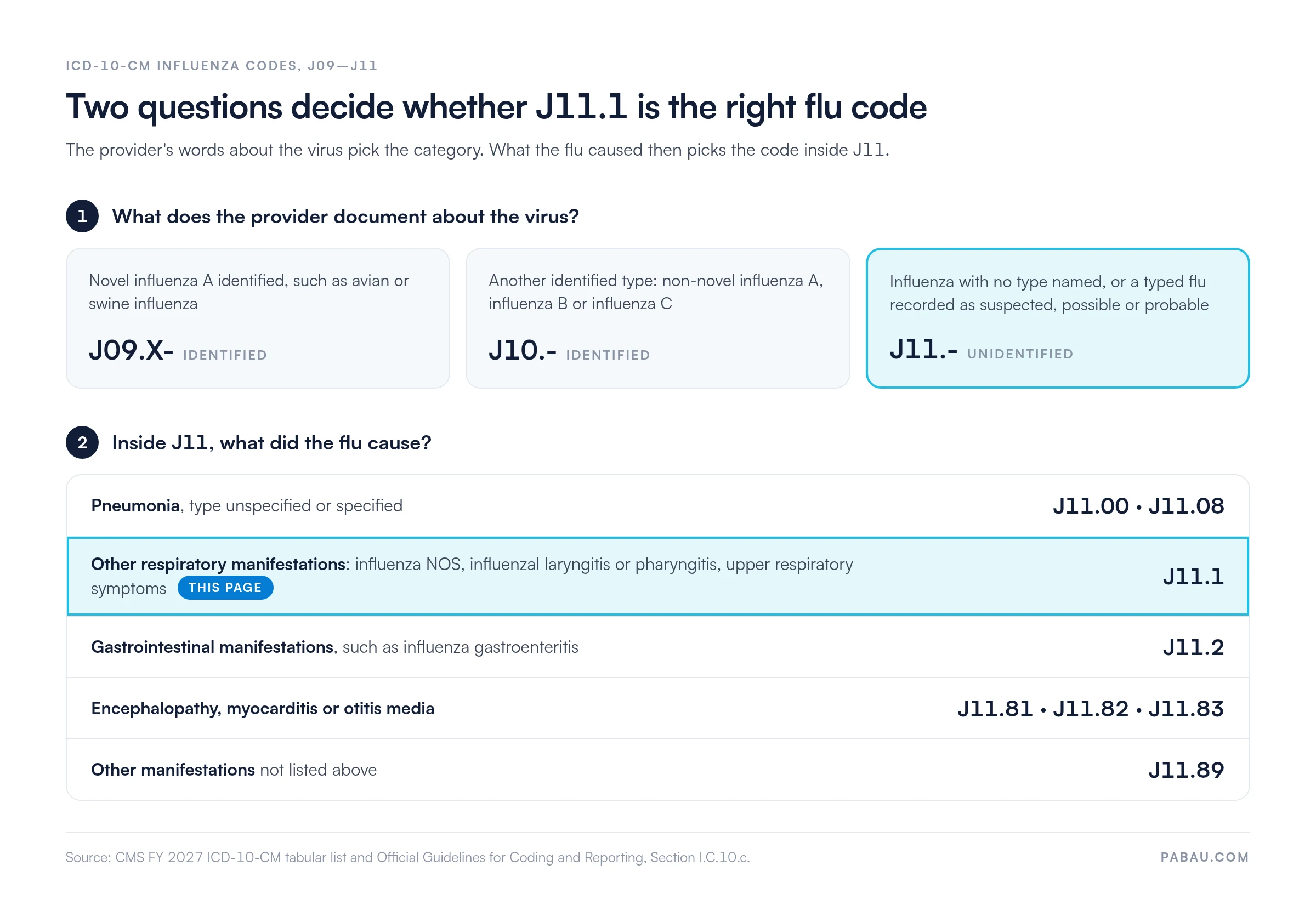
The pending-lab column settles a question that comes up every flu season. Under Section IV.H of CMS’s official coding guidelines, outpatient encounters are coded to the highest degree of certainty at the visit.
If results are still pending when the note is finalized, the provider’s assessment drives the code, and J11.1 is correct. A typed result that arrives after submission doesn’t make that claim wrong, because the code matched the record at the time.
Inpatient coding normally treats an uncertain diagnosis as if it were confirmed. Influenza is the exception. Under Section I.C.10.c, a “suspected” or “probable” typed flu still codes to J11, never to J09 or J10.
The CDC/NCHS ICD-10-CM tabular list gives J11.1 four inclusion terms and two “use additional code” notes. The Excludes1 notes that affect it sit on neighboring categories.
Common error: coding J11.1 when imaging or the note describes consolidation consistent with pneumonia. Once the provider documents pneumonia, even clinically without imaging, the code moves to J11.00 or J11.08.
Haemophilus influenzae is a bacterium, despite its name. It codes to A49.2, or to B96.3 when it causes a condition classified elsewhere, and it has no bearing on J11.1.
Section I.C.10.c of the official guidelines says confirming an identified influenza virus does not need a positive lab test. The provider’s diagnostic statement controls the code instead. For J11.1, that statement has to show the points below.
Use this checklist when reviewing notes for J11.1. Submitting a clean claim starts with documentation that answers each point before the coder opens the chart.
J11.1 generally does not require prior authorization for outpatient visits. It appears on standard E/M claims without triggering pre-service review from Medicare, Medicaid or most commercial payers. The code draws more scrutiny when it is the principal diagnosis on an inpatient claim.
For inpatient admissions, J11.1 feeds into MS-DRG grouping. The CMS MS-DRG v44 definitions manual covers FY 2027 discharges. It groups the J11 family by the presence of complications and comorbidities (CCs and MCCs). Leaving documented complicating conditions off the claim drops it into a lower-weighted DRG. That underpays the admission, the reverse of upcoding but just as inaccurate.
Pabau, the practice management platform we build, submits claims through the Claim.MD clearinghouse, which connects to thousands of US payers. Eligibility checks before the visit confirm the patient’s coverage, so a lapsed plan surfaces before the flu claim goes out.
J11.1 denials cluster around three root causes: wrong code selection, thin documentation and sequencing errors. Each has its own fix. Our guide to denial management in healthcare covers the appeal workflow once a denial lands.
Read the claim adjustment reason code (CARC) on each rejection next to our list of denial codes. CARC 4 means the procedure code doesn’t match the modifier, and CARC 5 means it doesn’t match the place of service.
Both point to the claim form, not the diagnosis. CARC 50 is the medical necessity denial, which often follows a wrong code choice or thin documentation.
Run a quarterly audit of the J11.x claims from the previous flu season. Filter the denials by CARC and sort them by provider. A provider who routinely documents ‘flu-like illness’ or ‘pulmonary involvement’ needs targeted feedback, not a blanket policy change.
J11.1 alone doesn’t build a payable claim. It needs CPT codes for the services rendered, and each pairing below holds up when the note supports it.
Our guide to CPT 87804 covers how the rapid flu test itself is billed and reimbursed. Use the AAPC ICD-10-CM lookup to check J11.1 against your specialty and payer mix. Payer rules on E/M levels for flu visits vary, so check them before billing a high-level visit.
Most J11.1 problems start between the visit note and the claim form. A coder works from a preliminary note, and a lab result lands later. The claim then goes out on a code the final record no longer supports.
Pabau’s claims management software keeps the visit note and the claim in one system, so the coder bills from the final note. Claims go out as electronic CMS-1500 (837P) claims through Claim.MD. Eligibility checks run before the visit, and remittance advice posts back against the same patient record.
In flu season, a held claim is checked against the final note in one place. A denial then shows up on the patient record it belongs to, not at month-end reconciliation.

Pabau’s claims management software keeps visit notes and claims in one system. It submits claims through Claim.MD, checks eligibility and posts remittances against the patient record.

J11.1 rests on two facts in the note: influenza diagnosed without a named type, and respiratory effects that stop short of pneumonia. When either one is unclear, query the provider before the claim goes out. A two-line query costs far less than a denial and an appeal.
The trade-off is timing. Holding flu claims until results are back slows payment a little in peak season. In return, the J11.1-to-J10.1 corrections get made before submission instead of arriving as denials. Book a demo to see how Pabau keeps the final note and the claim side by side for every flu visit.

Building denial-proof habits across your billing team? Medical billing compliance covers the laws, common violations and a checklist for audit-ready claims.
ICD-10 Code J11.1 is the billable ICD-10-CM diagnosis code for influenza due to an unidentified influenza virus with other respiratory manifestations. It covers flu diagnosed without a named virus type, where the respiratory presentation is not pneumonia. It sits under category J11 in the J09-J18 influenza and pneumonia block.
Yes, J11.1 is a billable ICD-10-CM code listed in the CMS code files. It remains valid and unrevised through fiscal year 2027. It can be used as a primary diagnosis on outpatient, emergency department and inpatient claims.
J09 applies when the provider documents a novel influenza A virus, such as avian or swine influenza. J10 applies when the provider names another identified type, such as influenza B or a non-novel influenza A strain. By contrast, J11 applies when no type is named, or when a typed flu is recorded only as suspected, possible or probable.
No. J11.1 needs a provider’s clinical diagnosis of influenza, with no type or strain named. It fits cases where lab results are absent, negative or still pending at the time of coding. Under Section I.C.10.c of the official guidelines, even J09 and J10 rest on the provider’s diagnostic statement rather than a positive test.
The common patterns are J11.1 billed after the provider named the virus type, and J11.1 used when pneumonia is documented. Others are J11.1 assigned when the note only says “flu-like illness” and Haemophilus influenzae misread as influenza. On inpatient claims, J11.1 is sometimes sequenced as secondary when it drove the admission.
J11.1 covers influenza-related pharyngitis, laryngitis, tracheitis, tracheobronchitis, bronchitis, croup and upper respiratory symptoms, all within a clinical influenza diagnosis. It excludes pneumonia. When pneumonia is present, the correct code is J11.00 for an unspecified pneumonia type or J11.08 for a specified type.