HCPCS Code Q4185: Cellesta flowable amnion billing guide
HCPCS Code Q4185: definition and official descriptor HCPCS Code Q4185 is the Lev...

Last Updated: Nov 20, 2026
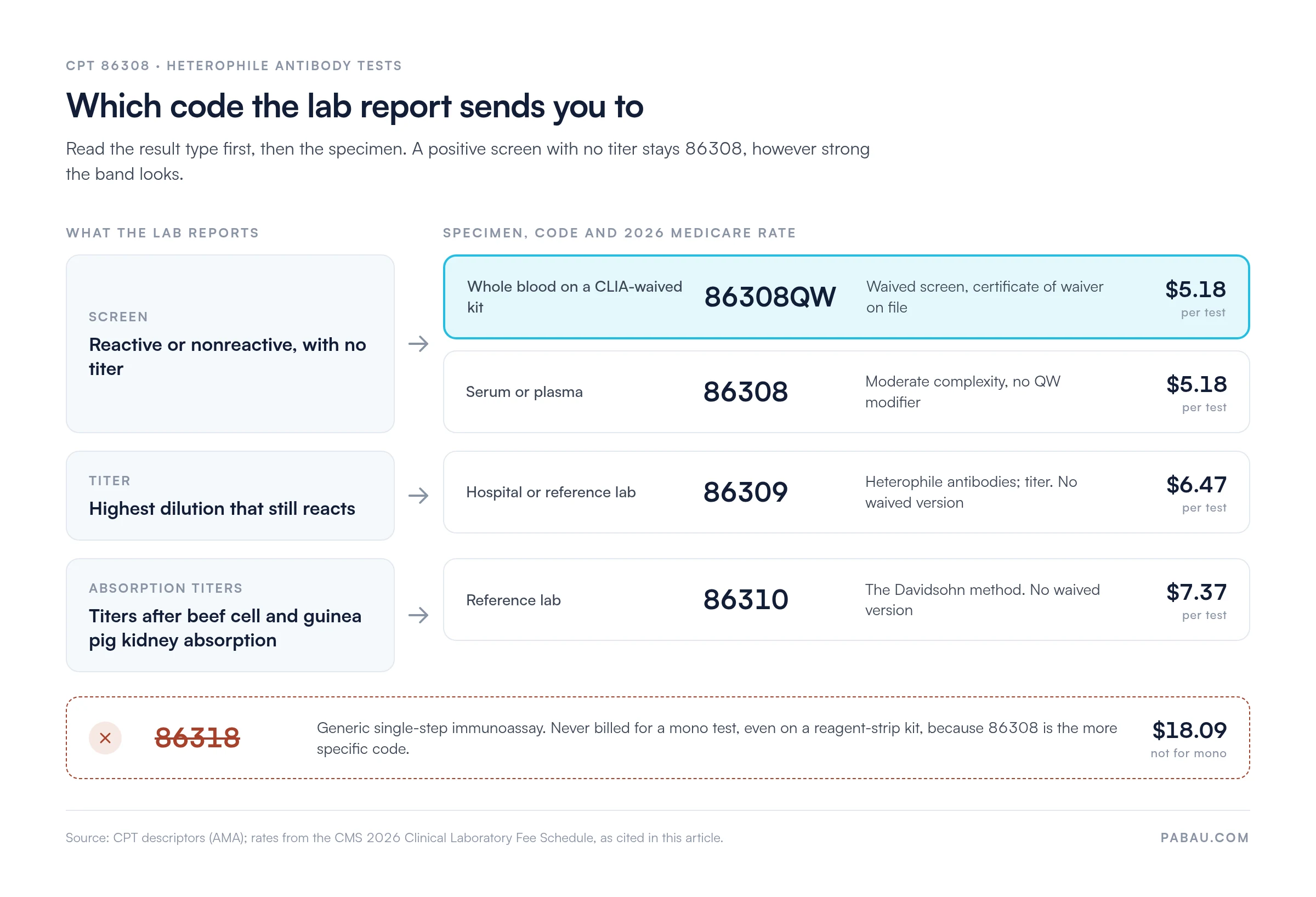
86308 is the CPT code for heterophile antibodies; screening. It reports the monospot, a rapid test that shows whether heterophile antibodies linked to infectious mononucleosis are present.
A titer is billed 86309, and titers after differential absorption are billed 86310. CPT 86318 is a generic single-step immunoassay code, so it is not used for a mono test.
Let Pabau's smart automation suggest the right codes, reduce claim denials, and keep your practice compliant—effortlessly.
Automate repetitive tasks and focus on what matters most—your patients.
Reduce coding errors and ensure compliance with the latest regulations.
Clean claims, fewer denials, and faster reimbursements.
Powerful insights and reporting to help your practice thrive.
HIPAA compliant SOC 2 certified GDPR-compliant Trusted by 4,000+ clinics worldwide

CPT code 86308 reports a heterophile antibody screen, the monospot test, and returns a reactive or nonreactive result.
A titer on a heterophile test is billed 86309, and titers after absorption with beef cells and guinea pig kidney are billed 86310.
CPT 86318 is a generic single-step immunoassay code and is not used for heterophile tests, because 86308 is the more specific code.
A waived rapid mono kit run on whole blood is billed 86308QW. The same kit run on serum or plasma is moderate complexity and billed 86308.
Medicare’s 2026 Clinical Laboratory Fee Schedule pays $5.18 for 86308, so a denial costs more to appeal than to prevent.
CPT code 86308 reports a heterophile antibody screen, the monospot test used to check for infectious mononucleosis. The American Medical Association (AMA) descriptor reads “Heterophile antibodies; screening.” The test returns a reactive or nonreactive result, with no titer.
Heterophile antibodies are IgM antibodies that most adolescents and adults make during Epstein-Barr virus (EBV) mononucleosis. They react with antigens from horse, sheep or beef red cells, and that cross-reaction is what the kits detect. Rapid kits use red cell agglutination or a lateral-flow immunoassay and read within minutes.
Medicare’s 2026 Clinical Laboratory Fee Schedule lists 86308 under that same descriptor. It pays the code at one rate, with or without modifier QW.
Three CPT codes cover heterophile antibody testing, and the method on the lab report decides which one applies. 86308 is the screen. 86309 and 86310 measure how much antibody is present, and neither has a waived version on the Medicare fee schedule.
Bill 86309 or 86310 only when the report shows a titer. A positive rapid kit with no titer stays 86308, however strong the band looks. When a screen and a titer are both ordered and resulted on one date, each code is billed for its own test.
On a screen, the specimen then decides whether QW applies, and 86318 never enters the picture.
CPT 86318 reads “Immunoassay for infectious agent antibody(ies), qualitative or semiquantitative, single-step method (eg, reagent strip).” It is a generic parent code for single-step antibody kits and names no specific antibody. CPT 86328, the single-step SARS-CoV-2 antibody test, sits under it, and waived rapid H. pylori antibody kits bill as 86318QW.
CPT tells coders not to use 86318 when a more specific code describes the test. For heterophile antibodies, that code is 86308. A rapid mono kit is a reagent-strip test, yet it still bills as 86308QW on whole blood and 86308 on serum or plasma.
The fee schedule shows why this mistake draws attention. Medicare pays $18.09 for 86318 in 2026, against $5.18 for 86308. A monospot billed as 86318 collects $12.91 more than the correct code, and a payer audit can recover that difference as an overpayment.
A mono workup often adds other lab codes. Each one needs its own order and a diagnosis that supports it.
The clinician collects a fingerstick or venous blood sample and applies it to the test device. Whole blood goes straight onto a waived kit. Serum or plasma has to be separated first, and that step moves the test into moderate complexity.
Heterophile antibodies may not have formed early in the illness. A screen run in the first days of symptoms can be negative and turn positive on a later test. The note should record when symptoms started.
For 86308 to hold up under audit, the medical record must show the following.
The superbill documentation should carry the CPT code, any QW modifier, the CLIA number and the supporting ICD-10 diagnosis. A claim missing one of these is the quickest route to a denial.
A CLIA certificate is valid for two years. Put the renewal date in your compliance calendar well ahead of expiry. Waived tests billed after the certificate lapses can be denied, or recovered later as overpayments.
Medical necessity for CPT code 86308 depends on a supported ICD-10-CM diagnosis. Payers that follow local coverage policies may limit the accepted list. The codes below are the ones most often used to support the test. You can check each one against our ICD-10-CM code library before the claim goes out.
Until mono is confirmed, the claim rests on a symptom code. R50.9 fits when fever leads the picture, and J02.9 fits a sore throat that is still being worked up.
Never submit 86308 with a diagnosis the test cannot address, such as streptococcal pharyngitis (J02.0) once group A strep is confirmed. The claim has to show the test was ordered to rule mononucleosis in or out.
Yes, when an FDA-cleared waived kit is run on whole blood. The FDA grants the waiver to a specific kit used with a specific specimen type. Several mono kits are waived for whole blood but moderate complexity on serum or plasma. Check the package insert and the FDA CLIA database before treating a test as waived.
Two modifiers come up on 86308 claims. Using the wrong one, or leaving off a required one, is a common denial trigger.
Modifier 59 is rarely needed with 86308. The October 2026 Medicare NCCI practitioner edit table has no active edit pairing 86308 with 86309, 86310 or the EBV antibody codes 86663 to 86665. Add 59 only when a payer’s own edit calls for it and the record shows a distinct service.
QW is a Medicare modifier, and many commercial payers accept it too. Some require it on every waived test, while others apply waived-test logic themselves. Check each payer’s rule once a year.
Medicare Part B covers 86308 when the test is ordered to diagnose the patient’s symptoms. Routine screening with no clinical indication is not covered. Run insurance eligibility verification before the visit when lab work is likely.
Medicare pays $5.18 for 86308 under the 2026 Clinical Laboratory Fee Schedule, with or without modifier QW. The fee schedule sets one national rate, so it does not change by locality. CMS updates the rates each January 1 and posts quarterly files on its CLFS page.
Commercial payers reimburse at a contracted rate negotiated separately. Patients on high-deductible plans may owe the full allowed amount until they meet their deductible.
86308 denials follow predictable patterns. The denial management workflows for lab codes differ from E/M denials, because the fix almost always sits upstream in documentation or code choice.
Error-flagging claims software catches a missing modifier or diagnosis before the claim leaves the practice. Clean claim standards for lab codes need the CLIA number, ordering provider NPI and diagnosis codes to match the encounter.
If 86308 denials cluster around one payer, pull that payer’s current coverage policy before the next submission cycle. Covered diagnoses for lab codes change, and a pairing that passed last year can fail this year.
A negative 86308 result does not rule out EBV infection. The CDC notes that the Monospot produces false positives and false negatives. It adds that heterophile antibodies are often absent in children with infectious mononucleosis. EBV-specific serology is often ordered after a negative screen in a young child.
Each EBV antibody code answers a different question, so each needs its own documented reason.
Moving from 86308 to EBV serology is supportable when the note says why the screen was not enough. Patient age, a negative screen with ongoing symptoms and an immunocompromised status are the usual reasons. That same note is what protects the EBV codes from a medical-necessity denial.
In many practices the monospot result, the kit and the specimen type sit in the clinical note. Someone at the billing desk picks the code later. The QW decision and the choice of code then fall to a person who never saw the test. That hand-off is where specimen and code-choice errors on 86308 begin.
Pabau, the practice management platform we build, keeps the order, the result and the claim on one patient record. In the US, claims go out through Claim.MD as CMS-1500 and 837P claims, with eligibility checks before the visit and electronic remittances after it. Practices that switch on Labs can also order Quest tests from the record, and results import automatically.
The result is a claim that matches the note, with the code, modifier and diagnosis your clinician documented. Your team spends less time rebuilding lab details for a payer weeks later.

Pabau keeps the test result, the code and the claim on one patient record. Submit 86308 with the right modifier through Claim.MD, check eligibility first, and track remittances as they arrive.

Bill a monospot as 86308, and add QW when a waived kit runs on whole blood. Move to 86309 or 86310 only when the lab reports a titer. Keep 86318 off heterophile claims entirely. At $5.18 a test, a denied 86308 rarely repays an appeal, so the code has to be right the first time.
The trade-off to remember is speed against certainty. A rapid screen settles the question for most adolescents and adults. A negative result in a young child calls for EBV serology, and for a note that justifies it. Book a demo to see how Pabau keeps lab orders, results and claims on one record for primary care and urgent care practices.

Need a framework for managing lab claim denials? Denial codes in medical billing explains the most common CARC codes and how to build a resolution workflow around them.
Submitting 86308 through a clearinghouse? Claim.MD clearinghouse guide covers payer enrollment, claim status tracking, and 835 remittance automation.
Looking for the 837P file structure behind lab claims? 837 EDI file overview walks through the transaction set used to submit professional claims including laboratory codes.
Filling in item 23 for a waived test? CMS-1500 form guide covers how to complete the professional claim form, with a free template.
Running a rapid strep test alongside the monospot? CPT code 87880 covers billing and reimbursement for the rapid group A strep test.
CPT code 86308 is the code for a heterophile antibody screen, the rapid monospot test for infectious mononucleosis. It returns a reactive or nonreactive result. It is ordered most often in primary care, urgent care and emergency settings.
CPT 86308 is the screen and returns a reactive or nonreactive result. CPT 86309 reports a heterophile antibody titer. CPT 86310 reports titers after absorption with beef cells and guinea pig kidney, the Davidsohn method. Bill the code that matches the method on the lab report.
No. CPT 86318 is a generic code for a single-step immunoassay for infectious agent antibodies, such as a reagent strip. CPT directs coders to a more specific code when one exists, and for heterophile antibodies that code is 86308. A waived rapid mono kit run on whole blood is billed 86308QW.
B27.00, B27.09 and B27.90 cover mononucleosis itself. R50.9 for fever, R59.0 for localized enlarged lymph nodes, R21 for rash and J02.9 for acute pharyngitis support a suspected case. Payer policies may restrict the accepted list further. Never submit 86308 with a diagnosis the test cannot address.
Yes, when a waived kit is run on whole blood. The waiver belongs to the kit and the specimen type, so the same kit run on serum or plasma is moderate complexity. Bill the whole-blood test as 86308QW from a certificate-of-waiver lab, and the serum or plasma test as 86308.
Medicare’s 2026 Clinical Laboratory Fee Schedule pays $5.18 for CPT 86308, with or without modifier QW. The fee schedule sets one national rate, so it does not change by locality. CMS updates the rates each January, so check the current-year file before you set fees.
Most commercial plans cover 86308 at urgent care when the claim carries a diagnosis that supports the test. High-deductible plans may apply the allowed amount to the deductible. Check the patient’s plan benefits before the visit when lab work is likely.