ICD-10 Code Y76.0: Diagnostic obstetric and gynecological devices
ICD-10 Code Y76.0: Definition and billable status ICD-10 Code Y76.0 is a valid, ...

Last Updated: Oct 23, 2026
Billable Code Specific Code
G53 is the billable ICD-10-CM code for cranial nerve disorders in diseases classified elsewhere.
G53 sits within Chapter 6 (Diseases of the Nervous System, G00-G99) of the ICD-10-CM tabular list, under the G50-G59 block covering nerve, nerve root, and plexus disorders. It applies specifically when a cranial nerve disorder is caused by a disease documented elsewhere in the record, rather than arising independently.
Let Pabau's smart automation suggest the right codes, reduce claim denials, and keep your practice compliant—effortlessly.
Automate repetitive tasks and focus on what matters most—your patients.
Reduce coding errors and ensure compliance with the latest regulations.
Clean claims, fewer denials, and faster reimbursements.
Powerful insights and reporting to help your practice thrive.
HIPAA compliant SOC 2 certified GDPR-compliant Trusted by 4,000+ clinics worldwide

ICD-10 code G53 is a billable diagnosis code for cranial nerve disorders caused by an underlying systemic disease
G53 requires a Code first instruction: The underlying etiology (such as diabetes mellitus or herpes zoster) must be coded before G53
G53 has no ICD-10-CM subcodes; it is always used as a single, complete three-character code
G53 is unacceptable as a principal or primary diagnosis by many payers; it must always appear as a secondary manifestation code
Pabau’s claims management software helps neurology and specialty practices apply correct code sequencing and reduce claim denials
ICD-10 code G53 describes cranial nerve disorders that arise as a manifestation of another documented systemic or infectious disease. The cranial nerves control critical functions including vision, facial movement, chewing, swallowing, hearing, and certain autonomic responses. When an underlying disease damages one or more of these nerves, G53 captures the neurological manifestation.
Confirmed synonyms for G53 include cranial nerve palsy due to diabetes mellitus, which reflects the most common clinical presentation coders encounter. Other synonyms and applicable scenarios include postherpetic cranial nerve involvement and cranial nerve dysfunction secondary to sarcoidosis. Each manifestation code carries its own sequencing rules that must be followed precisely.
Clinicians also use cranial neuropathy as an informal term for the same finding. It isn’t an official ICD-10-CM synonym, but documentation using that wording still maps to G53 once the systemic cause is confirmed.
The Code first instruction is the single most important rule for using G53 correctly. ICD-10-CM uses an etiology/manifestation convention to handle conditions where a body system disorder (the manifestation) results directly from another disease (the etiology). G53 is the manifestation. It cannot stand alone.
When the encounter involves a cranial nerve disorder caused by an underlying systemic disease, coders must sequence the underlying etiology code first, followed by G53 as the secondary code. The WHO ICD-10 classification system establishes this convention globally, and ICD-10-CM applies it consistently for all manifestation codes.
Good clinical documentation practices should explicitly state the causal relationship between the underlying disease and the cranial nerve involvement for the sequencing to hold up on audit.
The physician’s documentation must explicitly establish that the cranial nerve disorder is caused by the underlying condition. “Cranial nerve palsy in a patient with diabetes” is insufficient without a direct causal link being documented.
G53 has no fourth-character subdivisions in ICD-10-CM. Codes such as G53.1 exist only in the World Health Organization’s international ICD-10 classification, not the US clinical modification. Regardless of how many cranial nerves are affected, coders use the single code G53, always sequenced immediately after the etiology (Code first) code.
For a related example, the article on ICD-10 codes for intraparenchymal hemorrhage covers I61.x, a Chapter 9 circulatory code rather than a Chapter 6 manifestation code like G53. Chapter 9 has manifestation codes of its own, and ICD-10 code I41 is sequenced after its etiology exactly as G53 is.
Don’t assume a code has ICD-10-CM subdivisions just because a related WHO ICD-10 code does. G53 is billable and complete as a single three-character code — check the CDC’s current tabular list before submitting a claim with an invented subcode.
G53 is easy to confuse with other codes in the same block. The key differentiator is always whether a documented underlying disease is causing the cranial nerve disorder. When no systemic etiology is present, a different code applies.
If the documentation describes facial nerve palsy with no documented underlying systemic disease, G51 is the correct code, not G53. If it describes trigeminal neuralgia without an etiology, G50 applies. Only when the cranial nerve disorder is explicitly attributed to a disease documented elsewhere in the record does G53 become the right choice.
For a contrasting example.

Pabau’s claims management tools help neurology and specialty practices apply correct code sequencing, flag manifestation code errors before submission, and keep clinical documentation aligned with payer requirements.

Payer auditors look for one thing above all else when G53 appears on a claim: an explicit, physician-authored causal link between the systemic disease and the cranial nerve involvement. Documentation that simply lists both conditions without connecting them will not support the code sequence in a retrospective audit.
A robust clinical documentation system makes this easier to enforce consistently. When providers use structured templates for neurological encounters, the required elements, causal language, and code-supporting detail are prompted at every visit. Practices that rely on freeform notes have a harder time producing documentation that survives payer scrutiny.
A cranial nerve examination checklist gives clinicians a standardized way to record exam findings for each nerve, supporting both the specificity of the etiology code and the causal statement payers expect to see.
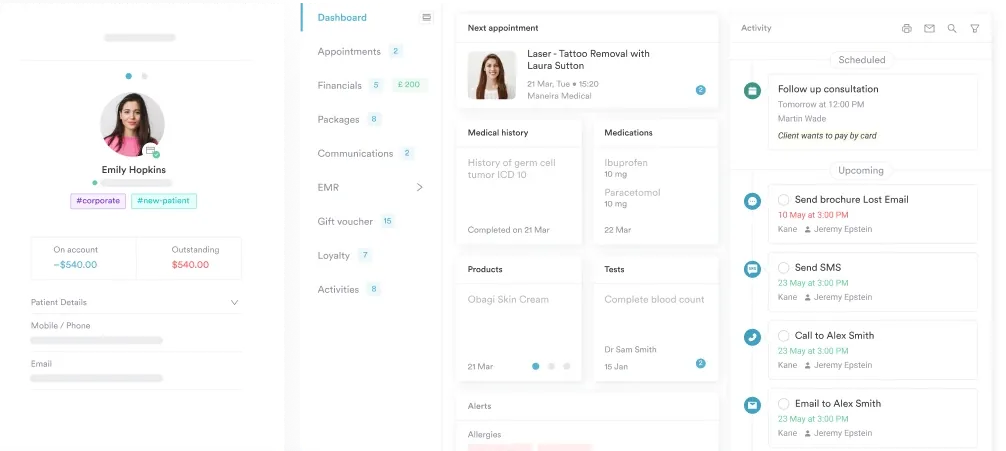
Using digital intake forms tailored to neurology assessments can pre-populate the structured fields that support G53 coding, reducing the burden on providers to remember documentation requirements mid-consultation.
For practical guidance on getting patients to submit these forms on time.

Query the physician directly when the record shows both diabetes mellitus and cranial nerve palsy without a documented causal statement. Adding a physician attestation or addendum that explicitly attributes the palsy to the diabetes is far less expensive than a claim denial and rebilling cycle. Flag this at the point of clinical note review, not post-submission.
The Rhode Island EOHHS ICD-10 Never Primary Diagnosis list explicitly includes G53: submitting it as the principal diagnosis results in a denial. G53 is a manifestation code, and manifestation codes cannot anchor a claim.
Beyond principal diagnosis errors, the two most common denial triggers for G53 claims are insufficient specificity in the etiology code and missing causal documentation. A claim sequence of E11.40 followed by G53 will survive payer scrutiny only if the clinical notes clearly connect diabetic neuropathy to the cranial nerve disorder documented in that encounter.
Robust claims management software can flag sequencing errors at the pre-submission stage, before they reach the payer.

Practices using EHR integration workflows that connect clinical notes directly to the billing module narrow the disconnect between what was documented and what was coded. When the coder can see the physician’s full note alongside the code assignment, the causal language is harder to miss.
Practices still working with historical claims data or comparing records across the ICD-9 to ICD-10 transition will find G53 maps approximately to ICD-9-CM code 352.9 (Unspecified disorder of cranial nerves). This is a forward crosswalk from ICD-9 to ICD-10; the reverse mapping also applies for legacy data analysis.
The “approximately” qualifier matters. ICD-9-CM 352.9 was a broad, unspecified code with no inherent Code first instruction. ICD-10-CM added the explicit sequencing rules that govern G53 today, even though the code itself remains a single three-character code with no further subdivisions.
Practices querying historical data for cranial nerve disorder cases should apply this crosswalk cautiously when comparing pre-2015 claim volumes to current figures. The CDC/NCHS ICD-10-CM web tool provides the current official code descriptions and hierarchy for verification, and the AAPC Codify ICD-10-CM lookup includes crosswalk functionality alongside the full tabular list.
Ensuring your HIPAA-compliant practice software maintains accurate historical coding records is particularly important when auditors request multi-year claim histories for cases involving chronic underlying conditions like diabetes that frequently generate G53 codes over time.
Manifestation codes create workflow friction because they require two things to happen correctly at the same time: the clinician must document the causal relationship, and the coder must sequence the codes in the right order. When either step fails, the claim fails.
Pabau’s AI-assisted clinical documentation helps clinicians capture structured notes that include the causal language coders need, reducing the back-and-forth between clinical and billing teams. Combined with Pabau’s built-in claims workflow tools, practices can build pre-submission checks that flag G53 sequences missing an etiology code.
The result is fewer denials and less time spent on rework. Explore how Pabau handles end-to-end billing workflows for specialty practices with practice management software built for clinical complexity.
ICD-10 code G53 is straightforward in principle but demanding in practice. The code is billable, but it cannot stand alone. Every G53 claim requires a specific etiology code sequenced first and explicit causal documentation in the clinical record connecting the two.
Get the sequencing right, and the claim submits cleanly. Get it wrong, and the denial is predictable.
Practices that handle significant volumes of diabetic neuropathy, herpes zoster, or sarcoidosis cases will encounter G53 regularly. Building documentation templates and pre-submission coding checks into your workflow is the most reliable way to prevent systematic errors. To see how Pabau’s clinical documentation and claims tools support accurate sequencing for specialty practices, book a demo.

Coding a soft tissue tumor of the abdomen? abdominal soft tissue tumor coding guide ICD-10 code C49.4 covers malignant neoplasm of connective and soft tissue of the abdomen, within the broader C49 category.
Coding a soft tissue tumor of the trunk? trunk soft tissue tumor coding guide ICD-10 code C49.6 applies when a confirmed trunk soft tissue malignancy cannot be assigned to a more specific sub-site.
Coding a primary vaginal malignancy? vaginal cancer coding guide ICD-10 code C52 is the billable code for a primary malignant neoplasm of the vagina, valid for 2026.
Coding urgent care visits? HCPCS code S9083 walks through the global fee billing guide for urgent care centers.
Coding a confirmed endometrial malignancy? endometrial cancer coding guide ICD-10 Code C54.1 is the site-specific code for endometrial cancer, avoiding the flagged error of using unspecified C55.
Coding an unspecified uterine malignancy? unspecified uterine cancer coding guide ICD-10 Code C55 applies when a confirmed uterine malignancy has no documented specific anatomical site.
ICD-10 code G53 is a billable diagnosis code for cranial nerve disorders that arise as a manifestation of another disease documented elsewhere in the patient record, such as diabetes mellitus, herpes zoster, or sarcoidosis. It sits within Chapter 6 (Diseases of the Nervous System, G00-G99) under the G50-G59 nerve and plexus disorders block, and requires a Code first instruction for the underlying etiology.
G53 covers cranial nerve palsy only when a systemic disease causes it, such as diabetes mellitus. Code the underlying condition first (for example, E11.40 for diabetic neuropathy), then add G53 as the manifestation code. When no systemic cause is documented, use G51 for facial nerve palsy or G50 for trigeminal nerve palsy instead.
Yes, G53 is a billable ICD-10-CM diagnosis code. However, it is unacceptable as a principal or primary diagnosis by many payers, including those following Rhode Island EOHHS guidelines. It must always be sequenced as a secondary manifestation code, with the underlying etiology code (such as a diabetic neuropathy code) listed first.
The Code first rule requires coders to list the underlying etiology code before G53 on every claim. For example, if the cranial nerve palsy is caused by type 2 diabetes with unspecified neuropathy, the sequence is E11.40 followed by G53. Submitting G53 without the etiology code first will result in a claim denial.
No. The World Health Organization’s international ICD-10 classification splits G53 into subdivisions such as G53.0 and G53.2, but ICD-10-CM, the US clinical modification, never adopted them. In US billing, G53 is always reported as a single three-character code, regardless of how many cranial nerves are involved or which disease caused the palsy.
No, G53 cannot be used as a primary or principal diagnosis. It is a manifestation code, meaning it describes a condition caused by another disease. Payers that follow the ICD-10-CM Never Primary Diagnosis list will deny any claim where G53 appears as the first-listed diagnosis.
ICD-10-CM G53 converts approximately to ICD-9-CM 352.9 (Unspecified disorder of cranial nerves). The crosswalk is approximate because ICD-9-CM 352.9 lacked the Code first sequencing instruction that governs G53 in ICD-10-CM. Use this crosswalk cautiously when comparing historical claim data across the coding transition.
G53 applies when cranial nerve disorders are caused by systemic or infectious diseases documented elsewhere, including diabetes mellitus (cranial nerve palsy) and certain herpes zoster or infectious/parasitic presentations. Some related conditions, such as postherpetic trigeminal neuralgia and multiple cranial nerve palsy in sarcoidosis, are Excludes1 under G53 and are coded with their own standalone codes instead. The underlying disease must be explicitly documented as the cause of the cranial nerve disorder in the clinical record.