Fertility clinic marketing: Strategies that attract & convert patients
Fertility clinic marketing is how a fertility practice attracts, educates, and c...

Last Updated: Oct 14, 2026

Online reputation management for doctors directly affects new patient acquisition: most patients read reviews before booking, and a sub-4-star average significantly reduces consideration.
The biggest platforms to claim and monitor are Google Business Profile, Healthgrades, Vitals, Zocdoc, and Facebook – each reaches a different patient segment.
Responding to negative reviews requires HIPAA-compliant language that never confirms a patient relationship, even indirectly.
Pabau’s automated review workflows send post-appointment requests and surface feedback in a single dashboard, removing the manual effort from reputation management.
Around 71% of patients use online reviews as their first step in finding a new doctor, according to Software Advice research, and the vast majority won’t consider a doctor rated below four stars. Yet plenty of practices still have no systematic process for collecting, monitoring, or responding to patient feedback, which is exactly where reputation damage sets in. That is where online reputation management for doctors (or ORM for short) begins to pay its way.
This guide covers the practical steps of managing online reputation for doctors: which platforms matter, how to generate reviews without violating FTC or platform rules, what to say when a negative review lands, and how your practice management software can handle most of this automatically. Whether you run a solo practice or a multi-location med spa, these principles apply.
Patients now behave like consumers. Before booking an appointment, they search your name, read three to five reviews, and compare your average rating against nearby alternatives. A 3.8-star profile on Google means most searchers move on before clicking your website. Your patient acquisition strategies can spend heavily on ads, but a weak review profile neutralizes that spend before a single call is made.
There’s also a revenue dimension that often goes unacknowledged. Strong physician reputation management affects the bottom line directly: a practice with 4.7 stars and 150 reviews will consistently out-convert one with 3 stars and 12 reviews, even if clinical outcomes are equivalent. Trust in healthcare is formed before the consultation.
The compounding effect matters too. Reviews age. A cluster of five-star feedback from 2019 is actively hurting you today if nothing more recent exists. Google’s local algorithm weights recency, so practices that generated reviews years ago and stopped are slowly losing ground to newer competitors actively asking patients for feedback.
Not all review sites carry equal weight. Where a patient looks depends on their age, condition, and whether they’re seeking a specific specialist or a general practitioner. Spreading your monitoring across the right mix prevents blind spots.
| Platform | Primary audience | Why it matters |
|---|---|---|
| Google Business Profile | All patients | Appears in local search results; highest-volume discovery channel |
| Healthgrades | US insurance patients | Aggregates malpractice, board actions, and patient ratings in one place |
| Vitals | Specialty patients | Specialty-specific reviews; ranks in Google for doctor name searches |
| Zocdoc | Urban, tech-forward patients | Review appears at the point of booking decision |
| Facebook Reviews | Existing community patients | Visible to friends of patients who engage; trust amplified by social proof |
| Yelp | Consumer-facing practices | Relevant for aesthetics, dentistry, wellness; less so for specialist care |
| RateMDs | Patients vetting a named physician | Doctor-focused ratings that surface in name searches, especially for specialists and surgeons |
Claiming your profile on each platform is step one. Unclaimed listings show incomplete information, allow others to suggest edits, and may display outdated phone numbers or addresses. Claiming takes 10 to 15 minutes per platform and prevents a category of avoidable damage.
Monitoring manually across six or seven platforms is unsustainable for a busy practice. This is where doctor review management becomes a system rather than a chore. Dedicated review management software aggregates notifications into a single feed, so your team sees every new review within hours rather than stumbling on a critical one weeks later. Speed of response correlates directly with how reviewers and prospective patients perceive the practice’s attentiveness.
For practices in the UK, Care Quality Commission (CQC) inspectors review publicly available patient feedback alongside formal inspection data. A pattern of unresolved negative feedback on review platforms can be cited as evidence of concerns about patient experience during a CQC inspection.
Audit your existing profiles on all six platforms before building any new content. Check that your name, address, phone number (NAP) are identical across every listing. Inconsistent NAP data confuses both patients and Google’s local algorithm, silently suppressing your visibility.
The most common reason doctors have too few reviews is simple: they never ask. Patients who had a positive experience rarely think to leave a review unprompted. Those who had a frustrating one often do. That asymmetry skews the natural review distribution toward the negative, which is why proactive capturing patient feedback matters so much.
The optimal moment to ask is 24-48 hours after an appointment, when the experience is fresh but the patient is no longer in the clinical environment. An automated post-visit message with a direct link to your Google Business Profile or Healthgrades page removes every friction point. The patient doesn’t need to search for you; they just tap the link.
Automated email and SMS campaigns can send that review request at exactly the right moment, every time.
A few important guardrails apply. FTC guidelines on endorsements prohibit incentivizing reviews with discounts, gifts, or any material benefit. Google and Healthgrades also explicitly ban review gating (the practice of filtering patients to only ask satisfied ones). Ask every patient, every time, with no conditions attached.
Volume and recency both matter to the algorithms. Ten new reviews this month carry more weight than fifty reviews spread across the past four years. Consistency, driven by automation, is what converts occasional feedback into a durable competitive advantage.
A negative review works as a public test of how your practice communicates, rather than a reputation emergency. Research consistently shows that a thoughtful response to a negative review builds more trust among prospective patients than an identical practice with no negative reviews and no responses at all.
The hardest constraint for physicians is HIPAA. In the US, any response that confirms, implies, or could reasonably be interpreted as acknowledging a patient relationship violates the Privacy Rule. The correct response acknowledges the concern, invites the reviewer to contact the practice directly, and says nothing about the specifics of any visit or treatment.
For UK practitioners, the General Medical Council’s guidance and GDPR both create similar obligations around patient confidentiality in public communications. Review the HIPAA and social media guidelines applicable to your practice before drafting any public response.
A compliant, effective negative review response follows this structure:
On removing reviews: platforms will remove content that violates their policies (spam, fake reviews, content that reveals personal health information). File a formal dispute and document your case. Platforms will not remove a genuine negative review simply because you disagree with it. Services claiming to “remove any review” should be treated with significant skepticism, and paying for fake positive reviews is both an FTC violation and a platform policy breach.
Flag every negative review in your internal practice management system the same day it appears. Assign a designated responder (not the treating clinician), use a pre-approved template that your legal or compliance team has reviewed, and aim to publish a response within 48 hours. Speed of acknowledgment matters as much as the content.
The practices that consistently maintain strong review profiles aren’t doing more manual work. They’ve automated the right touch points so that doctor reputation management happens as a byproduct of normal clinical operations. Approached this way, healthcare reputation management stops being a separate marketing chore and becomes part of how the practice already runs. This is where purpose-built practice management software like Pabau creates an operational advantage.
Pabau’s patient review tools are built directly into the post-appointment workflow. When an appointment is marked complete, the system can automatically trigger a review request via SMS or email at a configured interval. No staff action required. No manual list of patients to chase. The request goes out consistently, to every patient, every time.
Beyond review collection, automated clinic workflows handle the surrounding tasks that feed into reputation: appointment reminders that reduce no-shows (fewer frustrated patients means fewer frustrated reviews), post-care instruction messages that improve treatment outcomes, and recall notifications that keep long-term patients engaged. Each touch point shapes how patients feel about the practice before they ever think to write about it.
Seen together, those touch points are a patient relationship management strategy in practice, where a strong review is one outcome of a relationship managed end to end.
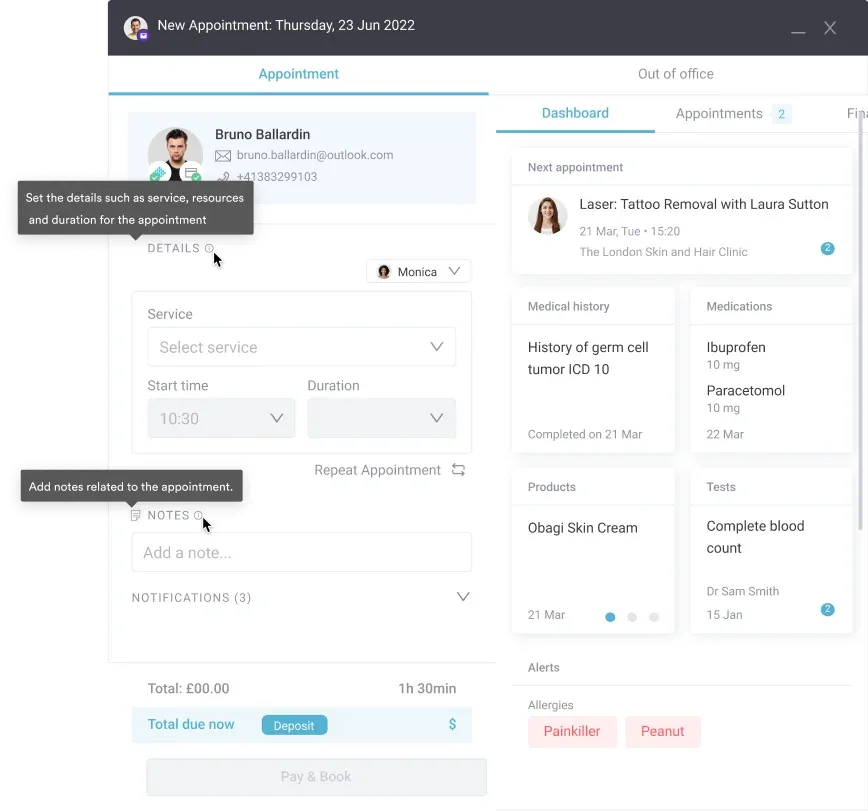
The consolidated feedback dashboard is particularly valuable for reputation management features across multi-location practices. Rather than having each site run its own doctor online reputation management in isolation, practice managers see all incoming feedback in one view. Patterns emerge. If three locations are getting strong reviews but one is consistently scoring lower on wait times, that’s actionable operational intelligence, not just a star rating.
For practices that want to go deeper, survey-based reputation workflows let you capture structured Net Promoter Score (NPS) data alongside public review requests. Internal survey responses stay private (giving you detailed qualitative feedback without airing every complaint publicly), while patients who score highly are prompted to share their experience on Google or Healthgrades. This isn’t review gating, because all patients receive the survey; the public review invitation is a natural follow-up for those who’ve already indicated satisfaction. Online booking software puts availability in front of the patient and writes the appointment straight into the calendar. Online booking software puts availability in front of the patient and writes the appointment straight into the calendar.
A scale of opposite words turns that qualitative detail into a number. Patients mark where the visit sat between pairs like rushed and unhurried, so you see which part moved the score.
The function for measuring patient satisfaction in Pabau tracks trends over time: which practitioners are generating the most positive feedback, which appointment types generate complaints, which locations have declining scores. That data closes the loop between reputation management and clinical operations improvement.

Pabau sends post-appointment review requests automatically, aggregates feedback across platforms, and gives you the data to spot operational patterns before they become reputation problems.

Practices lose patients every week to competitors with a more recent and more visible review profile, even when their own clinical care is stronger. Effective online reputation management for doctors is an operational discipline more than a marketing campaign. The core work stays the same across every practice:
Pabau’s automated review and feedback tools remove the manual effort from this process, embedding it into the clinical workflow so it runs consistently without additional staff overhead. If you’re ready to build a more systematic approach to medical practice growth planning, book a demo and see how the platform handles reputation management alongside scheduling, clinical notes, and billing.

Want feedback without the public review risk? Ways to collect patient feedback covers surveys, on-site forms, and landing pages that capture input while it is still fresh.
Ready to get ahead of your online reviews? Medical practice reputation management guide explains why review platforms now shape how patients choose a provider.
Online reputation management for doctors is the practice of monitoring, generating, and responding to patient reviews across platforms like Google, Healthgrades, and Zocdoc to influence how a practice is perceived by prospective patients. It covers claiming profiles, systematically requesting feedback, and maintaining HIPAA-compliant responses to both positive and negative reviews.
Acknowledge the concern in general terms, invite the patient to contact the practice directly via phone or email, and avoid any language that confirms, implies, or could be interpreted as acknowledging a patient relationship. Never reference the date of a visit, a treatment, or any clinical detail. A compliant response might read: “We’re sorry your experience didn’t meet your expectations. Please contact our patient care team at [phone] so we can address your concerns directly.”
Not quite. Doctor review management focuses on collecting, monitoring, and replying to reviews on sites like Google and Healthgrades. Reputation management for doctors is broader: it also covers claiming and maintaining accurate profiles, managing what shows up in search results, and shaping how a practice appears everywhere a prospective patient looks. Review handling is the engine, but it runs inside the wider reputation strategy.
Platforms will only remove reviews that violate their specific policies, such as spam, fake reviews, or content revealing protected health information. A genuine negative review, even one you believe is unfair, cannot be removed by request. You can flag it for review and document your case, but the practical response is to address it publicly with an empathetic reply and to generate enough new positive reviews that it becomes a minor outlier in your overall profile.
Send an automated SMS to every patient 24-48 hours after their appointment with a direct link to your Google Business Profile or Healthgrades page. Ask every patient, without filtering by satisfaction score. Keep the message short: two sentences, one link. Consistent volume, not persuasive copy, is what drives steady review accumulation over time.
Yes, particularly for solo practices where a single physician’s profile is the entire practice’s online identity. A solo GP or specialist with 4.8 stars and 60 recent reviews will consistently outrank a larger practice with a lower or more dated profile in local search. The investment in automated review workflows pays back in new patient acquisition within the first few months.