Fertility clinic marketing: Strategies that attract & convert patients
Fertility clinic marketing is how a fertility practice attracts, educates, and c...

Last Updated: Oct 14, 2026
Spa reputation management features are the tools that pull your Google and Trustpilot reviews into one screen. They also request the feedback in the first place, decide what gets published, and flag a complaint before it turns into a one-star review.
Practice management software like Pabau bundles six of them. You get automated feedback requests, a central review dashboard, a survey builder, Google Reviews integration, review publishing and multi-site management.
The table below has the whole set at a glance. Each section under it shows how the feature works in a spa’s week, and what you have to decide before you switch it on.

Spa reputation management features cover six jobs: requesting feedback, monitoring reviews, building surveys, syncing Google Reviews, publishing praise and managing multiple sites.
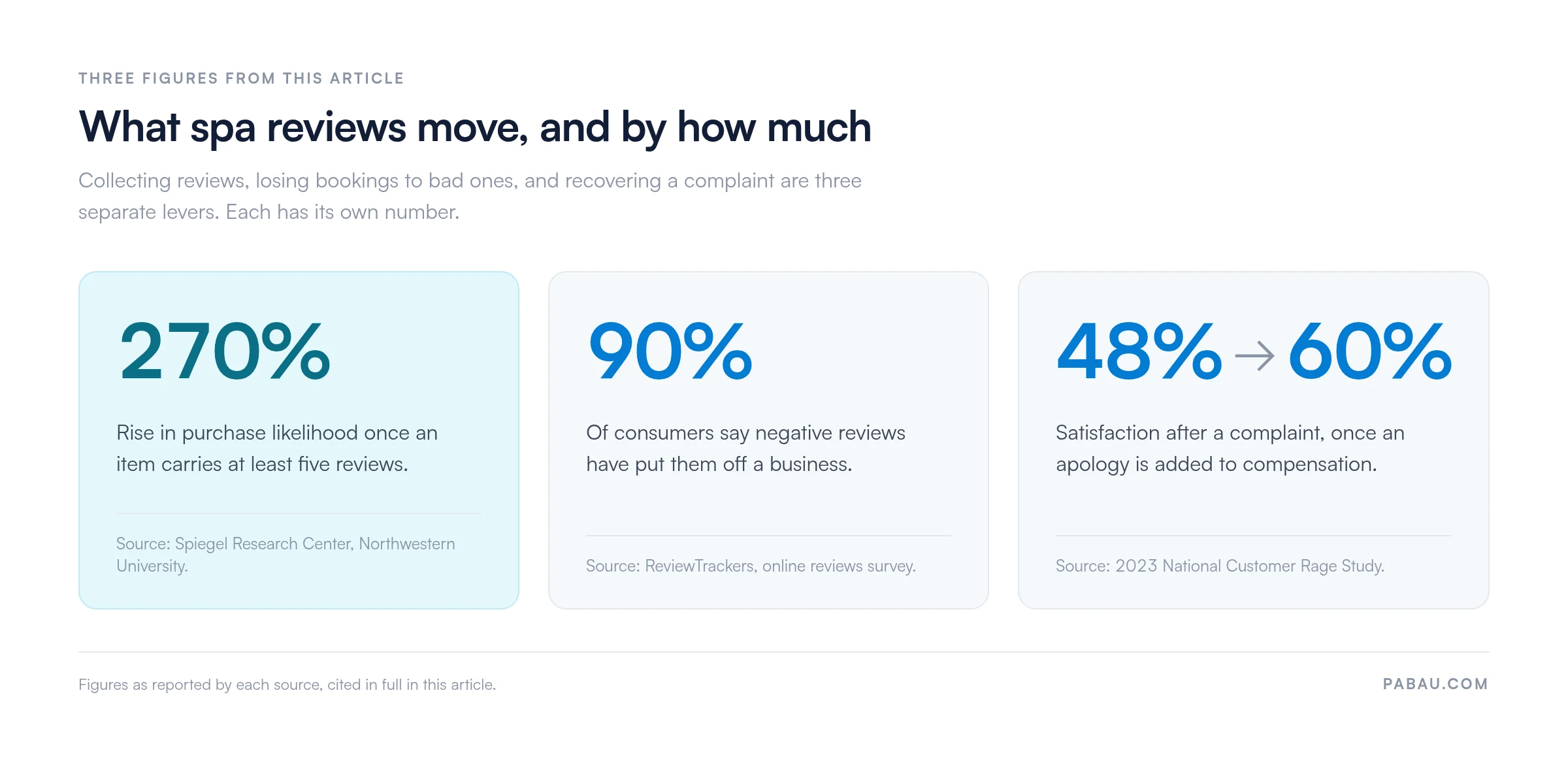
Purchase likelihood rises 270% once an item carries at least five reviews, according to Northwestern’s Spiegel Research Center.
Our Publish-or-Route rule publishes reviews at 4 stars and above automatically, and sends lower scores to a manager queue first.
Book a demo to see how Pabau collects, sorts and publishes spa feedback from a single dashboard.
Pabau’s spa reputation management features are automated feedback requests, a central review dashboard, a survey builder, Google Reviews integration, review publishing and multi-site management.
Every one of them is included in every subscription, so none of the six sits behind a higher tier.
Reputation management matters because your reviews are the first signal a prospective patient reads, and they decide whether the next booking is yours.
A patient’s journey to your spa usually starts with a search, and the star rating loads before your photos do. Over 90% of consumers are put off by negative reviews, and the same report puts the most trusted star ratings at 4, 4.5 and 5.
Reputation management is how you take that narrative back. The payoff splits into four separate wins, and each one needs a different feature.
Medical and clinical spas work under extra constraints when asking for and replying to reviews. If that is you, start from medical spa software rather than a general spa setup.
Responding to a bad review in public repairs the relationship with the reviewer and shows every future reader how your spa handles a problem.
Sooner or later a review lands that does not match the service you know you gave. Most replies to those fail for the same reason: they argue the facts. A four-part pattern keeps the reply useful instead.
Here is that pattern applied to a massage that ran short. “Thank you for flagging this. Your session started 10 minutes late because of an overrun before you, and that came out of your time. We have added a 10-minute buffer between deep-tissue bookings. Please email our spa manager and we will put the missing time right.”
In practices we onboard, the replies that land are the ones naming what changed, not the ones offering a discount. A discount reads as a payoff. A buffer between bookings reads as a fix.
Reviews lift local search visibility because Google counts review volume, recency and rating among its local ranking signals.
SEO researchers place reviews among the eight strongest local ranking factors. So the more recent reviews you collect, the higher your spa tends to sit in the map pack.
Patients are also asking AI assistants now, and those assistants read the same public footprint. A query like “what are the best med spas in Houston?” gets answered partly from your review profile.
Retention is quieter work than acquisition, and reviews are one of the few places you can see it slipping before the rebooking rate does.
Replying to the good reviews as well as the harsh ones tells patients their opinion reached a person. Responding promptly, acknowledging the concern and apologizing sincerely does more than compensation on its own.
The National Customer Rage Survey found that adding an apology on top of monetary compensation lifted satisfaction from 48% to 60%. The apology was free.
Reviews move revenue directly, with purchase likelihood rising 270% once an item carries at least five reviews.
That figure comes from Northwestern’s Spiegel Research Center, and the jump happens between zero reviews and five. Getting a new treatment from zero to five reviews is therefore worth more than getting an established one from 50 to 80.
The three numbers in this article pull in different directions, so they are worth seeing side by side.
Patients who feel heard also spend more on the visits they already have booked. A regular who trusts your judgment says yes to the add-on.
Sourcing reviews is one more job on a list that is already full. Reputation management software earns its place by doing the chasing, the sorting and the publishing without anyone opening a second tab.
Where it lives matters more than the feature list suggests. Built into your booking system, the review request fires off the appointment that just finished. Bought as a separate subscription, the same tool needs someone to tell it the appointment happened.
Comparing the best software for spas side by side shows which platforms carry reviews natively and which bolt them on afterwards.
Pabau sends each patient a feedback request by email or SMS as soon as their appointment closes, while the result is still fresh.
Timing carries most of the value here. A request that lands the same evening reaches someone still enjoying the treatment. A request that lands on Friday reaches someone who has moved on.
Early feedback is also the cheapest customer complaint management you will ever run. A patient who tells you privately that the room was cold has not told Google yet, and you still have a week to fix it.
Set the flow up once, and spa software like Pabau sends every request from then on. Nobody has to remember, which is the point.
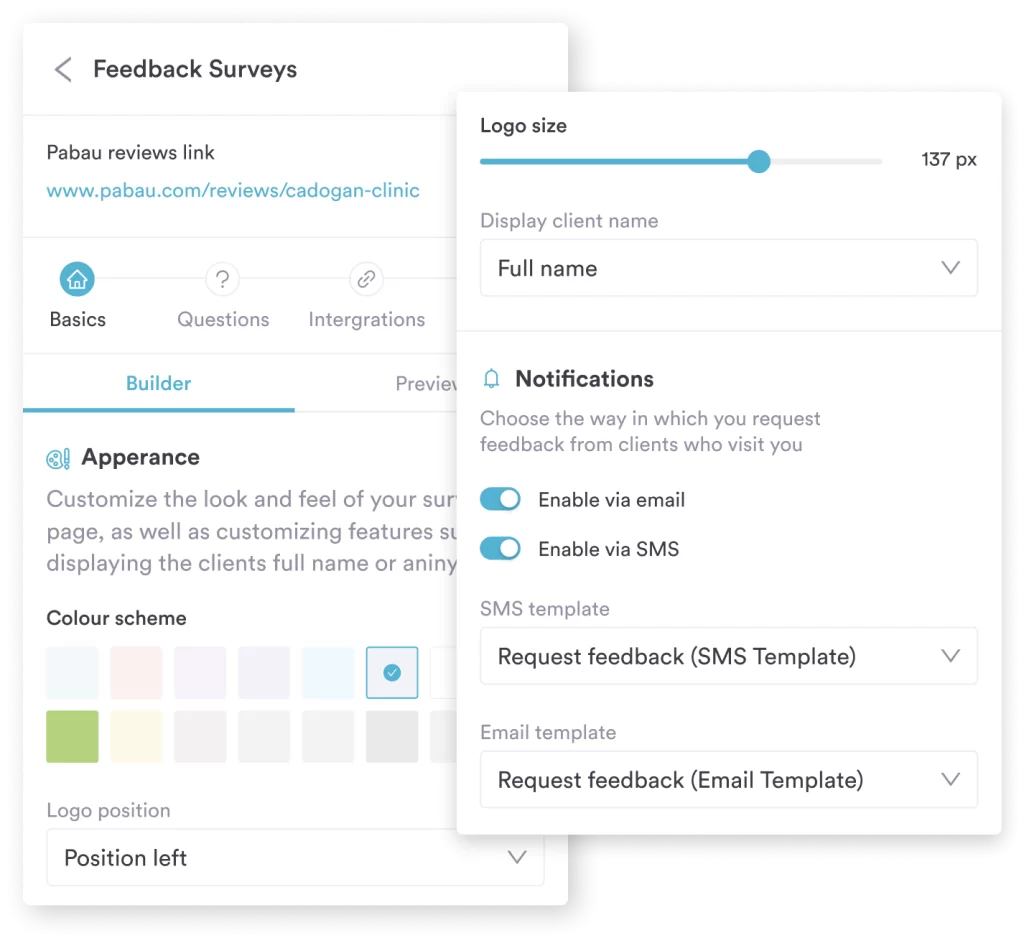
💡 Useful hint: Marketing Plus, an add-on that sits on top of Pabau’s built-in marketing suite, can fold feedback requests into a longer campaign sequence.
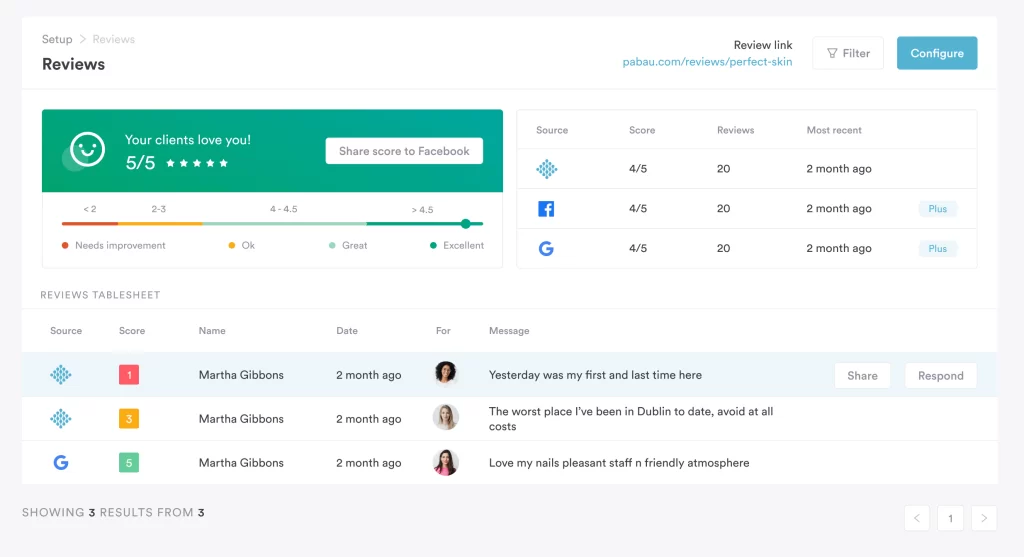
Pabau’s review dashboard brings your Google and Trustpilot reviews into one screen, alongside the feedback collected through Pabau itself. Doctify is listed as coming soon.
From there you read your overall score, the latest reviews and the replies you still owe. No logging into four separate accounts to find out whether a review landed over the weekend.
Platform coverage is worth checking against your own list before you buy any tool. Facebook, Yelp, RealSelf and ClassPass all sit outside the set Pabau connects to, so a spa collecting reviews there monitors them directly.
That single view is what stops a one-star review sitting unanswered for three weeks. An unanswered bad review is the version that costs you bookings.
You would not ask the same questions after a deep-tissue massage and after a chemical peel. One is about pressure and pacing. The other is about downtime and results.
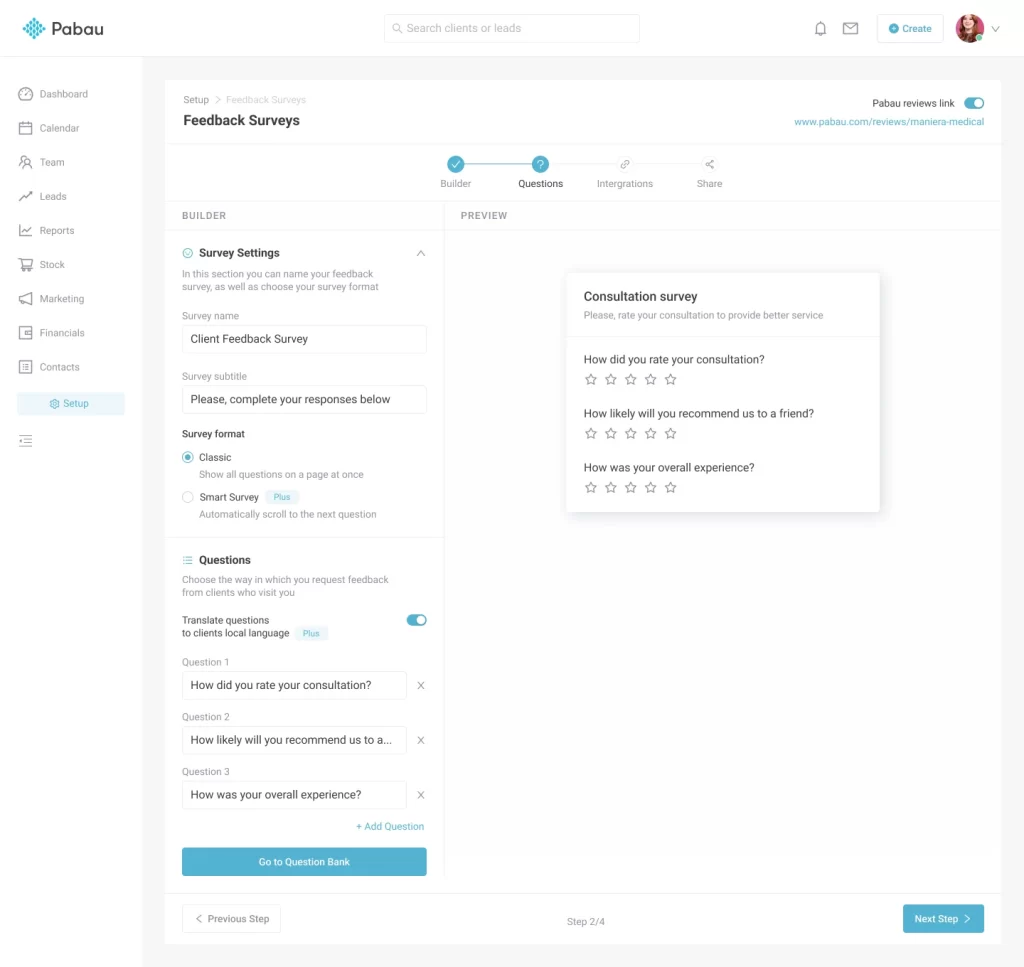
Pabau’s feedback builder attaches a different form to each service, so the questions match the treatment the patient received.
Write questions that return something you can change. “How did we do?” returns a star and no detail. “Was the pressure right?” returns a note your therapist can act on next week.
Pabau syncs your Google reviews into the same dashboard, so the score most prospective patients see sits next to the rest of your feedback.
No software changes where a Google review lives. A review a patient posts sits on Google’s own platform, so you can reply to it and you cannot remove it.
What you do control is the feedback you collect yourself, and which of it goes public on your website. That control needs a rule, or it becomes a judgment call someone makes at 6pm on a Friday. We call ours Publish-or-Route.
A common setup is exactly that split, and the threshold is the part worth arguing about. Set it at 5 stars and most genuinely warm feedback never reaches your site. Set it at 3 stars and a lukewarm review lands on your homepage with nobody having read it first.
Google reviews also outlive your software. Reviews collected inside a platform leave with that platform when you switch. The ones on Google stay where they are, which is why Publish-or-Route ends with a nudge toward Google rather than toward your own site.
Added bonus: with Marketing Plus, patients who leave strong feedback get prompted to repeat it on Google automatically. 🌟
A five-star review sitting in a dashboard does no work for you. Pabau publishes the ones you approve straight to your website and social accounts.
Publishing steadily is also the quiet half of protecting brand reputation. A page carrying 40 recent reviews absorbs one bad week. A page carrying four does not.
Fold the strongest ones into your social media marketing rather than posting them as one-off screenshots. A reviewer describing the result of a treatment sells that treatment better than your own copy does.
Pabau tracks reviews location by location under one login, so a group can see which site is pulling the average down.
A group-level score hides a lot. Split it by site and by service and the picture sharpens. One location’s facials may carry a service reputation its massage room does not, and that is a training problem rather than a marketing one.
Pabau’s multi-location management also lets you reply across every site from the same screen. Each location stops handling its own reviews on its own schedule.
Most spas run reputation management from memory. Someone remembers to ask a happy patient for a review. Someone else spots a bad one a week late. The warm feedback stays in an inbox nobody exports.
Pabau makes each of those an automatic step. The request goes out when the appointment closes. The reply lands in the same dashboard as your Google and Trustpilot reviews. Approved reviews publish to your site without a copy-paste.
What changes is the hour a week your front desk spent chasing and checking. The review count changes too, because the asking no longer depends on anyone remembering to ask.

Pabau collects feedback after every appointment and pulls your Google and Trustpilot reviews into one dashboard. Approved reviews publish straight to your website, so your best feedback reaches people who are nearly booked.

The feature list is the easy part. The decision underneath it is what publishes on its own and what a person reads first. Settle that before you switch the automation on.
Pick a threshold, write the four-part response pattern down where your team can see it, and the nightly judgment call disappears. A low threshold fills your site faster. A low threshold also puts weaker reviews in front of people who were nearly booked.
Book a demo to see the review dashboard, the survey builder and the publishing rules running on your own spa’s calendar.

Want the reviews to reach further than your website? Social media marketing for clinics shows how to turn approved feedback into posts that book appointments.
Comparing platforms before you commit? The best software for spas compares platforms on booking, payments and reviews rather than on feature counts.
Running a wellness practice rather than a day spa? Nine wellness clinic software options sets out which systems suit smaller multi-practitioner teams.
Coverage depends on the platform list each vendor supports. Pabau’s review dashboard connects Google and Trustpilot directly, plus the feedback you collect through Pabau, and Doctify is coming soon. Yelp sits outside that set, so check a vendor’s platform list against where your own reviews land.
A worked reputation management example is a clear publishing rule. Reviews at 4 stars and above publish to your website automatically and prompt the patient to repeat it on Google. Scores below 4 stars route to a manager queue, unpublished, with a reply owed inside 24 hours. That rule, which we call Publish-or-Route, removes the nightly judgment call about what goes live.
The best tool for a spa is the one already holding your appointments, because it knows when to ask. Reputation management software built into a practice management system such as Pabau fires the request off the completed appointment. A standalone review platform monitors well, but someone still has to tell it the appointment happened.