EHR ROI: How to calculate and maximize your return
EHR ROI is the financial return a practice earns on its electronic health record...

Last Updated: Oct 15, 2026

EHR benefits include reduced documentation errors, faster chart access, and safer medication management across clinical settings.
78% of physicians with EHRs reported the technology enhanced patient care overall, according to a peer-reviewed PMC study.
Clinics that centralize records in a single EHR also cut administrative overhead, freeing staff time for patient-facing work.
Pabau combines EHR with scheduling, billing, automated workflows, and digital forms in one platform built for private and aesthetic clinics.
Most private clinics still treat their EHR as a digital filing cabinet. However, in a peer-reviewed PMC study 78% of physicians with EHRs reported the technology enhanced patient care overall, 81% said it helped them access charts remotely, and 65% said it alerted them to a potential medication error, driving direct outcomes.
The difference between a clinic extracting those outcomes and one that isn’t usually comes down to how the system is implemented and what it connects to. This guide covers the core benefits of EHR for private practice operators, and how to get more value from a system you may already be using.
Paper records break in predictable ways. Handwriting becomes illegible. Files get misfiled. Two clinicians document the same visit in different places. When something goes wrong, there is no audit trail. An EHR closes each of these failure points directly.
According to the Centers for Medicare and Medicaid Services (CMS), an EHR automates access to information and has the potential to streamline the clinician’s workflow. That means a practitioner pulling up a returning patient’s allergy list, previous treatment notes, and current medications before the appointment starts, not midway through.
For aesthetic and wellness clinics, this matters in specific ways. A client presenting for a second round of filler needs their previous injection volumes, product used, and any adverse reactions visible in seconds. With paper charts, that information lives in a folder that may or may not be on the desk.
With an EHR, it loads on the screen when the appointment opens. Practice management software like Pabau keeps this together: its clinical record keeping captures treatment notes, before-and-after documentation, and consent status in one place, linked to the client’s full history. Aesthetic teams can also chart procedures visually with Pabau’s injection plotting tool.
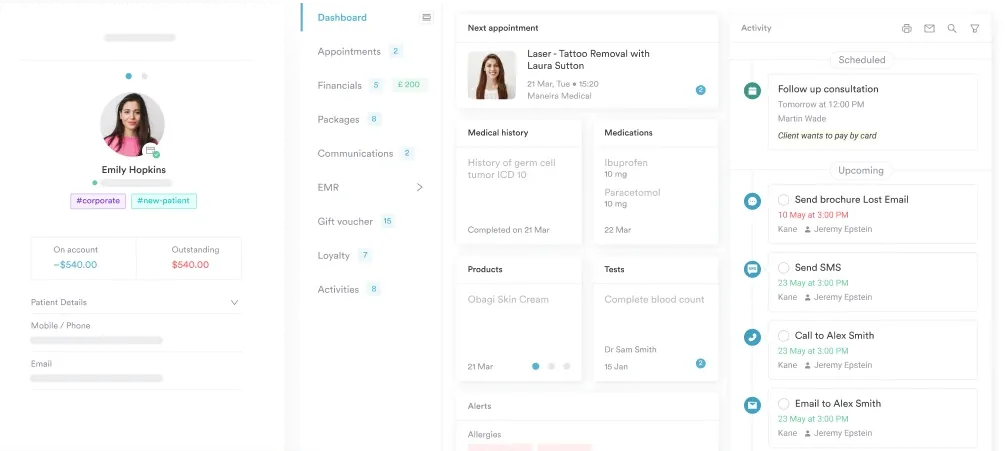
The same PMC study found that 62% of physicians reported their EHR alerted them to critical lab values. That alert layer, built into the documentation workflow, is something paper simply cannot replicate. Understanding the difference between a practice management system and an EMR helps clarify which capabilities apply to your specific clinic model.
| Documentation challenge | How EHR addresses it |
|---|---|
| Illegible handwriting | Structured digital entry with dropdown fields and typed notes |
| Missing patient history | Centralized record accessible from any authorized device |
| Duplicate documentation | Single source of truth shared across the care team |
| No medication alert | Built-in interaction and allergy flags at point of care |
| Missing audit trail | Timestamped, user-attributed access and edit logs |
Understanding EHR integration workflows matters here. A standalone EHR that doesn’t connect to your scheduling or billing system still creates manual data-entry steps. Those steps reintroduce the errors the system was supposed to eliminate.
Care coordination is where the clinical case for EHRs is strongest. A client who sees a primary care physician, a physiotherapist, and a dermatologist may never have those three practitioners share a single piece of information under a paper-based system. An EHR with interoperability changes that.
Care coordination is one of the primary advantages, specifically the ability to share accurate, up-to-date patient information across providers. For multi-location clinics, this is directly operational. A client who visits the New York site this month and the Los Angeles site next month should have the same record available to both clinicians. Without a shared EHR, that coordination requires phone calls, faxes, or memory.
Managing patient data security is inseparable from care coordination. Every clinician who accesses a shared record needs role-based permissions that limit what they can see and edit. A well-implemented EHR enforces those boundaries automatically.
For aesthetic clinics specifically, digital intake forms capture medical history, consent, and contraindication data at the patient-facing stage. That information feeds directly into the clinical record, so the treating practitioner is not relying on verbal disclosure alone.
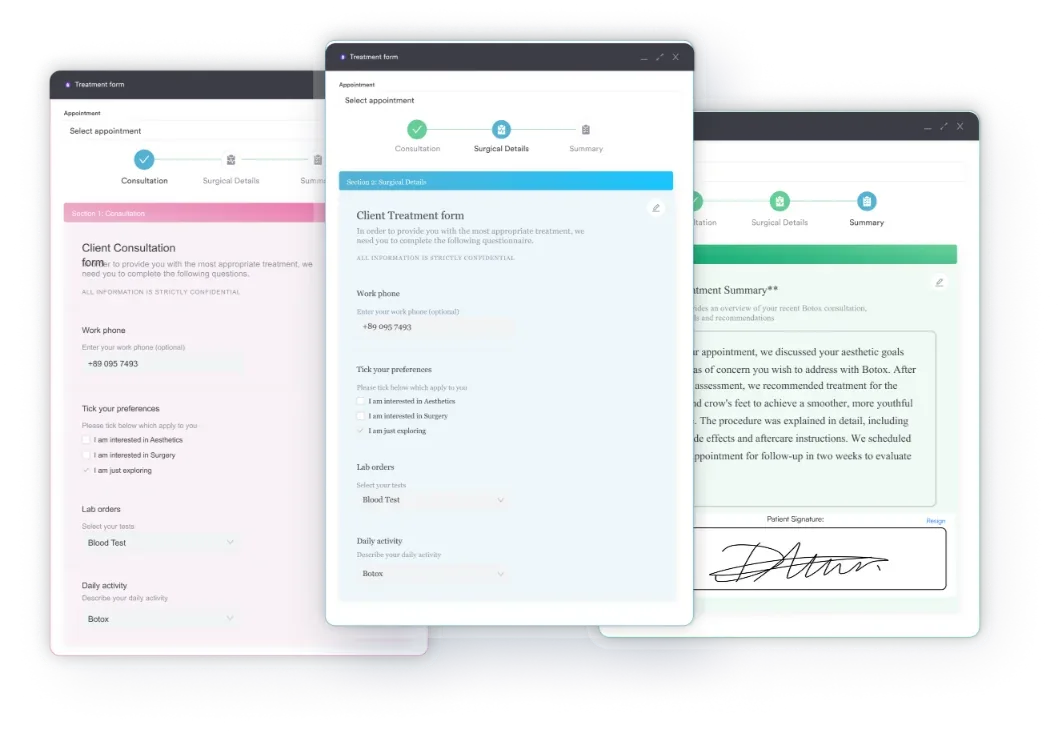

Private clinics and aesthetic practices use Pabau to run complete clinical workflows, from digital intake through treatment notes, prescriptions, and automated follow-ups, without switching between systems.

Most EHR coverage stops at what the clinician gains. For a private clinic, the patient-facing side is where retention actually moves. When records, booking, and forms connect, the client feels the benefits of EHR directly, before and after they ever sit in the chair.
None of this asks the patient to understand the software. They see a clinic that remembers them, answers quickly, and wastes none of their time. That is the version of the benefits of EHR that shows up in reviews and repeat bookings.
Documentation burden is one of the leading drivers of clinician burnout. Practitioners who spend more time typing notes than talking to patients report lower job satisfaction, higher error rates, and higher turnover intentions. EHRs do not automatically solve this, but a well-configured system reduces the friction significantly.
The specific gains here depend on what the system can do beyond storing records. Voice dictation, AI-assisted note drafting, templated treatment plans, and automated pre- and post-care messaging all reduce the manual load per appointment. A solo practitioner seeing 20 patients a day who saves 4 minutes per note saves over an hour and a half daily.
When EHR connects to scheduling, the clinical workflow starts before the patient arrives. Automated reminders reduce no-shows. Digital consent forms collected at booking mean the practitioner opens the appointment with a complete intake, not a blank form. Pabau’s automated clinical workflows handle this handoff between booking and clinical documentation without manual steps.
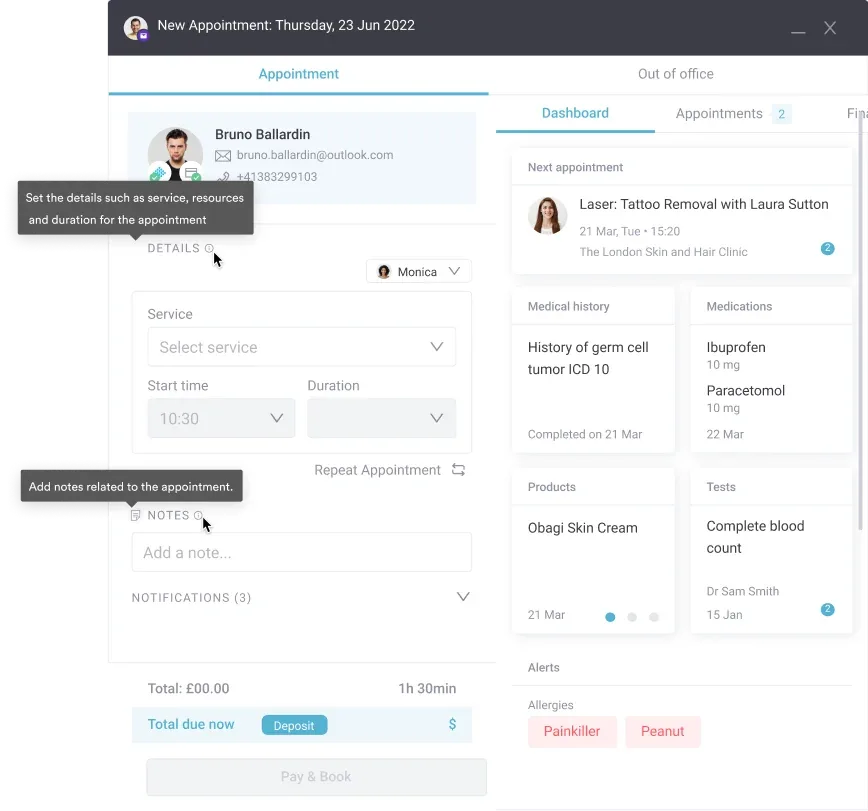
For clinics prescribing medications, embedding prescription management inside the EHR removes a dangerous handoff. The prescriber documents the clinical rationale and issues the prescription in the same system. The prescription is attached to the patient record. If a different clinician sees that patient six months later, the prescription history is visible, not lost in a separate software tool.

Audit your documentation time per appointment for two weeks. Track the minutes spent on notes after the patient leaves. If the average exceeds 5-7 minutes, your EHR configuration is likely adding friction rather than removing it. Check whether templated note structures, pre-populated fields, or AI dictation tools are available in your current system.
The administrative benefits often get less attention than the clinical ones, but for a practice owner they are equally significant. Billing accuracy, compliance documentation, and data-driven growth decisions all depend on clean, connected records.
When clinical documentation and billing are in separate systems, coding errors multiply. A procedure documented one way in the notes gets coded differently in the billing tool because someone is manually re-entering or interpreting the data.
An integrated EHR links the clinical record to the billing workflow, so the documented procedure generates the correct code. For private clinics not relying on insurance, the benefit appears in invoicing accuracy and audit readiness rather than claims approval rates.
HIPAA in the US and GDPR in the UK and EU both require documented access controls, breach notification processes, and data retention policies. An EHR that enforces role-based access, timestamps every record interaction, and produces audit logs makes compliance demonstrable rather than asserted.
When a regulator asks who accessed a patient record on a specific date, the answer is in the system, not in someone’s memory. For UK clinics navigating GDPR requirements, this audit trail function alone justifies the EHR investment.
A clinic running on paper records cannot answer basic operational questions without manual counting. How many clients returned within 90 days? Which treatments have the highest no-show rate? Which practitioners generate the most revenue per hour? An EHR that feeds into a reporting layer answers these questions from existing data.
For multi-location clinics, that visibility across sites is the difference between managing by gut feel and managing by evidence. Exploring the best EHR options for private practice often reveals that reporting capability is where platforms diverge most significantly.
It is worth acknowledging the counter-evidence. A PMC literature review on electronic medical record value found clear evidence of EHR benefits for quality of care, while noting that realizing those gains depends heavily on implementation quality, staff training, and system configuration.
A poorly implemented EHR can increase documentation time rather than reduce it. Reviewing resources on AI scribes and clinical documentation shows how newer tools are addressing some of the traditional EHR friction points.
The benefits most clinics capture are the surface ones: fewer lost files, faster chart retrieval, digital consent forms. The deeper gains come from connecting the EHR to scheduling, billing, prescriptions, and reporting in a single platform. That is where documentation time drops, compliance becomes demonstrable, and growth decisions get grounded in data rather than guesswork.
Pabau combines clinical records, structured treatment documentation, digital forms, automated workflows, and reporting in one platform built for private and aesthetic clinics. If your current EHR is a standalone system that doesn’t connect to the rest of your operations, it is worth seeing what an integrated approach looks like. Book a demo to see how Pabau handles the full clinical and administrative workflow.

Want to understand how EHR connects to your wider practice operations? EHR integration workflows covers how modern systems connect clinical records to scheduling, billing, and communications.
Considering the switch from paper? Going paperless in your clinic walks through the practical steps and time savings clinics see after digitizing records.
Running a medical spa or aesthetic practice? Medical spa software explains the specific EHR and workflow features that matter most for aesthetic and wellness clinics.
The main EHR benefits for providers include faster chart access, reduced documentation errors, automated medication alerts, and the ability to share accurate patient information across a care team. For private practice owners, integrated EHRs also reduce billing errors and make regulatory compliance demonstrable through audit logs and access controls.
An EMR (Electronic Medical Record) is a digital version of a single practice’s paper chart. An EHR (Electronic Health Record) is designed to share information across multiple providers and settings. In practice, many clinic management platforms use the terms interchangeably, but the distinction matters when evaluating interoperability capabilities.
EHRs reduce medical errors through built-in alerts for drug interactions and allergies, structured documentation that eliminates illegible handwriting, and single-source records that prevent conflicting information across multiple files. A peer-reviewed PMC study found 65% of physicians said their EHR alerted them to a potential medication error.
EHR systems can increase documentation time if poorly configured, require significant upfront staff training, and create workflow disruption during implementation. A PMC literature review on EHR value emphasized that realizing the benefits depends heavily on how well the system is implemented, staff are trained, and workflows are connected to other clinic systems.
EHRs can reduce costs by cutting administrative staff time, reducing duplicate testing through shared record access, and improving billing accuracy to reduce claim errors. For private clinics, the clearest cost benefit is reduced administrative overhead when the EHR connects directly to scheduling and invoicing workflows.
For patients, an EHR means self-service online booking, digital intake completed before the visit, and their full treatment history available to the clinician on screen. In a private clinic that shows up as shorter waits, fewer repeated questions, and pre- and aftercare that arrives automatically instead of being chased.