HIPAA compliant texting: What you can send patients & how to communicate securely
HIPAA compliant texting is possible when a text holds no protected health inform...

Last Updated: Oct 16, 2026

Med spas are covered entities under HIPAA, so the same patient data rules that apply to hospitals apply to your treatment room, front desk, and camera roll.
Most breaches trace back to three fixable causes: Weak encryption, phishing, and staff error. Each one maps to a specific software control you can turn on today.
Secure practice management software consolidates encryption, role-based access, audit trails, secure messaging, and backups into one system, so protection stops depending on individual staff habits.
Pabau supports both HIPAA and GDPR, so a single setup covers US and international practices, backed by AES-256 encryption, 2FA, and granular role-based permissions.
Running a successful med spa isn’t just about the quality of service and patient care management you offer. There’s another success factor providers can’t ignore: Patient data security. HIPAA compliance is one of the topics covered in our comparison of the best med spa software.
Every treatment record, before-and-after photo, and stored card number is protected health information, and med spas are legally on the hook for keeping it safe. Over the past 12 months, 93% of healthcare organizations experienced at least one cyberattack, averaging 43 attacks each.
The good news: You don’t need an IT department to fix this. The US Department of Health and Human Services Cybersecurity Program traces most breaches to three fixable causes: Poor encryption, phishing attacks, and employee error.
This guide maps each threat to the exact control that stops it, walks through the compliance standards that apply, and shows how practice management software like Pabau builds those controls in, so security stops depending on who remembers to lock the computer.
A breach does lasting harm precisely because trust is so hard to rebuild, which is why data security and managing your online reputation are two sides of the same strategy. HIPAA compliance is the floor, not the finish line.
A patient record is worth far more to a criminal than a stolen card number. It bundles identity details, medical history, and payment data in one file, which is why healthcare has been the costliest sector for breaches 14 years running, at an average of $7.42 million per breach.
Med spas are especially exposed. Bookings arrive by phone, email, and Instagram DM. Consult photos land on a practitioner’s personal phone. The front desk shares one login. None of that is malice, it’s just how a busy medical spa grows, whether you’re running one location or opening a second, and every workaround is a soft spot an attacker can use.
HHS points to three root causes behind most healthcare breaches. Here’s how each one shows up in a med spa and the single control that neutralizes it, so you know what to look for when you evaluate any system.
Notice the pattern: Every fix shifts responsibility off individual staff and onto the system. That’s the case for consolidating your tools into one secure platform rather than stitching security onto spreadsheets, personal phones, and a standalone card machine.
To stay compliant and out of legal trouble, med spa owners must follow the key regulatory standards for their region. Which ones apply depends on where your patients are.
HIPAA, the US Health Insurance Portability and Accountability Act, governs any business that handles protected health information, known as PHI. That includes med spas offering medical treatments, not just hospitals and insurers.
The rules on offering injectables and prescription treatments make you a covered entity, so the same standards behind HIPAA for medical offices apply to your practice.
Failure to comply carries penalties ranging from $145 to $2,190,294 per violation, depending on the culpability tier, from Tier 1 (lack of knowledge) to Tier 4 (uncorrected willful neglect), with a $2,190,294 annual cap for the most severe tier.
PHI is any information that can identify a patient and relates to their care or payment. In a med spa, that’s more than you might think:
If a piece of information ties a person to their visit, treat it as PHI, and secure it the same way you would a clinical record.
The General Data Protection Regulation is the UK and EU’s leading data protection law. It governs how personal data is processed and protects EU citizens and residents regardless of where they’re physically located, so it can apply even to a US practice with international clients.
GDPR sets a high consent standard that gives clients control over how their data is used. A GDPR checklist is the fastest way to see where you stand.
Cyber Essentials is a UK government-backed certification that confirms an organization has strong baseline security controls in place. It provides an assurance framework, alongside a handful of technical controls, that shields patient and business information from common online attacks.
Any vendor that touches your patient data, from your booking software to your payment processor, is a business associate under HIPAA. A business associate agreement is a signed contract making that vendor legally responsible for protecting the PHI they handle.
Before you trust any tool with patient records, ask for a signed BAA. If a vendor calls itself “HIPAA friendly” but won’t sign one, that’s a red flag, not a technicality.
Securing patient information takes a layered approach rather than a single fix. The steps below cover the controls HHS and HIPAA expect, and most of them come built into robust practice management software.
Your practice deals with sensitive patient information every day, and that data has to be protected and kept private in line with HIPAA’s legal requirements. The simplest way to do that is to run on HIPAA-compliant software with the right safeguards built in, rather than bolting security onto tools that were never designed for medical data.
Here’s the good news: Pabau supports HIPAA compliance. A HIPAA support toggle activates the compliance features in the system, so the safeguards work in the background while your team gets on with treating patients.
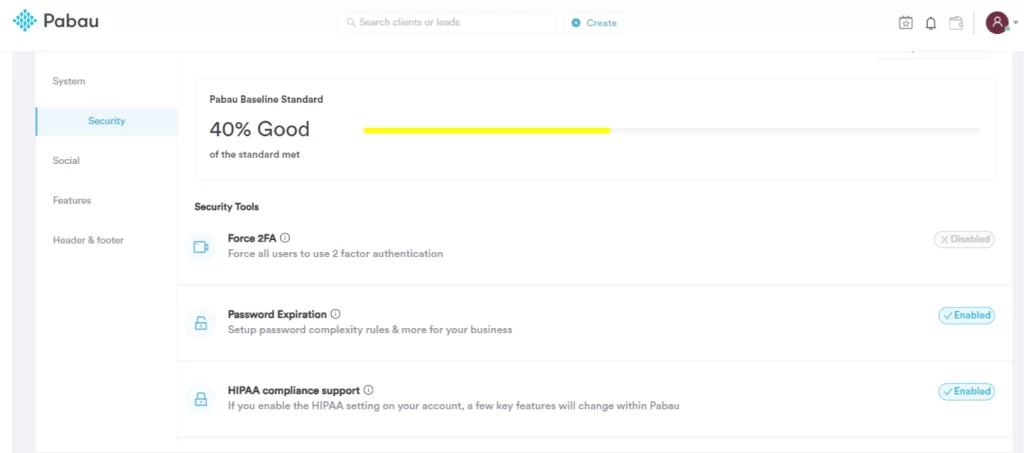
Keep in mind that using Pabau’s HIPAA functionality alone won’t make you compliant on its own. You still have to put the required policies and procedures in place. If this is your first time, a HIPAA compliance checklist is a handy guide.
Not everyone on your team needs to see everything. Role-based access restricts records so only authorized staff can view or edit sensitive data.
Your reception team may only need appointment history and contact details, while licensed nurses and physicians need the full record, including past treatments, allergies, and prescribed medications. Granting access strictly by role limits exposure and shrinks the damage a single compromised login can do.
Risk assessments should run at least annually, and again whenever you make a change that could introduce new risk, like adding a location or a new tool. The goal is to find weak points before an attacker does. Key factors to review in a med spa assessment include:
Employees are the single biggest risk factor. Verizon’s 2025 Data Breach Investigations Report found the human element involved in 60% of breaches. Ongoing cybersecurity training for healthcare teams is what turns your staff from the weakest link into the first line of defense. Cover at least these three areas:
Social media is an easy place for staff to slip up, so make it part of the training. Refresh it regularly, because both the threats and the regulations keep changing.
Even well-run practices can be hit, and how fast you respond decides how much damage is done. Under HIPAA’s Breach Notification Rule, you must notify affected patients and HHS within set timeframes, so waiting to figure out the steps mid-incident isn’t an option.
Write the plan before you need it: Who investigates, how you contain the breach, which records were involved, and how you notify patients and regulators. A system with detailed audit trails makes this far easier, because you can see exactly what was accessed and when.
The right platform builds most of the controls above into one system. When you compare skin clinic software options, HIPAA-compliant practice management software should cover all five of these:
Any HIPAA-compliant software you shortlist should also come with a signed BAA, whether you’re comparing Pabau alternatives or sticking with your current system. If it doesn’t, it isn’t truly compliant, whatever the marketing says.
Use this as a quick self-audit. It spans both HIPAA (US) and GDPR (global), so it works whether your patients are down the street or overseas.
Pabau is practice management software built for medical and aesthetic practices, so patient data security is designed in rather than added on. Here are the features that keep your data protected.
Permissions are one of the biggest security levers when handling patient data. Pabau’s permissions can be switched on and off to grant or revoke each team member’s access to exactly the data they need.
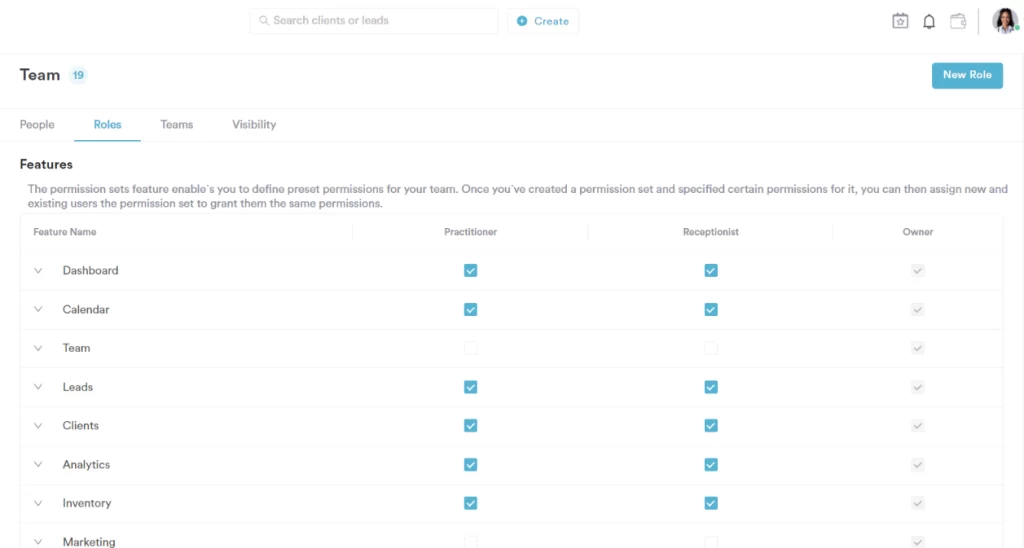
You control who can reach areas like dashboards, calendars, leads, clients, analytics, stock, marketing, payments, and setup. You can manage patient-facing permissions two ways:
Two-factor authentication cuts the risk of data exposure by securing the login itself. If a patient’s password is ever compromised, sign-in still requires a second step, typically a code sent by SMS. Without approving that 2FA prompt, no one gets in, so only the account owner can log in.
For the highest level of PCI DSS (Payment Card Industry Data Security Standard) compliance and secure card transactions, Pabau integrates Stripe, a widely used payment platform. Stripe encrypts card numbers and keeps its internal systems from accessing the data, adding another layer of protection to every payment.
Pabau lets you upload patient photos straight to the client record. Take a photo in the app and it’s stored against that record automatically, so nothing sits on a personal phone or has to be transferred between devices, and before-and-after shots stay tied to the same consent and access rules as the rest of the file.
Sharing API keys, the codes that identify and authenticate connected apps, with third-party tools raises your risk. Pabau lets you share, limit, or disable those keys as needed, so you can restrict third-party access and keep sensitive data locked down.
Encryption has been part of Pabau since day one. It uses high-level encryption to secure patient files, including photos, videos, alerts, and other sensitive data, through standards such as:
Pabau takes extra steps to protect your patient data:
The safety of sensitive patient data should be one of your top priorities as a med spa owner. Get it wrong and you risk penalties, lost trust, and a reputation that’s hard to win back.
Robust practice management software like Pabau doesn’t leave patient data to chance. It builds encryption, access control, 2FA, and monitoring into one system, and supports both HIPAA and GDPR, so it’s a fit for practices at home and abroad, as med spas like Ageless Enhancements have found.
Book a demo with us to see how Pabau keeps your patient data stored, sealed, and secured at every step.
Start by running on HIPAA-compliant practice management software that builds in encryption, role-based access, two-factor authentication, audit trails, and automated backups. Then layer on the human side: Train staff on phishing and data handling, run an annual risk assessment, sign BAAs with every vendor, and keep a written breach response plan ready.
Limit who can see each record through role-based permissions, encrypt everything in transit and at rest, capture consent before using any patient photo, and secure the channels you use to message patients. Confidentiality holds when protection is built into the system rather than left to individual habits.
US practices must follow HIPAA for any protected health information they handle, while any practice serving EU or UK patients also falls under GDPR. UK practices can additionally pursue Cyber Essentials certification. Each standard sets rules for how patient data is protected, processed, and stored, and non-compliance carries financial penalties.
HIPAA penalties range from $145 to $2,190,294 per violation depending on the culpability tier, capped at $2,190,294 a year for the most severe tier. Beyond the fine, a breach damages patient trust and your practice’s reputation, which often costs more over time than the penalty itself.
According to the HHS Cybersecurity Program, the top threats are poor encryption, phishing attacks, and employee error. Each maps to a control you can put in place: Strong encryption, two-factor authentication plus training, and role-based access with audit trails. Even a minor breach from one of these can lead to identity theft and fraud, so closing all three matters.