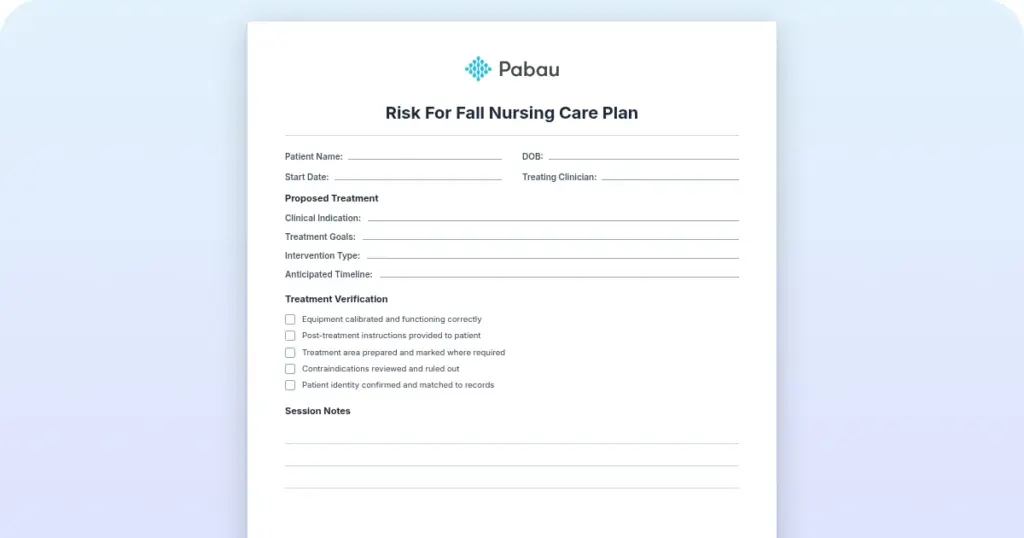
Risk for fall nursing care plan: Template and worked example
A risk for fall nursing care plan records why a patient might fall and what the ...

2
Last Updated: Oct 21, 2026
A nursing narrative note template is a structured PDF that guides you through recording a patient’s assessment, nursing interventions and outcomes in chronological prose. It gives nurses a consistent frame for narrative charting, so the important details are captured in the same order on every shift.
Below you’ll find the free PDF and a five-step method for writing an entry. Six worked examples follow, from a routine assessment to the events that need the most careful wording. Those are a change in condition, a fall and a refused dose.
A ready-to-use PDF covering the patient assessment, nursing interventions, patient response, outcomes and the plan of care. It includes space for the date, time, author and signature on every entry.
Download template
A nursing narrative note template is a free PDF for chronological, prose-based patient documentation.
Narrative notes record the assessment, the intervention and the patient’s response in one flowing entry.
Late, vague or subjective entries carry the most medicolegal risk, so date and time every note as you go.
Label any note written after the event as a late entry, with both the current time and the time of the event.
Practice software such as Pabau keeps narrative notes in the patient record, next to appointments and treatment history.
A nursing narrative note template is a pre-set layout that prompts the writer through each element of a narrative entry. It defines the headings to complete, the order of events and the sign-off fields, so every note meets the same baseline.
Nursing programs and facility policies treat narrative charting as one of several accepted formats, alongside SOAP, DAR and PIE charting. Nurses use it to describe what happened during a shift in the order it happened.
Documentation also carries legal weight. Under CMS guidance for skilled nursing and home health, the record must show the skilled need and the patient’s response to care.
The PDF is built around the sections a reviewer expects to see in a complete narrative entry. Each section maps to one stage of the nursing process.
Most units expect a narrative entry at set points in the shift, plus one whenever the plan of care changes. The routine points come from facility policy. The event-driven ones are where documentation most often falls short.
Each event below needs its own timed entry, written as close to the event as you can. The third column is the detail reviewers look for first.
If a shift passes with no events, the entry still records that. A short note stating the patient was stable, with the times you checked, closes the record for that shift.
Writing a strong entry is a matter of sequence. Work through the assessment first, then record what you did and how the patient responded.
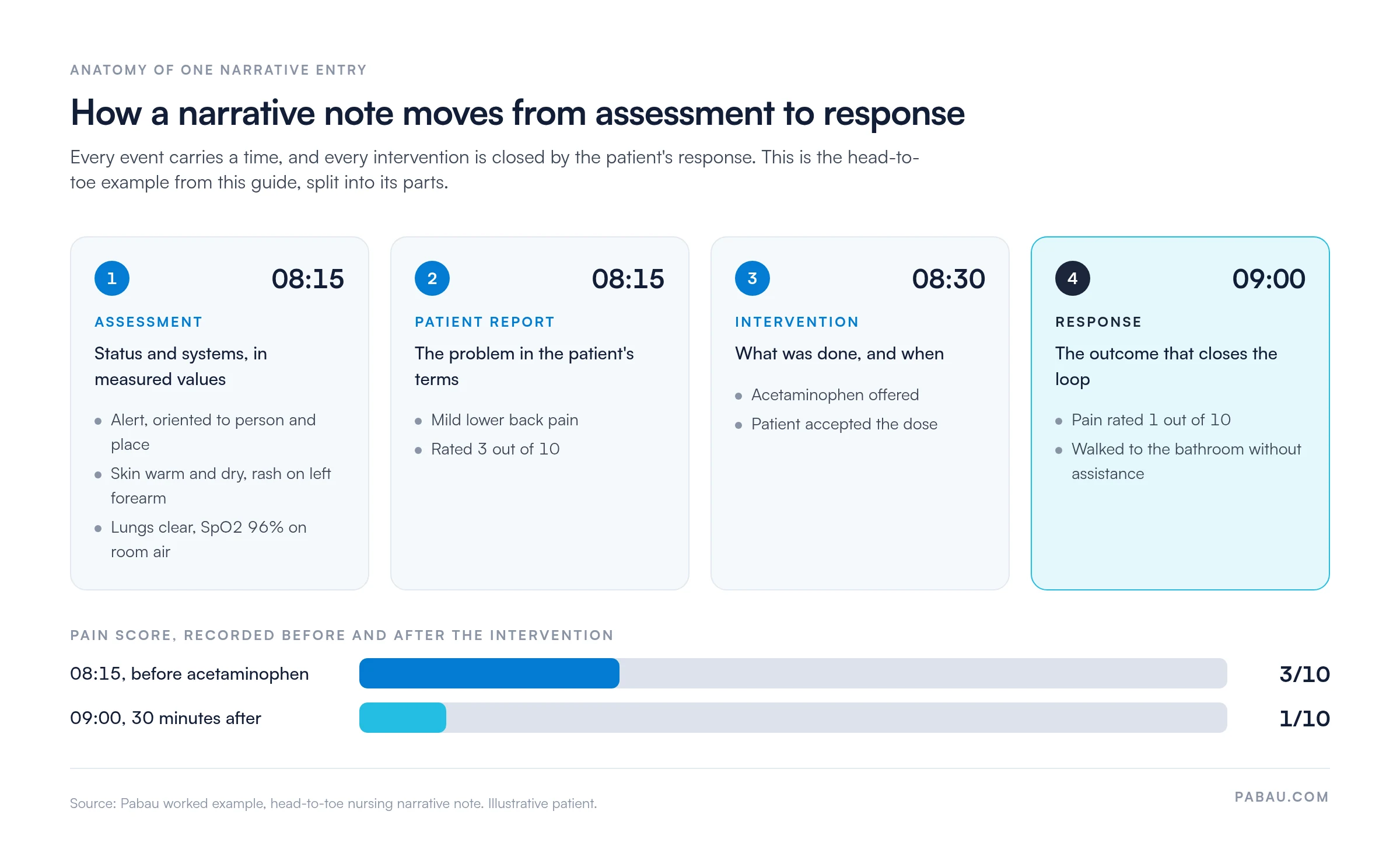
At 08:15, the patient was alert and oriented to person and place. Skin was warm and dry, with a blanching rash on the left forearm. Lungs were clear bilaterally, and oxygen saturation was 96% on room air.
The patient reported mild pain at 3 out of 10 in the lower back and accepted acetaminophen at 08:30. At 09:00, pain was reported as 1 out of 10, and the patient was observed walking to the bathroom without assistance.
Laid out as a timeline, the same entry shows why each intervention needs a matching response.
At 19:00, the patient was resting in bed with the call bell within reach. Vital signs were stable, and fluid intake over the shift totaled 1,200 mL. The patient asked about discharge timing, and the charge nurse was informed. Plan for the night shift: reassess pain at 22:00 and confirm the morning medication round.
For a fuller handoff, pair this entry with an end-of-shift report that lists each patient’s status and pending tasks.
During today’s home visit, the nurse completed a wound assessment on the sacral area and measured the wound at 3 by 2 cm. The dressing was changed using the agency protocol, and the patient tolerated the procedure.
The caregiver was taught the signs of infection to watch for between visits. The skilled need for wound care remains, and the plan is to reassess at the next scheduled visit.
At 14:10, the patient was newly confused and oriented to person only. At 08:00, the patient had been oriented to person, place and time. Temperature was 101.2°F, heart rate 112, blood pressure 98/60 and oxygen saturation 93% on room air.
At 14:20, the attending physician was called and given an SBAR report. Orders were received for blood cultures and a chest X-ray, read back and confirmed. At 15:00, the patient remained confused, and blood cultures had been drawn.
SBAR stands for situation, background, assessment and recommendation. The entry records the call itself, the orders and the reassessment, so a reviewer can see that the change was acted on.
At 02:40, the patient was found sitting on the floor beside the bed. The patient stated, “I tried to get to the bathroom on my own.” No head strike was reported, and the patient did not lose consciousness.
The patient moved all four limbs without pain, and the skin was intact. Blood pressure was 134/82, heart rate 88 and oxygen saturation 97%. Two staff assisted the patient back to bed. The physician and the patient’s daughter were notified at 02:55, and neuro checks were started per fall protocol.
Notice the wording “found sitting on the floor”. Nobody saw the fall, so the note describes what the nurse saw. Most facilities also keep the incident report out of the narrative, so the entry records the facts and not the paperwork.
At 09:00, the patient declined metoprolol 25 mg, stating, “It makes me dizzy when I stand up.” Blood pressure was 142/88 and heart rate 92. The purpose of the medication was explained, and the patient repeated it back but still declined.
The dose was recorded as refused on the medication record. The prescriber was informed at 09:15 and asked to review the dizziness. The patient was reminded to call before getting up.
Each format suits a different job. SOAP notes split the entry into four labeled sections, while DAR notes track one focused event from data to response. The table below shows when a team might choose one over another.
Narrative charting captures context that boxed formats lose, such as the order events happened in and what the patient said. Its weakness is scanning. A long free-text entry is slow to search and hard to trend across shifts.
That is the job of the template. Fixed headings put the same facts in the same place, so a reviewer can find the pain score without reading the whole entry. Many units use narrative notes for the shift and SOAP for the care plan. Check your facility’s policy before changing formats.
Good narrative notes read as a clear account that a colleague could act on without calling you. These habits, drawn from wider nursing documentation standards, make the difference.
The fastest way to tighten a narrative note is to replace each judgment with what you saw or measured. These swaps show the pattern.
The Joint Commission keeps an official “Do Not Use” list of abbreviations that cause medication errors. They are banned in handwritten notes and in free text, so they apply to narrative entries too.
Narrative notes tend to go wrong in four predictable ways. Each one is easy to catch when you reread your own entries.
Late entries: notes written at the end of a long shift lose detail and invite questions. Chart each intervention close to the time it happened. If you must add a note afterward, follow the late entry rules below.
Vague language: “patient doing better” gives a reviewer nothing to act on. Describe the observable change instead.
Missing patient responses: an intervention without a documented response leaves the outcome unclear.
Opinion instead of observation: “the patient seemed difficult” should be replaced with the specific behavior you saw and the time it happened.
A narrative note is a legal record, so the original wording has to stay readable after any change. Most facility policies follow the same rules.
Never erase, use correction fluid, or write over an entry. Never alter another nurse’s note, and never back-time an entry to look as if it was written earlier.
A downloaded PDF records the note, but it sits outside the rest of the chart. Someone has to print it, scan it and file it before the next nurse can find it.
Pabau’s medical records keep clinical notes against each patient, so the narrative entry sits with the history it refers to. Timestamps and author details are stored with each entry, which supports an audit trail.
Practices that want to move from a downloaded template to in-system charting can use digital intake forms to capture the same structured fields. The next nurse opens one record and sees the assessment, the intervention and the response together.

Pabau stores each narrative note against the patient record with its author and timestamp. Handoffs and chart reviews start from one complete history instead of a stack of PDFs.

If your unit still charts on paper, start with the PDF and use it for every entry on one shift. The fixed order makes missing times and missing responses obvious before a reviewer finds them.
The trade-off is that a PDF lives outside the record, so it still has to be scanned and filed. If your team wants notes stored with the patient’s history from the start, book a demo to see how Pabau handles clinical documentation.

Charting for EMS instead of a ward? EMS chart narrative shows how the same chronological approach works for a prehospital patient care report.
Need a shorter format for routine shifts? Shift note template gives you a compact layout for documenting a standard shift.
Prefer charting around one problem at a time? Focus charting (F-DAR) explains how to write focused nursing notes that hold up under review.
Documenting a new admission? Admission nursing note covers what to record when a patient first arrives on the unit.
Want the key abbreviations and phrases on one page? Nurse charting cheat sheet collects the wording that keeps entries objective and clear.
A nursing narrative note is a chronological prose entry that records a patient’s assessment, interventions and response. It is one of several accepted nursing charting formats.
It should include patient identifiers, the assessment findings, each intervention with its time, the patient’s response, the outcome and the plan. Each entry should be signed with the author’s name and credentials.
A narrative note tells the story of the shift in order, while a SOAP note separates the content into subjective, objective, assessment and plan sections. Many teams use both, depending on the setting.
Narrative notes can support home health documentation, but recertification requirements are set by CMS and your agency’s policy. Check current CMS guidance before relying on any template for that purpose.
On paper, draw a single line through the error so it stays readable. Label it as a mistaken entry, then add your initials, the date and the time. In an electronic record, use the amend function so the original entry is kept.
Avoid the Joint Commission’s Do Not Use list: U, IU, Q.D., Q.O.D., MS, MSO4, MgSO4, trailing zeros and missing leading zeros. Write the full word or the correct number instead.
Long enough to show the assessment, each intervention and the patient’s response, and no longer. A routine shift may need one short paragraph, while a fall or change in condition needs its own timed entry.