Fun journal prompts for adults
Fun journal prompts for adults are short, open-ended questions that make sitting...

Last Updated: Oct 6, 2026

DAR stands for Data, Action, and Response, a nursing note format built around one named patient focus.
Data covers what the patient reports and what you observe, Action covers your interventions, and Response covers the outcome.
Focus charting, or F-DAR, adds the focus in front of the note so a chart is faster to scan and pull by concern.
Practice management software like Pabau lets you build the same Data, Action, and Response fields into every note your team writes.
The template gives you a focus line, then Data, Action, and Response fields with prompts for findings, interventions, and patient outcomes. Print it for the ward, or copy the fields straight into your clinical software.
Download templateDAR notes are nursing notes written in three parts. Data records what you found, Action records what you did about it, and Response records what changed. Each note covers one focus, meaning the single patient concern you are charting.
The format is also called focus charting. It keeps a record organized around patient concerns rather than a long shift narrative. A colleague can scan the chart, find every note about pain, and see whether it improved.
Nurses use it on medical-surgical floors, in mental health practices, in rehabilitation, and in long-term care. It sits neatly beside a written nursing care plan, which sets the goals each note then tracks.
Each part answers a different question about the same focus. Filling in all three is what makes the note defensible and useful to the next clinician.
Write the response in the same terms as the data. A pain score at the start and a pain score at the end tell the story in one line.
A consistent order keeps notes quick to write and quick to read. If the sequence is new, rehearse it on a guided notes sheet first, where labeled sections leave space to write under each one. Work through these five steps.
Three formats cover most clinical notes. The choice comes down to who reads the note and how much reasoning it has to carry.
Choose DAR when notes follow one concern at a time and need to be quick to scan. Choose SOAP notes when clinical reasoning has to be visible on the page.
There is a fourth option worth knowing about. The DAP note folds subjective and objective findings into a single data section, which suits talk therapy better than bedside nursing.
Completed forms belong in structured medical records management, not a filing cabinet.
The structure holds across settings. What changes is the focus and the language you use in it.
Focus: Post-operative pain, day one after knee arthroscopy
Data: Patient reports incision pain 6/10, four hours after acetaminophen. Dressing clean and intact, with no swelling beyond what is expected. Temperature 99°F. Says movement “feels safer” today, but avoids full knee extension.
Action: Applied a wrapped ice pack for 20 minutes. Elevated the leg on two pillows. Reviewed the pain plan and offered ibuprofen 400 mg, which the patient declined over stomach concerns. Gave written ankle mobility exercises and encouraged short walks with the walker.
Response: Pain down to 4/10 after ice and elevation. Walked 30 feet with the walker and staff support. Repeated the exercise schedule back, and knew which symptoms to report.
Focus: Anxiety before group therapy
Data: Patient reported rising worry through the morning. Observed fidgeting, rapid speech, and no eye contact with peers. Heart rate 92 bpm. Said, “I don’t think I can talk about this in front of everyone.”
Action: Offered a choice of group or a one-to-one session. Taught the 5-4-3-2-1 grounding technique. Gave 10 minutes of quiet time first, and a seat near the door. Told the facilitator the anxiety level before the session started.
Response: Attended the group and spoke twice. Heart rate settled to 78 bpm. Said afterwards that staying had been worth it, and agreed to the same plan next week.
In outpatient therapy. Progress on each one stays visible from session to session.
Focus: Anxiety before venipuncture
Data: Eight-year-old reports fear of needles. Observed clinging to a parent, and tearful. Said it would “hurt a lot.” Vital signs stable, and the parent is anxious too.
Action: Explained each step in child-friendly words and showed the equipment. Applied topical anesthetic cream 30 minutes before the draw. Let the parent hold their hand, used counting and guided breathing, and offered a sticker afterwards.
Response: Cried briefly at insertion, but stayed still. Said it was not as bad as expected. Heart rate returned to baseline, and the parent thanked the team.
A feelings face chart gives younger children a way to report distress before you start. It also gives you something concrete to quote in the data section.
Focus charting, written as F-DAR, gives the focus a column of its own. Nothing about the three sections changes. The reader simply stops having to infer what the note is about.
The order becomes focus, data, action, response. A focus is short and specific, such as acute anxiety, post-operative pain, or difficulty breathing. Entries can then be pulled by focus and read in sequence.
That helps most where one patient has several concerns running at once. Pain, nausea, sleep, and mood each get a thread of their own.
DAR suits settings where the same concern is revisited over days or weeks.
Handover gets faster. A colleague reads the focus, then the response, and knows where the patient stands. Nobody has to reconstruct a shift from a paragraph of prose.
Records hold up under review. The note says what was observed, what was done, and what changed. That is exactly what an auditor or a lawyer looks for years later.
Audits get less painful. The American Nurses Association sets out documentation principles that expect complete, timely records. In the UK, the Nursing and Midwifery Council asks for the same standard.
Writing gets quicker. Once a team agrees on the fields, nobody stops to decide where a detail belongs. Each decision saves seconds, and those add up across a full shift.
In most practices, note structure lives in someone’s head. The format sits in a Word file, on a paper pad, or in the habits of whoever trained the newest nurse. Wording drifts, and audits turn up missing detail. Intake forms completed on paper get transcribed, and transcription is where detail is lost.
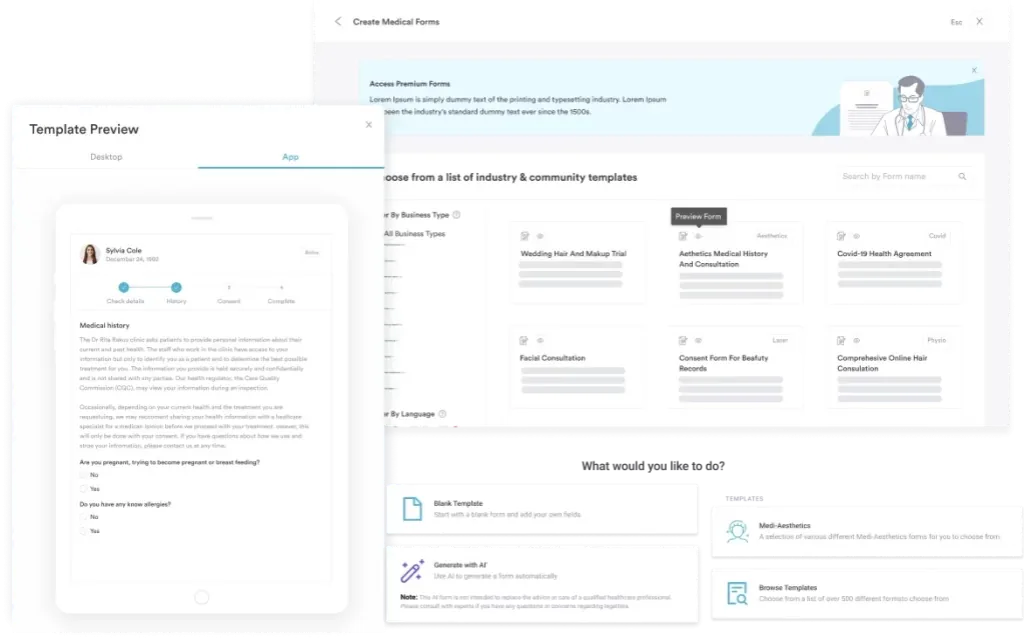
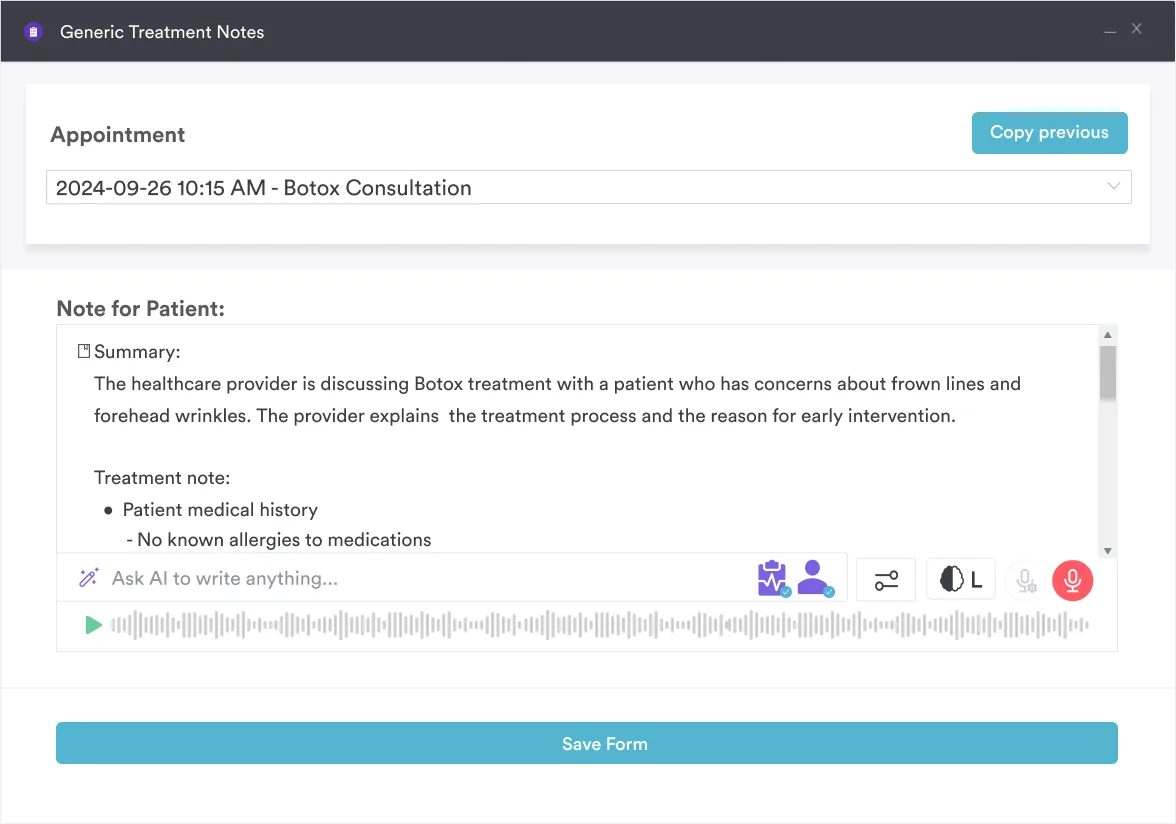
Practice management software like Pabau puts the structure into the record itself. You build a form with a focus line, then separate Data, Action, and Response fields, and every clinician completes the same one. Each note attaches to the appointment, the treatment history, and the photos, so the care timeline stays in one place.
You shape the three sections and sign, rather than typing into a blank field at the end of a long shift.
That is the same shift most teams make when they finally standardize a note format.

Pabau’s customizable forms and treatment notes keep Data, Action, and Response consistent across your team. Records stay complete, and audit season stops being a scramble.

DAR works because it makes the note close its own loop. You cannot write a response without an action behind it, and you cannot write an action without a finding that prompted it.
Pick the format once, then hold the team to it. A unit where half the notes are DAR and half are freeform prose loses the benefit, because nobody can scan a chart with confidence.
Download the template, adapt the wording to your specialty, and give the team one finished note to copy. Book a demo to see how Pabau holds that structure in every record your practice writes.

Need a structured layout for neuro findings? Cranial nerve nursing assessment walks through each nerve, so your data section has nothing missing.
Confirming a patient is fit for treatment or activity? Medical clearance letter documents clinical assessment and fitness for treatment, work, or sports.
Authorizing care for a child in your absence? Medical consent form for babysitter covers caregiver details, medical history, and the scope of consent.
Documenting an abdominal exam? Medical release form for minor authorizes a caregiver to treat a child when a parent is unavailable.
Keeping a record of a patient’s medications? Medication log template comes in daily, weekly, PRN, and caregiver formats for tracking each medication.
DAR stands for Data, Action, and Response. Data covers what the patient reports and what you observe or measure. Action covers the interventions you carried out. Response covers how the patient responded and what changed.
A DAR note is organized around one patient focus and reads as a short narrative. A SOAP note separates subjective and objective findings, then adds assessment and plan. SOAP carries more clinical reasoning, which is why physicians tend to prefer it.
F-DAR is focus charting. It adds an explicit focus statement in front of the Data, Action, and Response sections. The subject of the note is then obvious, and every entry about one concern can be pulled together.
Yes. The focus approach tracks one symptom at a time, such as anxiety, low mood, or suicidal ideation. Progress and setbacks across sessions stay visible to the whole care team.
DAR is widely used in nursing, mental health, therapy, physical therapy, and rehabilitation. Some hospitals and physician-led practices ask for SOAP or another format instead. Check your facility’s documentation policy before you switch.