Despina Petrushevska

OT SOAP note sample: Free template and worked examples
Download your free OT SOAP note sample A four-page form with an identifying head...

3
Last Updated: Nov 5, 2026
Free PDF 1 page, print-ready Clinician-reviewed
A SOAP note for nursing is a structured clinical record that organizes each patient encounter into four parts: subjective, objective, assessment, and plan. Subjective holds what the patient reports, and objective holds what you measure. Assessment states the nursing diagnosis, and plan sets the next steps and a review date. Keeping facts and interpretation in separate sections lets the next shift trust the record. This guide walks through each section, a worked blood pressure example, and the charting mistakes to avoid, with a free template to download. In Pabau, the practice management platform we build, each note sits on the patient record beside the rest of the patient history.
A ready-to-use SOAP note template built on the four-section subjective, objective, assessment, and plan layout. It was written for mental health encounters, so nurses should adapt the wording to their own setting before use.
Start from scratch, or upload this PDF or any form you already use, and Pabau's AI Form rebuilds it with tick boxes, text fields and a signature. Attach it to the treatment once, and every patient gets it on time.
AI Form rebuilds the consent, history and aftercare forms you already use. You review each one, then publish.
Patients complete forms on their phone before they arrive, so the front desk stops retyping paper.
Every signed form is versioned and attached to the treatment record, ready when you need it.
Set how long a consent stays valid. Returning patients skip forms they have already signed.
Supports HIPAA and GDPR compliance AES-256 encryption 4.8 on G2 4.7 on Capterra Trusted by 4,000+ practices worldwide

A SOAP note for nursing splits each encounter into four ordered sections.
Subjective holds patient reports, while objective holds measured findings.
Assessment states the nursing diagnosis, and plan lists interventions and follow-up.
Every plan needs a review date, so the next shift knows when to reassess.
Pabau stores each SOAP note on the patient record, so handoffs and audits read from one place.
A SOAP note for nursing separates facts from interpretation, and that separation is why the format has lasted. Lawrence Weed developed the SOAP layout in the 1960s as part of the problem-oriented medical record, and clinicians have used it ever since.
Nurses rely on the format for three reasons:
Joint Commission accreditation standards expect clinical records to be complete and timely. A consistent structure makes that easier to meet every shift. The wider charting rules nurses work under are set out in our guide to nursing documentation.
Work through the note in order, starting with the patient’s own account and ending with the plan. Each section should stand on its own, so a reader can see where every fact came from.
Subjective data is information only the patient or a family member can give you. Record the chief complaint in the patient’s own words, then add onset, severity, and relevant history.
Objective data is what you can measure, see, or test. Keep it factual and leave your interpretation for the assessment.
Typical entries include blood pressure, heart rate, respiratory rate, temperature, and oxygen saturation (SpO2), along with physical exam findings. Record the time and method for each reading so the next clinician can compare results.
The assessment states your nursing diagnosis and the reasoning that supports it. Many teams use NANDA International diagnostic labels because they give every reader the same wording.
Keep it specific. A vague entry like anxiety tells the next reader little, while a named diagnosis with the evidence behind it gives them something to act on.
The plan lists what you did, what you taught, who you referred, and when you will reassess. A plan without a review date is hard to act on at the next visit.
This example shows a SOAP note for nursing written after a primary care follow-up. It is illustrative, so adapt it to your facility’s policies and your state’s scope of practice.
Subjective: The patient, a 58-year-old man, reports morning headaches for two weeks. He missed two doses of his blood pressure medication last week because of his work schedule.
Objective: BP 152/94 mmHg on recheck after five minutes seated. Heart rate 78, respiratory rate 16, SpO2 98% on room air, and no edema. His home log shows readings above 140/90 on four of the last seven days.
Assessment: Blood pressure is above target. Nursing diagnosis: Ineffective health management related to missed doses. He understands his medication but finds the schedule hard to keep on workdays. His high home readings line up with the missed doses.
Plan: Reviewed the home BP log with the patient and used teach-back to confirm his dosing times. He agreed to take the morning dose with breakfast and set a daily phone reminder. Provider notified of today’s reading. Recheck BP in two weeks, or sooner if headaches worsen or a home reading reaches 180/120 mmHg.
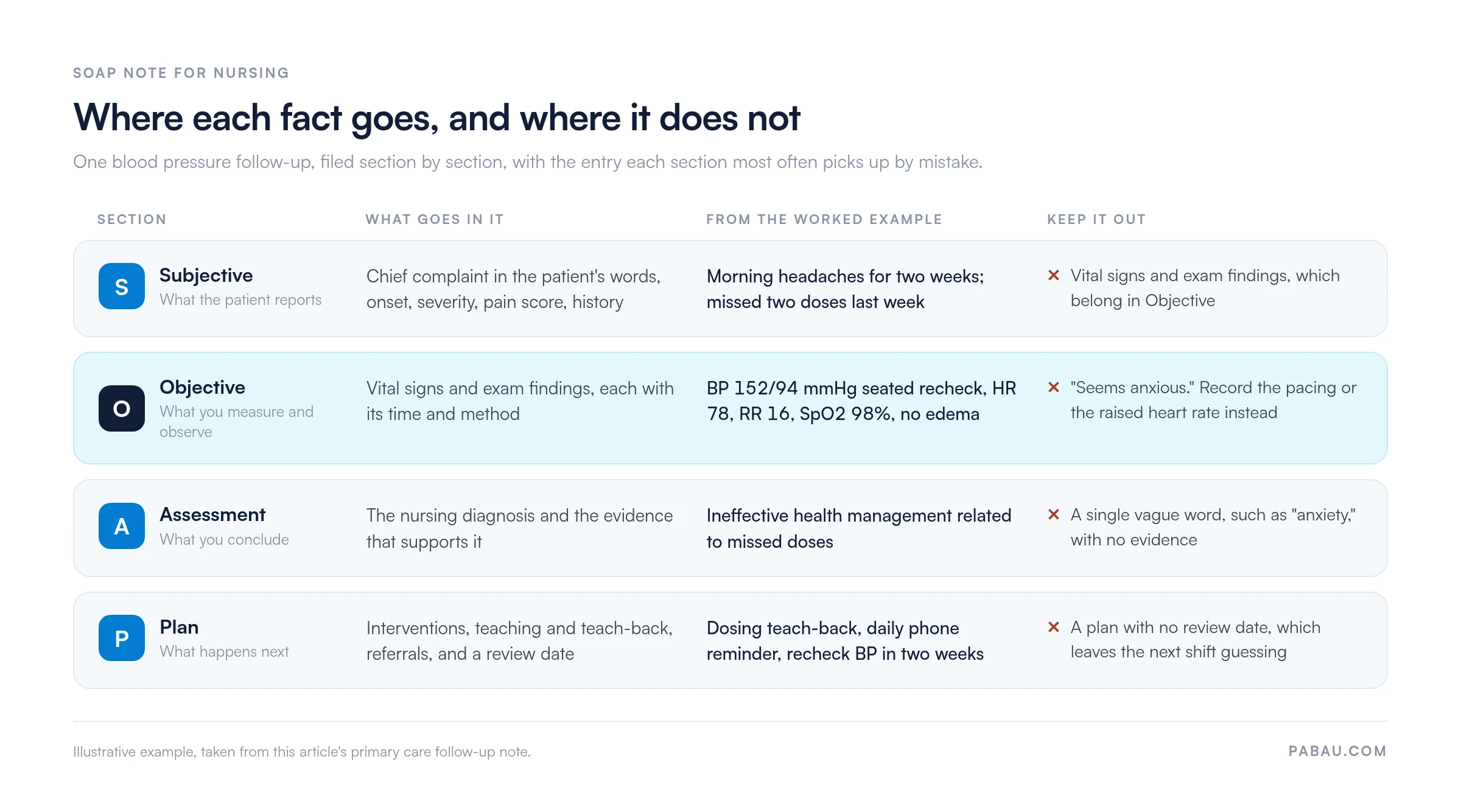
Each section answers one question. The subjective records what he said, and the objective records what was measured. The assessment links the two, and the plan says what happens before the next visit.
The diagram files the same visit section by section, next to the entry each section most often picks up by mistake.
To see the format applied outside nursing, these SOAP notes examples cover several other specialties.
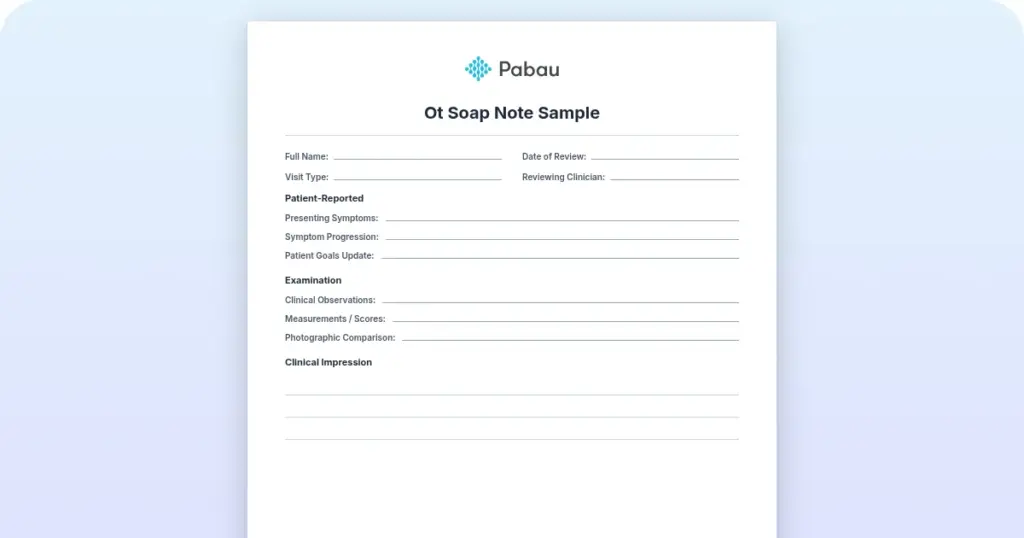
The free template gives you a one-page form built on the same four sections. It is a blank structure, so you write every entry in your own words.
The form is titled for mental health encounters, but the four sections are the same for nursing. Check the wording against your facility’s documentation policy before you use it.
SOAP is not the only structure nurses use. Your facility may ask for a different format depending on the setting and the purpose of the note.
Use the format your facility’s policy names. If you hand off a patient verbally, an SBAR nursing handoff often sits alongside the written SOAP note.
When the note covers a single event, a DAR notes template keeps the data, action, and response together. Units that chart against a care plan often use a PIE nursing chart instead.
Most errors in nursing SOAP notes come from putting a fact in the wrong section or leaving a section incomplete. These six cause the most trouble at handoff or audit.
Paper SOAP notes get filed in one place while the rest of the patient history sits somewhere else. The next nurse then searches two systems before a handoff, and an auditor has to match them by hand.
Pabau keeps each note in the patient record, next to appointments, forms, and treatment history. Pabau’s digital forms can turn a SOAP layout into a structured form that saves straight to that record.
Pabau Scribe, our AI scribe, can also draft notes from the consultation for the clinician to review. The nurse still checks and signs every entry, but the typing load drops.

Book a demo to see how SOAP notes sit alongside appointments, forms, and patient history in Pabau.

A SOAP note for nursing works when each section does one job. Keep facts and interpretation apart, and the next nurse can trust what you wrote.
Start with the template and use the same order every shift. Give every plan a review date, because that is the line the next reader acts on.
Book a demo to see how Pabau keeps every SOAP note on the patient record your team already uses.

Need more worked examples? SOAP notes examples shows the format across several specialties.
Handing off at the end of a shift? SBAR nursing handoff template structures the verbal report that goes with your notes.
Prefer a free-text format? Nursing narrative note template covers when a narrative entry fits better than SOAP.
Discharging a patient? Nursing discharge note lists what the final nursing record must include.
Tracking a patient over several visits? SOAP progress notes template gives you the same four sections for follow-up entries.
A SOAP note for nursing is a structured record of a patient encounter in four sections: subjective, objective, assessment, and plan. It separates what the patient reports from what the nurse measures and concludes.
Subjective data comes from the patient or family, such as symptoms and pain scores. Objective data is what you measure or observe, such as vital signs and exam findings.
The assessment states the nursing diagnosis and the reasoning behind it. Many teams use NANDA International labels so every reader sees the same wording.
SOAPIE adds two sections to SOAP: intervention and evaluation. It records what was done and how the patient responded in the same note.
Yes. The form uses the standard four SOAP sections with patient details and a signature line. It is titled for mental health, so adapt the wording to your facility’s policy.