Maja Popovska

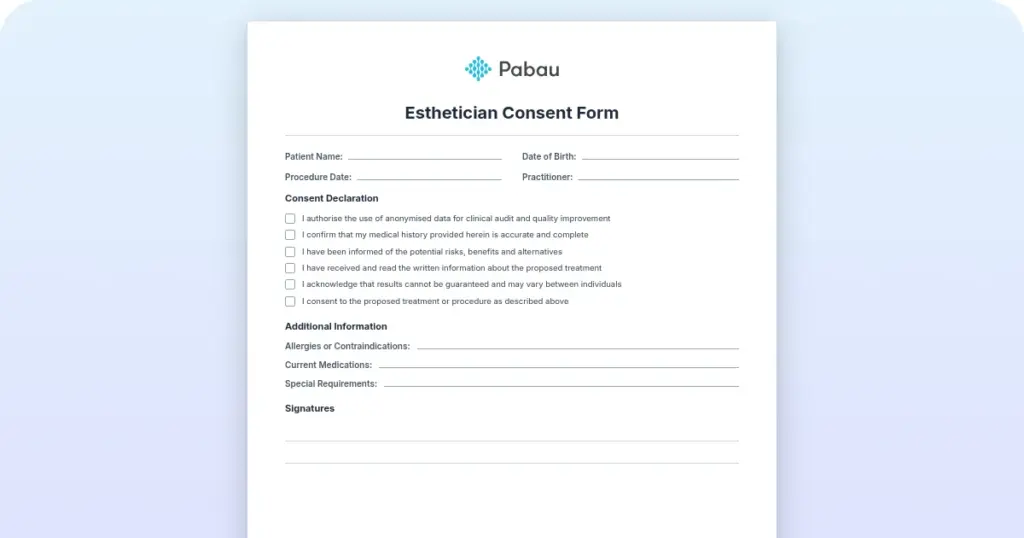
Cytocare consent form
Cytocare is a hyaluronic acid-based mesotherapy skin booster from Revitacare, in...

1
Last Updated: Oct 27, 2026
Free PDF 5 pages, print-ready Clinician-reviewed
A neuro check form is a structured clinical tool that records a patient's neurological status at a single check. It covers consciousness, pupils, cranial nerves, reflexes, motor and sensory function, and vital signs. Nurses complete a new form at each interval their protocol sets. Filed in order, the forms show early changes, such as a falling Glasgow Coma Scale (GCS) score or unequal pupils. A consistent template means every shift records the same findings in the same order, which makes trends easier to see.
This free neuro check form is a printable PDF you can adapt to your ward or practice protocol. It supports documentation and never replaces clinical judgment or your facility's own assessment policy.
A ready-to-use neurological assessment covering level of consciousness, GCS, pupil response, cranial nerves, motor, sensory and cerebellar function, reflexes and vital signs. It records the date and time of assessment.
Start from scratch, or upload this PDF or any form you already use, and Pabau's AI Form rebuilds it with tick boxes, text fields and a signature. Attach it to the treatment once, and every patient gets it on time.
AI Form rebuilds the consent, history and aftercare forms you already use. You review each one, then publish.
Patients complete forms on their phone before they arrive, so the front desk stops retyping paper.
Every signed form is versioned and attached to the treatment record, ready when you need it.
Set how long a consent stays valid. Returning patients skip forms they have already signed.
Supports HIPAA and GDPR compliance AES-256 encryption 4.8 on G2 4.7 on Capterra Trusted by 4,000+ practices worldwide

A neuro check form standardizes how consciousness, pupils, motor function and vital signs are recorded at every check.
GCS is scored across eye (1–4), verbal (1–5) and motor (1–6) responses, giving a total between 3 and 15.
Charting each subscore and pupil reactivity shows which response changed, which a total alone hides.
Post-fall check frequency and escalation triggers follow your facility protocol, not a fixed universal timeline.
Pabau, the practice software we build, files each completed check in one patient record, so every shift reviews the same trend.
A neuro check form is a standardized clinical document that captures a patient’s neurological status at one point in time. It records the findings that show whether the nervous system is functioning as expected. A new form at each interval your protocol sets lets changes be detected and escalated.
The form creates a consistent baseline, and a set of completed forms becomes a running record. Two nurses assessing the same patient an hour apart should record findings in the same structure. A change is then visible rather than buried in free text.
The form helps any team that must show a patient has stayed stable, or exactly when they changed. These settings use it most.
A fixed structure reduces the chance that a subtle change goes unrecorded. When every field is present, a missing pupil check or an unscored GCS is visible at a glance.
Standard documentation also supports audit and handover. A series of completed forms, filed in time order, shows the direction of travel. That tells the next nurse more than a single reading.
A complete form covers the domains that together describe neurological function. The table below sets out each section and what it captures.
Head injury guidance sets a useful floor. The NICE head injury guideline (NG232) lists GCS, pupil size and reactivity, and limb movements as minimum neurological observations. It adds respiratory rate, heart rate, blood pressure, temperature and blood oxygen saturation.
The GCS scores eye opening, verbal response and motor response, with a combined total from 3 (deep unconsciousness) to 15 (fully awake). Record each subscore so a change in one component is not hidden by the total.
The table below shows each subscore, using the response terms from the Glasgow Coma Scale’s official site. Score the best response you see in each column.
Write the result in component form, such as E3 V4 M5 = 12, rather than the total alone. Where a component can’t be tested, record it as not testable (NT) under your local convention. Intubation, for example, rules out a verbal score.
Some teams also record the GCS-P, which combines the GCS with pupil reactivity. You subtract a pupil reactivity score from the GCS total. That score is 0 when both pupils react to light, 1 when one is unreactive, and 2 when both are.
Pupil checks document size in millimeters, whether the pupils are equal, and how each reacts to light. Many nurses use PERRLA (pupils equal, round, reactive to light and accommodation) as shorthand. Spell out any finding that is unequal or sluggish. A pupil dilation chart held beside the eye keeps size estimates consistent between nurses.
Level of consciousness is often captured with AVPU, which sorts the patient into Alert, responds to Voice, responds to Pain, or Unresponsive. Orientation to person, place and time sits alongside it, so confusion can be recorded as a specific finding rather than a general impression.
Our template has no separate orientation line. Orientation shows in the GCS verbal score, where “Oriented” scores 5, and any detail goes under Other observations.
Record limb strength and grip on both sides, and note any drift or weakness. Sensory checks follow the same side-to-side logic, so an asymmetry is easy to spot on the next round.
Our printable form goes further than a basic bedside check, so you can use one document for a fuller neurological exam. Alongside vital signs, consciousness and GCS, it includes these sections.
You won’t need every section on every round. Hourly checks usually cover GCS, pupils, limbs and vitals, while the full exam suits admission or a change in status. If the cranial nerve lines are new to you, our cranial nerve assessment checklist covers the bedside technique for each nerve.
Complete one form per check, in one sitting where possible, so findings are recorded close to the time of assessment. Follow the same sequence every time, so findings are comparable across shifts.
File each completed form in the patient record in time order. The next clinician then sees the trend as well as the latest reading. Where a finding changes, record what changed and what action was taken.
These two illustrative checks were each recorded on their own form, then read side by side. The patient and figures are invented for teaching.
Read on its own, the 14:30 total of 13 says little. Next to the 14:00 form, it shows a two-point drop, a new pupil difference and new one-sided weakness. That combination is what the form exists to catch.
Most charting errors on a neuro check form come from shortcuts taken under time pressure. Watch for these.
Escalate any sign of neurological deterioration under your facility protocol, which sets the exact thresholds and who you call. The findings below are common triggers in published guidance.
NG232 also advises having a second competent colleague confirm a deterioration before calling the supervising physician, if that can happen immediately. If it can’t, call without waiting. Record both the confirmation and the call on the form.
Neuro checks are used wherever the nervous system is at risk of change. The scenarios below are the most common reasons a clinician opens the form.
After a fall, the neuro check form records whether the patient’s neurological status is stable. The form is the record. The frequency and escalation thresholds come from your facility protocol.
The first form after a fall carries extra context that later forms depend on. Record these details alongside the usual fields.
That last point matters most in long-term care. A resident with dementia may never be fully oriented, so “confused” on its own isn’t a change. Compare each finding with the resident’s known normal, and record that normal on the first form.
Frequency is set by facility policy, not by a single universal timeline. Many protocols check most often in the first hour, then space checks out if the patient stays stable. Use the schedule your organization has approved.
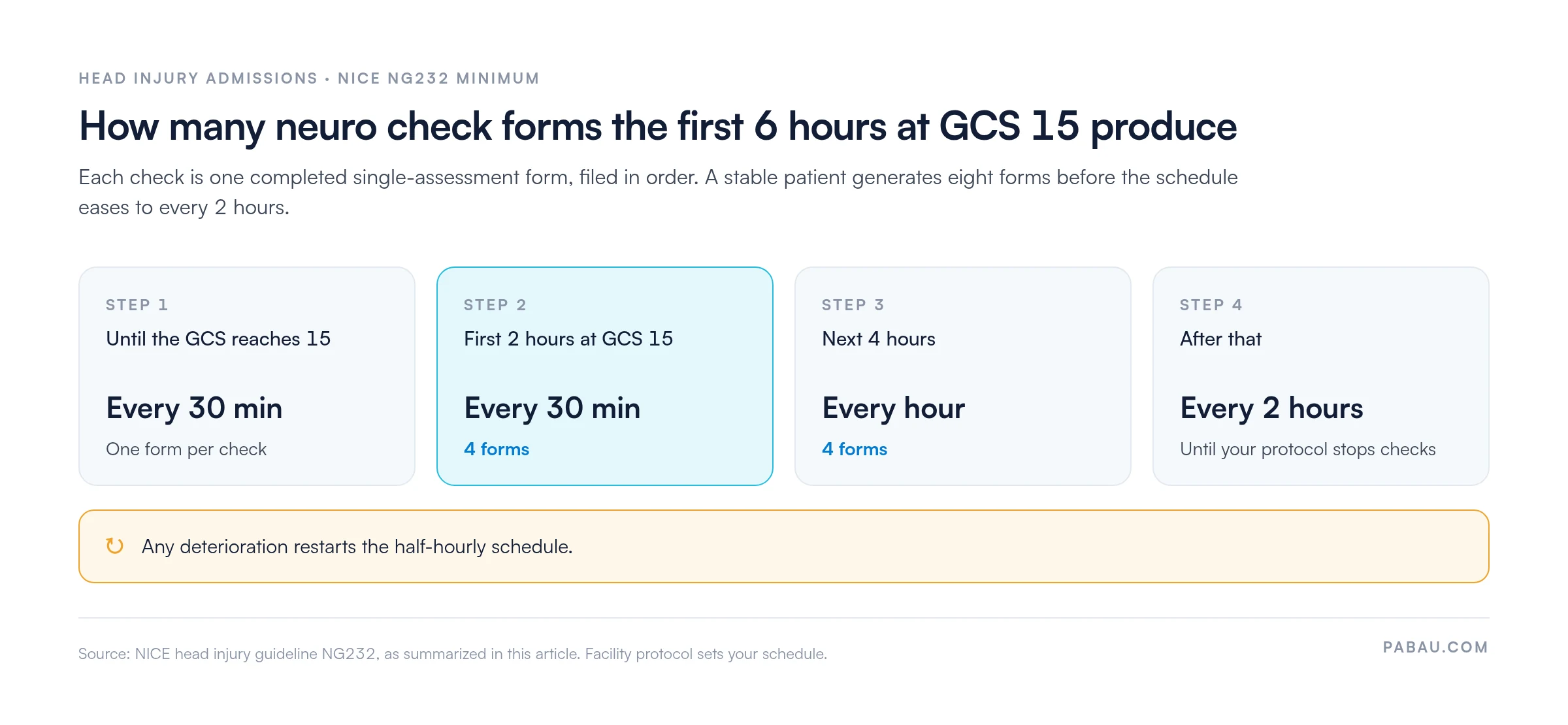
For patients admitted after a head injury, NG232 gives one published example. Observations run half-hourly until the GCS reaches 15. From there, the minimum is half-hourly for 2 hours, hourly for 4 hours, then every 2 hours. Any deterioration restarts the half-hourly schedule. Because our template records one check per form, that schedule also tells you how many forms to expect.
Stroke pathways use dedicated scales, and a neuro check form does not replace them. Its role is to capture the bedside observations that sit alongside a formal stroke assessment, such as GCS, pupils and limb function.
The National Institutes of Health Stroke Scale (NIHSS) and FAST indicators are separate tools with their own scoring rules. Use them as set out in your stroke protocol, and record the scale name and score on the form when you use it. An NIHSS score sheet captures all 11 scored items on one page.
Our template’s stroke section prompts balance, eyes, face, arm and speech findings, with a findings box beneath. The PDF heads it NIHSS, but those prompts follow a quick BE-FAST style screen rather than the full scale. Time-stamp the first abnormal finding clearly, because stroke teams work from the time symptoms were first noticed.
A neuro check form captures one assessment at one point in time, while a flow sheet records repeated observations across a shift or admission. Both document the same domains, but they serve different purposes. Our template is the single-check kind, so a series of checks means a series of completed forms filed in order.
Paper forms are easy to start with, but they are hard to search and easy to misplace. Comparing tonight’s check with this morning’s often means finding the right sheet in a stack of handover notes.
Pabau’s digital forms let teams complete structured assessments on a tablet or computer, with the same fields every time. Each completed check sits in the patient record, so the trend across checks is visible in one place.
The next clinician can review the full sequence before they assess, and you have a tidy record when an audit comes around.

See how Pabau keeps completed neuro checks, vital signs and follow-up notes in the patient record, so every shift can review the same history.

A neuro check is only as useful as the entry before it. Pick one form, agree on the fields with your team, and use it at every check. That turns a series of scores into a trend someone can act on.
The trade-off is time. Subscores, pupil sizes and a recorded action take longer than “GCS 14, PERRLA”. Those extra seconds are what let the next nurse see a two-point drop in the middle of the night.
Once the form works on paper, moving it into a shared digital record keeps that trend in one place for every shift. Book a demo to see how Pabau stores neuro checks and assessments in one patient record your whole team can review.

Need a fuller charting reference? Neuro assessment documentation guide covers what to chart at each stage of a neurological exam, with a free checklist.
Measuring pupils at the bedside? Nursing pupil dilation chart helps you record pupil size the same way on every check.
Running a formal stroke score? NIHSS score sheet template gives you a ready sheet for recording the NIH Stroke Scale.
Planning care after a stroke? Stroke nursing care plan sets out NANDA diagnoses and interventions for stroke patients.
Tracking vitals alongside neuro checks? Vital signs record template keeps timed readings in one log your team can share.
Answers below reflect general clinical practice. Always follow your facility protocol.
A neuro check form is a standardized template for recording one neurological check. It covers consciousness, GCS, pupils, motor and sensory function, and vital signs. A new form is completed at each interval your protocol sets.
A full neurological assessment is a comprehensive exam by a qualified clinician, while a neuro check form is a focused monitoring record. The form supports the assessment but does not replace it.
Scope varies by jurisdiction, role and facility policy. Confirm which neuro checks your role may perform and when to escalate.
Frequency follows your facility protocol, which often uses closer checks early and spaces them out if the patient is stable.
The GCS scores eye opening from 1 to 4, verbal response from 1 to 5, and motor response from 1 to 6. The three subscores add up to a total between 3 and 15.
PERRLA stands for pupils equal, round, reactive to light and accommodation. Use it only after checking each pupil, and spell out any finding that is unequal or sluggish.