Anja Dodevska

MRC dyspnea scale (mMRC): Grades, GOLD cutoff and free PDF
What the MRC dyspnea scale measures and where it came from The MRC dyspnea scale...

1
Last Updated: Nov 5, 2026
Free PDF 4 pages, print-ready Clinician-reviewed
An OT SOAP note sample is a completed occupational therapy session note, written in subjective, objective, assessment, and plan sections. It shows how much detail each section needs, and how to tie every measurement to a daily task such as dressing or meal preparation. This free template adds a seven-step assist scale, today, previous, and goal columns, and a worked sample note. What follows explains each section, gives short examples by setting, and turns the sample's minutes into Medicare billing units.
A four-page form with an identifying header, subjective fields, occupation and impairment tables, assessment, and plan. It closes with a completed sample note you can adapt.
Start from scratch, or upload this PDF or any form you already use, and Pabau's AI Form rebuilds it with tick boxes, text fields and a signature. Attach it to the treatment once, and every patient gets it on time.
AI Form rebuilds the consent, history and aftercare forms you already use. You review each one, then publish.
Patients complete forms on their phone before they arrive, so the front desk stops retyping paper.
Every signed form is versioned and attached to the treatment record, ready when you need it.
Set how long a consent stays valid. Returning patients skip forms they have already signed.
Supports HIPAA and GDPR compliance AES-256 encryption 4.8 on G2 4.7 on Capterra Trusted by 4,000+ practices worldwide

An OT SOAP note sample models the four parts of a session note.
Objective entries need measurable data, such as range of motion and standardized scores.
Assessment links observations to functional goals and justifies continued skilled services.
Under Medicare’s 8-minute rule, the timed minutes recorded in the note decide how many units you can bill.
Pabau, the practice software we build, keeps SOAP notes, digital forms, and scheduling on one patient record.
An OT SOAP note sample is a session record that separates what the patient reports from what the therapist measures and decides. SOAP stands for subjective, objective, assessment, and plan, and each heading answers a different question about the session.
Physical therapists, speech therapists, and nurses write under the same four headings. What makes the OT version different is the content under them.
Open the PDF, complete the header, then write one SOAP entry per session before you close the record. The template covers what makes a note occupational and includes a sample note, so read the OT SOAP note sample once before your first entry.
Store completed notes in a system that supports HIPAA compliance. A template does not make a practice compliant on its own, so check your platform and policies against HHS guidance on HIPAA.
The OT SOAP note sample suits any occupational therapist or assistant who documents skilled sessions for a payer, a supervisor, or the next clinician. It is most useful in these settings:
The form puts today’s, previous, and goal values side by side. That layout also helps a covering therapist pick up a caseload partway through an episode of care.
An OT note ties every measure to the occupation it limits. A note that records only degrees and strength grades reads as a physical therapy note, and a reviewer will read it that way. Our PT SOAP note shows that impairment-led layout for comparison.
The template builds that link into its structure. The objective section starts with occupations, such as dressing, grooming, feeding, toileting, meal preparation, and functional transfers. Impairment measures come second, as the reason a task is hard.
Try one check before you sign. Read the assessment without the occupation names in it. If it still makes complete sense, it describes a joint or a muscle. Rewrite it around the task the patient is trying to do.
Record how the patient and any caregiver describe performance in daily occupations, what gets in the way, and what matters most to them. Quote the patient where a phrase captures the goal, such as “I want to wash my own hair.”
The template adds four quick fields: the patient-stated goal, home program adherence, pain from 0 to 10, and fatigue from 0 to 10. Adherence matters because it helps explain progress, or the lack of it, in the assessment.
For each occupation, note the assist level, any adaptation used, and today’s performance. The template uses a seven-step assist scale that runs from independent to dependent:
Impairment measures follow, each recorded as today, previous, and goal. The form covers grip strength, pinch strength, active range of motion, a coordination test, and a standardized outcome measure. The Canadian Occupational Performance Measure is one OT-specific option for that last row.
Close the section with the interventions delivered, treatment time in minutes, billing units, and any equipment issued.
The assessment is your clinical reasoning. State whether the patient is progressing toward each goal, which change in impairment explains it, and why skilled OT is still needed. A payer reads this section to decide whether the next visit is medically necessary. Where goals are individualized, a goal attainment scale turns that progress into a score.
List the frequency and duration, the focus of the next session, home program changes, equipment, and the re-assessment date. Write the next step clearly enough that a covering therapist could run the session from it.
The PDF closes with a completed note for an adult patient after surgery, with limited right shoulder flexion. Here is that sample, section by section.
S: The patient reports she put on her own socks twice this week using the sock aid, the first time since her surgery. She rates shoulder pain at 4 out of 10 when reaching overhead and still needs help washing her hair.
O: Lower body dressing is at modified independence with a sock aid and long-handled reacher, up from minimal assist on April 2. Upper body dressing is independent. Grooming is at supervision level for hair washing, because active right shoulder flexion measures 118 degrees, up from 105.
She completed a simulated meal preparation task, retrieving items from a counter-height shelf, with modified independence in 11 minutes. The session included 25 minutes of therapeutic activity and 20 minutes of self-care retraining.
A: The patient has moved from minimal assist to modified independence in lower body dressing, meeting her short-term goal two weeks early. Shoulder flexion gains now carry over into overhead reach during grooming, though hair washing remains limited. She has built the sock aid into her daily routine, which suggests good carryover.
P: Continue twice weekly for three weeks. Next session, trial a long-handled sponge and a handheld shower head for hair washing. Progress overhead reaching to shoulder-height shelf retrieval. Re-assessment is due April 30, and the home program has been updated and reviewed with the patient.
Each impairment figure in the sample is reported against a task. The 118 degrees of shoulder flexion matters because it explains why hair washing still needs supervision.
The four sections stay the same in every OT setting, but the occupations change. These short illustrative entries show the objective and assessment lines, where the difference is clearest.
O: Child fastened three of five shirt buttons independently and needed verbal cues for the last two. Held a tripod grasp for four minutes during a drawing task. A: Fine motor endurance is improving, which supports the parent’s goal of the child dressing for school without help.
O: Student copied a four-line sentence from the board in six minutes, using a slant board and pencil grip. Letters stayed within the lines on most attempts. A: Legibility now meets the classroom goal, so sessions can move on to keyboarding and written output speed.
O: Right grip strength is 14 kg, up from 9 kg two weeks ago. Opened a jar lid using an adaptive gripper. A: Strength gains are carrying over to kitchen tasks. Return to work as a mechanic depends on sustained grip, so graded strengthening continues.
O: Patient planned and cooked a simple meal in a group kitchen session, with two verbal prompts for sequencing. Followed a written weekly routine on four of seven days. A: Executive function for daily routines is improving, which supports the goal of living independently after discharge.
Medicare sets the strictest baseline for outpatient OT notes, and many commercial payers follow its lead. The rules sit in section 220.3 of the Medicare Benefit Policy Manual, chapter 15.
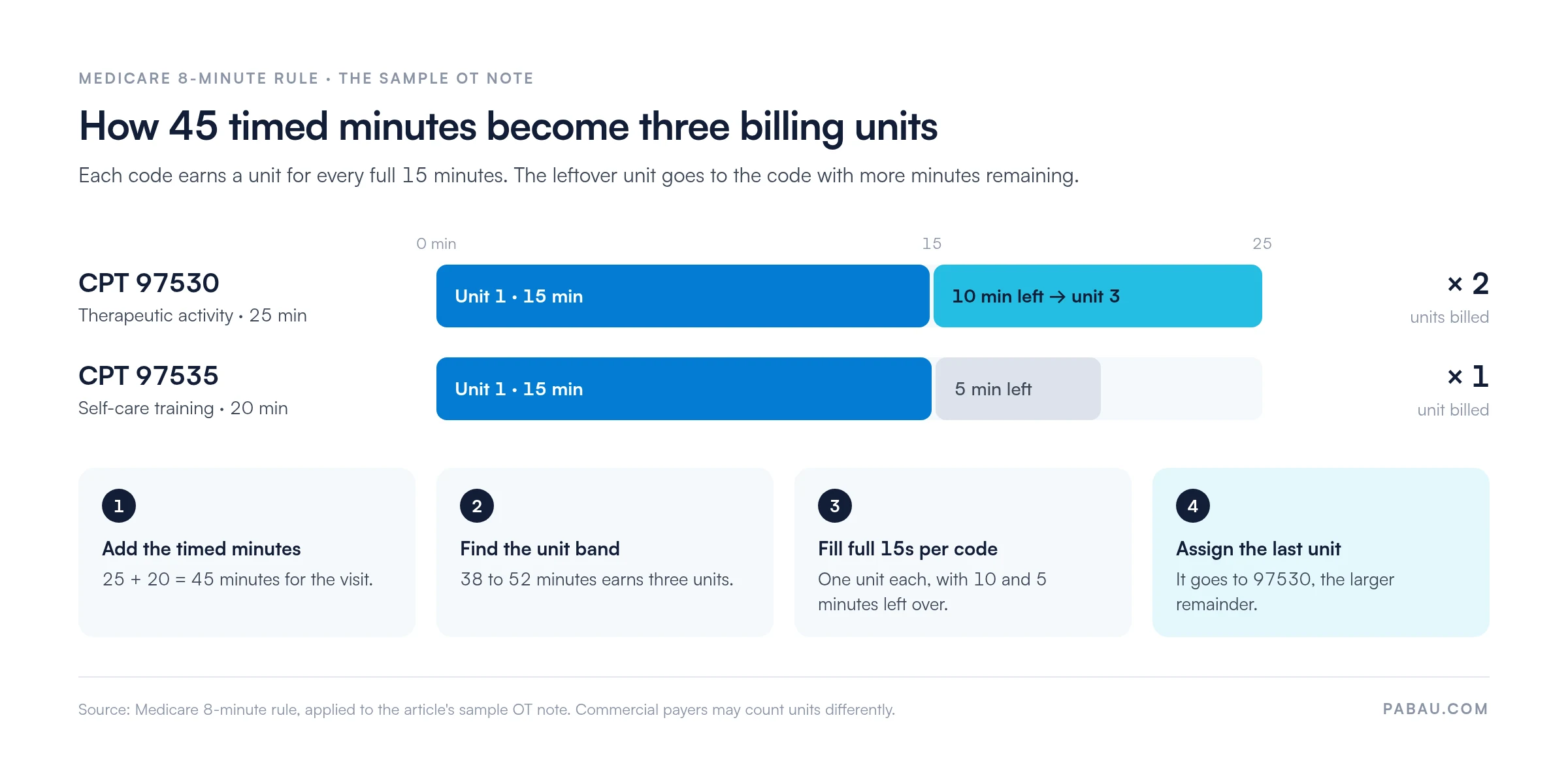
Medicare converts timed minutes into units under the 8-minute rule. It adds up the timed minutes for the visit, and a total of 38 to 52 minutes earns three units.
In the sample note, 25 minutes of therapeutic activity (CPT 97530) and 20 minutes of self-care training (CPT 97535) total 45 minutes. Each code first earns one unit for a full 15 minutes, which leaves 10 and 5 minutes over.
The third unit goes to the code with more minutes left, so the claim shows 97530 × 2 and 97535 × 1. The chart traces that split, step by step.
Commercial payers may count units differently, so check the contract before you fill in the billing units field.
Paper OT notes and PDFs saved to a shared drive drift away from the rest of the record. A covering therapist then has to find last week’s grip strength before the session can start.
Pabau works as an EMR for rehab practices, so each note sits in the patient record beside appointments, forms, and treatment history. Its digital forms can turn this SOAP layout into a structured form. Today’s, previous, and goal values then sit in the same fields at every visit.
Pabau Scribe, our AI scribe, can draft the note from the session for the therapist to review and sign. Clinical judgment stays with the therapist, and less of the typing spills into the evening.

Book a demo to see how Pabau keeps SOAP notes beside appointments, forms, and treatment history for each patient.

An OT SOAP note earns the next visit when the assessment explains a change in function. Report the task first and the impairment second, and the reasoning follows.
Keep the assist scale and the today, previous, and goal columns consistent from visit to visit, and record timed minutes every time. Progress then shows on the page, and the billed units hold up to review.
Book a demo to see how Pabau keeps each OT note on the patient record your team already uses.

Want a form with prompts in every section? SOAP notes for physical therapy covers pain, functional limits, goals, and home exercise in one note.
Choosing an EMR for your OT caseload? Occupational therapy EMR walks through the features and compliance checks that matter for OT documentation.
Comparing practice software for OT? Best occupational therapy practice management software ranks the platforms OT practices use for notes, scheduling, and billing.
Supervising PTAs or students? Physical therapy documentation cheat sheet lists what every note needs, from evaluation through discharge.
An OT SOAP note is an occupational therapy session record in four sections: subjective, objective, assessment, and plan. It links each measurement to a daily occupation, such as dressing or feeding.
Both use the same four sections. An OT note reports performance in occupations, such as dressing or meal preparation, and explains how each impairment limits that task. A PT note centers on mobility and the impairment itself.
Yes. An occupational therapy assistant can write daily treatment notes within the supervising therapist’s plan of care. Under Medicare, the supervising therapist stays responsible for the plan of care and the progress reports. Your state practice act sets the supervision details.
Medicare requires a progress report at least once every 10 treatment days. The plan of care must also be recertified at least every 90 days.
A good assessment states progress toward a functional goal and the finding that explains it. The sample note does this when it reports a move from minimal assist to modified independence in lower body dressing.
Yes. The PDF is free to download and adapt. Follow AOTA documentation guidance, your state practice act, and your payer’s requirements when you adapt it.