Despina Petrushevska

Operative note: Required elements, templates and CMS rules
An operative note is the surgeon’s signed record of an operation, covering...

Last Updated: Nov 12, 2026
Free PDF 2 pages, print-ready Clinician-reviewed
A 7 day gout diet plan pdf is a two-page printable for documenting low-purine dietary advice for gout. Dietitians, nutritionists and primary care teams use it to give every patient the same structure. It lists the foods to limit and the foods patients can eat freely. It also sets out a full week of meals and a daily tracker for water, alcohol and joint pain. A final section covers what to do during a flare. Diet supports gout care but does not replace urate-lowering medication, so the plan records advice alongside the treatment plan.
A two-page plan with patient fields, foods to limit and eat freely, a seven-day meal plan, a symptom tracker and flare steps. It notes that diet supports, but does not replace, urate-lowering medication.
Start from scratch, or upload this PDF or any form you already use, and Pabau's AI Form rebuilds it with tick boxes, text fields and a signature. Attach it to the treatment once, and every patient gets it on time.
AI Form rebuilds the consent, history and aftercare forms you already use. You review each one, then publish.
Patients complete forms on their phone before they arrive, so the front desk stops retyping paper.
Every signed form is versioned and attached to the treatment record, ready when you need it.
Set how long a consent stays valid. Returning patients skip forms they have already signed.
Supports HIPAA and GDPR compliance AES-256 encryption 4.8 on G2 4.7 on Capterra Trusted by 4,000+ practices worldwide

The 7 day gout diet plan pdf documents low-purine advice, a full week of meals and a daily symptom tracker on two pages.
Diet supports gout management but does not replace prescribed urate-lowering medication.
Organ meats, certain seafood, beer, spirits and fructose-sweetened drinks are what the plan asks patients to limit.
Purine-rich vegetables such as spinach, peas and mushrooms stay on the menu, because they have not been shown to raise flare risk.
Pabau, the practice management platform we build, lets teams file completed plans in the patient record.
The 7 day gout diet plan pdf is a two-page form covering foods to limit, a week of meals and flare guidance. Its limits match the 2020 ACR gout guideline, which conditionally recommends limiting alcohol, purine intake and high-fructose corn syrup for patients with gout.
Print it for the consultation and complete it with the patient. The form is split into seven parts.
Medication decisions stay with the prescribing clinician, so the plan records diet advice alongside the treatment plan rather than in place of it.
Diet can reduce purine intake and limit trigger exposure, but for many patients it does not replace urate-lowering medication. Medication is often required alongside diet, so the two should be planned together.
Weight loss is one area where diet and clinical outcomes overlap. Lower weight is associated with lower uric acid in overweight patients. Rapid weight loss can temporarily raise uric acid, though, so the pace of change should be agreed with the clinician.
DASH-style eating may also help lower uric acid, although the evidence is supportive rather than conclusive. A DASH diet plan sets that pattern out for patients who want to try it.
For background on the condition and its management, see the NHS guidance on gout.
Work through the template in this order at each consultation, so advice builds on the patient’s current situation.
Dietitians, nutritionists, rheumatology teams and primary care clinicians are the main users of this template.
Mixed teams benefit most, because every clinician records the same core points. Consistency also helps when patients see several clinicians, since each one can pick up the same plan rather than starting again.
Standard documentation shows what advice was given and when, which matters at audit and at clinical review.
Patients also get one clear reference instead of scattered leaflets, which makes it easier to follow the plan between visits.
Keep the plan with up-to-date patient records, so the reasoning behind each piece of advice is visible later.
Start each consultation by asking what the patient drinks, not only what they eat. Beer, spirits and fructose-sweetened drinks can all raise uric acid, so record them on the plan alongside food. Agree one swap per week rather than a full diet overhaul, then review it at the next visit. Patients who change one habit at a time are easier to follow up with.
Organ meats, certain seafood, beer, spirits and fructose-sweetened drinks are the items most worth limiting. The plan sorts each food group into what to limit and what patients can eat freely. The restricted side is shorter than many patients expect.
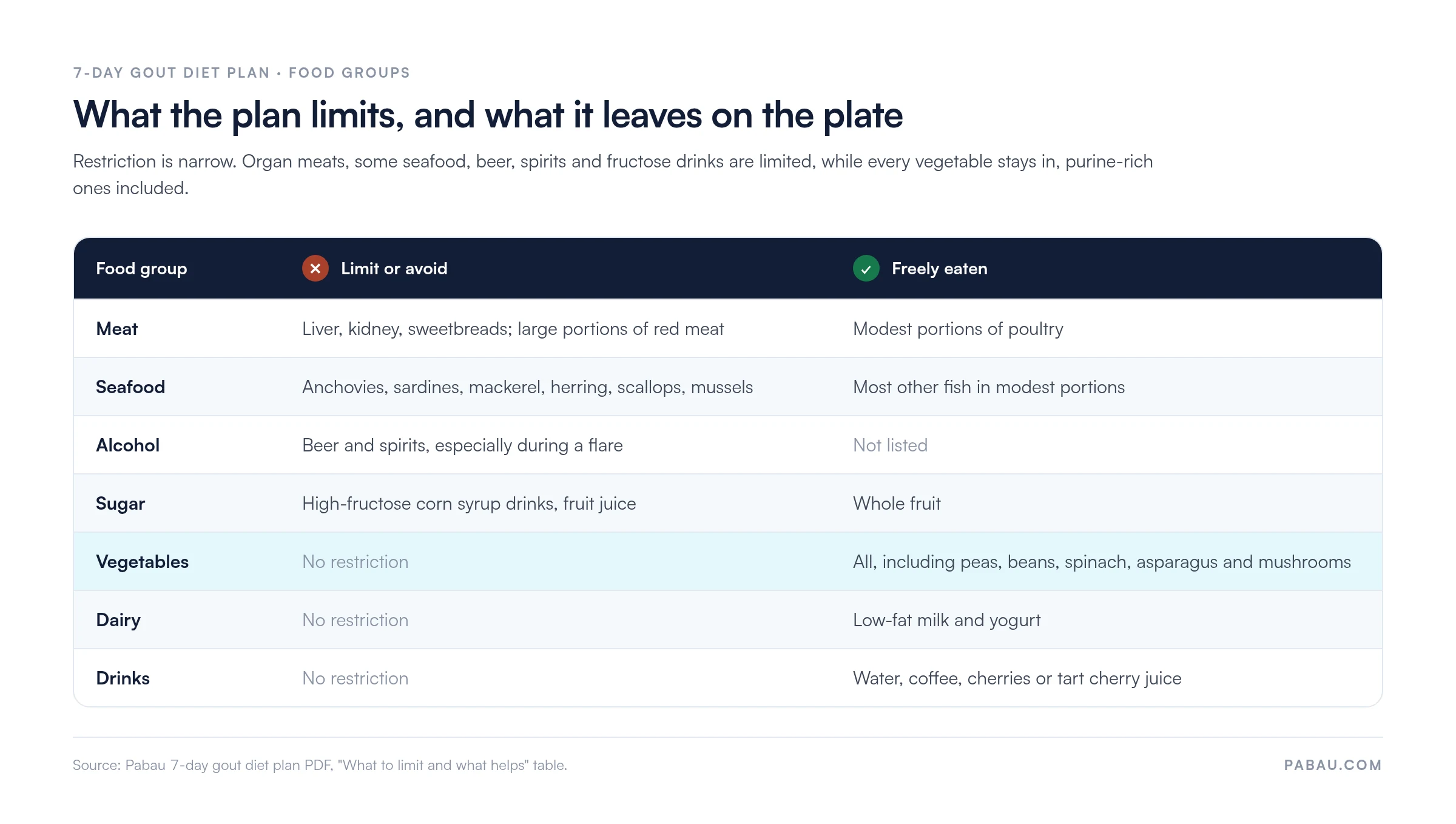
Spinach, asparagus, mushrooms, peas and beans are high in purines, yet the plan leaves them unrestricted. They have not been shown to increase gout attacks, so patients do not need to cut them.
Purine values vary by preparation and portion, so check specific items against USDA FoodData Central before giving written guidance. For a wider list patients can keep at home, the uric acid foods chart groups common foods by purine load.
Consider a patient with a weekend beer habit and a fondness for sardines on toast. The plan lets you flag both on day one, then agree one lower-purine swap the patient commits to, rather than cutting several foods at once.
Some trial evidence links tart cherries with fewer flares, but the evidence is not conclusive. Present cherries as an option, not a treatment.
Staying well hydrated is commonly advised for gout, as dehydration concentrates urate. The plan asks patients to drink enough fluid that their urine stays pale.
Paper diet plans tend to go home with the patient. The next clinician then has no record of which swaps were agreed or how the tracked week went.
Pabau’s digital forms let you rebuild the plan as a form the patient completes on their phone, filed to their record with the consultation note. Practices that run dietitian-led programs on weight loss clinic software can send the same form before every follow-up visit.
Pabau Scribe, our AI medical scribe, drafts the consultation note for the clinician to check. The advice, the tracker and the reasoning then sit on one patient record.
Once your team is ready to keep this documentation inside the patient record, book a demo to see how the workflow runs in Pabau.

See how Pabau’s digital forms and clinical notes keep dietary advice with each patient.

A gout diet plan works when the advice is short, specific and reviewed. Agree one or two swaps from the limit list, leave the vegetables alone, and check the tracker before changing anything else.
The trade-off is time at the first consultation. Filling in the plan with the patient takes longer than handing over a leaflet, but it gives the next clinician a record to build on.
Book a demo to see how Pabau keeps each patient’s diet plan, tracker and consultation note together.

Need a wider purine reference? High uric acid foods chart lists common foods by how much they raise uric acid.
Starting with a full dietary assessment? Nutrition assessment form captures intake, history and goals before you write the plan.
Want patients to log what they eat? My food diary gives patients a simple daily record to bring to review.
Discussing DASH-style eating? DASH diet plan sets out the eating pattern in a printable format.
Looking for a broader anti-inflammatory approach? Anti-inflammatory meal plan covers a week of meals built around plant foods and oily fish.
A 7 day gout diet plan pdf is a printable template that structures low-purine dietary advice for gout across one week. It helps clinicians document what was discussed, what was agreed and what the patient should limit during flares.
No. A gout diet plan supports, but does not replace, prescribed urate-lowering medication. Patients should not stop or change medication based on diet advice alone.
DASH-style eating may help lower uric acid, but the evidence is supportive rather than conclusive. Clinicians can discuss it as part of a wider plan with the patient’s dietitian or prescriber.
Beer is the alcohol most strongly linked to raised uric acid, so it is the first to limit. Spirits also raise uric acid, and fructose-sweetened drinks increase uric acid production, so both should be reduced.