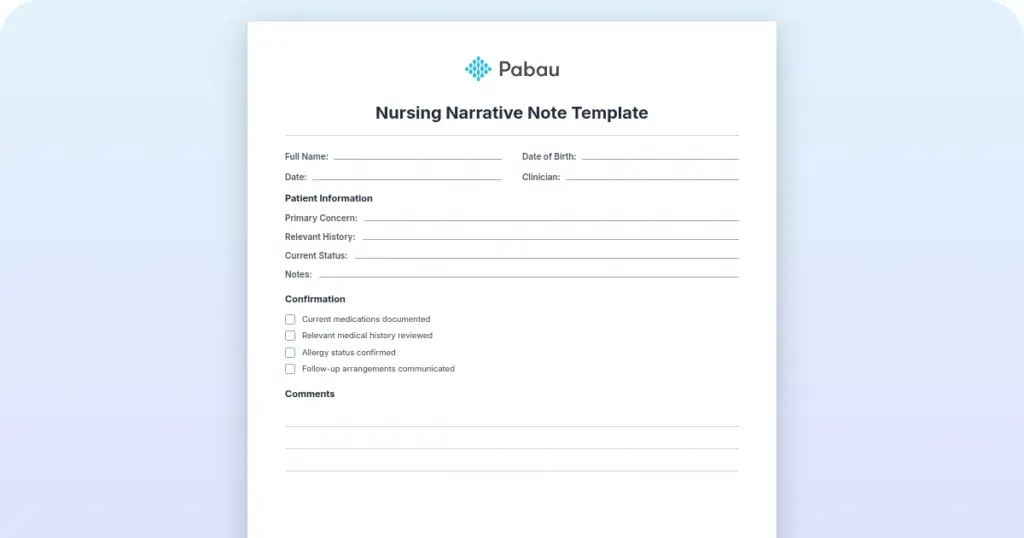
Nursing narrative note template
A nursing narrative note template is a structured PDF that guides you through re...

2
Last Updated: Oct 21, 2026

A shift note is a documented record of patient care and clinical observations made during a work shift. It’s foundational to care continuity.
Structured shift notes using frameworks like SBAR reduce handover errors and improve communication between care team members across shift changes.
Poorly documented shift notes leave patient information incomplete for the next shift and can expose practices to medicolegal liability.
Pabau’s digital forms and automated workflows transform shift documentation from manual templates into real-time, searchable patient records accessible to the entire care team.
A ready-to-use shift note template for documenting patient care during a shift. It covers vital signs, medications given, patient status, incidents, and the handover plan for the next team.
Download templateShift notes are the backbone of safe clinical handovers. When nurses, doctors, and allied health professionals clock out, the shift note passes the patient’s story to the next team. It captures vital signs, medication changes, patient status, incidents, and care goals. A well-documented shift note prevents missed treatments, catches emerging complications early, and protects both patient safety and your practice’s legal standing.
A shift note is a structured documentation record of patient care, clinical observations, and clinical decisions made during a healthcare professional’s work shift. It serves as a handover document – capturing what happened, why it matters, and what the next team needs to know.
Unlike progress notes (which focus on clinical assessment and intervention), shift notes are time-bound summaries that prioritize continuity. They document routine care, medications given, vital signs changes, patient complaints, incidents, and any clinical decisions made during the 8-, 10-, or 12-hour shift.
A complete shift note template includes fixed sections so every team member knows where to find critical information. Structured clinical documentation frameworks like SOAP (Subjective, Objective, Assessment, Plan) and SBAR (Situation, Background, Assessment, Recommendation) ensure nothing is missed.
Patient care workflows differ between day, night, and specialty units. Here are worked examples showing how shift notes adapt to different clinical settings. The chart entry you write alongside the handover follows a different structure. Our nurse note examples compare the SOAP, DAR, and narrative formats.
Patient: Joan M., 72-year-old admitted for pneumonia. Shift: 07:00-15:00.
Joan remained stable throughout the day shift. Vital signs: T 37.2°C, HR 82, BP 128/76, RR 18, O₂ sat 96% on 2L nasal cannula. Completed a course of IV ceftriaxone at 10:30 and oral paracetamol at 14:00 with good tolerance – no nausea or rash. Assisted with personal care and mobility: able to walk to the bathroom with minimal assistance. Appetite fair – took 80% of lunch. Patient expressed concern about her grandchildren’s visit this weekend; nursing support provided. No incidents. Plan: continue IV antibiotics, monitor respiratory status, chest X-ray pending (ordered by Dr Patel – results expected evening shift). Discharge planning underway; social work to assess home care needs tomorrow.
Patient: Michael T., 34-year-old admitted for depression with suicidal ideation. Shift: 21:00-07:00.
Michael slept 4-5 hours, waking at 03:30 with anxiety. Spoke with nursing staff; reassured re: safety plan. Mood stable, no reported suicidal thoughts during night shift. Took sertraline 50mg at 22:00 and zopiclone 5mg at 22:30 as prescribed. No behavioral incidents. Observed sitting alone in common room at 02:00; engaged in supportive conversation. Vital signs stable. Ate light breakfast at 06:30. Psychiatry review scheduled for 10:00 this morning; patient aware and willing to attend. Observations: patient appears to be responding positively to therapeutic milieu – made conversation with another patient during breakfast. No safety concerns overnight.
ICU shift notes carry more monitored data points than any other setting: vital signs, ventilator settings, and drips that change hour to hour. The next team needs every setting adjustment captured, not just the resulting numbers.
Patient: Angela R., 58-year-old with septic shock, mechanically ventilated. Shift: 19:00-07:00.
Angela remained hemodynamically stable on norepinephrine, weaned from 0.15 to 0.08 mcg/kg/min by 05:00 as blood pressure improved. Ventilator settings: SIMV mode, FiO2 reduced from 50% to 40%, PEEP 5, spontaneous breathing trial planned for morning rounds. ABG at 02:00 showed pH 7.36, PaO2 88, PaCO2 42 – acceptable gas exchange. Sedation: propofol infusion at 20 mcg/kg/min, RASS score -2, lightened per sedation vacation protocol at 04:00. Foley catheter output averaged 45mL/hr, adequate for weight. Temperature trended down from 38.9°C to 37.4°C after piperacillin-tazobactam given at 20:00 and 04:00. Central line and arterial line sites clean, dry, intact. No arrhythmias on telemetry. Family updated by phone at 22:00. Plan: continue sedation vacation and SBT trial, repeat lactate at 06:00, ICU attending to reassess extubation readiness on rounds.
Before clocking out, review this checklist to ensure your shift note covers what the next team needs. Keeping this information in a digital patient record ensures the entire care team can access it instantly.
SBAR (Situation, Background, Assessment, Recommendation) is the gold-standard framework endorsed by the Joint Commission and the Institute for Healthcare Improvement for structured clinical communication. Using SBAR in your handover ensures continuity and reduces the risk of miscommunication during care transitions. For a dedicated version of this framework, use our SBAR report template.
Open with the patient’s current status in one or two sentences. This is the snapshot the incoming team needs immediately.
Example: “Mrs. Chen is a 64-year-old admitted this morning with acute appendicitis. She is post-operative (appendectomy at 14:00) and currently stable, alert, and oriented. Pain level 4/10.”
Provide the relevant history: admission reason, past medical history, allergies, current medications, and any special precautions.
Example: “PMHx includes hypertension (controlled on lisinopril) and type 2 diabetes (HbA1c 7.2%). No known drug allergies. Admitted through the emergency department with sudden onset right lower quadrant pain and fever 38.5°C. CT scan confirmed acute appendicitis with early perforation risk.”
Summarize the current clinical picture based on vital signs, observations, and tests.
Example: “Post-operative recovery on track. Vital signs stable (T 36.8°C, HR 84, BP 132/78). Dressing clean and dry. Pain controlled with regular paracetamol and PRN oxycodone. Urine output adequate (350mL since recovery). No signs of post-operative infection or bleeding.”
Be explicit about the plan: what tests are pending, what interventions continue, what the team should watch for, and when to escalate.
Example: “Continue IV fluids, advance diet as tolerated tomorrow morning. Monitor vital signs and dressing. Surgical review tomorrow morning. Escalate immediately if fever >38.5°C, tachycardia >100, or increased abdominal pain. Likely discharge post-op day 3 pending wound inspection.”
Shift notes written on paper or in rushed typed templates often repeat the same preventable errors: incomplete information, illegible handwriting, or missing safety details. Going paperless removes these risks.
Wrong: “Patient had a fall at 16:30. Otherwise stable.”
Right: “Patient had a fall at 16:30 getting out of bed without assistance. Fell on left hip. Assessed for injury: alert, no loss of consciousness, able to move all limbs, pain 6/10 in left hip. Helped back to bed. Incident report filed. Doctor notified; no fracture suspected but X-ray ordered pending radiology review. Fall risk reassessed – bed rails raised, call bell within reach. Observations: patient confused and attempting to mobilize independently despite safety plan. Family to be called with update.”
Wrong: “Patient seems okay today.”
Right: “Vital signs: T 37.8°C, HR 102, BP 138/82, RR 22, O₂ sat 94% on room air. Trending: heart rate and respiratory rate elevated compared to yesterday – patient reports fatigue and mild dyspnea. Monitored closely. No acute distress currently.”
Wrong: “Pt c/o pain in L leg, gave analg., feels OK now. Amb. with walker x3.”
Right: “Patient reports pain 7/10 in left leg. Administered paracetamol 1g orally at 14:00; pain reduced to 4/10 by 14:30. Assisted with ambulation using walker – walked 30 meters three times throughout shift. No complaints of increased pain or swelling.”
Wrong: “Patient in good spirits. Behavior normal.”
Right: “Patient engaged in conversation, laughed while speaking with visitor, ate full meal, initiated mobilization independently. No mood changes or behavioral concerns noted during shift.”
Wrong: “Medication list updated.”
Right: “Medications: administered ceftriaxone IV 1g at 10:00 and 22:00 as prescribed. Patient refused afternoon dose of metformin – reports nausea. Reported to doctor; doctor advised to skip dose and reassess tomorrow. Allergy update: patient reports new reaction to penicillin family – documented in chart and flagged for incoming team.”
Shift notes in regulated mental health and healthcare settings are legal clinical documents. They are discoverable in malpractice litigation, auditable by accreditation bodies, and required by multiple regulatory frameworks.
Shift notes are part of the patient’s medical record and carry the same legal weight as physician progress notes. They can be subpoenaed in court. Poor documentation – vague language, missing information, alterations without timestamps – weakens your defense if a lawsuit arises. Complete, clear, contemporaneous shift notes are your legal protection.
Document in real-time or as soon as possible after care delivery (not at the end of shift from memory). Use objective language – describe what you observed, not your interpretation. Never alter a shift note retroactively without a dated addendum explaining the change. Store notes digitally if possible – paper notes fade, get lost, or are accidentally destroyed.
Manual shift note templates – PDFs printed and filled by hand, or Word documents typed and filed – introduce delays, errors, and missed information. Pabau’s automated workflows route shift documentation tasks to the right clinician at the right time, ensuring shift notes are completed before handover.
Instead of hunting for a template, printing, and filing, clinicians in Pabau document directly into the patient’s digital record using structured digital forms. Every field (vital signs, medications, incidents, next-shift plan) is built-in. Notes are timestamped, electronically signed, and instantly accessible to the incoming team – no waiting for paperwork to be retrieved, no illegible handwriting, no missing information.
The result: safer handovers, faster shift changes, and a permanent audit trail that protects your practice from compliance failures and medicolegal exposure.

Pabau’s digital forms and automated workflows capture every shift note in the patient’s record automatically, so handovers stay accurate without extra paperwork.

Shift notes are the foundation of safe patient handovers and the legal cornerstone of your clinical record. Whether you use the free template above or a digital platform, structure your shift notes the same way. Cover patient status, medications, observations, and the explicit plan for the next team. Clear, complete shift notes prevent errors, protect patient safety, and shield your practice from compliance and medicolegal exposure.
Book a demo with Pabau to see how digital shift note workflows replace manual templates. Every note is captured, signed, and accessible in real time to the whole care team.

Want a deeper legal and compliance breakdown? Nursing documentation principles and legal requirements covers the standards regulators expect from every clinical record, not just the shift note.
Need a dedicated ICU note template? The ICU note template gives a systems-based format for documenting ventilated and hemodynamically monitored patients in more depth.
Need a template for another clinical form? Clinical forms and templates for healthcare practices covers templates for consent, intake, assessment, and handover documentation across all specialties.
A shift note is a documented record of patient care, clinical observations, and clinical decisions made during a healthcare professional’s work shift. It serves as the handover document that communicates patient status, treatments given, pending tasks, and the plan for the next shift.
Write shift notes using a structured framework like SBAR (Situation, Background, Assessment, Recommendation). Document in real time, include vital signs, and record all medications, treatments, and incidents. Clearly state the plan for the next shift. Use specific language, standard abbreviations, and sign the note with your full name and credentials.
Include patient identification, vital signs, and medications administered with responses. Add a status summary, treatments, incidents, fluid intake/output, pain level, fall risk, wound observations, test results, and the plan for the next shift. Always sign with your name, credentials, date, and time.
A shift note is time-bound and summaries what happened during a specific work shift, prioritizing handover communication. A progress note is typically written by a physician and documents the patient’s clinical trajectory, assessment, and plan over a longer time period. Shift notes are routine; progress notes are episodic and more deeply analytical.
Yes. Shift notes are part of the patient’s medical record and are legally discoverable in malpractice litigation and regulatory audits. They carry the same legal weight as physician notes. Complete, clear, contemporaneous shift notes protect you in court; poor documentation weakens your defense.
Use a structured format such as SBAR (Situation, Background, Assessment, Recommendation) or a facility-specific template. Include fixed sections for patient ID, vital signs, medications, patient status, treatments, incidents, and next-shift plan. Ensure the format is consistent across your team so the incoming shift knows where to find critical information.
Yes. The template at the top of this page is a free, downloadable shift note ready to use in your practice. Many electronic health records (EHRs) and practice management platforms also provide built-in shift note templates customizable to your facility’s needs.