HIPAA compliant texting: What you can send patients & how to communicate securely
HIPAA compliant texting is possible when a text holds no protected health inform...

Last Updated: Oct 16, 2026

An end of shift report documents patient status, completed tasks, incidents, and handover details to ensure continuity of care between shifts.
Shift handovers reduce patient safety risks: Poor communication is a leading cause of preventable adverse events in healthcare.
Essential sections include patient updates, task completion logs, outstanding items, incidents, and next-step instructions.
Practice management software like Pabau automates manual shift reports with digital forms and team messaging, creating a searchable audit trail and reducing handoff delays.
A ready-to-use shift handover template covering patient status, task completion, incidents, and next-shift instructions. Download in PDF format and customize for your practice’s workflow.
Download templateAn end of shift report is a formal handover document. It transfers critical patient information, task status, and operational updates from the outgoing shift to the incoming shift. This ensures continuity of care by documenting what has been done, what remains pending, and any incidents the next team must know. A completed review of systems from intake gives the incoming shift the same patient detail this report is built to carry forward.
The primary purpose is straightforward: Prevent information loss during staff transitions. When one healthcare professional hands over to another, misaligned communication can result in missed treatments, duplicated efforts, or overlooked safety concerns. A structured handoff process reduces the risk of missed information and clinical errors. Pairing this handoff with a medical review of systems keeps symptom detail from slipping between shifts.
This template works across healthcare settings, including hospitals, private practices, aesthetic clinics, mental health services, and wellness centers. The format remains consistent: A structured document completed at shift end and reviewed by incoming staff. Nursing teams that need a format built specifically around clinical handoffs can adapt a dedicated nursing shift report instead.
Poor shift handovers rank among the leading causes of preventable adverse events in healthcare. The Joint Commission’s Sentinel Event Alert 58 specifically addresses hand-off communication failures. The stakes are clinical safety, team accountability, and operational efficiency.
For compliance-regulated environments (CQC-registered clinics, HIPAA-covered practices), a documented handover is non-negotiable.
A comprehensive end of shift report captures the full operational and clinical state of the previous shift. Use these core sections as your template framework:
Clinical teams using the SBAR framework (Situation, Background, Assessment, Recommendation) can organize the report around these four pillars. This structure, endorsed by the Institute for Healthcare Improvement, works well for high-acuity handovers.
Completing an end of shift report should take 10-15 minutes, done at shift end before the incoming staff arrives. Here’s the process:
The frequency depends on your setting. Hospital and 24-hour clinics complete a report at every shift change. Appointment-based practices might complete one daily or at end of week.
Here’s a bedside shift report example for a mental health practice using the SBAR structure:
Aesthetic practices and medical spas follow a similar structure but focus on treatment-specific details and client satisfaction:
Shift Date: July 28, 2026 | Shift Time: 1:00 PM-5:30 PM | Clinician: Emma L.
Clients Treated: 5 appointments completed. Hydrafacial (×2), dermal filler consultation and touch-up (×1), microneedling (×1), laser hair removal (×1).
Client Status Notes: Post-Hydrafacial clients advised on retinol avoidance for 48 hours. One filler client showed slight asymmetry in the left cheek; she was informed, and a follow-up is booked for 2 weeks. All clients collected aftercare instructions.
Outstanding Items: One client (Jessica M.) requested a quote for a second round of filler. An email with options was sent, and a response is pending. Retinol cream restocking is needed before tomorrow’s shift (currently low).
Incidents: None. All procedures uneventful. Client feedback positive (5-star ratings from 4 of 5 clients).
Next Shift Priority: Restock retinol. Follow up with Jessica M. if she hasn’t responded by 10 AM. Prepare room 2 for tomorrow’s first appointment (microneedling prep).
Sign-Off: Emma L., 5:35 PM | Received By: Alex R., 5:45 PM
This format ensures client continuity across shifts and builds a searchable archive for compliance audits.
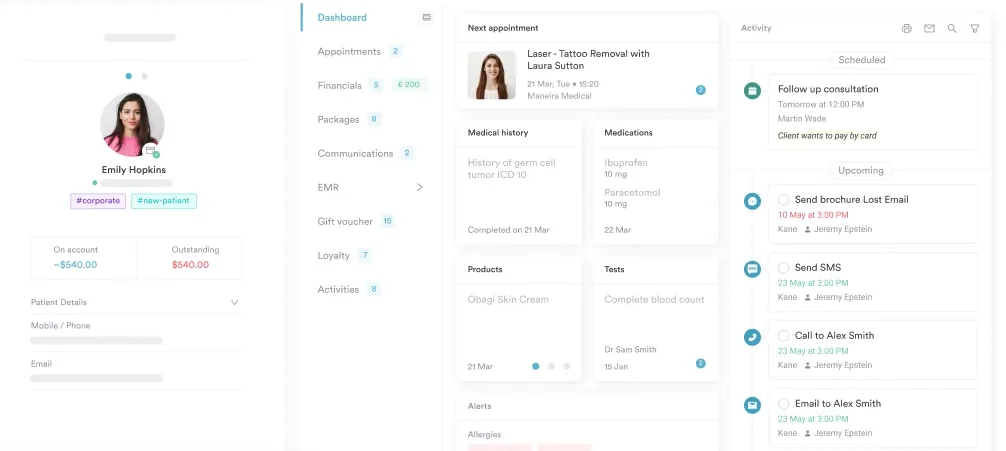
Manual paper or email-based shift reports are slow, prone to loss, and difficult to audit.
Pabau’s team management software allows clinicians to log shift notes and handover details directly into the system. Incoming staff receive instant notifications, can access the full report history, and can acknowledge receipt, with every action tracked automatically for compliance.
The result: Less administrative friction, safer handovers, and a defensible record of what happened during each shift.

Stop using paper end of shift reports. Pabau’s team messaging and digital forms turn manual handovers into structured, searchable records, cutting completion time and boosting compliance.

Treat the shift report as a habit, not paperwork you rush through. Teams that complete it consistently catch problems early and build a record that protects both patients and staff. The only cost is a few minutes at the end of every shift, a small trade for fewer dropped handoffs and cleaner audits.
Download the free template above and adapt it to your team’s workflow. As your practice grows, moving to digital shift reports removes the friction of paper handovers and keeps every transition documented, searchable, and compliant. Book a demo to see how Pabau’s team management tools simplify shift reporting.

Presenting a patient on rounds instead? ICU presentation runs head to toe by organ system in the five parts attendings expect to hear.
Need a framework for handover communication? SBAR example shows the structured tool clinicians use to prevent communication breakdowns at patient handover.
Need aftercare guidance for another treatment? aftercare guidelines template covers post-treatment instructions, activity restrictions, wound care, medication guidance, and follow-up scheduling.
Need the first form new patients complete? patient application form template is the first document a new patient completes when they join your practice.
Need a plan for cardiac patients? atrial fibrillation nursing care plan covers diagnoses like decreased cardiac output and stroke risk, plus interventions for monitoring and medication.
An end of shift report is a formal handover document. It transfers critical patient information, task status, and operational updates from outgoing staff to incoming staff, ensuring continuity of care and preventing missed information.
Patient or client status, completed tasks, outstanding items awaiting the next shift, any incidents or safety concerns, and specific instructions or alerts for incoming staff. The template in this guide provides the exact format.
Follow the SBAR (Situation, Background, Assessment, Recommendation) framework endorsed by the Institute for Healthcare Improvement. Document patient vital signs, condition changes, medications, and clinical recommendations for ongoing care.
According to the Joint Commission, poor shift handovers are a leading cause of preventable adverse events. A documented report ensures critical patient updates reach the next clinician without omission, reducing safety risks and improving accountability.
24-hour operations complete a report at every shift change. Appointment-based practices typically complete one daily or weekly. The frequency depends on your practice’s operating model and regulatory requirements.
Yes. Digital reports are faster to complete, searchable for audits, and automatically archived, making them compliant with HIPAA and GDPR when stored securely. Practice management software with integrated forms automates the process entirely.