The clinical audit cycle: Stages, challenges, and how to complete it
The clinical audit cycle is a repeating process for measuring care against an ag...

Last Updated: Nov 10, 2026
An operative note is the surgeon’s signed record of an operation, covering the technique used, what was found and any tissue removed or altered. Under the CMS surgical services rule, it must be written or dictated immediately following surgery and signed by the surgeon. The Joint Commission sets the same deadline as the moment before the patient moves to the next level of care.
The risk sits in the hour after closing. The surgeon moves to the next case, the dictation waits, and the chart shows no entry between the OR and recovery. A brief operative note fills that hole while the full report catches up, and a tight template keeps the full report from missing fields.

An operative note must be written or dictated immediately after surgery and signed by the surgeon, under 42 CFR §482.51(b)(6).
If the full report can’t go in the chart right away, enter a brief operative note before the patient moves on.
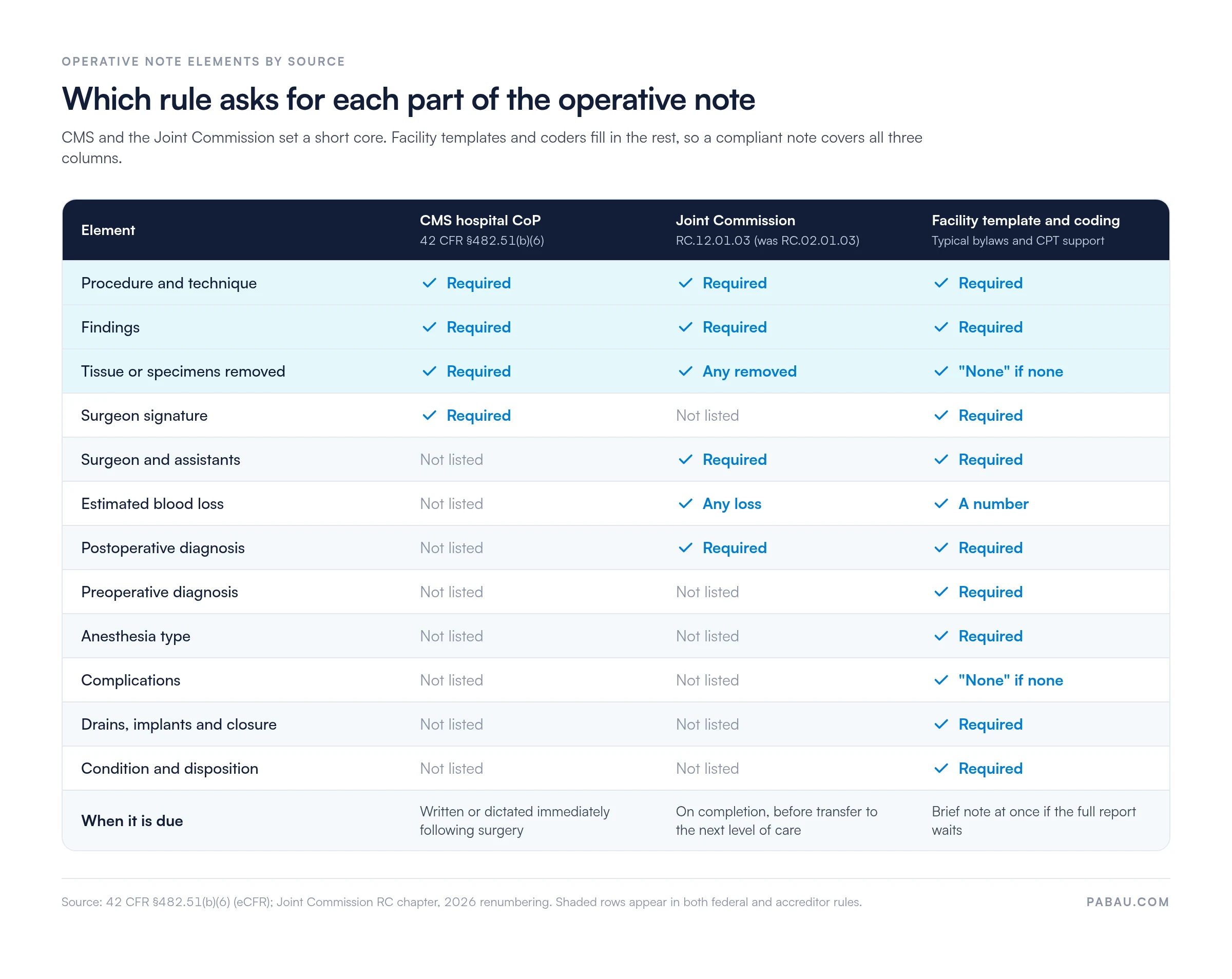
CMS and the Joint Commission require only a core set of elements, so your facility template supplies the rest of the note.
Ambulatory surgery centers follow 42 CFR §416.47, which asks for the findings and techniques plus a pathologist’s report on removed tissue.
Retention periods come from state law, and CMS requires hospitals to keep medical records for at least 5 years.
Vague procedure wording lets coders support only the lowest code, so name the approach, side and any added procedures.
No single rule lists every field. CMS asks for the technique, the findings and any tissue removed or altered. The Joint Commission adds the surgeon and assistants, any estimated blood loss, any specimens and the postoperative diagnosis. Facility bylaws and coders cover the rest, as the matrix below shows.
The cards below map each field your template should carry to its clinical job and the omission that tends to trip it up.
11 fields your operative note template should carry
01Preoperative diagnosis
Clinical purposeClinical justification for the procedure
✕Omission riskMissing or inconsistent with consent form
02Postoperative diagnosis
Clinical purposeUpdated finding after direct visualization
✕Omission riskLeft identical to pre-op when findings differ
03Procedure performed
Clinical purposeExact operation name for CPT code selection
✕Omission riskGeneric description that cannot support the billed code
04Primary surgeon and assistants
Clinical purposeAccountability and credentialing verification
✕Omission riskAssistant surgeon name missing when billing modifier 80, 81, 82 or AS
05Anesthesia type
Clinical purposeClinical record and anesthesia billing support
✕Omission riskOften omitted in outpatient ASC settings
06Intraoperative findings
Clinical purposeSupports postoperative diagnosis and coding
✕Omission riskVague or absent; “unremarkable” without specifics
07Specimens submitted
Clinical purposePathology chain of custody
✕Omission riskLeft blank when no specimen was sent
08Complications or adverse events
Clinical purposePatient safety record and ICD-10 complication coding
✕Omission risk“None” left unstated, so the field reads as skipped
09Estimated blood loss (EBL)
Clinical purposeTransfusion decisions, postoperative monitoring
✕Omission risk“Minimal” written instead of a number in mL
10Drains and closures
Clinical purposeContinuity of postoperative care
✕Omission riskDrain type/location vague or omitted
11Patient condition at conclusion
Clinical purposeTransfer-of-care documentation
✕Omission riskOften missing in notes dictated hours after the case
Write a number for blood loss, such as “approximately 50 mL,” and state “none” when no specimen went to pathology. The Joint Commission’s wording covers “any” blood loss and “any” specimens, but a blank field reads as skipped to a coder or surveyor.
CMS sets the federal rule for Medicare-participating hospitals. Under 42 CFR §482.51(b)(6), a report describing techniques, findings and tissues removed or altered must be written or dictated immediately following surgery. The surgeon then signs it.
The Joint Commission’s operative-report standard for hospitals is RC.12.01.03, numbered RC.02.01.03 until its January 2026 renumbering. It expects the report on completion of the procedure, before the patient is transferred to the next level of care.
When the full report can’t go in the chart right away, a brief operative note goes in first. It gives the next team what they need for safe care while the dictation is transcribed. A brief note usually records:
Skipping it shows up in surveys. In Joint Commission data from May 2024 to May 2025, the brief post-op note requirement drew 151 hospital findings. That made it the third most common record-of-care finding in hospitals.
Much plastic and cosmetic surgery happens outside a hospital, so the hospital rule above may not be the one that applies to you. Ambulatory surgery centers (ASCs) answer to the CMS Conditions for Coverage instead.
The medical records standard is 42 CFR §416.47. Under paragraph (b), every record must be “accurate, legible, and promptly completed.” Paragraph (b)(4) covers the operation itself. The record must hold the “findings and techniques of the operation, including a pathologist’s report on all tissues removed during surgery.” Only tissue the ASC’s governing body has exempted skips that report.
Note what the ASC rule leaves out. It sets no “immediately following surgery” deadline, only that records are promptly completed. The same list asks for anesthesia entries, documented informed consent and a discharge diagnosis, so your ASC template should leave room for all three.
Office-based surgery is different again. Unless the suite is a certified ASC, neither federal rule above covers it, and state medical boards set most of the requirements. Some states also require office surgery suites to be accredited, often depending on the level of anesthesia used.
The main accreditors are AAAASF, AAAHC and The Joint Commission’s ambulatory health care program. Each sets its own documentation standards and updates them on its own schedule. Check your state medical board’s rules and your accreditor’s current manual for the exact operative-report fields and deadline.
Each handoff in this chain is a point where the note can stall. Here’s the usual path in a hospital or surgery center.
Step 3 is where notes tend to sit. A report waiting for a signature holds up the chart and the claim at the same time.
CMS and the Joint Commission specify content, not layout. Facilities usually capture it in one of three ways.
Working through the sections in this order at every closing makes a missing field easier to spot. For smaller cases, our operation notes template gives you a printable starting point.
Here’s sample language for the sections that cause the most coder queries. Adapt the narrative fields to your procedure.
A structured template can fill in the identifiers, surgeon names, anesthesia type and date before the surgeon starts. That leaves the findings and technique, where the clinical judgment sits. If you’re weighing systems for this, our roundup of clinical documentation software compares the options.
Coders select CPT codes from the operative note, not from the scheduling record or the consent form. If the note says “hernia repair” without the approach, side or mesh, the coder can only support the lowest code it describes. That downcoding costs revenue on every vague case.
Payers read the same note when they review a claim. If billed codes keep outrunning what the notes describe, expect record requests and possible repayment. Three habits keep the note and the claim aligned:
Assistant-at-surgery claims lean on the note too. Medicare’s assistant-at-surgery modifiers are 80 (assistant surgeon), 81 (minimum assistant surgeon) and 82 (assistant surgeon when no qualified resident is available). A physician assistant, nurse practitioner or clinical nurse specialist who assists bills with modifier AS instead. It’s the one to know if a PA or NP assists in your office-based cases. Whichever you bill, the note should name the assistant and what they did.
Pabau, the practice management platform we build, runs claims management from the same patient record as the clinical note. Your coder can then check the billed code against the documentation before the claim goes out.
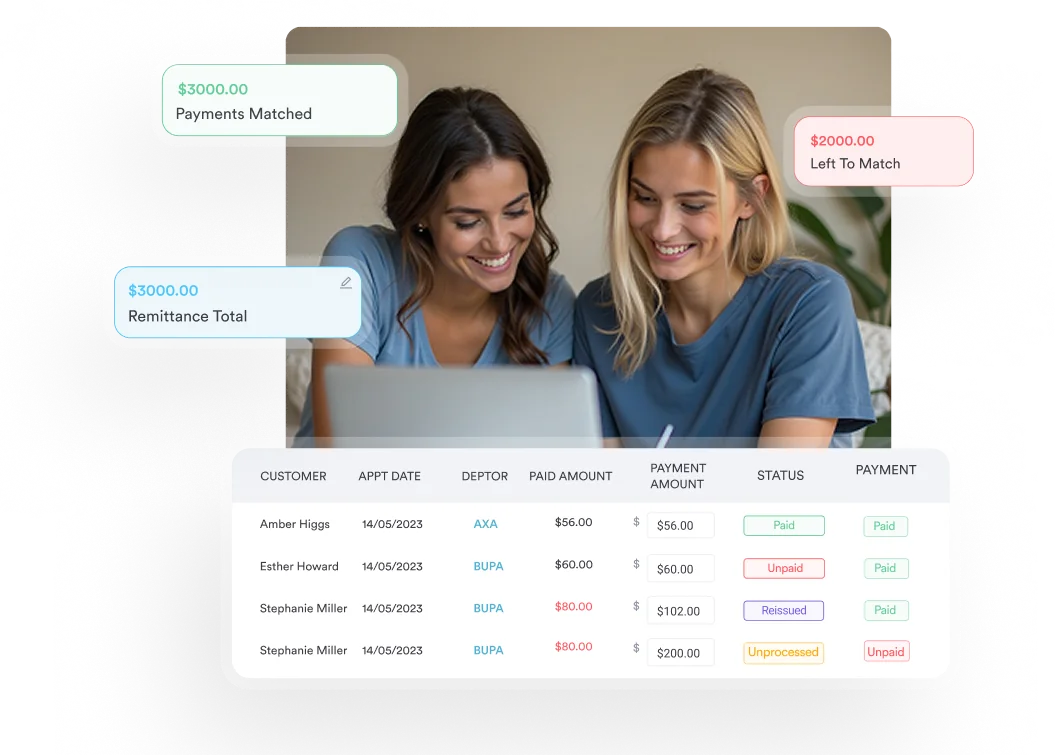
Run a quarterly operative note audit. Pull 10 random cases per surgeon and compare each documented procedure with the billed CPT code. Flag any note that couldn’t support the code on its own.
Run through this list before you authenticate the report. Each item matches a query coders or surveyors raise often.
The same handful of problems turns up in chart reviews. Each one is easy to prevent once you know to look for it.
A compliance management routine helps here, with scheduled chart reviews and each finding assigned to a named owner. The American Health Information Management Association (AHIMA) also publishes clinical documentation integrity guidance for HIM teams.
No single federal rule sets how long every practice keeps operative notes. Medicare-participating hospitals must keep medical records for at least 5 years under 42 CFR §482.24(b)(1). State law often requires longer, and you follow whichever rule is stricter.
HIPAA’s six-year rule is often quoted here, but it covers a different set of records. 45 CFR §164.530(j) requires covered entities to keep HIPAA documentation, such as policies and required written communications, for six years. It doesn’t set a retention period for the medical record itself.
CMS hospital CoP, §482.24(b)(1)
5 years
At least 5 years
Applies to Medicare-participating hospitals; state law may require more
State law (common range)
7–10 years
Often 7 to 10 years from last service
Varies significantly by state; check your state medical board
Minors
Extended
Until age of majority plus the applicable retention period
Most states extend retention for pediatric records
HIPAA documentation, §164.530(j)
6 years
6 years from creation or last effective date
Covers HIPAA policies and required documentation, not the chart itself
Not the chart itself
Electronic records are faster to pull during a survey or payer audit, provided access controls are in place. Paper notes need the same physical security and take longer to retrieve. Pabau’s medical records management keeps signed notes on the patient’s record, so you can find them when a surveyor or payer asks.
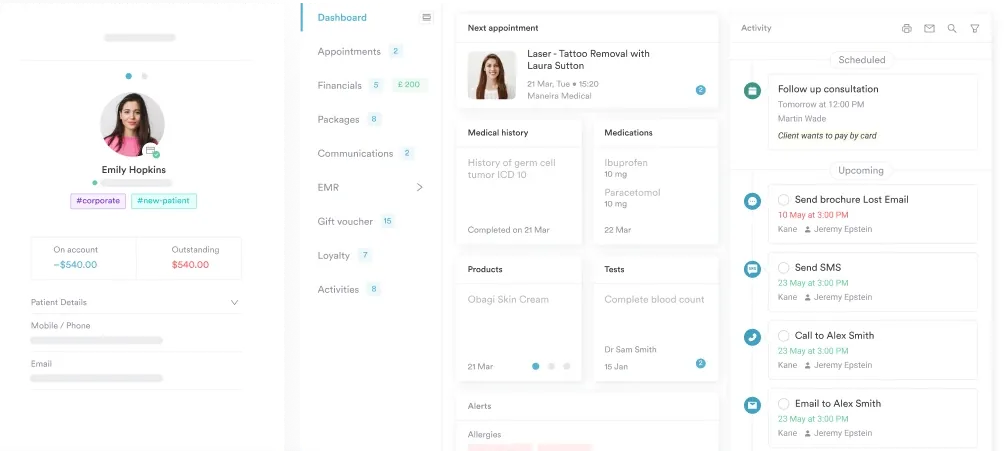
In many surgical practices the operative note still depends on a dictation queue and a reminder to sign. Consent forms sit in one place, the note in another and the claim in a third.
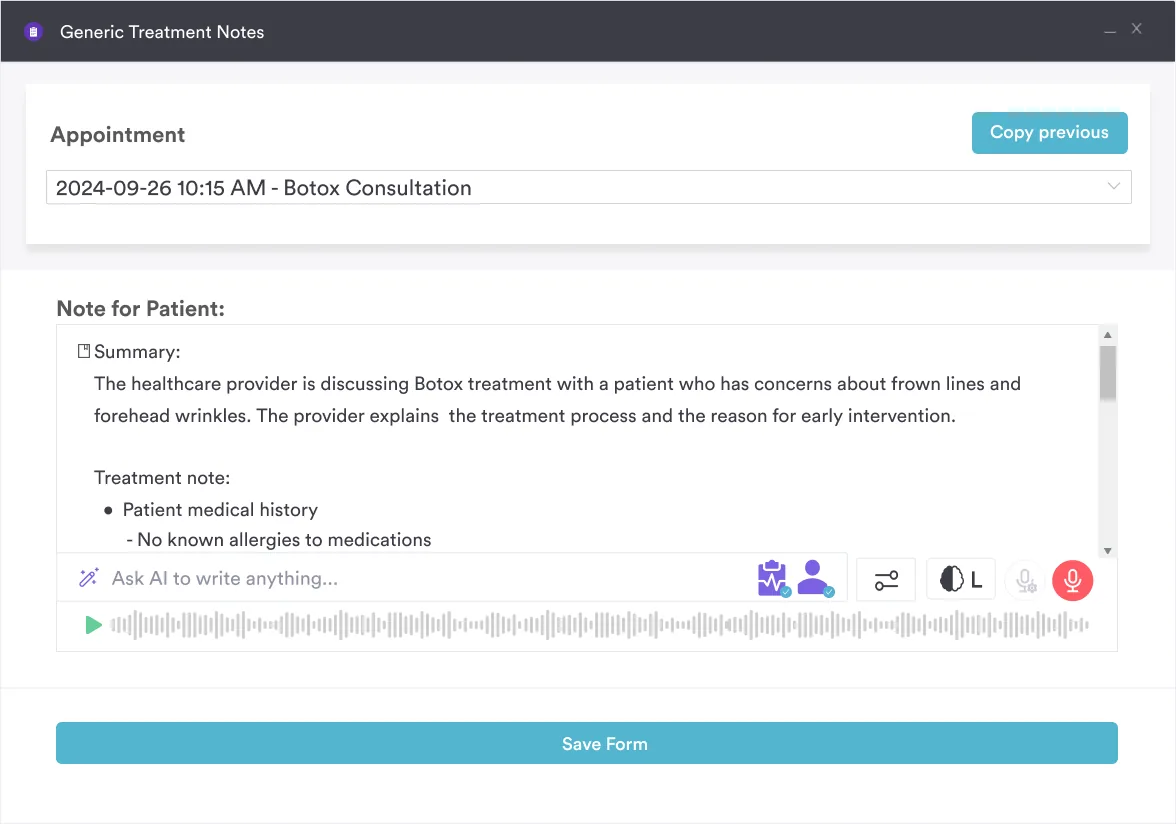
Pabau brings those pieces onto one patient record. Your note templates can follow the section order above. Pabau Scribe, our AI scribe, turns the pre-op and post-op consultations into draft notes for the surgeon to review and sign.
The operative note itself is still the surgeon’s own account of the case. Surgeons who dictate after closing can record or upload that dictation, and Pabau Scribe drafts it into your note template. The surgeon then checks the draft against the case and signs it.
Before surgery, digital consent and intake forms capture the planned procedure, history and allergies on the same record. When the case closes, the details the note refers to are already in the chart.
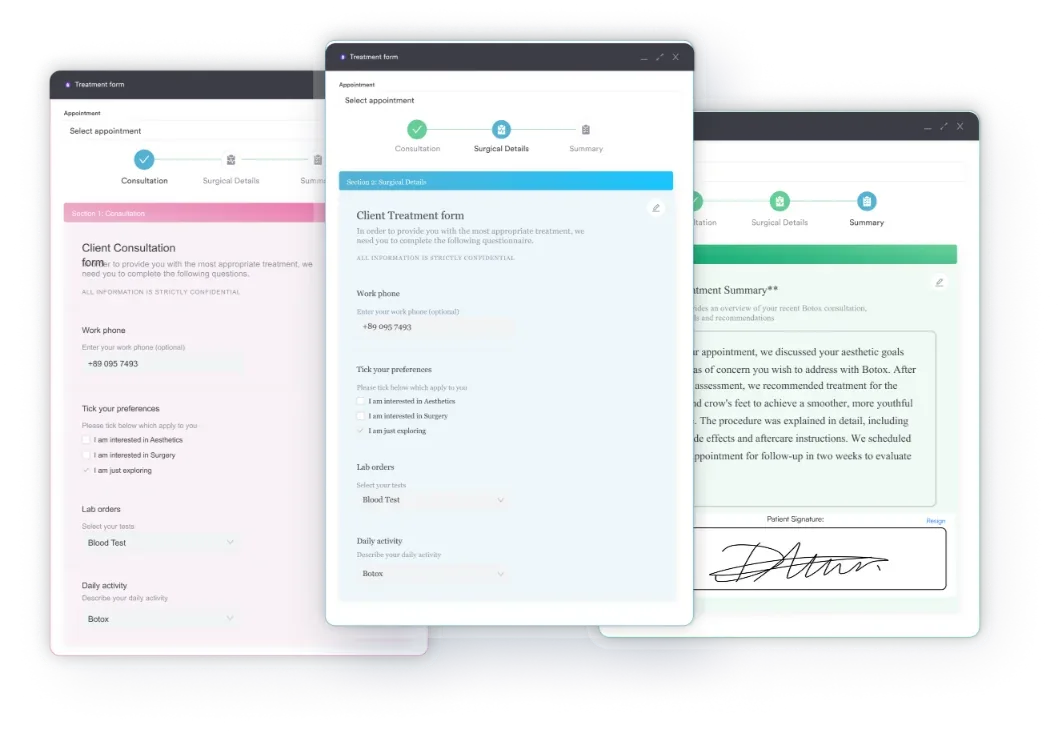

Pabau’s note templates, Pabau Scribe and digital forms help practices capture the required elements in one record. Consent forms, signed notes and claims stay together on each patient’s file.

The rules on operative notes are short, and the deadline is the end of the case. If you change one habit, make it the brief note. Enter it before the patient leaves recovery whenever the full report has to wait.
Then tighten your template so the fields CMS, the Joint Commission and your coders need are hard to skip. A few extra minutes at closing cost far less than days spent chasing a chart, a signature or a denied claim.
Book a demo to see how Pabau helps practices capture the required elements in one record, from consent to the signed note.

Need a printable note for minor procedures? Operation notes template gives you a ready-made layout for documenting smaller operations.
Getting consent right before the case? Free operation consent form covers the risks, alternatives and signatures a surgical consent needs.
Clearing patients for surgery? Surgical clearance form explains what the form records and who completes it.
Documenting care after the OR? Nursing documentation guide sets out the principles and legal requirements for nursing records.
Cutting confusing shorthand from dictated notes? Medical terminology abbreviations worksheet helps staff learn the abbreviations that show up in clinical notes.
The operating surgeon is responsible for it, and CMS requires the surgeon’s signature. A resident or physician assistant may draft it where facility bylaws allow, but the surgeon reviews and signs it. In Medicare teaching cases, 42 CFR §415.172 also requires the record to show the attending was present for the key and critical portions.
They’re close. An operative note covers surgery in the operating room, while a procedure note covers smaller bedside or office procedures. The Joint Commission applies its operative-report rule to other high-risk procedures too, so check your facility’s list.
Yes, but only through a dated, timed and signed addendum. The original entry stays visible, and the addendum explains what changed and why. Never edit or delete the signed text, because that can look like tampering in an audit or lawsuit.
Yes. Under HIPAA’s right of access, patients can request copies of their records, including operative reports. Covered entities generally must respond within 30 days, with one 30-day extension allowed.
Op note is shorthand for the operative note, also called the operative report or surgical report. All three names refer to the same document, so pick one and use it consistently in your templates and policies.