OT SOAP note sample: Free template and worked examples
Download your free OT SOAP note sample A four-page form with an identifying head...

6
Last Updated: Nov 5, 2026
The clinical audit cycle is a repeating process for measuring care against an agreed standard, fixing what falls short, and re-measuring to confirm the change.
This guide splits it into six stages: choose a topic, set criteria, collect data, analyze and present results, implement change, then re-audit.
HQIP’s Best Practice in Clinical Audit guidance builds re-audit into the cycle. One audit only shows where care stood on the day it was measured. Below, you’ll find each stage with a worked example, the reasons teams stall before re-audit, and how practice software shortens the data work.

The clinical audit cycle is a continuous loop: select a topic, set standards, collect data, compare results, implement change, then re-audit.
Guidance commonly describes the cycle in five stages, as HQIP does, or in six, with presenting findings and re-audit split out.
NICE guidelines and royal college standards are the most common sources of audit criteria in the UK.
Re-audit completes the cycle, and without it no one can show the improvement happened.
Practice management software speeds up data collection and outcome tracking, which makes the cycle easier to repeat.
The clinical audit cycle compares clinical practice against an established standard, changes what falls short, and re-measures to confirm the intended improvement. A one-off audit stops after the first measurement. It tells you where care stands today, while the full cycle shows whether care has moved since.
Fowkes described the medical audit cycle in 1982, and it has since become a core part of NHS clinical governance. NICE’s 2002 publication, Principles for Best Practice in Clinical Audit, describes audit as an ongoing quality improvement process that repeats over time.
Three features make the cycle distinctive:
A clinical audit shows whether care follows the guidelines a team believes it follows. Without systematic measurement, good intentions don’t reliably produce good outcomes, and the data often tells a different story.
The main reasons to carry out a clinical audit:
The clinical audit cycle is commonly described in five stages, as in HQIP’s guidance, or in six, with presenting findings and re-audit split out. This guide uses six, with re-audit as the final stage. The core sequence is the same in every version.
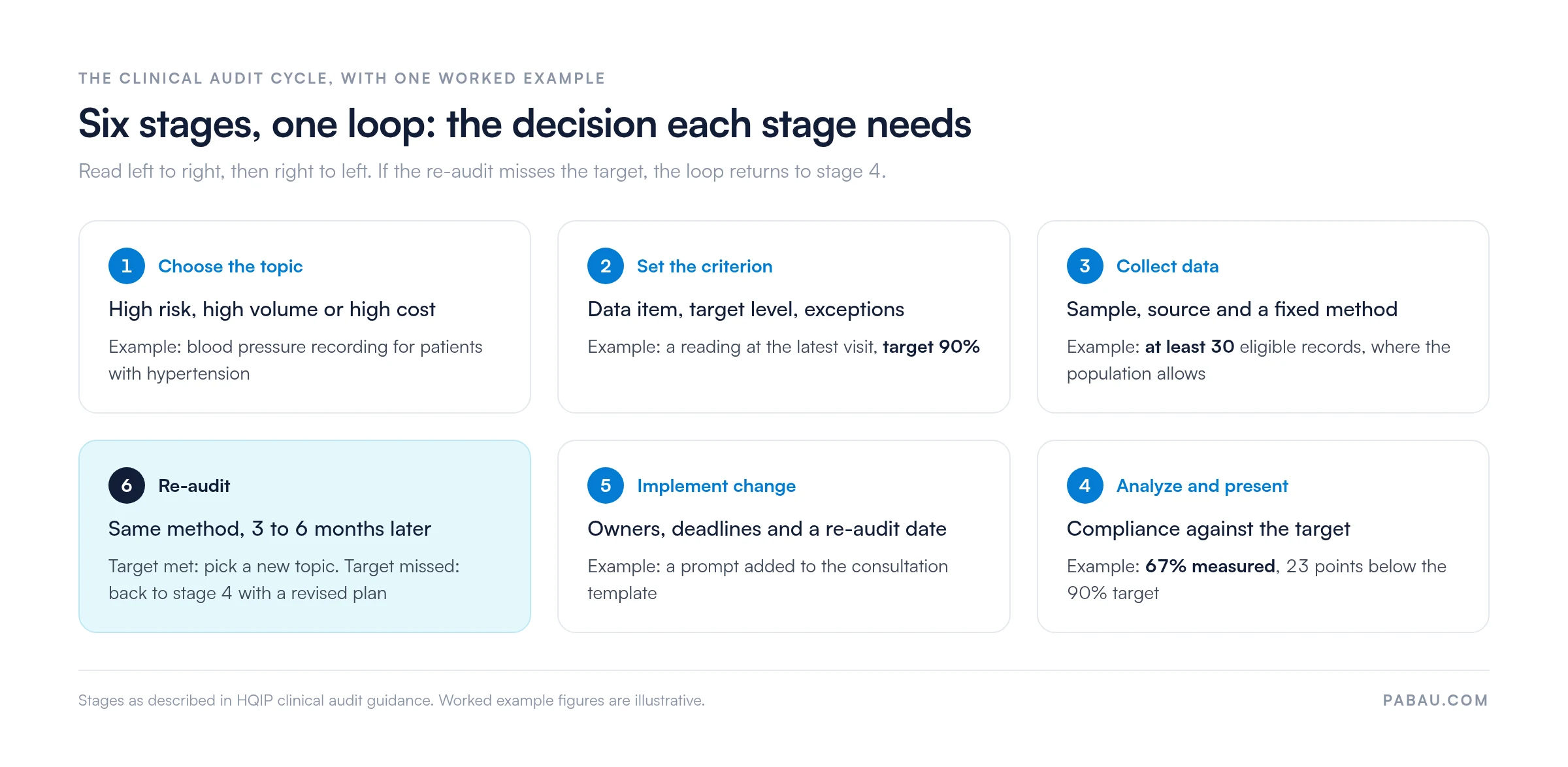
Topic selection shapes every later stage, and a poorly chosen topic produces findings no one acts on. Good topics are clinically significant, measurable, and backed by a credible standard.
NHS guidance recommends prioritizing topics that are high risk, high volume, or high cost. A prescribing audit in a primary care practice often meets all three. Patient experience of the waiting room may matter, but it’s hard to anchor to a measurable standard. That makes the later stages harder to run.
Practical tip: Involve the clinical team in choosing the topic. Buy-in at this stage makes the change at stage 5 much easier.
A standard defines what good practice looks like, and a criterion is a measurable statement derived from it. A standard might be “all patients with hypertension should have their blood pressure recorded at every consultation.” The criterion becomes “percentage of hypertensive patients with a blood pressure recording at their most recent appointment.”
Sources for standards include NICE guidelines, royal college publications, local policies, and NHS England frameworks. Define three things for each criterion before data collection begins:
Data collection is where the clinical audit cycle meets day-to-day practice. The common pitfalls are samples too small to support conclusions, data sources that miss the criterion, and collection periods too short to reflect typical practice.
Key decisions at this stage:
Analysis means calculating compliance for each criterion and comparing it with the target set at stage 2. If the target was 90% and the audit shows 67%, the team is 23 percentage points short. The analysis should also show where in the process the shortfall starts.
Presenting findings to the clinical team is a step many audits skip or handle poorly. Data shared in a blame-free way gets better engagement than data presented as a verdict. Show each criterion separately, with the target beside the measured result, so each shortfall is concrete and actionable.
The clinical audit cycle most often stalls at this stage. Spotting a shortfall is fairly simple. Fixing it means changing behavior and processes, then sustaining the change under normal clinical pressure.
Effective change at this stage involves:
That last point matters most. A date set now creates accountability, and without one the cycle drifts. Practices that rewrite a policy after an audit can track which staff have read the new version with policy management software.
Re-audit is what makes the clinical audit cycle a cycle. The team re-collects data with the same method as the original audit. That is typically three to six months later, once the changes have had time to work.
The re-audit answers three questions the first audit can’t:
If the target is met, the team can start a new topic or re-audit the same one at a longer interval. If it’s missed, the analysis and change stages repeat with a revised action plan. Either way, the loop continues.
Clinical audit checks whether care meets a known standard, while quality improvement (QI) redesigns a process when the right standard is unclear. The two are often confused, and knowing which fits a problem stops teams from using the wrong tool.
The two approaches complement each other. An audit often surfaces a process problem that a QI project is better placed to solve. A QI project may produce a new standard that the next audit cycle measures. Used in sequence, they produce more durable improvement than either one alone.
Before starting an audit or a QI project, check whether an HQIP national program already covers your clinical area. Joining one gives you benchmarking data, a validated method, and regulatory credibility without duplicating effort.
Most clinical audits produce a report, but far fewer complete the full cycle. The improvement is lost somewhere between the first report and the re-audit.
The most frequently cited barriers:
The CQC’s quality statements (for example learning culture and learning, improvement and innovation) expect providers to show how they learn and improve. Completed audit cycles are strong evidence for both. A missing re-audit weakens the governance story a practice can tell at a CQC inspection.
Data collection and re-audit take the most time in the clinical audit cycle. Both mean pulling consistent data from patient records, and many teams still do it by hand from paper notes and spreadsheets.
Pabau, the practice management platform we build, keeps appointments, treatment notes, and forms in one structured patient record. The data items an audit needs sit in set fields, so the same records can be pulled again at re-audit without retyping.
For analysis, Pabau’s core reporting tools filter appointments and treatments by date, service, and practitioner. That saves rebuilding a spreadsheet every time the team needs a baseline.
For the change stage, a new standard can go straight into a digital form. If an audit shows pre-treatment assessments are completed inconsistently, a required intake form makes them part of every visit. Pabau’s compliance management software keeps those forms and consents on record for the next inspection.
The audit itself stays the team’s job. Pabau cuts the admin enough that completing the full cycle, re-audit included, fits into a normal quarter.

Pabau keeps patient records, forms, and reports in one system, so your team can pull audit data again at re-audit without rebuilding spreadsheets.

Plan a clinical audit around its re-audit. Set the re-audit date when you agree the action plan. Fix the data items before the first collection, so the two results can be compared.
Teams that work this way spend less effort on each new cycle, because the criteria, sample, and method already exist. The trade-off is discipline up front. A loose first audit can’t be re-run, and the whole effort then starts over.
Book a demo to see how Pabau keeps audit data in structured records your team can pull again at re-audit.

Getting ready for an inspection? CQC requirements sets out what every provider must prove, including the governance evidence audits supply.
Need a record for incidents your audit uncovers? Incident report form covers what to include when something goes wrong in a healthcare setting.
Auditing privacy compliance in a US practice? HIPAA audit checklist gives a ready-made set of criteria to measure against.
Checking where patient data is exposed? HIPAA risk assessment walks through finding and ranking risks before an audit does it for you.
The clinical audit cycle is a repeating improvement process. Healthcare teams measure practice against defined standards, make changes, then re-audit to confirm the improvement. Unlike a one-off audit, the loop is designed to repeat, so continuous improvement becomes the expectation.
The cycle is commonly described in five stages, as HQIP does, or in six. The six stages are choosing an audit topic, setting standards and criteria, collecting data, analyzing results and presenting findings, implementing change, and re-auditing. The re-audit closes the loop and shows whether the change worked.
Clinical audit gives structured evidence that care meets defined standards. It supports regulatory compliance, since CQC inspections expect audit evidence, surfaces training needs, and shows accountability to commissioners and patients. Without it, teams judge their care on assumption instead of data.
Clinical audit measures compliance against a predefined standard and produces a compliance percentage. Quality improvement uses methods such as PDSA (plan-do-study-act) cycles to redesign processes, often without a fixed standard. Audit suits problems with a clear guideline, and QI suits complex problems where the right approach is still unclear. The two often work in sequence.
Schedule the re-audit date before the action plan is finalized, and use the same method as the original audit. Allow three to six months for the changes to take effect. The cycle is complete when the re-audit results can be compared directly with the baseline.
The team reviews whether compliance reached the target fully, partially, or not at all. If the target is met, it starts a new topic or re-audits the same one at a longer interval. If not, the analysis and change stages repeat with a revised action plan, and the loop continues.