Nitrates medication list
A nitrates medication list is a point-of-care reference that sets out the main c...

Last Updated: Oct 6, 2026
Focus charting is a nursing documentation method that organizes every note around one patient concern, behavior, or condition change. It runs on the F-DAR framework: Focus, Data, Action, and Response. You name the focus, record what you observed, log what you did, then record how the patient responded.
The American Nurses Association (ANA) treats clear, consistent documentation as a professional and legal responsibility tied to care continuity and patient safety. F-DAR meets that bar when all four parts are present. Drop the Response and the entry records what happened to the patient without recording whether it helped.
This guide walks through each part and gives three worked examples, from surgical, med spa, and psychiatric settings. It also compares F-DAR with SOAP, PIE, and charting by exception, so you can pick the right format for your setting.

Focus charting (F-DAR) organizes nursing notes around a patient-centered focus rather than a problem list or a system-by-system review.
F-DAR stands for Focus, Data, Action, and Response, and all four parts belong in every entry.
The Response entry is the one most often left out, which is what makes a note hard to defend in an audit.
A focus scoped too widely, such as post-op care, produces entries nobody can search or audit later.
Practice management software like Pabau supports structured note templates and AI-assisted documentation, so nurses spend less time formatting entries.
Focus charting is a patient-centered documentation system where each note entry is built around one named clinical focus. It does not follow a chronological narrative or a problem-by-problem structure.
The method was developed in the 1980s as a more holistic alternative to SOAP notes. It is still in use across acute care, psychiatric, and long-term care settings.
The “Focus” itself can be any of the following:
Each entry then follows the DAR sequence: Data, Action, Response. The structure makes every note record what the nurse observed, what they did about it, and how the patient responded. Named focuses also keep structured patient records searchable, which matters at handoff and at audit.
The DAR structure splits every focus charting note into three sequential parts. Each part has a defined scope. Blur the boundaries and the entry becomes hard to audit and harder to defend.
Response is the part left out most often. Without it, the entry shows what happened to the patient but never whether the intervention worked. Accreditors from the Joint Commission expect patient outcomes to be documented, and a DAR note with no Response falls short of that.
An F-DAR note takes about as long to write as a SOAP note once the format is familiar. The sequence below matches the approach documented by JoVE Science Education in its clinical nursing documentation series.
The diagram below sets those parts against a completed entry, alongside the error that most often breaks each one.
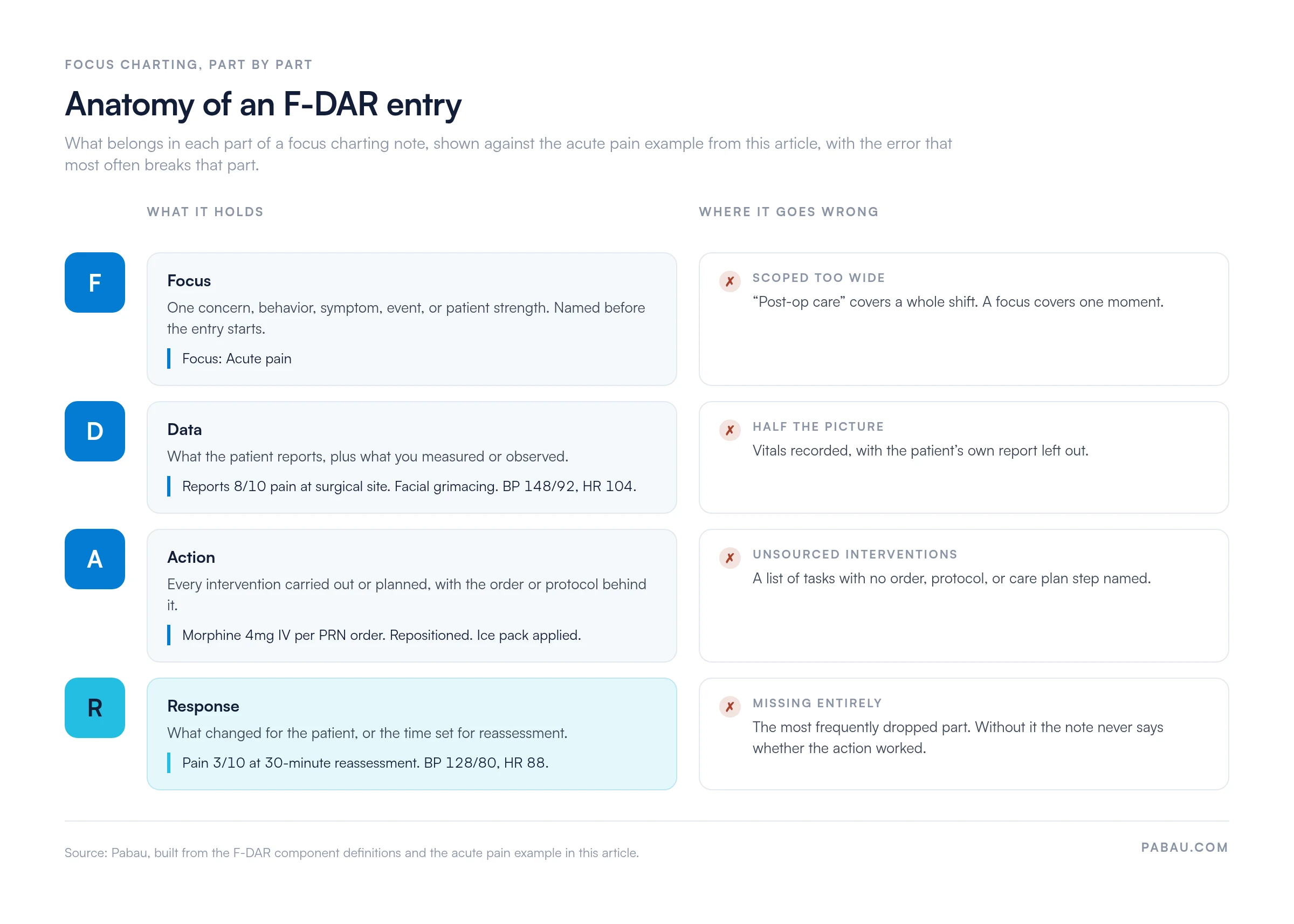
Flag the focus label in your EHR before writing the DAR entries. Later you can search for pain, wound care, or fall risk in seconds. Scanning chronological narrative notes for the same material takes far longer.
The worked examples below show how the format applies in three common situations. Each one labels the focus first, then completes DAR in sequence. If you want the shape on paper before your next shift, the DAR notes template lays out the same four fields.
Focus: Acute Pain
D: Patient reports 8/10 pain at surgical site, describing it as “sharp and constant.” Facial grimacing noted. Vitals: BP 148/92, HR 104. Last analgesic 6 hours ago.
A: Physician notified. Morphine 4mg IV administered per PRN order. Patient repositioned. Ice pack applied to site. Pain reassessment scheduled in 30 minutes.
R: Pain rated 3/10 at 30-minute reassessment. Patient resting comfortably. BP 128/80, HR 88. States pain is “manageable.”
Focus: Wound Integrity
D: Post-procedure wound to right cheek, day 3. Wound measures 1.5cm x 0.8cm. Edges approximated, no erythema extending beyond 2mm border. Minimal serous drainage on dressing. Patient reports mild tenderness, denies fever.
A: Wound cleaned with saline, non-adherent dressing applied. Post-procedure aftercare instructions reviewed with patient. Next review booked for day 7. Photographic record updated in patient file.
R: Patient verbalized understanding of aftercare steps. No signs of infection at assessment. Tolerating procedure well.
Focus: Medication Response
D: Patient on day 5 of new antipsychotic. Reports reduced auditory hallucinations (“only once today versus constant”). Observed appropriate affect during morning interaction. No EPS symptoms noted.
A: Medication administered as prescribed. Therapeutic response documented per unit protocol. Prescriber updated via handoff note. Patient encouraged to report any new side effects.
R: Patient engaged in group therapy session for 45 minutes without incident. Mood stable. Continues to show improvement from baseline at admission.
Focus charting has clear strengths for teams that adopt it consistently. It also carries limits worth knowing before you roll it out across a practice.
The last two limits are the ones a practice can design around. A system with configurable note templates removes the compatibility problem. Creating a standing focus for routine care, such as hygiene or mobility, keeps ordinary care on the record when nothing unusual happens.
Choosing between documentation methods depends on the setting, the size of the team, and the detail regulators or accreditors expect. The table below sets the three main nursing formats side by side.
PIE charting (Problem, Intervention, Evaluation) sits between SOAP and focus charting. It organizes notes around nursing diagnoses rather than patient-centered focuses.
That makes it more problem-centric than F-DAR and more nursing-specific than SOAP. Many psychiatric units use PIE for initial assessments and F-DAR for ongoing shift notes.
Charting by exception (CBE) records only findings that deviate from predefined normal standards. Nurses skip the assessment points that came back normal. That makes CBE far quicker than focus charting for routine care, but the two carry very different risk profiles.
Some facilities run both. CBE covers routine assessments on flow sheets, and F-DAR covers any abnormal finding or clinical event that needs an intervention record. Check that hybrid against your state board of nursing’s documentation requirements first, since they vary by jurisdiction.
Focus charting works best when a specific clinical concern is present. The nurse needs to show what they observed, what they did, and what changed. It fits these settings, according to published research on F-DAR use in psychiatric facilities and the wider nursing education literature:
F-DAR is weaker for comprehensive initial assessments, where SOAP or a head-to-toe narrative fits better. It also struggles when a multidisciplinary team needs the full clinical story at handoff.
Whatever system you run, look for one that supports focus-based note templates natively rather than making nurses rebuild the structure in a free-text field.
Plenty of EHR systems ship no focus charting template at all. Nurses adapt by typing the labels into a free-text field, which works well enough. The cost is the searchability that made focus charting worth adopting.
Practice management software like Pabau approaches the problem in three ways:
Whether a practice adopts focus charting, SOAP, or a hybrid, the requirement is the same. Notes must be accurate, timely, complete, and retrievable. Software that handles the structure leaves nurses free to think about the clinical content of each entry.

Pabau’s AI medical scribe and digital forms keep clinical notes accurate and consistent. More of the day goes to care rather than paperwork.

Focus charting gives clinical teams a patient-centered, defensible framework that travels across acute, psychiatric, outpatient, and med spa settings. Its strength is the action-response chain. Every entry shows what the nurse observed, what they did, and what changed for the patient.
Most of the work sits in the system around the format, not in the format itself. Nurses need a template that holds the four fields, and a standing focus for the routine care nobody thinks to name. Get those two right and the Response entry stops going missing.
Pabau’s structured clinical notes and digital forms keep documentation consistent without adding to the admin load. Book a demo to see how a focus-shaped note template works inside a live patient record.

Want the F-DAR structure on a page you can fill in? DAR notes: format, examples, and a free template lays out the four fields with a downloadable version for your next shift.
Need the ground rules behind every nursing entry? Nursing documentation: principles, best practices, and legal requirements covers what a record has to show and how it has to be kept.
Writing progress notes rather than shift entries? Clinical progress notes: template, examples, and how to write one walks through the format and what belongs in each section.
Documenting under time pressure in an emergency setting? Emergency nursing assessment template sets out a structured assessment you can complete at speed.
Focus charting is a patient-centered nursing documentation method that organizes clinical notes around one named focus. That focus can be a patient concern, behavior, sign, symptom, or significant event. Each entry then follows the F-DAR structure: Focus, Data, Action, and Response. The method was developed in the 1980s as a more holistic alternative to problem-oriented SOAP documentation.
F-DAR stands for Focus, Data, Action, and Response. Focus identifies the patient concern driving the entry. Data records objective and subjective observations. Action documents the nursing interventions. Response captures how the patient responded after those interventions.
Focus charting organizes notes around a patient concern, which is the focus. SOAP notes are organized around a clinical problem and follow a Subjective, Objective, Assessment, Plan sequence. F-DAR is generally preferred for nursing shift updates and psychiatric settings. SOAP is more common for physician and multidisciplinary encounters. Both formats are legally defensible when completed correctly.
Use focus charting when a specific clinical concern needs a documented observation, intervention, and outcome. It works best in psychiatric nursing, outpatient settings, med spas, and post-surgical care. It is less appropriate for comprehensive initial assessments or full head-to-toe documentation, where a narrative or SOAP format captures more detail.
Advantages include patient-centered organization, efficient documentation for targeted concerns, defensibility through an explicit action-response chain, and searchable focus labels in EHR systems. The disadvantages are a learning curve for new nurses and the risk of omitting routine care when no focus is named. EHR support for the F-DAR format also varies by platform.
Charting by exception (CBE) documents only findings that deviate from predefined normal standards. Focus charting documents every entry tied to a named clinical focus, whether the findings are normal or abnormal. CBE is quicker for stable patients but carries higher legal risk. Focus charting is more thorough and easier to defend in complex or changing situations.