OSHA respirator medical evaluation questionnaire
The OSHA respirator medical evaluation questionnaire is the mandatory health for...

3
Last Updated: Oct 15, 2026
A pie chart nursing template is a structured note format where nurses record the patient’s problem, the intervention they delivered, and how the patient responded. PIE stands for Problem, Intervention, Evaluation.
The format stays in wide use across acute care, long-term care, and community nursing. It follows the order nurses already work in. You name the problem, you act, then you measure what changed.
The free download below is a printable recording form for the bedside. The guide under it covers the note itself. You get worked examples, the five mistakes that weaken an entry, and a comparison with SOAP.
A printable one-page clinical form with a reference-values table and a dated recording log. Fields cover category, value, range, the source checked and the approver, plus date, time and who recorded each entry.
Download template
PIE charting stands for Problem, Intervention, Evaluation, a three-part note structure used on hospital wards, in community care, and in mental health settings.
The Problem line names the nursing diagnosis or patient issue. Intervention records what the nurse did, and Evaluation records how the patient responded.
Evaluation has to close on the measure the Problem line opened with, so a pain score of 8/10 is answered with a later score.
PIE notes are quicker to write than SOAP notes, which suits shift-to-shift updates better than a first comprehensive assessment.
The free PDF above is a printable recording form you can keep at the bedside and sign off after each entry.
PIE charting is a nursing note format that records one patient problem, the action taken in response, and the result, in that order. Unlike narrative charting, which reads like a story, or SOAP notes, which separate subjective and objective findings, PIE organizes the entry around action and outcome.
Each entry covers the problem the nurse met during that shift or visit, what was done about it, and whether it worked. The structure keeps entries short, which is part of why it survives on busy wards.
PIE is one of several accepted nursing documentation formats, alongside narrative charting, SOAP, focus notes and charting by exception. No accrediting body requires a particular format. What reviewers look for is an entry that shows the assessment, the action and the patient’s response.
Each part answers a different question, and the boundaries between them matter. Anyone reading the chart later should find the problem, the action and the result without hunting for them.
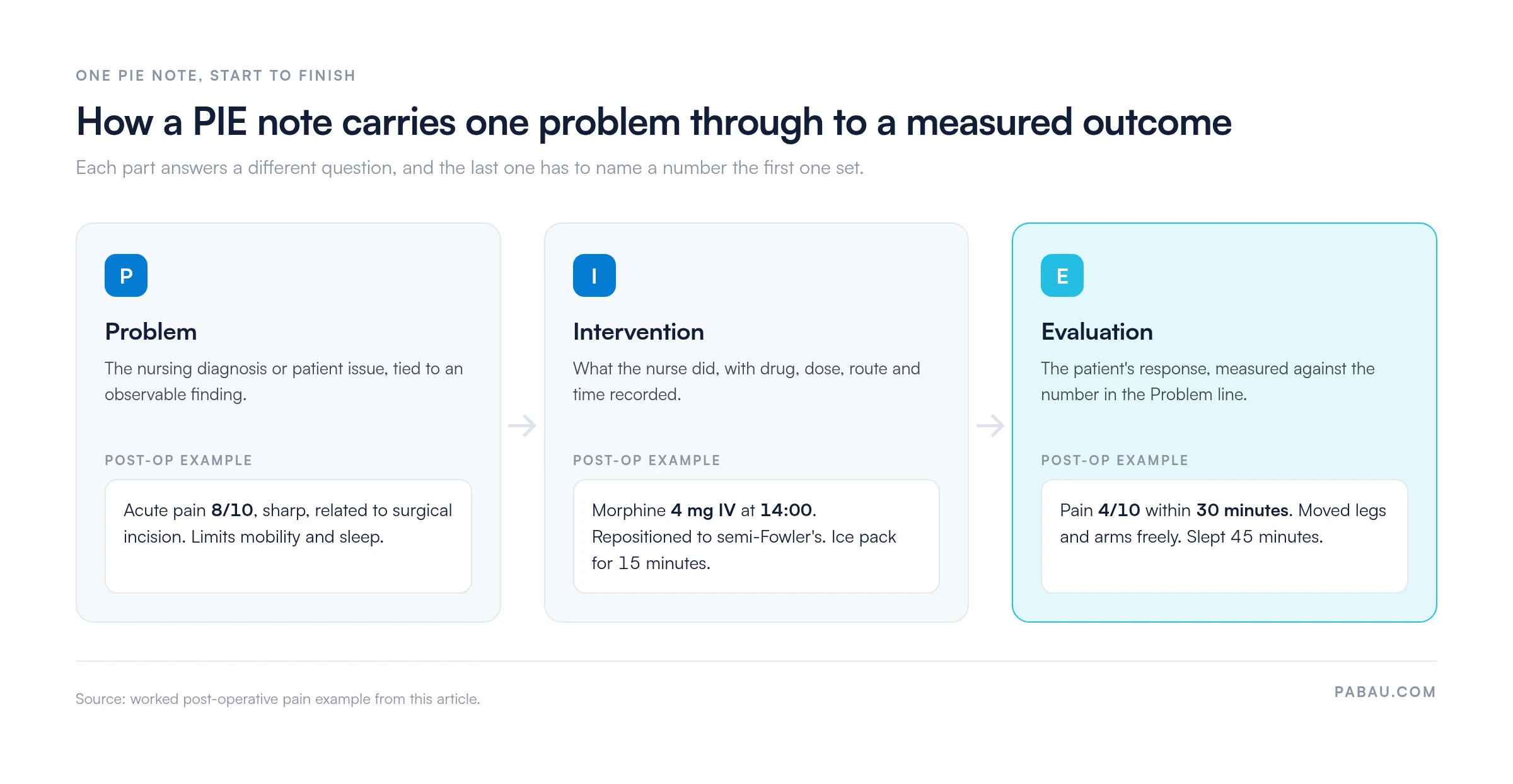
The post-operative example below runs all three parts through a single note. Watch the Evaluation line answer the number the Problem line set.
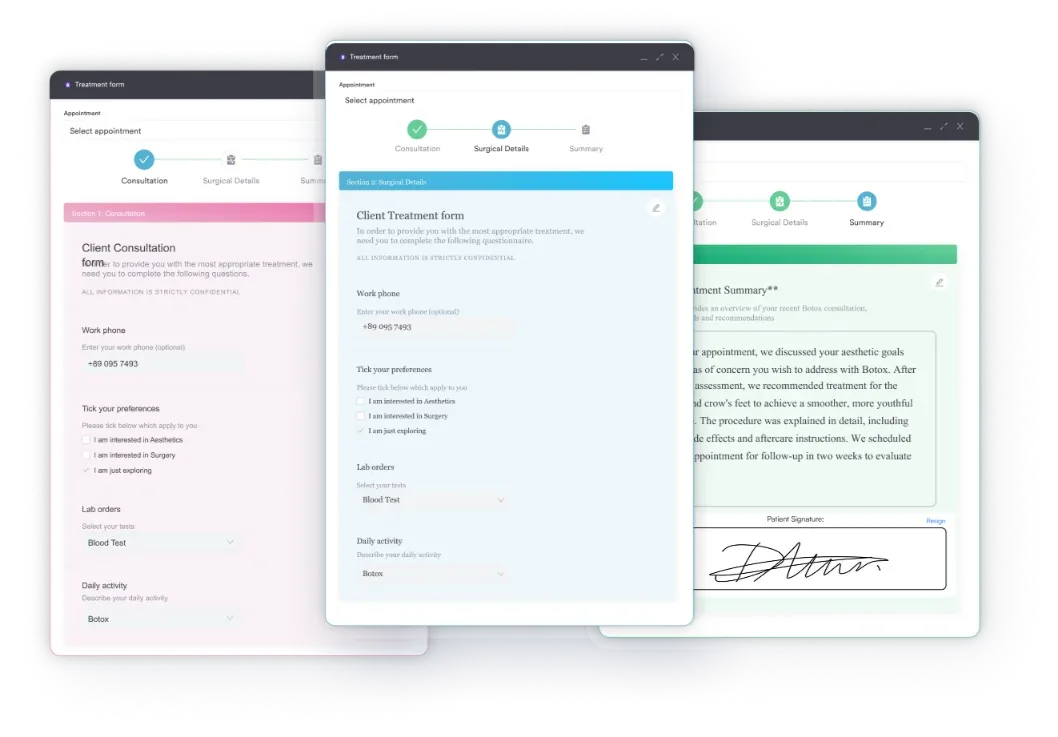
Effective notes follow a consistent sequence. Structured clinical forms built into patient intake software keep entries consistent across a team and cut the time spent typing the same headings.
Scenario 1: post-operative pain management
P: Acute pain 8/10 (sharp) related to surgical incision, limiting mobility and sleep.
I: Administered morphine 4 mg IV at 14:00. Repositioned to semi-Fowler’s. Applied ice pack wrapped in cloth to surgical site for 15 minutes.
E: Pain reduced to 4/10 within 30 minutes. Patient reports moving legs and arms without sharp pain. Slept for 45 minutes after the intervention.
Scenario 2: teaching insulin technique
P: Knowledge deficit regarding insulin administration technique. Patient uncertain about needle angle and injection site rotation.
I: Provided one-to-one education at 10:30 AM using an anatomical model. Demonstrated the 90-degree needle angle and an abdominal site rotation pattern. Patient returned the demonstration twice without error.
E: Patient verbalized understanding of the technique and agreed to rotate sites. Identified appropriate injection sites on own abdomen. Given a printed reference card, with follow-up teaching booked in 48 hours.
SOAP charting (Subjective, Objective, Assessment, Plan) splits the entry by type of data. PIE splits it by problem and response. If you want a refresher on the older format first, our guide to SOAP notes walks through what belongs under each letter.
Many practices use both. SOAP carries the first comprehensive assessment, then PIE entries track how each named problem moves over the shifts and visits that follow. A wider guide to structuring case notes compares SOAP with DAP, BIRP and GIRP, so you can match the structure to the work.
PIE charting is common through acute care hospitals, from medical-surgical wards to intensive care. Mental health teams favor it too, because problem, intervention and evaluation mirrors how a treatment decision gets made and reviewed.
The nurse names the presenting symptom, such as anxiety, suicidal ideation or medication non-compliance. They deliver the intervention, whether that is a therapy session, a medication adjustment or safety planning. Then they evaluate the patient’s mood, coping and safety status.
Community nursing, long-term care and home health agencies use PIE entries to document several visits in one shift. Each visit produces one or more entries, which builds a dated record of how a problem is resolving. Integrated patient record systems hold that history in one chart, so the next nurse is not reading three sources.
Mistake 1: vague problem statements. “Patient uncomfortable” gives the intervention nothing to aim at. “Acute pain 7/10 related to incision” does. Tie the problem to an observable finding and use nursing diagnosis language.
Mistake 2: interventions without detail. “Gave pain medication” is not charting. “Administered morphine 4 mg IV at 14:00 following pain assessment” is. Include the drug, dose, route and time, plus what prompted the choice where it is not obvious.
Mistake 3: an evaluation that answers a different question. If the Problem line said pain 8/10, the Evaluation line has to give a score. “Patient tolerated well” describes the nurse’s impression, not the patient’s outcome.
Mistake 4: evaluating the wrong measure. After an intervention on a psychological problem, evaluate mood, coping or expressed understanding rather than vital signs. An entry that checks the wrong measure reads as though nobody checked at all.
Mistake 5: charting long after the care. Delayed entries lose detail and are harder to defend in a review. Chart straight after the intervention, or at the end of the shift while the sequence is still fresh.
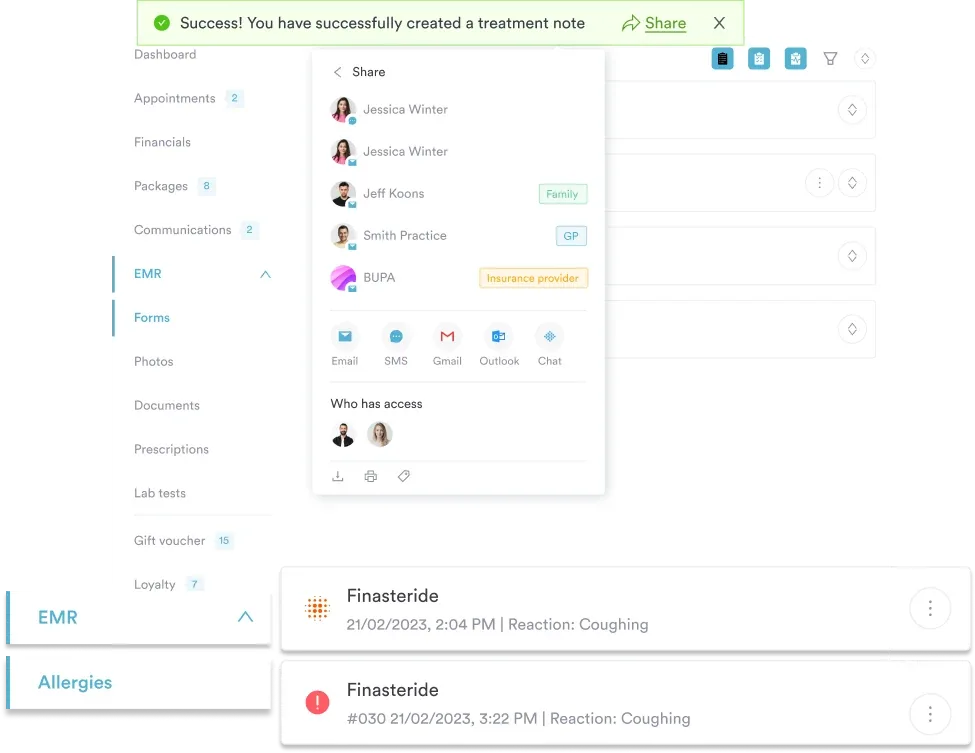
Most electronic medical record systems now carry configurable note templates, so a PIE layout can be built once and opened on every shift. Dropdown fields for problem lists, medication administration and outcome scales keep wording consistent between nurses and cut transcription errors.
Template design is only half the job. The rest is agreeing what belongs in each field, which our guide to nursing documentation works through across handovers, care plans and incident entries. Where the problem is neurological, a neuro charting checklist sets the wording for each finding.
On most wards the note gets written after the round, from memory or from a scrap of paper. Details thin out, the Evaluation line turns into “tolerated well”, and the next nurse inherits an entry that names a problem nobody closed.
Practice management software like Pabau stores your PIE layout as a custom clinical form. The fields open from the patient’s record on a laptop or on Pabau GO, our iOS app. The entry gets written where the care happened, not an hour later.
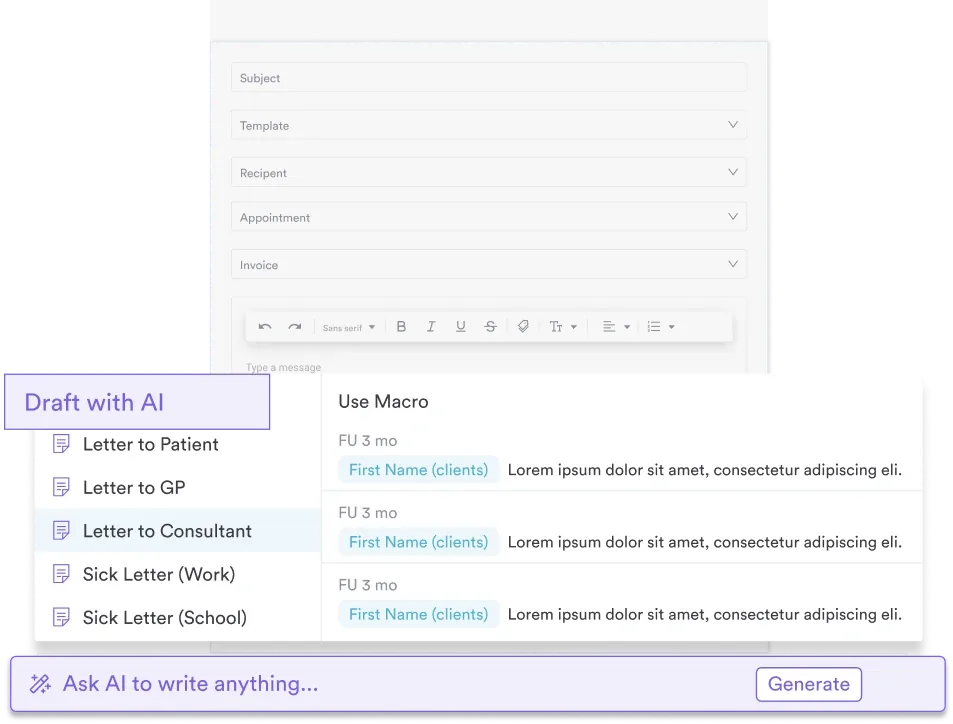
Pabau Scribe, our AI scribe, drafts the note from the consultation, which leaves the nurse editing rather than typing. Every entry files against the same patient record as the appointment, the care plan and the letters. An audit then reads one chart instead of three systems.

Pabau stores your PIE layout as a custom clinical form, so nurses chart from the patient record on any device. Every entry files against the same chart as the appointment and the care plan.

PIE charting earns its place because the structure forces a result. An entry that names a problem and never comes back to it is visibly incomplete, which is harder to say about a page of narrative.
If your team is moving to the format, settle the wording of the Problem line first. Audit, handover and continuity all depend on whether two nurses would describe the same patient the same way.
Print the form above, run it for a week, then look at how many Evaluation lines carry a number. Book a demo to see how Pabau holds that layout inside the patient record, so charting finishes at the bedside.

Comparing the note formats? Focus charting sets out the F-DAR structure and where it differs from a PIE entry.
Documenting a new admission? Admission nursing note template covers the first assessment that a run of PIE entries builds on.
Linking notes to the care plan? Plan of care explains how named problems and goals carry through to daily charting.
Handing over at the end of a shift? SBAR examples shows how to summarize what your entries evaluated in one handover.
PIE stands for Problem, Intervention, Evaluation. The nurse names a patient problem, documents the action taken, and records how the patient responded to it.
Yes. Most EHR platforms let you configure note templates. PIE stays common in acute care, mental health and community nursing because it matches how nurses work through a problem.
A PIE entry usually runs three to five sentences, and sometimes two short paragraphs for a complex problem. The format prioritizes conciseness, so aim for clarity rather than length.
Yes. It is most common in inpatient acute care and mental health. Many primary care and outpatient practices also use PIE entries for follow-up visits focused on one known problem.
SOAP separates subjective and objective data, adds an assessment, and ends with a plan. PIE covers one problem, the action taken and the outcome. PIE is faster to write, while SOAP gives a fuller initial assessment.
The free PDF sits at the top of this page. It is a printable recording form with a reference-values table and a dated log you can sign after each entry.