Questions about gender roles
Questions about gender roles are structured prompts that help clinicians, counse...

3
Last Updated: Oct 20, 2026
A managing stress worksheet gives patients a structured way to name what stresses them, how it shows up, and what they’ll do about it. Ask a stressed patient to “relax more” and you’ll get a nod. Ask them to fill in this form and you’ll get a plan. The free version below runs across eight sections on three pages.
It opens with personal details and medical history. Next, it moves through stressful situations, physical symptoms and emotional responses. Finally, the patient lists current coping habits, healthier strategies to try, and three concrete goals.
Use it as pre-session homework or fill it in together. Either way, you leave the session with goals you can review next time.
A three-page form covering personal information, medical history, stress identification, physical symptoms, emotional responses, current coping strategies, effective coping strategies and goal setting. Sections 3 to 8 each leave room for three answers.
Download template
The worksheet has eight sections, starting with personal details and medical history and ending with three written goals.
Sections 3 to 5 capture three stressful situations, three physical symptoms and three emotional responses.
Section 6 records current coping habits, healthy or not, so you see what the patient already relies on.
Section 7 lists healthier strategies to try, and Section 8 turns them into specific, achievable goals.
The download has no rating scale or tracking log, so build one yourself if you want to measure change.
The worksheet follows a simple arc. First it gathers context, then it maps how stress shows up, and last it builds a plan. Here’s what each section asks for, and what the answers tell you.
The form closes with a short disclaimer. It reminds the patient that the worksheet doesn’t replace professional medical advice.
Sections 1 and 2 take a couple of minutes, but they change how you read the rest. Occupation is the obvious one. A night-shift nurse and a retired teacher will describe very different stressful situations.
Medical history matters more than it looks. Some conditions produce symptoms that overlap with stress. An overactive thyroid, for example, can cause a racing heart and restlessness.
Medications can do the same. Steroids can disturb sleep, and some decongestants raise heart rate. Check this list before you attribute every physical symptom in Section 4 to stress.
Sections 3 to 5 form the assessment core of the worksheet. Each one asks for three entries, which is enough to spot a pattern without overwhelming the patient.
Section 3 asks for three situations where the patient felt stressed. The prompt is specific. It asks what they were doing, who they were with, and what was going through their mind.
The third prompt tells you the most. Thoughts like “I’ll never get this done” suggest the patient needs cognitive work alongside practical fixes. A thought record worksheet lets them test that thought between sessions.
Section 4 lists three physical symptoms. The worksheet’s own examples are headaches, stomachaches and an increased heart rate. These are classic signs of the fight-or-flight response, which prepares the body to act under threat.
Read this section alongside Section 2. A symptom that predates the stress, or matches a known condition, needs a different conversation.
Section 5 covers the emotional and mental impact, with anxiety, frustration and depression as examples. Look for the response that appears in more than one situation from Section 3. That’s usually the one to tackle first.
Section 6 asks what the patient does now to cope. The instructions invite both healthy and unhealthy habits, so expect honest answers like extra wine, scrolling late or skipping meals.
Don’t rush past this list. An unhealthy habit usually does a job for the patient, such as numbing a feeling or creating a break. A replacement has to do the same job.
Section 7 then asks for three healthier strategies that would suit them. The worksheet suggests mindfulness, deep breathing and a favorite hobby as examples.
Lazarus and Folkman’s coping model splits strategies into two groups. Problem-solving is problem-focused, because it changes the situation itself.
Relaxation, reframing and seeking emotional support are emotion-focused. They change how the patient responds when the situation can’t be fixed right now. A balanced Section 7 usually holds at least one of each.
Slow diaphragmatic breathing is associated with parasympathetic activation. That activity counters the fight-or-flight response the patient described in Section 4.
It’s also free, quick and usable anywhere, which makes it an easy first goal. A breathing exercises handout gives the patient a script to follow at home.
For patients who want more structure, mindfulness-based stress reduction offers an eight-week group program.
Section 8 asks for three specific, achievable goals for putting the new strategies into practice. Patients often write intentions here, so this section needs your help.
Tighten each one until it says what, when and how often. A SMART goals worksheet walks through the same step if the patient wants extra structure.
The form leaves room for three goals, but the patient doesn’t have to fill every line. One goal they complete beats three they abandon by Wednesday.
The sections work best in order. The patient handles the first two at home, you cover the rest together, and the next appointment reviews the goals.
The flow below shows who completes each section, and when.
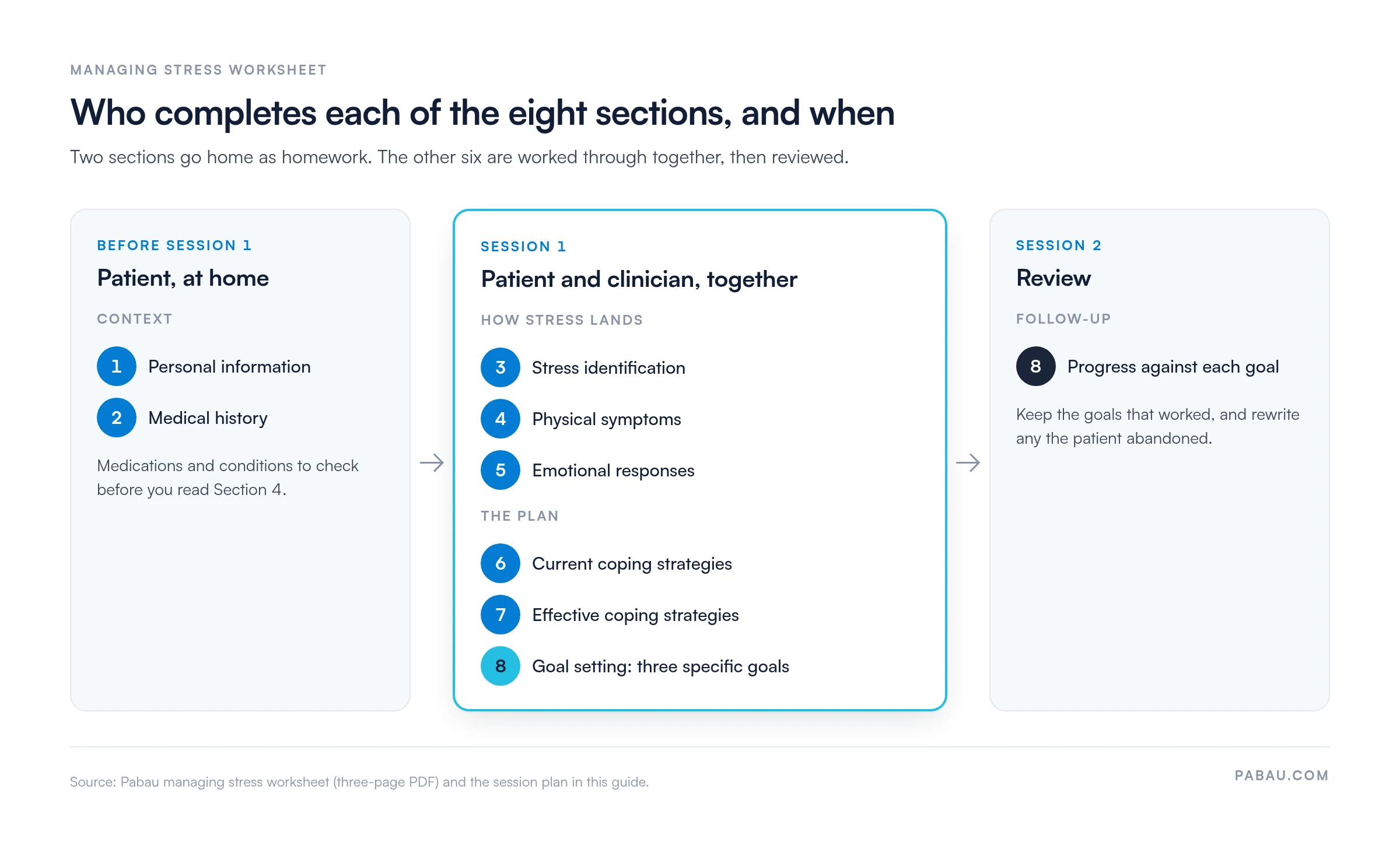
Keep the completed worksheet with the patient’s notes. At review, the goals give you a clear starting point for the conversation.
The download doesn’t include a rating scale or a tracking log. If you want numbers, you’ll need to add them yourself. For a validated baseline, the perceived stress scale is a separate questionnaire you can repeat at review.
Both are optional extras you create in your own system. Keep them on a separate sheet, so the worksheet itself stays as designed.
The World Health Organization lists burnout in ICD-11 as an occupational phenomenon, not a medical condition. It describes three dimensions. These are exhaustion, mental distance or cynicism toward the job, and reduced professional efficacy. (WHO classification of diseases)
The worksheet has no burnout section, but its answers can point there.
If several of these line up, talk about the job directly. Breathing exercises alone won’t fix a workload problem. The Maslach Burnout Inventory scores three closely matching dimensions if you want a structured check.
The worksheet’s own closing note says it isn’t a substitute for professional advice. It also tells patients with severe or chronic stress to contact a healthcare professional.
Take that seriously in your own reading. Persistent low mood or panic in Section 5 calls for a fuller clinical review. Any mention of self-harm calls for a formal self-harm assessment. In either case, follow your local referral pathway before setting self-help goals.
Paper worksheets get forgotten in bags and filed in the wrong folder. That leaves you starting the session without the answers you asked for.
Pabau, the therapy practice management software we build, can send the worksheet as a digital form before the appointment. The patient fills it in on their phone, and the answers land in their patient record.
When the session starts, Sections 1 to 8 sit next to your treatment notes. At the review, last time’s goals are already in the record, so you can pick up where you left off.

See how Pabau sends worksheets as digital forms and stores the answers in the patient record, ready for your next session.

The managing stress worksheet earns its place because it ends in goals the patient wrote themselves. Spend your time on Sections 3 and 6, because that’s where the patterns and the habits to replace come from.
Keep the goals small enough to complete, and add your own rating scale if you need to show progress. Book a demo to see how Pabau puts each completed worksheet in front of you before the session starts.

Want patients to name feelings more precisely? Emotional awareness worksheet builds the vocabulary that makes Section 5 easier to answer.
Is negative thinking driving the stress? Catastrophizing worksheet helps patients test worst-case thoughts in a CBT session.
Need a mindfulness exercise for Section 7? RAIN mindfulness worksheet walks patients through a four-step pause for difficult moments.
Looking to reframe self-critical thoughts? Positive self-talk worksheet gives patients a structured way to rewrite their inner commentary.
Want a broader view of wellbeing? Wellness worksheets cover sleep, movement and other areas that feed into stress.
Stress is usually a response to a specific pressure, and it eases once that pressure passes. Anxiety can persist without a clear trigger. If worry continues after the situation resolves, assess for an anxiety disorder.
The 4 A’s are avoid, alter, adapt and accept. Avoid unnecessary stressors, alter the situation where you can, adapt your expectations, and accept what you can’t change. They make a useful prompt list for Section 7.
Yes, older teenagers can usually complete it with some support. Younger patients may need help with Section 2, and parents or guardians often supply the medical history.
Yes, but keep Sections 1 and 2 private. Group members can share situations and coping ideas from Sections 3 to 7, then write their own goals individually.