Fair fighting rules worksheet
A fair fighting rules worksheet is a therapy handout that sets out ground rules ...

3
Last Updated: Oct 21, 2026
The name it to tame it worksheet is a structured self-reflection tool for working through strong emotions.
It helps people recognize emotional triggers, label their feelings accurately, and plan healthy ways to respond. It is built on the name it to tame it technique, which Dr. Dan Siegel popularized through his books Mindsight and The Whole-Brain Child.
The sheet opens with five calming steps, then moves through four written sections: identify, explore, cope and reflect. Practices can send it as one of the digital intake forms in Pabau, the practice management platform we build. This guide covers how the worksheet works, how to use it in clinical practice, and how it applies to children and adults.
A one-page printable worksheet that walks patients through recognizing emotional triggers, labeling feelings accurately, and developing healthy coping strategies. It opens with five calming steps, then sections to identify, explore, cope with and reflect on the emotion.
Download template
Naming an emotion out loud or on paper can lower its intensity, which is the idea behind Dan Siegel’s name it to tame it technique.
The worksheet opens with five calming steps, then moves through identifying, exploring, coping with and reflecting on the emotion.
It works for adults on their own and for children when a parent or clinician fills it in with them.
Use it as homework or an in-session prompt, and compare completed sheets over time to see patterns.
The worksheet supports emotional regulation work but does not diagnose or assess any condition.
Name it to tame it is an emotional regulation strategy. A person puts a word to a strong feeling so it becomes easier to manage. Dr. Dan Siegel and Dr. Tina Payne Bryson describe it in The Whole-Brain Child as a way for parents to calm an upset child.
When a feeling has a name, the person can talk about it, and talking about it tends to take some of its heat away. Siegel applies the same principle to adults in Mindsight.
Brain imaging research supports it. In a 2007 fMRI study, Lieberman and colleagues found that labeling an emotion reduced amygdala activity in response to negative images. Labeling also increased activity in the right ventrolateral prefrontal cortex, a region linked to regulating emotion.
The worksheet is a single printable sheet with space for the patient’s details and a parent or guardian’s name. It starts by settling the body, then guides the person through the emotion one question at a time.
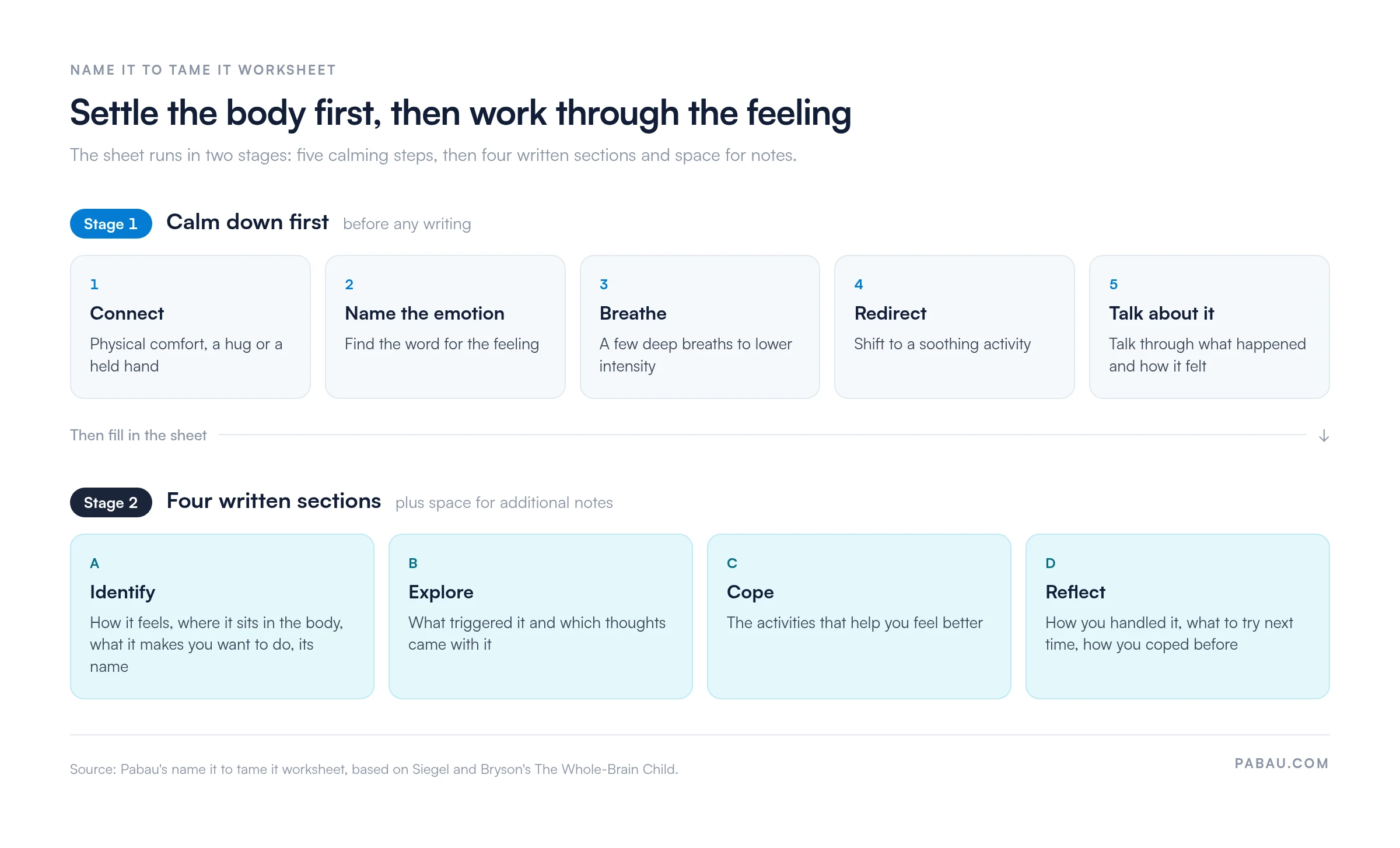
Before any writing, the worksheet asks the person, or the adult helping a child, to work through five steps:
After the calming steps, the worksheet moves through four sections and ends with space for additional notes:
The body-sensation question matters. Many people, children especially, notice a tight chest or a hot face before they can name a feeling. Starting with the body gives them a way in.
Therapists, counselors and psychologists can use the worksheet with individual patients, families and parents. A practical sequence looks like this:
The reflection section links naturally to cognitive behavioral therapy (CBT) and dialectical behavior therapy (DBT) work. The thoughts question gives you material for cognitive restructuring, and the coping list builds a personal toolkit.
Keep the clinical boundaries clear. The worksheet is a psychoeducational aid, not an assessment or diagnostic tool. If a completed sheet reveals thoughts of self-harm or harm to others, follow your practice’s risk and safeguarding procedures.
The same worksheet serves both age groups, but the way you use it changes. The main differences are who holds the pen and how much language the person brings.
| Children | Adults | |
|---|---|---|
| Who fills it in | A parent, caregiver or clinician, talking it through with the child | Usually the patient, alone or with their clinician |
| Calming steps | Physical comfort and co-regulation from a trusted adult come first | Self-soothing, breathing and a short pause before writing |
| Naming the feeling | Simple words like mad, sad or scared, often with an adult offering options | A more precise vocabulary, such as frustrated, ashamed or anxious |
| Exploring the cause | Retelling what happened as a short story | Linking the trigger to thoughts and recurring patterns |
| Reflection | One thing that helped and one thing to try next time | Comparing past coping with new strategies to test |
With children, the parent or clinician does most of the naming at first. Offer two or three words and let the child pick the closest one. Telling the story of what happened helps the child make sense of a big feeling. A child who can’t find any word yet can often point to a number on a feelings thermometer instead.
Clinicians can teach parents the five calming steps in a session, then send the worksheet home. Parents get a script for the next meltdown, and the completed sheet gives you something concrete to review.
Adults can usually complete the worksheet on their own. The challenge is often precision, because many adults default to broad words like stressed or upset. Push for a more specific word, since a precise label gives the patient more to work with. A printed list of feelings helps when the right word won’t come.
Adults also get more from the explore and reflection sections. Linking a trigger to a recurring thought often reveals a pattern the patient had not noticed before.
The worksheet suits any professional who helps people manage strong emotions:
Paper worksheets set as homework often come back crumpled or not at all. Completed sheets then sit in a folder, so spotting a pattern across several weeks means digging through paper.
Pabau’s therapy practice management software turns the worksheet into a digital form. You can send it automatically when a session is booked, and patients or parents complete it on their phone. Each answer is stored against the patient record.
In session, Pabau Scribe, our AI scribe, drafts the note while you debrief. Every Pabau subscription includes the full feature set, so forms, notes, scheduling and reminders sit in one system.

Pabau sends your name it to tame it worksheet before each session and stores every completed sheet in the patient record. You can review triggers and coping strategies over time without paper files.

The name it to tame it worksheet earns its value through repetition. One sheet shows how a person handled a single hard moment. Several sheets show whether their emotion words are getting sharper and their coping choices are working.
Start with the calming steps and the identify section until naming feels natural. With children, coach the parent before you hand the sheet over. With adults, push for precise words and keep every completed sheet for comparison.
Book a demo to see how Pabau sends worksheets before each session and keeps every completed sheet in the patient record.

Want patients to track emotions in more depth? Emotional awareness worksheet links each emotion to its trigger, intensity, thoughts and coping strategies.
Need a wider vocabulary for naming feelings? Emotion wheel worksheet gives patients a visual list of precise emotion words to choose from.
Want to connect emotions to body sensations? Sensation and emotion wheel helps patients map where each emotion shows up physically.
Ready to move from naming emotions to managing them? Emotional regulation worksheet builds on naming with structured regulation skills.
Looking for a mindfulness exercise to pair with it? RAIN mindfulness worksheet walks patients through recognizing and investigating difficult emotions.
Name it to tame it is a strategy where you put a word to a strong emotion to make it easier to manage. Dr. Dan Siegel popularized it in The Whole-Brain Child and Mindsight.
Research suggests it can. A 2007 fMRI study by Lieberman and colleagues found that labeling emotions reduced amygdala activity in response to negative images.
Yes. A parent, caregiver or clinician fills it in with the child, offers simple emotion words to choose from and talks through what happened.
It opens with five calming steps: connect, name the emotion, breathe, redirect and talk about it. Four sections follow: identify, explore, coping and reflection, plus space for notes.
Yes. The thoughts question supports cognitive restructuring in CBT, and the coping and reflection sections fit DBT emotion regulation work.
No. It is a psychoeducational and self-monitoring aid, best used under the guidance of a qualified mental health professional.
Ask them to complete it after a strong emotion, while the details are fresh. Reviewing a few sheets together helps you spot repeated triggers and coping patterns.