GI bleed nursing care plan
A GI bleed nursing care plan is a structured document for a patient with gastroi...

1
Last Updated: Oct 15, 2026
Wellness worksheets are structured self-assessment forms that capture a patient’s mood, stress, sleep, goals, and daily habits in one place. Practitioners use them before or between visits to see where a patient is now and to track progress over time.
Notes from verbal check-ins are hard to compare from one visit to the next. A standardized worksheet gives every practitioner the same questions, so changes in the answers are easier to spot.
Our free template has five sections. It opens with 1 to 10 ratings for mood, stress, and sleep. Then it covers goal setting, emotional well-being, a gratitude journal, and a daily habits tracker.
A five-section worksheet with 1 to 10 ratings for mood, stress, and sleep, plus space for goals and coping strategies. It closes with a gratitude journal and a daily habits and activities tracker.
Download template
Wellness worksheets give practitioners a consistent starting point for wellness conversations.
The 8 dimensions of wellness, a framework developed by Margaret Swarbrick and promoted by SAMHSA, provide a useful structure for worksheet content.
Worksheets support self-management alongside professional care. They don’t replace clinical treatment.
Repeating the same worksheet version at each review turns one-off answers into a trend you can show the patient.
Practice software such as Pabau can send worksheets as digital forms and store completed ones against the patient timeline.
Wellness worksheets are used to gather structured information about a patient’s well-being before or between appointments. Clinicians may use them to open a conversation about lifestyle, goals, and daily habits.
Worksheets can be completed at home, in the waiting room, or during a session. At home, patients have time and privacy to think through their answers. In the session, you can clarify a question the moment it causes confusion.
The template runs in five sections, and each one feeds a different part of the review conversation.
The three 1 to 10 ratings are the quickest answers to compare across visits. Read them first, then use the written sections to explain any shift.
The 8 dimensions of wellness are a framework developed by Margaret Swarbrick and promoted by SAMHSA. They cover physical, emotional, intellectual, social, spiritual, occupational, financial, and environmental wellness. For a worksheet that walks patients through all eight, our 8 dimensions worksheet adds reflection prompts and self-rating scales.
Physical wellness sections often include activity logs, sleep questions, and nutrition prompts. Emotional wellness sections typically ask about mood, stressors, and coping approaches.
Practitioners can review the physical and emotional responses first, then move to the dimensions that need deeper exploration.
A self-care worksheet asks an adult to note current routines, flag the habits that have slipped, and choose one or two areas to focus on. It’s built for reflection and isn’t designed to diagnose a condition.
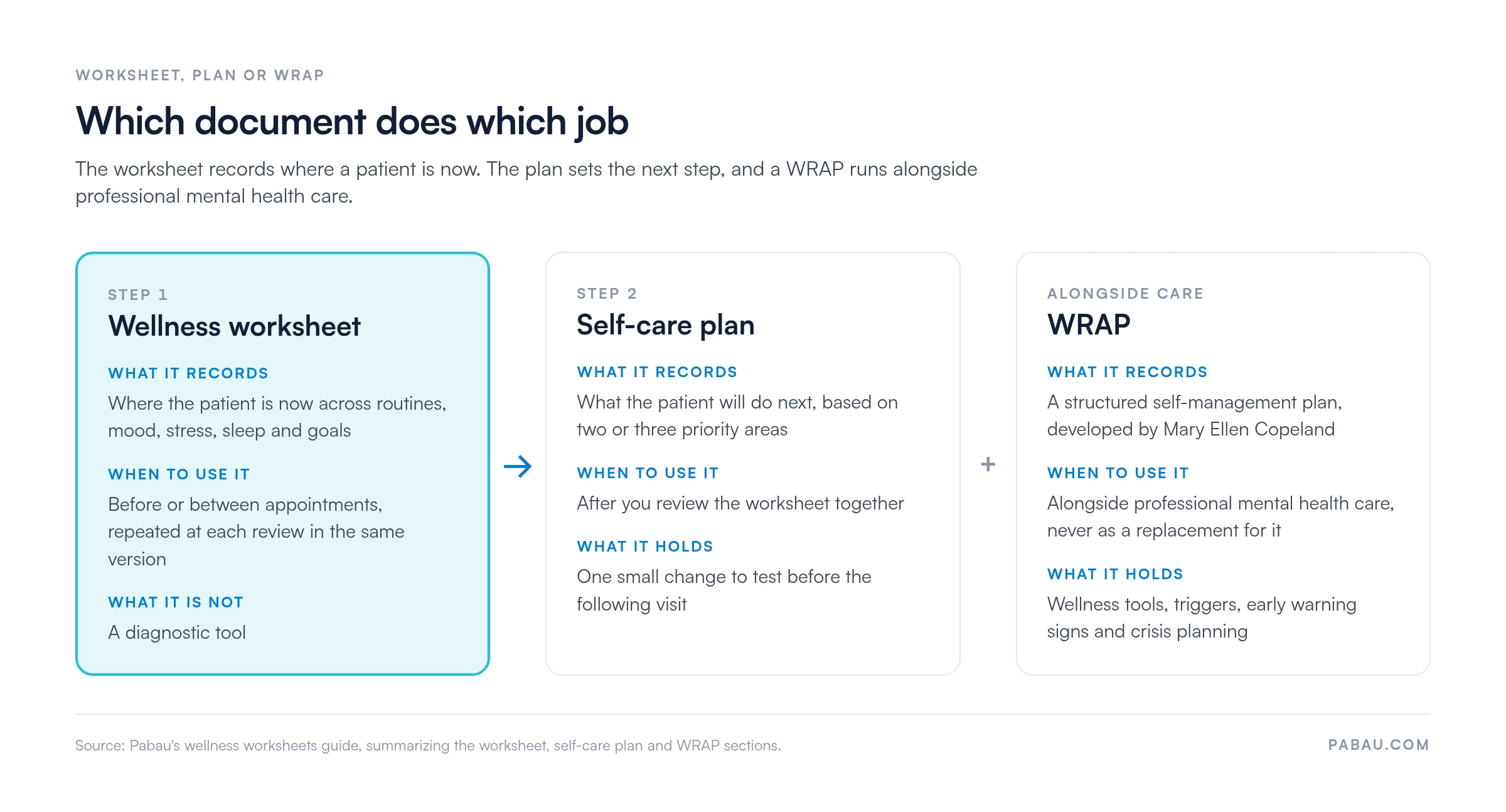
A self-care plan is the follow-on document. The worksheet captures where a patient is now, and the plan sets out what they will do next. Our self-care worksheet scores five parts of a patient’s life and sets one goal for each.
The Wellness Recovery Action Plan (WRAP) was developed by Mary Ellen Copeland as a structured self-management tool. It is used alongside professional care, not as a replacement for it.
WRAP worksheets typically cover wellness tools, triggers, early warning signs, and crisis planning. Mental health practitioners may use them to structure session discussions. Our WRAP worksheet adds a daily maintenance plan and post-crisis planning to those sections.
A wellness worksheet, a self-care plan, and a WRAP do different jobs, and one patient can hold all three. The comparison below shows where each one fits.
Review worksheets with the patient in the room rather than handing them off. Discussing two answers together usually produces a more useful plan than a completed form collected at reception.
A wellness worksheet works best when it has a clear place in the appointment flow. Decide at what stage it is assigned and who reviews it.
Use the same worksheet version for each review. Changing questions between visits makes trends hard to read.
On paper, a worksheet is handed out at reception, filed after the session, and rarely seen again. Comparing this month’s answers with last quarter’s means digging through folders.
Pabau, the practice management software built for therapists and wellness teams, sends the worksheet as one of its digital forms before the appointment. The patient completes it at home, and the response is saved with the rest of their documents.
Completed worksheets sit on the patient timeline, so practitioners can open the last visit’s answers beside today’s. When every review uses the same version, you can show the patient which ratings have moved.
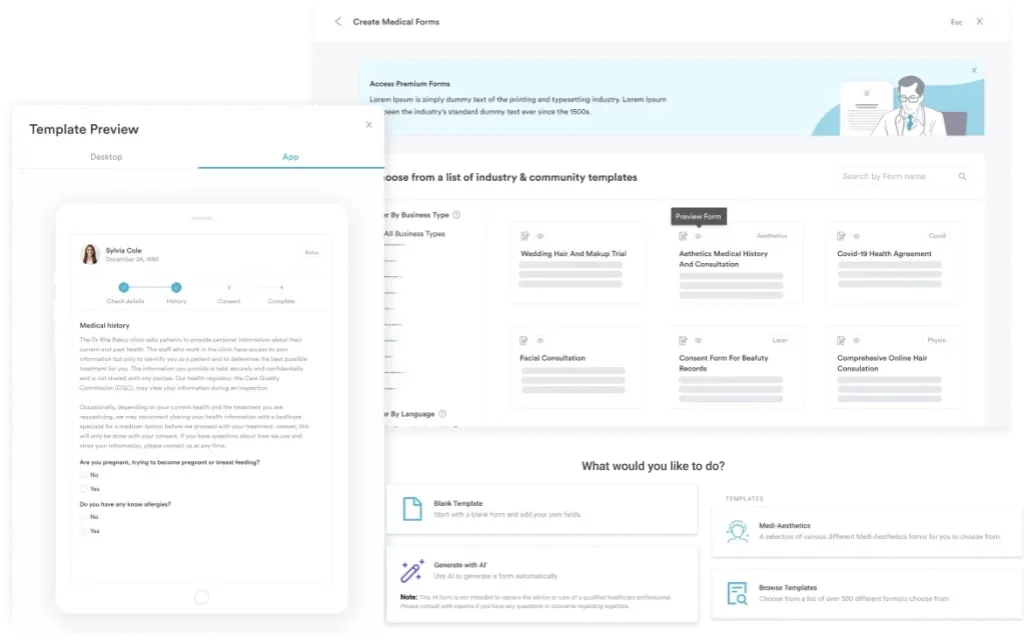

See how Pabau sends worksheets before appointments and saves each response to the patient’s record. Your team can then follow up on wellness goals.

A wellness worksheet only earns its place when someone reads it with the patient. Pick one version, assign it at the same point in every care pathway, and review two answers together at the next visit. That small routine does more than a longer form.
The trade-off is time. A reviewed worksheet adds a few minutes to a session, while a worksheet collected but never discussed just adds paperwork. If your team can’t commit to the review, shorten the form rather than skip the conversation.
Repeat the same worksheet every few visits and the answers start to show a trend. That’s the point where a one-off form becomes evidence of progress you can share with the patient.
Pabau’s client record keeps each completed worksheet beside the treatment notes, so the next review starts from the last one. Book a demo to see how Pabau sends wellness worksheets before appointments and tracks the answers over time.

Want a quick score across every dimension? Wellness wheel worksheet rates eight dimensions on a 1 to 10 scale and records two action-plan goals.
Need a deeper self-care assessment? Self-care inventory rates 55 self-care statements across six domains and closes with an improvement plan.
Exploring the spiritual dimension in more depth? Spirituality worksheet gives patients guided prompts on values, purpose, and meaning.
Turning worksheet answers into goals? Life goal planner helps patients break a wellness priority into steps they can track.
Need a measure of recent life stress? Holmes and Rahe Stress Scale scores major life events to show how much change a patient is carrying.
Wellness worksheets are structured tools that capture a patient’s lifestyle, goals, and wellness indicators. Practitioners use them to start conversations and track change between visits.
The 8 dimensions of wellness are physical, emotional, intellectual, social, spiritual, occupational, financial, and environmental wellness. The framework was developed by Margaret Swarbrick and is promoted by SAMHSA.
Worksheets help patients reflect on routines and identify one or two areas to focus on. They support self-management alongside professional care.
Yes. Practices commonly use worksheets as part of intake or between-session work. Check copyright terms before reproducing third-party materials.
There’s no set schedule. A common approach is to repeat the worksheet at each review appointment, using the same version every time. A consistent interval and question set make changes between answers easier to spot.
No. Wellness worksheets are reflective tools that help patients describe their routines and goals, and they don’t diagnose a condition. When an answer raises a clinical concern, follow up with a validated screening tool or a full assessment.
A wellness worksheet records where a patient is now across areas such as sleep, mood, and relationships. A self-care plan is the follow-on document. It sets out the specific actions the patient will take before the next review.
Yes. Practices can send a worksheet as a digital form before the appointment, so the patient completes it at home. In Pabau, completed forms are saved to the patient’s record, ready for the practitioner to review in the session.
Mary Ellen Copeland developed the Wellness Recovery Action Plan (WRAP) with a group of people who had lived experience of mental health difficulties. It’s a self-management plan covering wellness tools, triggers, early warning signs, and crisis planning.