Reflection questions: 14 examples and a free template
Reflection questions are open-ended prompts that guide a person through structur...

1
Last Updated: Oct 16, 2026
An emotional awareness worksheet is a structured psychoeducational tool that helps patients notice, name and track what they feel. Therapy can then build on that information. Many patients can describe a problem but struggle to say which emotion is driving it. That slows progress in early sessions.
This free PDF gives therapists and counselors a ready-to-use resource for adult patients in individual or group work. Its six sections cover emotions, triggers, intensity, thought patterns, coping strategies and reflection, and it fits alongside CBT and DBT approaches. Use it under the guidance of a qualified mental health professional, not as unsupported self-help.
A three-page worksheet with six sections: Identifying emotions, emotional triggers, a 1 to 10 intensity rating, thought patterns, coping strategies, and reflection and review. It closes with space for additional notes.
Download template
The worksheet is a psychoeducational aid for adult patients, not a diagnostic or standalone assessment tool.
Its six sections take a patient from naming an emotion and its trigger to rating intensity, spotting thought patterns and choosing a coping strategy.
Emotional awareness is a foundation for the emotional regulation skills taught in CBT and DBT.
Repeating the worksheet across sessions turns intensity ratings and reflections into a simple record of progress.
Use it under the guidance of a qualified mental health professional, with appropriate caveats for adolescents.
An emotional awareness worksheet is a printable therapeutic handout that guides a patient through naming and observing their emotions in a structured way. It is a psychoeducational and self-monitoring aid. It is not a diagnostic instrument, and it does not treat or cure any condition.
Emotional awareness sits within the wider concept of emotional intelligence. Salovey and Mayer, and later Goleman, both describe it as including the ability to recognize one’s own emotions. Clinicians use the worksheet to make that abstract skill concrete, one prompt at a time.
Feelings are the subjective experience a patient reports, while emotions are the broader physiological and behavioral states that produce them. Patients often use the two words interchangeably. The worksheet asks for specific, descriptive words, which makes the report more precise.
Emotional awareness comes before emotional regulation. A patient who cannot identify an emotion has few options for managing it, which is why many regulation frameworks start with identification. Gross’s process model shows where in the emotion process regulation strategies act. Models such as Gratz and Roemer’s treat emotional awareness and clarity as one dimension of regulation.
The clinical pathway runs from awareness to understanding to regulation. The worksheet’s six sections fall into those three stages in pairs, as the diagram below shows.
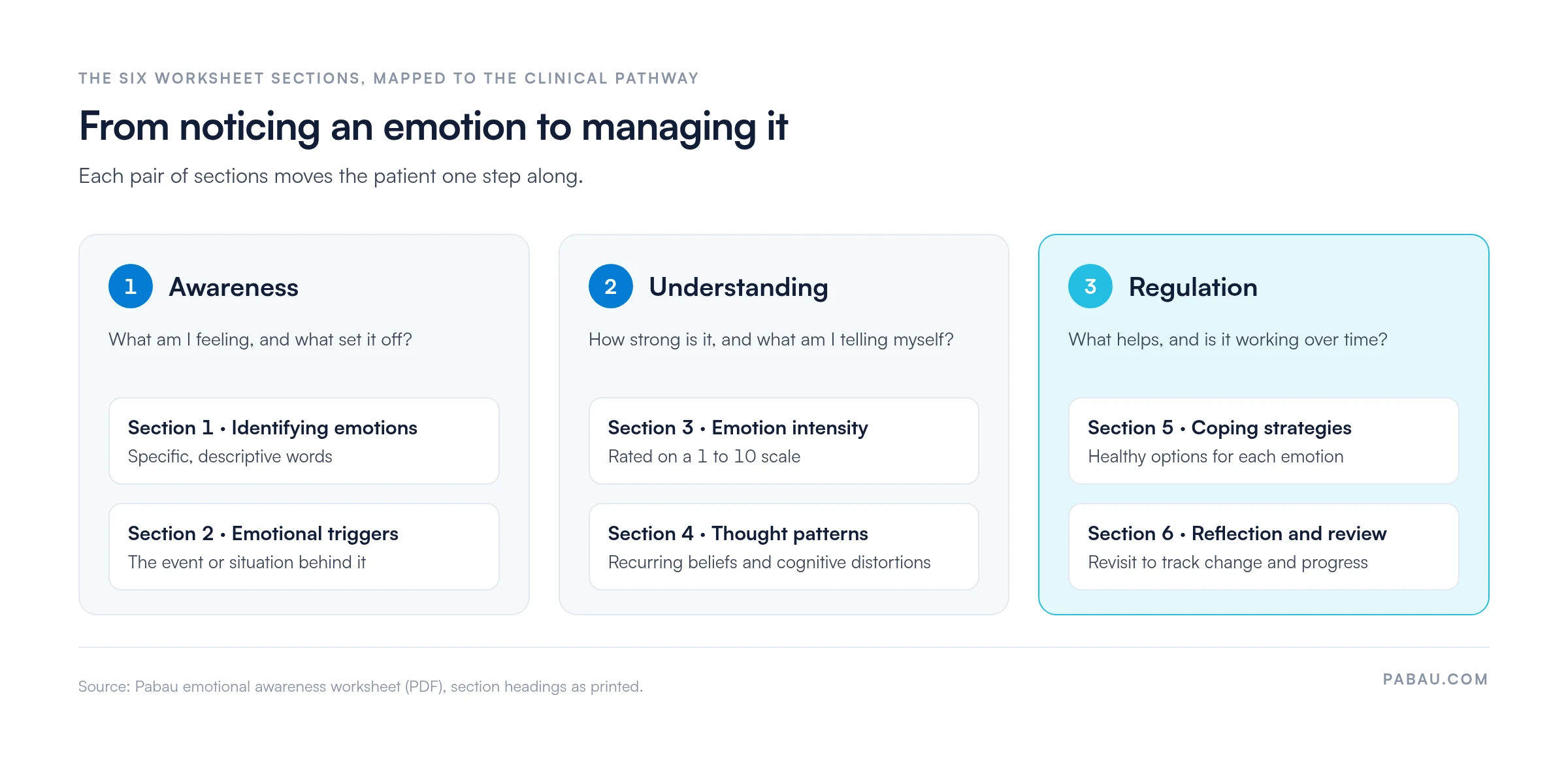
This order is useful when you pace the work. A patient who stalls at section 1 needs more vocabulary practice before coping strategies will stick.
The PDF has a patient name and date field, a short confidentiality note, and six sections that each target one step of emotional awareness. You can complete it in session or set it as homework, and each section also works on its own.
The intensity rating turns a vague feeling into a number you can compare. Agree what 1 and 10 mean with the patient the first time they use it. Without shared anchors, a 7 one week and a 7 the next may not describe the same experience.
Section 4 links each emotion to the thought that came with it. Common distortions to listen for include catastrophizing, mind reading and all-or-nothing thinking. Name the pattern gently, and leave detailed restructuring for a dedicated thought record.
A filled-in example helps patients see the level of detail you are asking for. The entries below are illustrative, written for a patient preparing for a performance review at work.
Notice how the example separates the trigger from the thought about it. That split gives you a clear place to start in session, and it shows the patient that coping can change a rating.
Introduce the worksheet as a way to make sense of feelings. Frame that purpose before the patient picks up a pen, because patients who expect a score often answer defensively.
Keep the debrief short, and link it to the patient’s goals for therapy. Completed worksheets hold sensitive personal information, so store them under your local data protection rules. In the US that means HIPAA, and in the UK and EU it means GDPR.
Patients who complete the sheet at home usually bring more honest answers. Sending it digitally before the appointment also saves session time for the debrief.
Most difficulties with the worksheet show up in the same few places. Each one tells you something about where the patient is on the awareness pathway.
Persistent difficulty identifying and describing feelings is sometimes called alexithymia. If you see it across several sessions, consider a validated measure and adjust your pace. The worksheet alone cannot assess it.
In CBT, the thought patterns section pairs naturally with thought records and cognitive restructuring. The patient can see how a thought shaped the emotion before testing that thought in later work.
DBT’s emotion regulation module includes skills for observing, describing and naming emotions, so the worksheet can sit alongside that work. It is not a DBT worksheet in the protocol sense, and it does not replace structured DBT skills training.
Section 6 asks the patient to revisit the worksheet over time. Used that way, a stack of completed sheets becomes a simple outcome record that you and the patient can read together.
Research on emotional granularity, the ability to tell similar emotions apart, links more precise emotion words with more flexible regulation. Rising vocabulary in section 1 is therefore worth noting as progress in itself.
The worksheet works best when patients practice between sessions. Short activities help them keep building the skill without a full written exercise each time.
Adult patients who find emotions hard to name benefit most, including those working on anxiety, depression, trauma or emotional dysregulation. The worksheet is designed for adults, and therapists often introduce it early in treatment.
It is not suitable as a standalone assessment, and it is not validated for children. Adolescents may use an adapted version only with appropriate clinical caveats and professional oversight. Once naming comes easily, an emotional regulation worksheet is a natural next step.
On paper, a worksheet set as homework often comes back crumpled, half-finished or not at all. Completed sheets then sit in a folder, so comparing this month’s ratings with last month’s means digging.
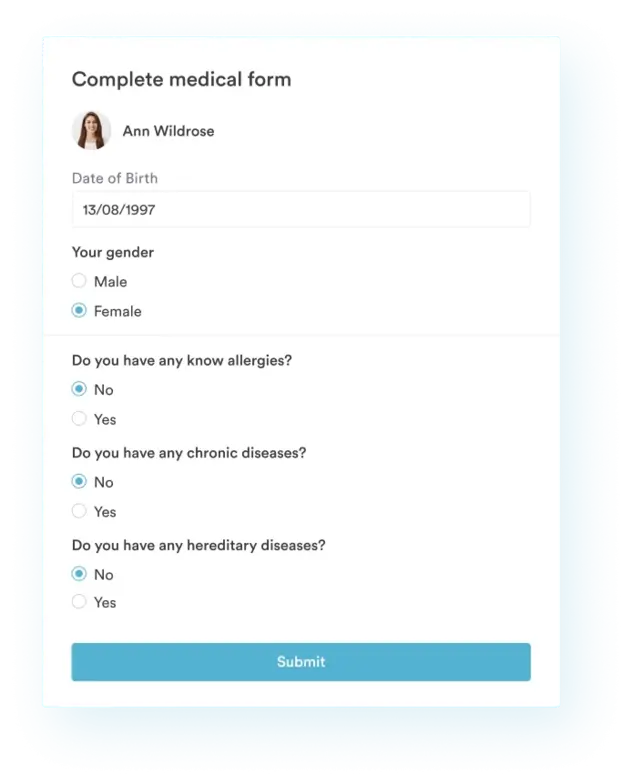
Pabau’s therapy practice management software turns the worksheet into a digital form. Patients complete it on their phone before the appointment, and each answer is stored against their patient record. Through digital forms, you can send it automatically when a session is booked.
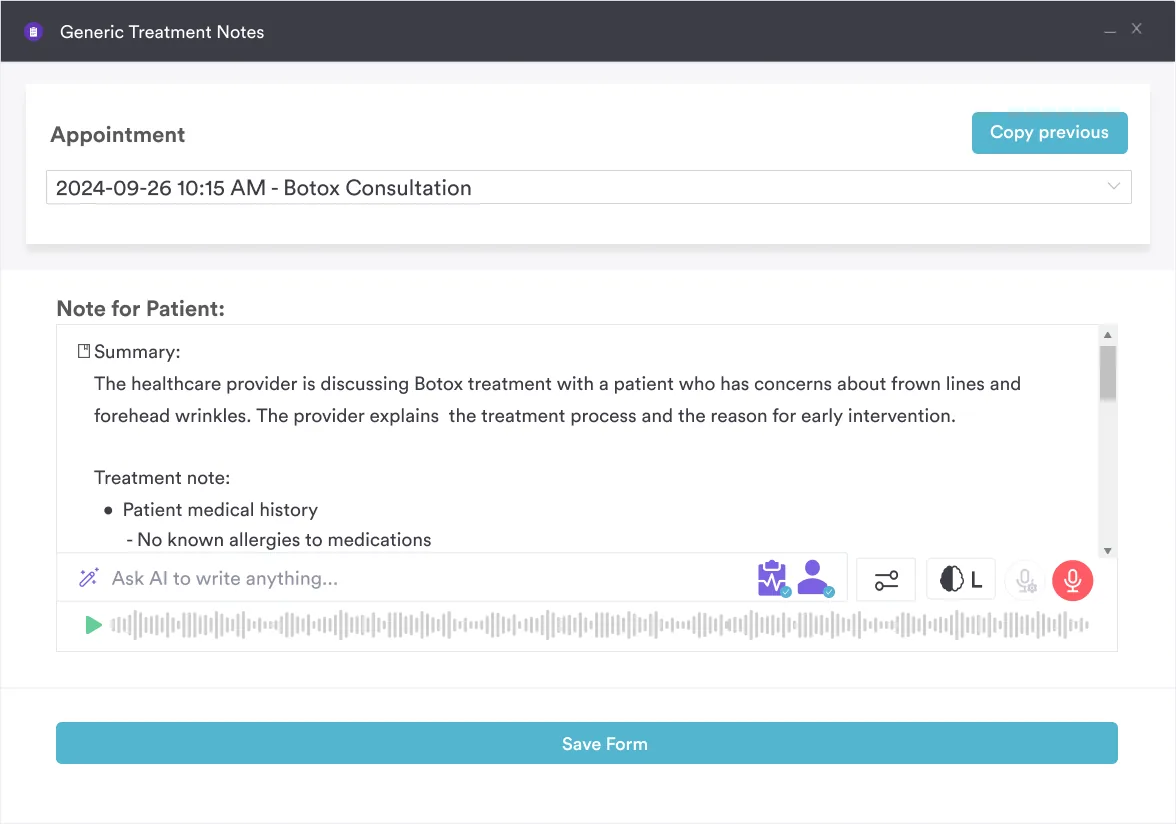
In session, Pabau Scribe drafts the note while you debrief. Every Pabau subscription includes the full feature set, so forms, notes, scheduling and reminders sit in one system.

Pabau sends your emotional awareness worksheet before each session and stores every completed sheet in the patient record. You can see how ratings change over time without digging through paper files.

An emotional awareness worksheet earns its place when it is repeated. A single sheet shows how a patient labels one hard moment. Six sheets show whether their words are sharpening and their ratings are falling.
Start with sections 1 and 2 until the patient can name emotions precisely, then build toward coping strategies. Keep each completed sheet, because the comparison between them is where the clinical value sits.
Book a demo to see how Pabau sends worksheets before each session and keeps every completed sheet in the patient record.

Need a wider emotion vocabulary for section 1? Emotion wheel worksheet gives patients a visual list of precise emotion words to choose from.
Want to connect emotions to body sensations? Sensation and emotion wheel helps patients map where each emotion shows up physically.
Ready to move from naming emotions to managing them? Emotional regulation worksheet builds on awareness with structured regulation skills.
Looking for a mindfulness exercise to pair with it? RAIN mindfulness worksheet walks patients through recognizing and investigating difficult emotions.
Measuring self-regulation over time? Self-regulation questionnaire gives you a structured way to assess change across treatment.
An emotional awareness worksheet is a printable psychoeducational handout that helps patients name and track their emotions. It supports self-monitoring within therapy and is not a diagnostic tool.
Yes, the worksheet can be used alongside CBT and DBT approaches. It is compatible with DBT emotion regulation modules but is not a protocol-specific DBT worksheet.
No, the worksheet is designed for adult patients. Adolescents may use an adapted version only with appropriate clinical caveats.
No, it does not diagnose or assess any condition. It is a psychoeducational and self-monitoring aid for use under the guidance of a qualified mental health professional.
The worksheet has six sections: Identifying emotions, emotional triggers, emotion intensity on a 1 to 10 scale, thought patterns, coping strategies, and reflection and review. It ends with space for additional notes.
Weekly is a practical default, set before or after a session. Repeating it lets you compare intensity ratings and emotion words over time, which section 6 is designed for.
Time varies with the patient and the situation. The first attempt usually takes longest, because naming specific emotions is the skill being practiced.
Start with an emotion wheel and ask the patient to pick the closest word. If the difficulty persists across sessions, consider whether a validated measure of alexithymia is appropriate.
Yes, it works in group settings. Ask members to complete sections 1 to 3 privately, then share only what they are comfortable with during the debrief.
An emotion wheel is a vocabulary tool for finding the right word. The emotional awareness worksheet goes further, linking that emotion to its trigger, intensity, thoughts and coping strategies.