Journal prompts for mental health
Journal prompts for mental health are guided questions that help people process ...

2
Last Updated: Oct 13, 2026

RAIN stands for Recognize, Allow, Investigate, and Nurture, a four-step technique for working with a difficult emotion.
Mindfulness teacher Michele McDonald originated RAIN in the 1980s. Tara Brach later adapted the fourth step to Nurture and popularized it.
The worksheet gives every step its own prompt, so clients can practice between sessions without a therapist guiding them.
Therapists use it live in session, in group work, as homework, and as a grounding tool when a client becomes anxious.
Four lines in the clinical note cover a RAIN session: the trigger, the resistance, the sensation named, and the phrase chosen.
Pabau sends the worksheet from the client’s record, chases completion, and files the answers back in the same place.
A RAIN mindfulness worksheet gives a client four printed sections, one for each step of the technique: Recognize, Allow, Investigate, Nurture. You can download ours free below. Every section carries its own prompt, so the client needs no prior meditation experience and no therapist reading a script aloud.
One pass through the sheet takes 10 to 20 minutes. Below you will find what each letter asks for and how to introduce the worksheet in session. It also covers what to record in the client’s note afterward, which is where the clinical value of the exercise ends up sitting.
A printable worksheet with a guided prompt for each of the four RAIN steps. It gives the client space for body-awareness notes, a self-compassion phrase, and a short reflection they write at the end.
Download templateA RAIN mindfulness worksheet is a therapy form that walks a client through a mindfulness practice, one step per section. The client sets the pace. That makes the same exercise usable in a session, in a waiting room, or at home on a bad evening.
RAIN was originated in the 1980s by mindfulness teacher Michele McDonald. Psychologist Tara Brach later adapted it, changing the fourth step to Nurture, and popularized the version most therapists use today. She publishes free RAIN guidance and guided meditations on her site.
A breathing exercise asks the client to calm down. RAIN asks them to name what is happening first, then soften toward it. The worksheet is what makes that sequence concrete enough to repeat without you.
The four steps build on each other, and the order carries the work. Jumping straight to self-compassion without recognizing what is happening tends to land as reassurance rather than practice.
Introduce the sheet in session before you ever send it home. Five steps cover the handover.
The map below pairs each step with the question you ask out loud and the line worth carrying into the clinical note.
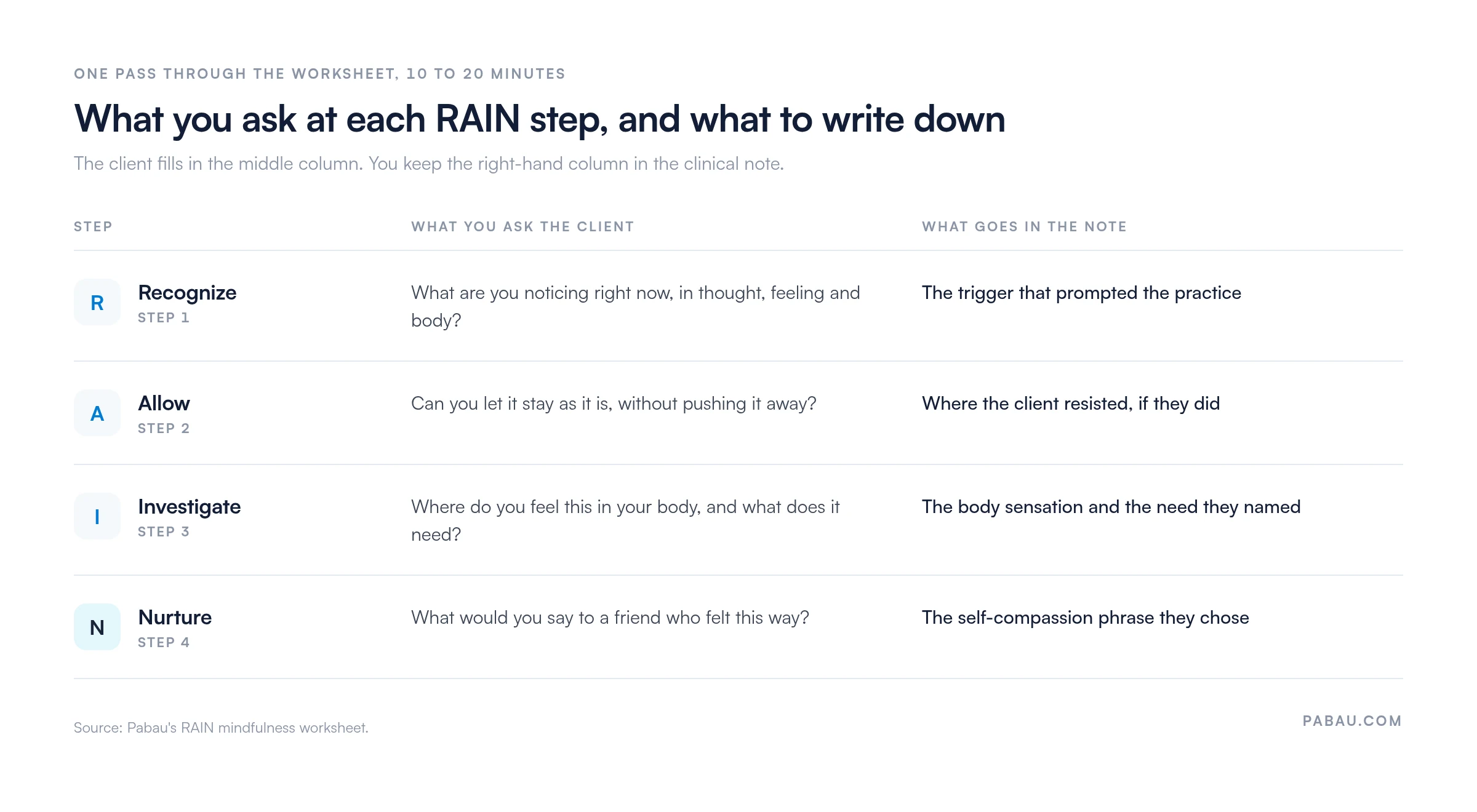
Record which step produced the most insight and which one the client resisted. A structured SOAP note keeps that detail attached to the session, so you know where to pick the work up next time.
RAIN works on anxiety because it interrupts avoidance, and avoidance is what keeps worry running. For a few minutes the client turns toward the feeling instead of away from it.
In session, reach for the sheet when a client gets triggered and starts to spiral. The prompts hand them a next action instead of a loop. If they are too activated to write at all, a grounding techniques worksheet is the gentler first move.
RAIN draws on the same principles as mindfulness-based cognitive therapy, known as MBCT, and on self-compassion research. It is not a formal MBCT protocol, so the published evidence supports the principles rather than this specific sequence. Say that plainly to a client who asks.
Where the exercise lands in a client’s week matters as much as how carefully they fill it in.
Finishing the sheet is the start of the work rather than the end of it. Ask the client for a short reflection straight afterward. Three prompts do the job: what did I learn, how do I feel now, and what will I do differently tomorrow?
Your own note needs far less than the client’s reflection. Four lines cover a RAIN session:
Filed in order, those four lines become a record of a client learning to sit with a difficult feeling. A single client record management system keeps the completed sheets beside the session notes, so the sequence still reads clearly months later.

A follow-up message raises the odds that the practice happens at all. Ask one short question about how the week went. That works better than a long reminder email nobody opens.
Most practices email the worksheet as a PDF attachment and hope it comes back. The client prints it and loses it, or completes it and forgets to bring it. The therapist then rebuilds the session from memory.
Practice management software like Pabau turns the sheet into a digital form you send from inside the client’s record. They complete it on a phone, and the answers land back in that same record, timestamped. Nothing gets rekeyed and nothing sits in an inbox.
Automated reminders chase whoever has not finished, so you are not doing it yourself on a Friday afternoon. Therapy practice management software from Pabau includes the forms, the reminders, and the client record in every subscription. There is no add-on to buy for this.

Pabau turns the RAIN worksheet into a digital form you send from the client’s record. Answers come back timestamped, and automated reminders chase whoever has not finished it yet.

RAIN earns its place because it hands a client something to do with a feeling they would otherwise avoid. The worksheet is what makes that repeatable when you are not in the room.
Use it live in one session, then send it home for the week after. Keep the four-line note discipline while you do. The sheets on their own are an exercise, and the notes are what turn them into a visible arc of progress.
Book a demo to see how Pabau sends therapy worksheets, chases the ones that come back late, and files every answer in the client’s record.

Is the client too activated to write anything down? Grounding techniques worksheet gives them something physical to do before they try RAIN.
Need words for the Nurture step? Self-compassion meditation script supplies phrasing you can read aloud or hand over.
Clients stalling on the Investigate step? Body scan meditation script teaches them to locate a feeling in the body first.
Stuck on Allow, session after session? Radical acceptance worksheet works the same muscle from a different angle.
Want a lighter weekly check-in between sessions? Emotional check-in worksheet takes two minutes and still gives you something to review.
RAIN is an acronym for Recognize, Allow, Investigate, and Nurture. Mindfulness teacher Michele McDonald originated the framework, and Tara Brach later adapted it and popularized it. The four steps ask the client to notice a difficult emotion, let it be, explore it with curiosity, and then respond with self-compassion.
A full pass usually takes 10 to 20 minutes, depending on how far the client goes with each step. First-timers take longer while they learn the sequence. Experienced practitioners move through it faster.
No. It suits most therapy clients, but body-focused awareness can raise distress during an acute psychotic episode or severe dissociation. Assess readiness first, and adapt the practice to the client in front of you.
RAIN draws on mindfulness-based cognitive therapy (MBCT) and self-compassion research, both of which carry peer-reviewed support for anxiety and emotion regulation. RAIN itself is not a formal MBCT protocol, so that evidence backs the principles rather than this specific sequence.
Mindfulness teacher Michele McDonald originated RAIN in the 1980s. Psychologist Tara Brach adapted it, changing the fourth step to Nurture, and popularized the version most therapists know today. Brach publishes free RAIN resources and guided meditations on her website.