Low-Fiber Food List: What to Eat, What to Avoid
A low-fiber food list sorts everyday foods into what a patient can eat and what ...

2
Last Updated: Oct 13, 2026
A positive self-talk worksheet is a structured therapy tool for catching a negative thought, testing it against the evidence, and rewriting it as realistic self-talk.
Our CBT-informed template uses principles from cognitive behavioral therapy (CBT) to guide users through a structured process drawn from CBT. It takes three steps: Identify the thought, challenge it, and write one to three short statements to repeat when it returns.
Negative self-talk is the inner critic’s running commentary, and it fuels anxiety, low confidence and depressive thinking. Research on CBT-based cognitive restructuring links it to improvements in mood and coping.
Clinicians can set the worksheet as homework or use it in session. Individuals can also complete it on their own whenever a familiar thought shows up.
A printable worksheet with space to record a negative thought, questions to challenge it, and lines for your reframe and personal self-talk statements. It follows CBT principles and works in session or as homework.
Download template
A positive self-talk worksheet guides users through spotting negative thought patterns and replacing them with realistic alternatives using CBT-informed cognitive restructuring.
The worksheet draws on cognitive behavioral therapy (CBT) and can help with anxiety, low self-esteem, depressive thinking and performance nerves. It complements professional mental health treatment and does not replace it.
Therapists and educators use it as homework, a group activity or an in-session tool, while individuals use it to manage recurring thoughts on their own.
A new statement only helps if you believe it, so rate each one from 0 to 100% and soften any that feel forced.
Pabau, the practice software we build, lets therapists send the worksheet through its digital intake forms and keep each completed copy in the patient record.
A positive self-talk worksheet is a therapeutic document that walks you through recognizing unhelpful thoughts and replacing them with balanced alternatives. It usually has three sections:
Therapists, counselors, psychologists and mental health educators use it in several settings:
Individuals also use the worksheet on their own, daily or as needed, to manage anxiety, build confidence or work through difficult emotions.
Positive self-talk is the practice of replacing self-critical inner dialogue with realistic, compassionate and encouraging thoughts. It differs from empty affirmations such as “I am perfect.” Helpful self-talk admits the difficulty and still offers support: “This is difficult, and I have handled difficult things before.” Because it stays grounded in fact, it is easier to believe.
Important note: Positive self-talk complements therapy, medication and professional treatment but does not replace them. For clinical anxiety, depression or trauma, work with a mental health professional who can build self-talk practice into a broader treatment plan.
Positive self-talk is rooted in CBT, one of the most researched psychotherapy models. CBT rests on the idea that thoughts, feelings and behaviors are linked, so changing a thought pattern can shift emotions and actions. Its core technique is cognitive restructuring. You identify an automatic negative thought, weigh the evidence for and against it, and build a more balanced alternative.
Say someone feels anxious before a presentation and thinks “I will fail.” CBT teaches them to pause and ask: “Is this thought based on fact? Have I presented before? What evidence contradicts it?” The restructured thought becomes “I am nervous, and nervousness is normal. I have prepared, and I can manage my anxiety.” That new thought holds up because the evidence supports it, which is why it works better than forced cheerfulness.
If you want a fuller layout for weighing evidence for and against a thought, pair this template with a cognitive restructuring worksheet.
The worksheet takes three steps, and each one builds on the last. The example below follows a single thought through all three sections.
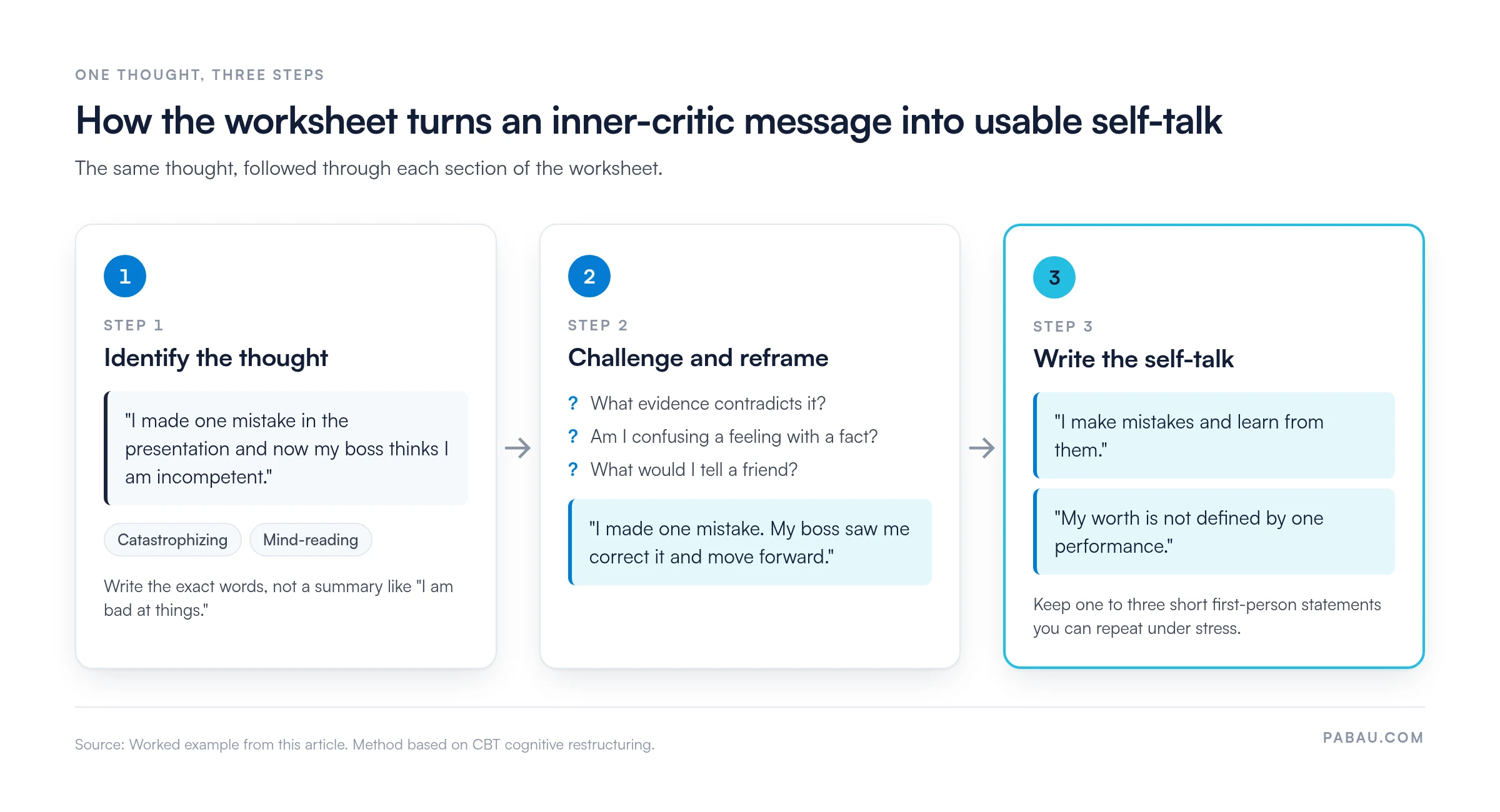
In the first section, write down the negative or anxious thought you want to work with. Be specific. Instead of “I am bad at things,” write “I made one mistake in the presentation and now my boss thinks I am incompetent.” Note the exact inner-critic message, including the leap from one mistake to your boss’s judgment.
Common patterns to watch for include:
If the same situation keeps setting the thought off, map it with trigger worksheets before you start reframing. Patients whose inner critic is loud and constant may get more from a negative self-talk worksheet first.
Use the worksheet’s reflection questions to test the thought. Ask yourself: “What is the evidence this thought is true? What evidence contradicts it? Am I confusing a feeling with a fact? What would I tell a friend in this situation?”
Then write a reframed thought that is honest but less harsh. For example: “I made one mistake. My boss saw me correct it and move forward. One mistake does not erase my overall competence.”
Write one to three short, realistic statements to repeat when the negative thought comes back. Each one should sound like encouragement you could believe on a bad day. Examples include “I make mistakes and learn from them,” “I have overcome challenges before,” and “My worth is not defined by one performance.”
Write the statements in first person (“I am…” or “I can…”), because first-person statements tend to feel more personal and are easier to remember. Keep them brief enough to recall during moments of stress.
Before you settle on a statement, rate how much you believe it from 0 to 100%. CBT thought records use the same kind of belief rating. If a statement scores low, soften it until it feels credible, for example “I am learning to handle this” instead of “I am confident.”
Different situations trigger different automatic negative thoughts. The examples below show how to reframe common inner-critic messages into supportive self-talk.
Self-compassion and positive self-talk are related but distinct. Positive self-talk uses cognitive techniques to reframe negative thoughts into more realistic, encouraging ones. Self-compassion goes one layer deeper. It means treating yourself with the kindness and understanding you would offer a friend. Where positive self-talk says “I can do this,” self-compassion says “This is hard, and it is okay to struggle.”
The two work well together. In one session, a therapist might teach cognitive restructuring to shift anxious thoughts. They might then add self-compassion practice, such as mindful acknowledgment and self-kindness, to keep the harsh inner critic from returning. People who practice both often find their reframes sound less forced and more supportive.
The worksheet carries the work of a session into the patient’s week. Clinicians often introduce it in session by explaining the CBT model, where thoughts shape feelings and feelings shape behaviors. They then model the reframing process with one of the patient’s own recent anxious thoughts. Walking through a live example together builds confidence in the technique.
The worksheet then goes home as homework. A typical instruction is “When you notice that familiar anxious thought this week, pause and complete one section before reacting.” Patients return with completed worksheets that reveal the thought patterns troubling them most.
The therapist reviews the reframes and praises accurate restructuring, for example “You caught that all-or-nothing thinking well.” They reinforce the self-talk statements through repetition. With consistent practice, the reframes tend to come more automatically and the inner critic loses some of its pull.
Therapists and counselors use it to teach CBT-based thought management in individual therapy, group therapy or psychoeducational workshops. It is especially useful for anxiety disorders, depression, post-traumatic stress disorder (PTSD) and self-esteem work. For self-esteem work, a self-esteem inventory gives you a baseline to compare against as the reframes take hold.
School counselors and educators assign the worksheet to support student mental health and teach emotional resilience. It also gives students a structured coping tool for academic stress and social anxiety.
Wellness coaches and life coaches build the worksheet into performance coaching, confidence-building and personal development programs.
Individuals managing anxiety, low confidence or depressive thinking use the worksheet independently as a daily or as-needed self-care practice. It helps them interrupt negative thought spirals and build resilience.
Structured practice. The worksheet provides a CBT-informed framework, so reframing stays grounded in CBT principles instead of drifting into vague positive thinking.
Increased awareness. Writing negative thoughts down makes them visible and workable. Many people do not notice their automatic thought patterns until they see them on paper.
Clinical documentation. Therapists use completed worksheets as a record of progress in thought management, which supports treatment planning and session notes.
Homework completion. Worksheets are concrete and specific, unlike “try to think more positively,” so patients are more likely to complete them consistently.
Portable coping skill. Once the process is familiar, individuals can apply it in the moment without a therapist present. That makes it a durable tool for ongoing mental well-being.
In many therapy practices, worksheets go home on paper and come back folded in a bag, if they come back at all. The therapist then retypes the key reframes into session notes, and older worksheets end up in a drawer instead of the patient’s file.
Pabau’s therapy practice management software brings that loop into one place. You can send the worksheet as a digital form and store each completed copy in the patient’s file.
Therapists using Pabau can reference completed worksheets in session notes with Pabau Scribe, our AI scribe, and track progress on specific thought patterns. That gives you one history of which thoughts a patient brought in and how their reframes changed over time.
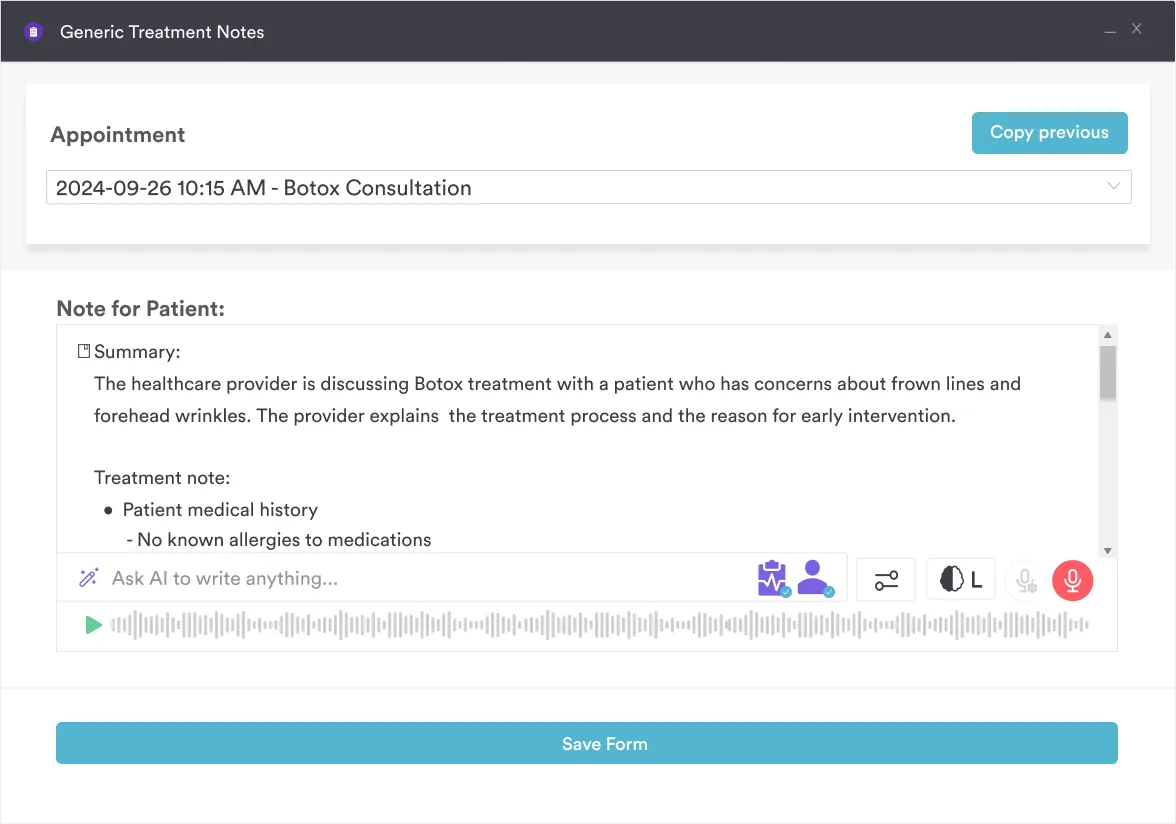

Pabau stores completed worksheets, session notes and treatment history in one patient record. Pabau Scribe drafts notes from the session, so you spend less time typing after hours.

Start small. Pick one thought that keeps coming back, run it through the three steps, and keep only the statements you can believe on a bad day. A reframe you doubt will not hold under stress, so the belief rating matters more than the wording.
For therapists, the payoff comes from repetition between sessions. Set one section as homework each week, review it together and adjust the statements that did not hold. Self-talk work supports professional treatment, so pair it with care for clinical anxiety, depression or trauma.
Download the free template and test it on the next thought that gets in your way. Book a demo to see how Pabau keeps completed worksheets and session notes in one patient record.

Running a psychology practice? Psychology practice software keeps session notes, forms and treatment plans together in one patient record.
Want a lighter daily exercise? Positive thinking worksheet offers a printable CBT template for building a more balanced outlook.
Is worry about the uncontrollable feeding the inner critic? Things I can control worksheet helps patients separate what they can act on from what they need to let go.
Need to measure coping confidence? Coping self-efficacy scale gives you a structured way to track how sure patients feel about handling stress.
Working on self-worth directly? Self-worth worksheet helps patients name their strengths and challenge beliefs about their value.
Positive self-talk means replacing negative, self-critical thoughts with realistic, encouraging ones grounded in evidence. It matters because automatic negative thoughts fuel anxiety and low mood. Reshaping them can reduce distress and build resilience. Research on CBT links changing thought patterns to improvements in mood and coping.
Affirmations are general positive statements, such as “I am strong.” Positive self-talk is realistic and grounded in evidence, and it answers the specific anxious thought you are having. For example: “I am nervous about the presentation, and nervousness is normal. I have prepared and can manage it.” Because it rests on facts, positive self-talk feels believable. Affirmations can feel false, and they help less when the person does not believe them.
Positive self-talk based on CBT techniques can support treatment for anxiety and depression when used as part of professional care. It interrupts negative thought loops, builds coping skills and can reduce the intensity of anxious or depressed thinking. It does not replace therapy, medication or professional treatment for clinical disorders. A therapist who builds the technique into a broader treatment plan can make it more effective.
A common starting point is two or three sessions per week, each targeting one specific thought pattern. Many people find it gets quicker with practice. Over time, you may be able to reframe a thought in the moment without writing it down. Keep practicing during stressful periods to maintain the skill.
No. Positive self-talk is a coping skill that supports therapy rather than replacing it. For clinical anxiety, depression, trauma or other mental health conditions, professional therapy or counseling is essential. A therapist teaches the technique, monitors progress and addresses underlying issues that reframing alone cannot resolve. Use positive self-talk as one tool within a comprehensive treatment plan.
Yes, with age-appropriate language and supervision. School counselors and therapists often simplify the wording and examples for children aged eight and older. Teens aged 13 and older can usually use the worksheet as written. For younger children, a parent or teacher should guide the process and help identify the thoughts to work with. Consult a professional if concerns arise.