Crisis safety plan template
A crisis safety plan is a short, personalized written plan that a patient and cl...

2
Last Updated: Oct 19, 2026
A catastrophizing worksheet is a structured CBT tool that walks a patient from a worst-case prediction to a balanced, realistic thought.
Most versions run to five columns, starting with the situation that set the thought off and ending with the alternative you write together.
Catastrophizing is the habit of assuming the worst will happen and that it would be unbearable. It sits behind a lot of anxiety, depression, and chronic pain presentations. The worksheet turns the decatastrophizing technique into four written steps you can complete in session and hand over as homework.
Download the worksheet below, then read on for the four steps, a filled-in example, and the questions worth asking at each column.
A printable five-column worksheet covering the triggering situation, the catastrophic thought, and a likelihood rating. The last two columns hold the patient’s coping resources and the balanced thought you agree on. It includes the prompt questions for each column, so it works as guided practice or as homework.
Download template
A catastrophizing worksheet is a CBT tool that moves a patient from a worst-case prediction to a balanced thought.
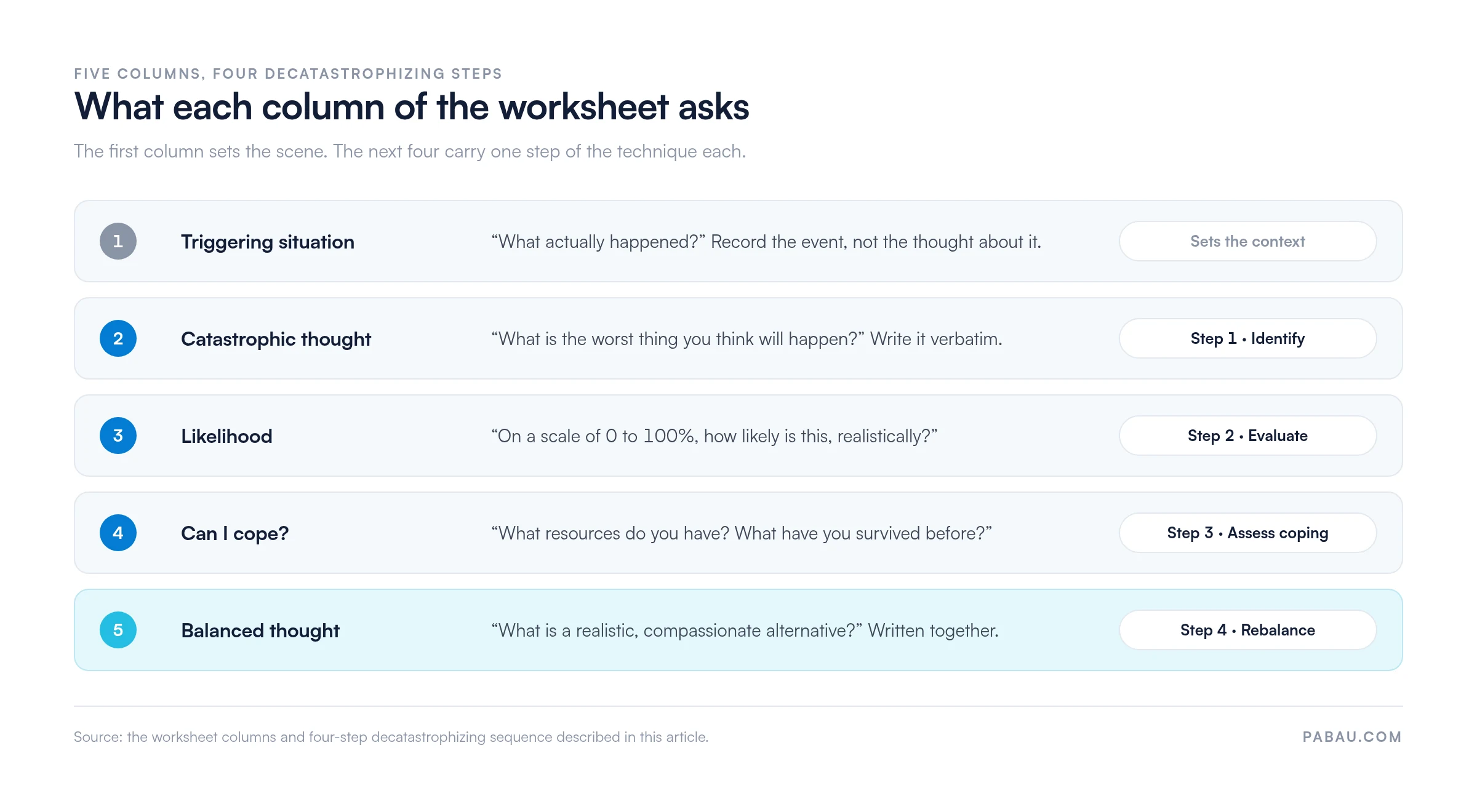
Its five columns capture the trigger, the catastrophic thought, the likelihood of that outcome, the patient’s coping resources, and the balanced alternative.
Decatastrophizing runs in four steps: identify the feared outcome, weigh its likelihood, assess coping, then write a balanced response.
Catastrophizing shows up in anxiety, depression, PTSD, and chronic pain, so the same worksheet adapts across all four.
Digital forms and patient records keep completed worksheets filed against the chart rather than in a paper folder.
A catastrophizing worksheet is a one-page thought record that guides a patient and therapist through cognitive restructuring. It sits in the same family as the general thought record worksheet, narrowed to one distortion: the worst-case prediction.
The tool does two jobs. It gets the catastrophic thought out of the patient’s head and onto paper, where both of you can look at it. It also gives them a method they can repeat between sessions, when you are not in the room.
CBT rests on the idea that a thought is not a fact. Writing the prediction down creates distance from the automatic response, and that distance is where an alternative becomes possible.
Catastrophizing is a systematic thinking error. The patient assumes the worst possible outcome will happen and that it would be unbearable. It usually pairs magnification, which inflates the threat, with minimization, which shrinks their own ability to handle it.
“If I make a mistake at work, I’ll be fired, lose my house, and end up alone” is a classic catastrophic chain. Each link sounds plausible on its own, which is what makes the whole chain hard to argue with.
It appears most in anxiety disorders, including generalized anxiety, social anxiety, and panic disorder. It also turns up in depression, post-traumatic stress disorder, and chronic pain syndromes. Patients who think this way carry sustained arousal and avoid more of daily life. CBT work aimed at catastrophizing tends to move those symptoms.
Catastrophizing rarely travels alone. All-or-nothing thinking and overgeneralization usually sit alongside it. For a patient who is new to CBT, a broader cognitive distortions worksheet often makes the better starting point.
If a patient cannot see why one thought deserves this much attention, the cognitive triangle is a useful detour before you hand over the worksheet.
Decatastrophizing is the CBT method for challenging a catastrophic thought head-on. It runs in four steps.
Steps two and three work as a pair. Catastrophizing overstates the odds and understates the patient, so challenging one without the other leaves half the distortion standing.
The worksheet gives each step a column of its own, so the whole sequence stays visible on one page.
Introduce the worksheet after the patient has described a situation that set off a catastrophic thought. A line like “let’s slow this thought down and look at it on paper” is usually enough.
Walk through the columns in order. In the triggering situation column, write the factual event and nothing about the thought attached to it. In the catastrophic thought column, write the prediction word for word as the patient says it.
Then ask the evidence questions for likelihood and coping, recording their reasoning rather than yours. Finish by drafting the balanced thought together. Keep it realistic instead of cheerful, or the patient will not believe it.
Complete the first worksheet together, then assign one or two independent copies as homework. Debrief them at the next session. Ask what they noticed, and whether the balanced thought held up once the anxiety was live.
Store completed worksheets in the patient record. Software built for therapists lets you send the worksheet out as a digital form and file the returned copy against the chart automatically.

Here is a filled-in worksheet for a patient presenting with social anxiety.
The patient arrives certain they will be fired. The worksheet gets them to 15% and to a coping plan they can name out loud. The balanced thought keeps the nervousness and drops the prediction of disaster.
Catastrophizing is most common in anxiety disorders and chronic pain, and the worksheet reads differently in each.
In anxiety, the feared outcome is social, physical, or emotional: “I’ll have a panic attack and lose control.” The likelihood column does most of the work here, because the predicted event so rarely arrives.
In chronic pain, the thought centers on escalation and disability: “my pain will get worse until I cannot walk.” The coping column matters more in these cases. The pain is genuine, so the distortion lives in what the patient believes it predicts.
The worksheet is free to print, or to import into your practice software as a digital form. Adapt it to your caseload. Add your practice logo, reword the column prompts to suit your modality, or simplify the language for younger patients.
1. Introduce it when the patient is ready. Skip the worksheet at peak anxiety. It builds a skill, and skill-building needs enough regulation to think, so keep it for the calmer part of the session.
2. Complete the first one together. Model the questions out loud, so the patient hears the internal dialogue you want them to copy at home.
3. Normalize the coping column. Many anxious patients assume they could not cope. Push back gently: “you have survived every difficult moment so far, so what would that version of you say?”
4. Debrief the homework. Review what came back with them. Ask what they noticed, whether the anxiety shifted, and what made the balanced thought easy or hard to believe.
5. Use it beyond anxiety. Depression, trauma, chronic pain, and perfectionism all produce worst-case thinking, and the same five columns hold up.
Keeping completed worksheets in patient records software rather than a paper folder makes the pattern visible. You can look back across six sessions and see whether the likelihood ratings are coming down.
Most therapy practices still hand worksheets out on paper. The completed copy comes back in a folder and gets scanned if there is time. It rarely lands in the note where the next clinician would look for it.
Practice management software like Pabau closes that loop. Build the catastrophizing worksheet once as a digital form. Send it to the patient before or after a session, and the completed version files itself against their record.
That leaves you with a dated series of worksheets on one screen. You can see which situations keep recurring, whether the likelihood ratings are falling, and which balanced thoughts the patient went back to.
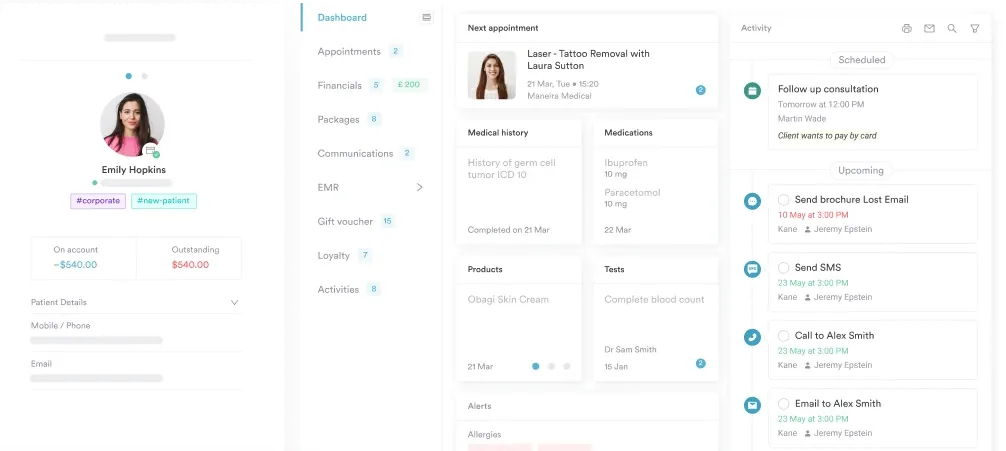

Pabau’s digital forms send the catastrophizing worksheet to your patient and file the completed copy against their chart. You get a dated history of each worksheet without scanning or chasing paper.

A catastrophizing worksheet earns its place by slowing a thought down. The columns hold the patient in the sequence long enough to weigh the odds and remember what they can handle.
Use it as guided practice first and homework second. A patient who has filled in six of them starts asking the questions without the page, and that is the point of the exercise.
Where it tends to fall down is storage. A worksheet in a drawer cannot show you a pattern, so file it where the rest of the note lives. Book a demo to see how Pabau sends therapy worksheets out and files the completed copies against the patient record.

Working with a patient whose worry spirals? The worry tree sorts hypothetical worries from practical ones before you reach for a thought record.
Seeing all-or-nothing thinking alongside the catastrophizing? All-or-nothing thinking worksheet gives you a free CBT PDF for the distortion that most often travels with it.
Need to work on the dread before the event? Anticipatory anxiety worksheet targets the waiting period rather than the feared moment itself.
Ready to test the prediction rather than discuss it? Behavioral experiment worksheet structures the experiment that turns a balanced thought into evidence.
Looking for an ACT alternative to disputing thoughts? Cognitive defusion explains how to loosen a thought’s grip without arguing about whether it is accurate.
A catastrophizing worksheet is a structured thought record that takes a patient through cognitive restructuring. It asks them to name the catastrophic thought, rate how likely that outcome is, assess whether they could cope, and write a balanced alternative. Those four moves are the decatastrophizing technique.
Complete it collaboratively in session. Write the triggering situation and the patient’s catastrophic thought, then ask the evidence questions about likelihood and coping. Draft a realistic alternative thought together. Assign one or two independent copies as homework, and debrief them next session so the skill moves from guided practice to independent use.
Decatastrophizing is a four-step CBT method. Identify the feared outcome and evaluate its likelihood against the evidence. Then assess whether the patient could cope if it happened, and generate a compassionate, realistic alternative thought. It targets the distortion directly rather than the emotion around it.
Repetition is what shifts the habit. The worksheet combines cognitive restructuring, which treats a thought as a thought, with a coping review that builds confidence. It also gives the patient practice at tolerating discomfort. Filled in often enough, it builds a competing habit the patient can run without the page.
Catastrophizing usually travels with magnification, which exaggerates the threat, and minimization, which underrates the patient’s coping. Overgeneralization and all-or-nothing thinking are common companions too. Because the worksheet weighs evidence on both the threat and the coping, it reaches all four.
Yes. In anxiety it targets feared social, physical, or emotional outcomes. In chronic pain it targets the belief that pain signals serious damage or guarantees disability. The four steps are identical, and only the examples in each column change.