Professional development record
A professional development record is a structured log of a healthcare practition...

7
Last Updated: Oct 8, 2026

A consent to treat minor form is a legal document that authorizes healthcare providers to deliver medical care to patients under 18 years of age, signed by parents, guardians, or authorized caregivers.
The form must include patient details, parent/guardian information, authorized adult information, scope of treatment, insurance information, emergency contacts, and signature lines – missing fields can create compliance and liability exposure.
Non-parent caregivers (grandparents, relatives, school officials) can authorize treatment only when the parent has granted written permission. State laws vary significantly on who qualifies and what documentation is required.
Pabau’s digital forms and patient portal streamline the consent-collection workflow, storing signed forms in the patient record automatically and ensuring compliance with HIPAA documentation requirements.
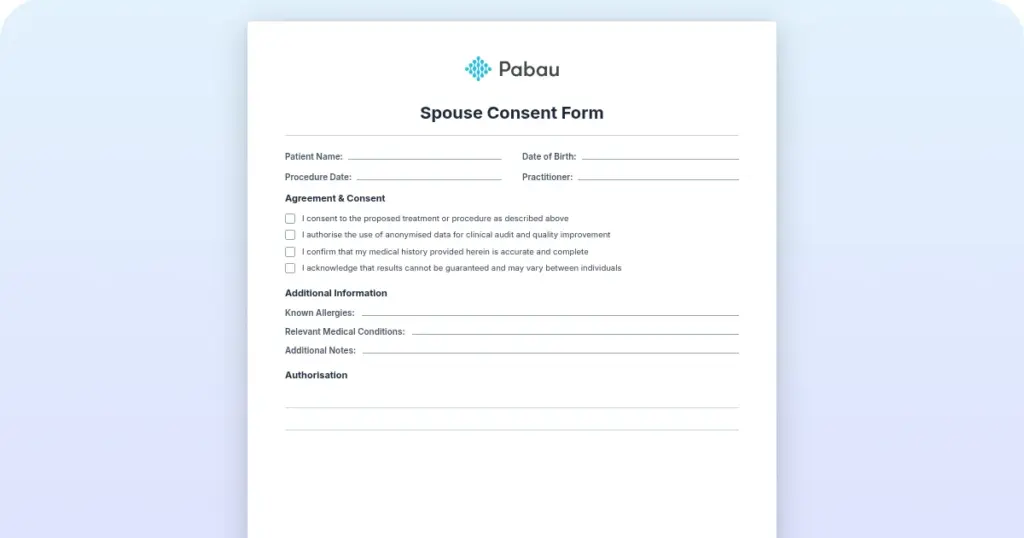
A ready-to-use form covering patient details, parent/guardian information, authorized caregiver information, scope of authorized treatment, insurance information, emergency contacts, and signature blocks for legal protection.
Download templateA consent to treat minor form is the legal foundation for delivering medical care to any patient under 18 years of age. Without a signed form, practices face serious compliance and liability risks. This guide walks you through what the form covers, who needs it, when it’s required, and how to use it correctly in your practice.

A consent to treat minor form authorizes healthcare providers to deliver medical treatment to a patient under 18 years of age. In most US states and UK settings, parents or legal guardians must provide written consent before any treatment occurs. This form documents that consent and establishes the scope of care the clinician is authorized to provide.
The form serves three critical purposes:
State laws and standard practice shape what a compliant form must cover, beyond those three core purposes:
Practices in mental health, aesthetic medicine, dermatology, physical therapy, and primary care all use this form regularly. Whether it’s a minor seeing a therapist, receiving Botox under a parent’s authorization, or attending a physical therapy appointment, the consent form is mandatory for legal and clinical reasons.
A properly completed consent form follows a structured five-step workflow. Each step ensures the form captures the information practices need to treat safely and remain compliant.
Misalignment between what the form authorizes and what was documented is a red flag for auditors and regulators.
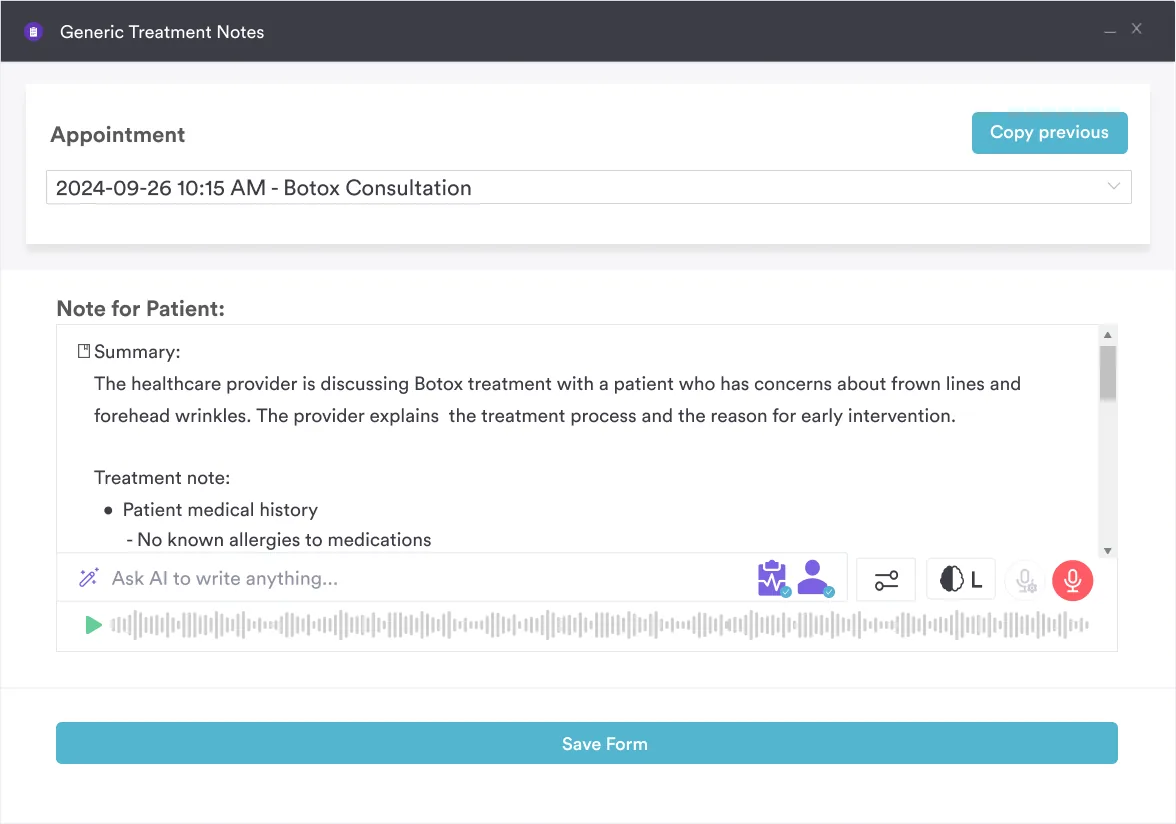

Pabau’s digital forms send consent documents to parents before the appointment, capture e-signatures automatically, and store signed forms in the patient record, eliminating paper handling and reducing compliance risk.

Any healthcare practice that treats minors needs a robust consent-to-treat-minor workflow. This includes mental health and therapy practices, aesthetic and dermatology practices, physical therapy practices, primary care practices, and other specialty practices. Pediatric speech and behavioral providers often align their treatment plans with the measurable IEP goals written by the patient’s school.
Aesthetic practices and medical spas are particularly reliant on these forms because many procedures (laser treatments, chemical peels, injectables under parental consent) carry specific risks and regulatory requirements.
The form is also essential in any setting where a non-parent caregiver (grandparent, school nurse, relative) needs to authorize emergency or routine care while the parent is temporarily unavailable.
The benefits of a properly implemented consent-to-treat-minor process extend across compliance, operations, and patient safety.
In rare cases, a minor can authorize their own medical treatment without parental consent. Understanding these exceptions matters because treating a minor without proper authorization is a serious compliance violation.
Emancipated minors are teenagers who have been legally declared independent of their parents by a court. An emancipated minor can give their own medical consent. However, emancipation is a formal legal process that varies by state. Living alone or working does not automatically qualify a teenager as emancipated, and the minor must present court documentation proving emancipated status.
The mature minor doctrine (recognized in some US states but not all) allows older minors to consent to certain treatments if they demonstrate sufficient maturity and understanding of the medical risks. This is a fact-specific determination: no universal age threshold applies, and courts weigh the minor’s age, intelligence, maturity, medical complexity, and whether the treatment is routine or risky. Risky treatments, such as surgery or chemotherapy, rarely qualify. Routine care, such as check-ups or dental cleaning, may qualify. Clinicians should not assume a 16-year-old automatically qualifies, and should obtain parental consent when in doubt.
Emergency situations may allow treatment without parental consent if the delay in contacting a parent would cause serious harm or death. Emergency doctrine is narrow: it applies only when the minor needs immediate life-saving or limb-saving care and parental contact is impossible. Once the emergency is stabilized, parental consent is required for any further treatment.
Campus health services and school nurses often work under an amnesty policy as well. It shields the student who calls for help, so nobody delays raising the alarm.
If a minor self-consents, the chart notes should explain why (emancipation status, mature minor assessment, or emergency circumstances). Absent clear documentation, a parent can later claim the minor lacked authority to consent. Practices that chart digitally can capture that reasoning with clinical notes tools and keep it beside the consent form.
A signed consent to treat minor form is a legal safeguard and an operational necessity. It protects the practice, clarifies the scope of care, ensures compliance with HIPAA and state law, and keeps emergency contacts on file. Without it, practices expose themselves to liability and regulatory risk.
The most effective consent workflows shift from paper to digital. Sending the form to parents before the appointment via a patient portal, capturing e-signatures automatically, and storing the signed form in the patient’s digital record management system eliminates manual filing, reduces lost documents, and ensures compliance across every service line.

Cutting down paperwork at patient intake? Digital admission nursing note template covers vital signs, physical exam findings, and care planning documentation.
Sharing a patient’s records with another provider? Authorization for release of confidential information covers the purpose of disclosure, recipient details, and expiration date.
Explaining a teething timeline to a parent? Baby teeth eruption chart lists the age range and order for all 20 primary teeth.
Coordinating care shared across several caregivers? Caregiver care plan template records medical conditions, medications, goals of care, and emergency contacts in one place.
A consent to treat minor form is a legal document signed by a parent or legal guardian that authorizes a healthcare provider to deliver medical treatment to a patient under 18 years of age. It includes the minor’s details, parent/guardian information, authorized treatment scope, insurance information, emergency contacts, and signature lines. The form protects both the practice and the family by documenting that informed consent was obtained before care began.
Yes, a grandparent or other relative can authorize treatment if the parent has given them written permission in advance. The parent must sign an authorization letter naming the grandparent and specifying which treatments the grandparent can approve. The consent to treat minor form should reference this delegation and include a copy of the authorization letter. State laws vary on what constitutes sufficient documentation, so verify your local requirements before relying on grandparent authorization.
No. Verbal consent is not legally sufficient for medical treatment of a minor. A signed written form is required. If a parent later disputes whether they authorized treatment, your verbal claim will not hold up legally or in regulatory review. Always obtain a signed, dated written form before proceeding with care.
If a parent is truly unavailable and the delay would cause serious harm, emergency doctrine may allow treatment without parental consent to prevent death or serious injury. However, emergency treatment is narrowly defined and applies only to life-saving or limb-saving procedures. Once the emergency is stabilized, you must obtain parental consent before proceeding. Always document the emergency circumstances in the chart.
A complete consent form includes: minor’s full name and date of birth, parent/legal guardian name and contact information, authorized caregiver information (if applicable), scope of authorized treatment (specific and detailed), health insurance information, emergency contact numbers, and signature and date lines for the parent or guardian. Missing any of these fields creates compliance and liability exposure.
Notarization is required in some states and situations but not others. For routine medical treatment, a parent’s signature is usually sufficient. However, if a non-parent (like a grandparent) is authorizing care, some states require notarization of the parent’s delegation letter. Verify your state’s specific requirements with your legal counsel or state medical board before assuming notarization is or is not needed.
In limited cases, yes. An emancipated minor (legally declared independent by a court) can give their own consent. Some states recognize the mature minor doctrine, which allows older minors to consent to routine or low-risk care if they demonstrate sufficient understanding of the risks. Emergency treatment may proceed without parental consent if delay would cause serious harm. In all other cases, parental consent is required. When in doubt, obtain parental authorization.
Signed consent forms contain sensitive patient and guardian information and are subject to HIPAA privacy rules. Store physical forms in a locked file cabinet, and store digital forms in an encrypted patient record system with access controls. Never leave signed forms in the waiting room or on desks. For minors, most states require records to be kept until the patient turns 18, plus an additional statute-of-limitations period on top – often adding up to retention until the patient is 21 to 30 years old, depending on the state. Verify the exact retention period for minors with your legal counsel or state medical board rather than assuming a fixed number of years. Audit access regularly to ensure only authorized staff can view consent documents.