HD Brows consultation form: Free template and guide
HD Brows is a seven-step brow treatment that combines consultation, tinting, wax...

2
Last Updated: Oct 13, 2026

A notice of privacy practices is the notice HIPAA requires you to give patients, explaining how you use, disclose, and protect their health information.
Every covered provider, health plan, and clearinghouse must hand it over in plain language, at or before the first service or enrollment.
45 CFR 164.520 fixes the content: the header, uses and disclosures, patient rights, your duties, changes to the notice, and the complaint process.
Covered entities that receive substance use disorder records under 42 CFR Part 2 had to revise their notice by February 16, 2026.
Keep the signed acknowledgment in the patient record, because it is your evidence that the notice was offered before treatment began.
The template is a four-page notice built on 45 CFR 164.520. It covers the required header, uses and disclosures, patient rights, covered entity duties, and the Office for Civil Rights complaint process. Page four is a signed acknowledgment of receipt, with a good faith effort box for patients who decline to sign.
Download templateA notice of privacy practices is the separate document HIPAA requires you to hand every patient. Your intake and consent forms don’t cover it. The notice explains how you use their health information, what rights they hold, and how to complain.
Not having one is a violation in its own right. Civil monetary penalties now start at $145 per violation and reach $73,011, after the inflation adjustment that took effect on January 28, 2026. Willful neglect that goes uncorrected carries a calendar-year cap of $2,190,294.
This guide covers what the notice has to contain, who is required to issue one, and how to distribute and document it. It also covers the substance use disorder update that fell due in February 2026. The template above is yours to customize.
A notice of privacy practices is the document a covered entity uses to tell patients, in plain language, how it handles their protected health information. The HIPAA Privacy Rule requires one from every healthcare provider, health plan, and clearinghouse it covers. The governing section is 45 CFR 164.520.
The notice does three jobs at once. It makes your handling of patient data transparent before treatment starts. It documents what your practice does with that data. And it tells patients what rights they hold and how to enforce them.
Most practices start from an HHS model notice and edit from there. Skipping that edit is a costly mistake. A notice that describes practices you don’t follow is worse than no notice. It commits you in writing to a standard you are already missing.
Section 164.520(b) sets out the content, and an auditor will look for each piece. The template above is organized in the same order, so you can work through it section by section.
Marketing is the authorization most practices run into. Keep a testimonial release form ready for any patient quote or photo you plan to publish.
Two extras are easy to forget. If you fundraise using patient information, the notice has to say so and offer an opt-out. If your state or specialty imposes a stricter rule, the notice has to describe that limit rather than the looser federal one. Our HIPAA compliance checklist covers the policies that sit behind both.
Any covered entity that holds or processes patient information has to issue one. That falls into three groups.
One test settles most cases. If you treat patients and transmit health information electronically for a covered transaction, you are a covered entity. Claims and eligibility checks both count. Medical spas with nurses or physicians usually qualify. Ask a healthcare attorney if your situation is borderline. Practices posting patient details on social media should review how HIPAA applies to those posts separately from this notice.
Completed forms belong in structured medical records management, not a filing cabinet.
Getting the wording right is half the job. The other half is proving that every patient received it.
Then keep it alive. A merger, a new data use, a breach, or a change in state law all mean the notice needs revising. Providers then have to post the revised version promptly and keep copies available. Practices running digital patient intake forms can re-issue the notice to their list instead of chasing signatures at the front desk.
Your notice is one of several documents patients receive at the first visit. A no-call, no-show policy is another, and most practices hand both over in the same packet.
Covered entities that receive or maintain 42 CFR Part 2 records had to update their notice of privacy practices by February 16, 2026. That deadline came out of the 2024 final rule aligning Part 2 with HIPAA, and it has already passed. A notice written before then is out of date for any practice that touches these records.
Two rules arrived together, which is where the confusion starts. The Part 2 notice amendments came alongside the 2024 reproductive health privacy rule. In June 2025, a federal court in Texas vacated that reproductive health rule nationwide. The Part 2 notice provisions survived the ruling. Practices that treated the whole package as dead are now non-compliant.
If you receive Part 2 records, four things belong in your notice.
If you never receive or hold Part 2 records, this requirement doesn’t reach you and your existing notice stands. Section 11 of the template flags Part 2 so you can decide either way and record the decision.
HIPAA sets a federal floor. States are free to go further. Where a state law protects patient information more strictly, that stricter law governs and your notice has to describe it. Getting this wrong is a state violation on top of any federal exposure.
Operating across state lines makes this harder. Write a state-specific section into the notice rather than issuing different versions per location, since one document is easier to keep current. Your state health department or a healthcare attorney can confirm which statutes apply to your specialty.
It closes off an easy enforcement finding. A missing or stale notice is simple for an investigator to establish, and it needs no patient harm to support a penalty.
It gives you an audit defense. A signed acknowledgment, dated and filed, answers a patient who later says they were never told. A digital signature adds a timestamp and an audit log to that record.
It builds patient trust. A notice a patient can actually read signals that you take their privacy seriously, which matters in specialties where the record itself is sensitive.
It forces you to write down what you do. Drafting the notice surfaces the parts of your privacy program that were never documented, such as inconsistent disclosure steps or an undefined retention policy.
Put the revision date in the footer of your notice and keep a dated archive of superseded versions. If an investigator asks what your policy was on the date of an incident, that archive is the answer. Set a calendar reminder to review the notice once a year and after any merger, breach, or change in state law.
At most practices the notice lives in a printer tray. Reception hands it over at check-in, the patient signs a page, and someone scans the page into the chart later that week. Signatures go missing, revisions reach only the patients who happen to book, and nobody can say who holds which version.
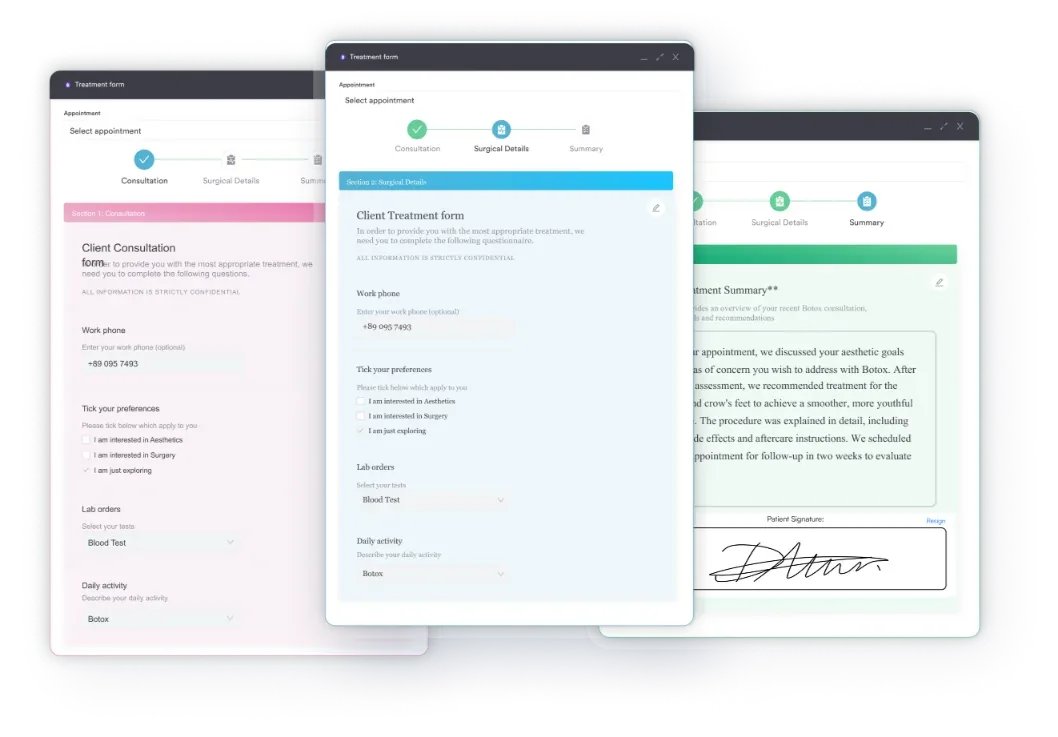
Pabau, our practice management software, moves the whole exchange into the patient record. You build the notice and its acknowledgment as a digital intake form. Then you attach it to the appointment types that need it and send it with the booking confirmation.
The patient signs on their phone before they arrive. The signed form files itself against their record with a timestamp, so nobody has to scan anything later.
That changes the follow-up too. You can see which patients still have the form outstanding before the day starts. When you revise the notice, you re-issue it to the affected patients in one action rather than one visit at a time. The signed versions stay in the record as your compliance documentation, ready to produce if anyone asks.

Send your notice of privacy practices with the booking confirmation, capture the signature digitally, and file it against the patient record automatically. No chasing paper at the front desk.

Treat the notice of privacy practices as a live document rather than a form you produced once. The wording only protects you while it describes what your practice does. The February 2026 Part 2 deadline shows how quickly that stops being true.
Download the template, edit it against your own disclosures and state law, and decide today whether Part 2 reaches you. Then turn to delivery, which is the harder half of the job. A signed, dated acknowledgment in every record is what turns a good notice into a defensible one.
Book a demo to see how Pabau delivers your notice with every booking and files the signed acknowledgment for you.

Running a practice in the UK? UK GDPR compliance checklist helps you close the gaps in privacy policies and patient consent forms.
Sharing records with another provider? Authorization for disclosure of information covers designated recipients, disclosure purposes, expiration dates, and signature blocks.
Building out the rest of your patient paperwork? Our medical power of attorney template covers another document patients sign, with its own consent and storage rules.
Is your authorization form missing an element? Authorization to disclose health information lists the eight elements a valid HIPAA authorization needs, including the redisclosure notice.
Need consent before you treat a patient? Consent for medical treatment covers treatment details, risks and benefits, contraindication screening, and signature blocks.
A notice of privacy practices is the HIPAA-required document that tells patients how your practice uses and discloses protected health information. It also sets out their rights and how to complain to the Office for Civil Rights. Providers must give it at or before the first service delivery.
Providers with a direct treatment relationship must give it no later than the first service delivery. Health plans must give it by the date of enrollment. After a material revision, a provider posts the new notice promptly and makes copies available, while a health plan has 60 days to notify enrollees.
You must make a good faith effort to obtain a written acknowledgment, but a refusal does not put you in violation. Record the effort in the patient record, with the date offered and the reason it was not signed, then go ahead with treatment. The template has a box for this.
Yes, for practices that receive or maintain 42 CFR Part 2 substance use disorder records. Those entities had to revise their notice by February 16, 2026. The additions cover Part 2 uses and disclosures, redisclosure limits, and the bar on use in legal proceedings. Practices with no Part 2 records were not affected.
Civil monetary penalties run from $145 to $73,011 per violation as of the inflation adjustment effective January 28, 2026. The calendar-year cap for repeated violations of one provision is $2,190,294. The Office for Civil Rights sets the amount by culpability, severity, and whether you corrected the problem.