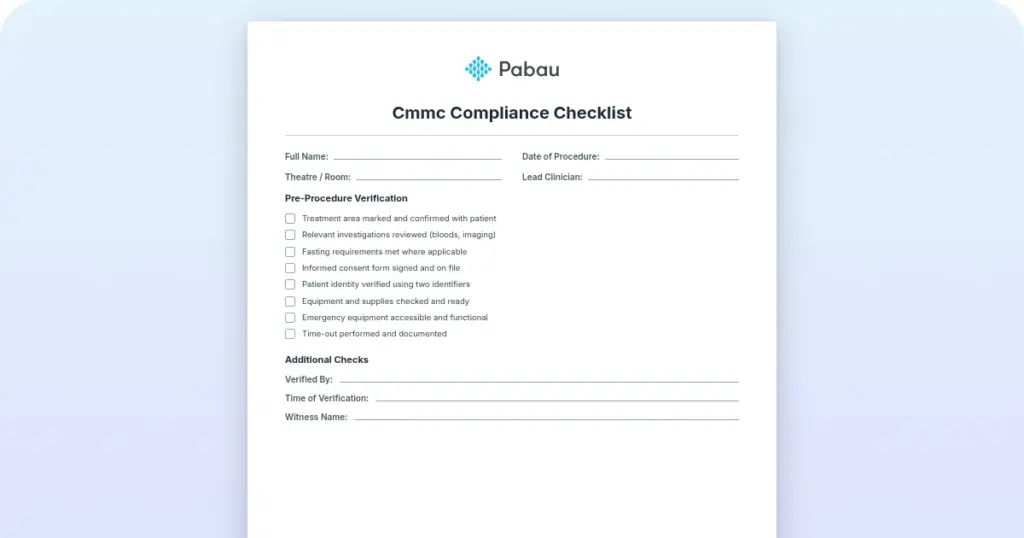
CMMC compliance checklist
A CMMC compliance checklist lists every security practice a Department of Defens...

Last Updated: Oct 6, 2026

A medical power of attorney names one trusted adult to make healthcare decisions for a patient who can no longer make them.
The form sits dormant until the attending physician certifies in writing that the patient lacks decision-making capacity.
A durable power of attorney for health care is the same instrument under another name, but a living will is not.
Most states accept either two qualified adult witnesses or a notary public, and Texas sets both routes out in statute.
Front-desk teams can verify an agent’s authority in four checks and file the form in practice management software like Pabau.
The form covers agent and alternate agent details, the authority the patient grants, and any limits they want to set. It also carries the witness and notary block, revocation instructions, and the disclosure to read before signing.
Download templateA medical power of attorney is a legal document that names one adult to make medical decisions for a patient. That person is the healthcare agent, and the form is also called a power of attorney for health care. Some states and hospitals call it a healthcare proxy instead.
The document stays dormant while the patient can still decide for themselves. It only becomes usable once a physician certifies in writing that the patient has lost capacity. Signing the form on its own changes nothing.
Below you’ll find the free form, plus a comparison with the living will and the financial power of attorney. After that come the signing rules, the revocation steps, and a front-desk checklist for practices that receive these documents.
A medical power of attorney is a legal document that transfers healthcare decision-making to a named agent when the patient loses capacity. The agent is sometimes called an attorney-in-fact or a healthcare proxy. Shorthand for the document itself is MPOA, and you will see that abbreviation on intake paperwork.
Capacity is the hinge. While the patient can understand a diagnosis, weigh the options, and say what they want, the agent has no authority at all. The moment a physician documents that the patient can no longer do those things, the agent steps in.
The document also differs from a living will in what it produces. A living will writes decisions down in advance. A power of attorney for health care appoints a person who can decide in the moment, including on situations nobody wrote down.
A durable power of attorney for health care is the same instrument as a medical power of attorney, named differently from state to state. A living will is not the same thing. It records treatment choices directly instead of appointing anyone.
A living will is one type of medical advance directive, and so is the medical power of attorney. Advance directive is the umbrella term, not a fourth document. The financial power of attorney sits outside that umbrella entirely and covers money, property, and taxes.
The table below sets the three side by side on the axes that decide which one a patient actually needs.
Most patients end up needing two of the three. The medical power of attorney handles who decides, the living will handles what they decide, and the financial one keeps the bills paid. Storing all three under HIPAA-compliant record rules becomes the practice’s job once copies arrive.
Any adult aged 18 or older should have one, and the best time to sign is before a hospital needs it. Waiting until a diagnosis arrives narrows the options, because the patient must still have capacity to sign.
Practices that ask about advance directives during patient intake catch this early. A yes.
Choose the person who will hold their nerve in a hospital corridor and repeat the patient’s wishes back to a physician. Trust matters more than proximity, and a calm friend often beats an anxious relative.
Unless the patient writes in limits, the agent can make any healthcare decision the patient could have made themselves. Those responsibilities run from routine consent all the way to withdrawing life support.
Patients can narrow that authority by writing the limit into the form itself. Two common examples are barring organ donation, or requiring the agent to consult the primary physician before major surgery.
Download your state’s form, fill in the patient and agent details, note any limits, then sign in front of two witnesses or a notary. It needs no lawyer and no court filing.
Getting hold of the right form is straightforward in most states. Your state health department publishes an official version, and the free form at the top of this page follows the same structure. Don’t mix pages from two states’ forms.
Practices that keep advance directive forms at the front desk can hand one over at check-in. Walking the patient through it takes a few minutes and removes the biggest excuse for delay. Keeping a consent for medical treatment form at the same desk protects patient rights when decisions must be made quickly.

Most states accept either two qualified adult witnesses or a notary public, and very few require both. Neither witness may be the agent, and in most states neither may work for the treating facility.
Texas is the clearest worked example. Its rules sit in the Health and Safety Code, and Texas legal aid guidance confirms both routes are valid. The patient signs in front of two qualified witnesses, or signs before a notary public instead.
If witnesses are used, at least one must be unrelated to the patient, not the agent, and not in line to inherit. A medical power of attorney in Texas also has to be preceded by a written disclosure statement that the patient reads first.
Once executed, the original goes somewhere safe and the copies go out. CMS patient rights guidance recommends filing a copy with the healthcare provider who holds the chart.
It takes effect when a physician certifies in writing that the patient can no longer make their own healthcare decisions. Signing the form doesn’t activate it, and neither does a hospital admission.
The number of physicians required varies. Some states are satisfied with the attending physician’s certification, while others want a second opinion. Once that certification is on the chart, the agent’s authority starts immediately.
Authority is not permanent either. If the patient recovers capacity, the agent steps back and the patient decides for themselves again.
A competent patient can revoke at any time, without a lawyer, a court, or the agent’s agreement. The revocation takes effect as soon as it is communicated, but written notice is what protects it later.
Chart updates are what make a revocation stick. A revoked form still sitting in a hospital record can be acted on in an emergency, because nobody there knows it was canceled. A periodic chart audit catches stale copies before that happens.
Store the original somewhere the agent can reach within an hour, and put copies everywhere the patient receives care. A document nobody can find during an emergency cannot be acted on.
A safe deposit box is the worst option, because it’s closed at 3 AM on a Sunday. A home safe, the agent’s own file.
Digital copies solve most of this.

When an agent presents a signed medical power of attorney at check-in, reception has to decide on the spot whether to accept it. Four checks settle it.
Two situations call for a different response. If the person presenting the form is not named on it, don’t treat them as the decision-maker. Escalate to the treating physician, who works from the state’s default surrogate order instead.
If the form checks out, ask one more question before filing it. Has a newer version been signed since this one? The most recent valid document controls, and families often carry the wrong copy.
Practice management software like Pabau turns that into a repeatable record instead of a sticky note. Scan the signed form into the patient’s file, tag it as an advance directive, and record the agent’s name, phone number, and signing date.
From there, the status travels with the patient. A flag on the centralized patient record tells whoever opens the chart that a directive exists, so nobody re-asks a family at the worst moment. Add an annual recall to re-verify the agent’s contact details, because phone numbers change faster than legal documents do. Compliance tracking works when the evidence is captured as the work happens, not assembled before an audit.


Pabau stores the signed form on the patient record, flags its status for whoever opens the chart, and keeps the agent’s contact details current. Your team stops hunting for paperwork during an emergency.

The document is cheap, quick, and useless if nobody can produce it. Getting one signed is the easy half. The hard half is making sure the right copy reaches the chart.
For patients, the practical move is to sign before there is a reason to. Name an alternate, then hand a copy to the practice that holds your records. For practices, the move is to ask the question at intake and verify the form when an agent presents it.
The trade-off worth remembering is that every limit a patient writes in is a decision the agent cannot make at 3am. Narrow the authority only where the patient genuinely wants it narrowed.
Book a demo to see how Pabau keeps advance directives on the patient record and flags them at check-in.

Ready for an emergency at your practice? OSHA emergency action plan covers evacuation routes, assembly points, emergency roles, and contacts for first responders.
Need the agent to actually see the records? HIPAA medical release form explains what a decision-maker can request and how to authorize it.
Working under Texas rules? HIPAA release form Texas sets out the state-specific wording and signing requirements.
Unsure how long the signed form stays on file? How long to keep medical records lists the retention periods state by state.
Going paperless with patient records? Paperless practice HIPAA compliance guide covers the steps to keep digital records secure as you go paperless.
A medical power of attorney is a legal document naming a trusted adult, the healthcare agent, to make medical decisions for the patient. It applies only when the patient cannot make those decisions themselves. The document takes effect after a physician certifies that the patient lacks capacity.
Any competent adult (18+) can serve as a healthcare agent, except the patient’s treating physician or an employee of the healthcare facility providing care. Family members, trusted friends, or others who know the patient’s values are common choices. Most patients also name a backup agent in case the first is unavailable.
The document does not take effect automatically upon signing. It remains inactive while the patient has full decision-making capacity. It activates only when a physician certifies in writing that the patient lacks the ability to make their own healthcare decisions.
A medical power of attorney designates an agent who can make a broad range of healthcare decisions when the patient lacks capacity. A living will documents the patient’s specific treatment preferences, such as whether to use life support in a terminal condition. The MPOA provides flexibility. The living will provides specific instructions. Both can work together.
An advance directive is the category, and a medical power of attorney is one document inside it. The other main type is the living will. A medical advance directive can be either one, or both signed together, which is what most attorneys recommend.
Only if the document grants healthcare authority. A financial or general power of attorney covers money, property, and legal matters, and does not extend to treatment consent. The agent needs a health care appointment, signed and witnessed, before any physician will act on their instructions.
Yes. A competent patient can revoke an MPOA at any time without court approval. Revocation can be done in writing, by notifying the agent and physician, or in some states orally to a healthcare provider. The patient should also request that their medical record be updated to reflect the revocation.
Notarization requirements vary by state. Most states require either two adult witnesses or a notary public, but not both. Check your state’s specific requirements before the patient signs the document. Either option is legally valid as long as state rules are followed.
Yes, in most contexts the terms are used interchangeably. “Healthcare proxy” is common in some states, especially the Northeast. “Medical power of attorney” is more common in the South and Midwest. Both refer to the same legal mechanism: naming an agent to make healthcare decisions when the patient lacks capacity.