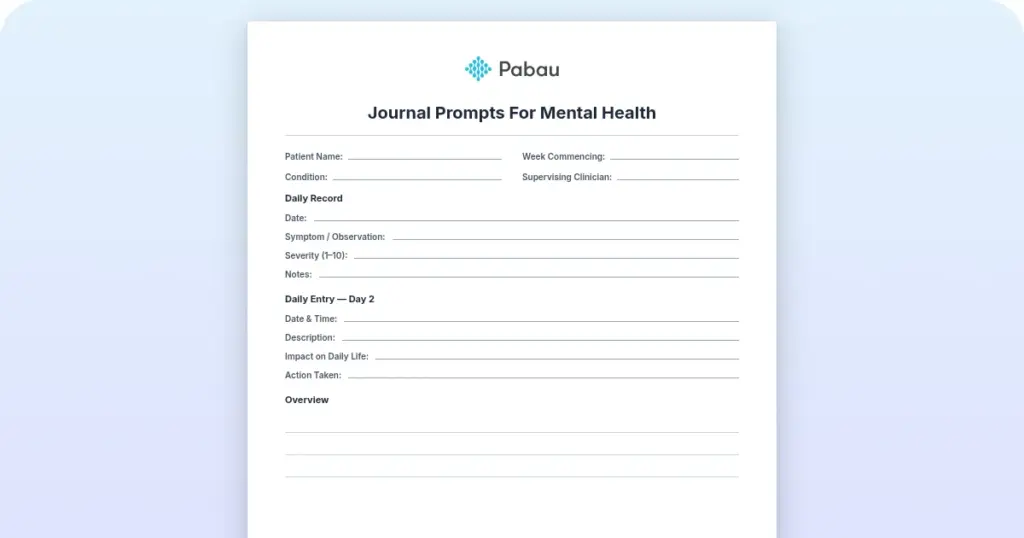
Journal prompts for mental health
Journal prompts for mental health are guided questions that help people process ...

2
Last Updated: Oct 13, 2026

An anger scale questionnaire is a validated self-report assessment tool that measures anger intensity, frequency, and expression across multiple dimensions.
The Clinical Anger Scale (CAS), DAR-5, and Novaco Anger Scale are among the most widely used instruments in mental health and therapy settings, alongside newer options like PROMIS Anger and the DSM-5 Level 2 Anger Scale.
Scoring thresholds and cut-off points vary by instrument and population; always reference original normative data rather than generalized cutoffs.
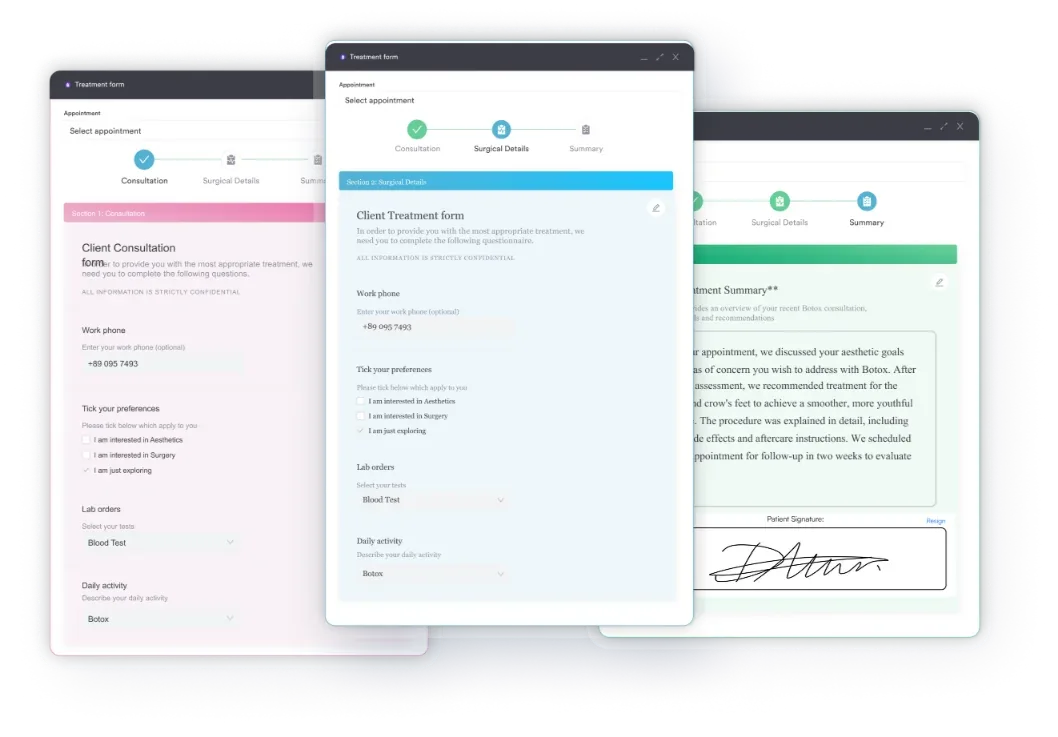
Pabau’s digital forms and AI-powered documentation features help clinicians streamline anger assessment administration and securely store completed questionnaires in client records.
A standardized assessment tool designed to evaluate anger levels, triggers, and behavioral responses in patients. This comprehensive questionnaire helps healthcare professionals identify anger management concerns and develop appropriate therapeutic interventions for improved emotional regulation.
Download templateAn anger scale questionnaire is a clinician-administered or self-report tool that captures how patients experience, express, and manage anger. Rather than a single yes-or-no question, a validated anger assessment measures several dimensions: anger intensity, frequency, triggers, physiological responses, and the strategies clients use to regulate emotions.
Mental health practitioners, therapists, counselors, psychiatrists, and primary care clinicians use anger scale questionnaires to establish a baseline, monitor therapeutic progress, and tailor treatment plans that address emotional dysregulation. This guide compares the most evidence-based scales, including two instruments practitioners often overlook, PROMIS Anger and the DSM-5 Level 2 Anger Scale, and shows how to administer, score, and document them in your clinical workflow.
An anger scale questionnaire is a validated, standardized self-report or clinician-administered assessment tool that measures anger as a multidimensional construct. It captures not just the presence of anger, but its intensity, frequency, triggers, physical expression, and the client’s ability to regulate the emotion.
Unlike informal anger rating scales (e.g. “rate your anger 1-10”), validated anger scale questionnaires are grounded in psychometric research, with established reliability, validity, and normative data. They help differentiate state anger (temporary emotional response to a specific trigger) from trait anger (a stable personality characteristic), and distinguish between anger experience (internal feeling) and anger expression (outward behavior).
From a clinical and legal standpoint, validated questionnaires provide documented evidence of the client’s emotional baseline at intake. This protects practitioners by creating an objective, auditable record aligned with best practice standards set by the American Psychiatric Association (APA) and embedded in DSM-5 assessment guidelines.
Administering an anger scale questionnaire successfully requires clear setup, accurate scoring, and thoughtful interpretation. A structured workflow using digital intake forms streamlines the process and reduces manual scoring errors.
Best practice: Readminister the same instrument at regular intervals (e.g. every 4-6 weeks) to measure progress objectively and adjust treatment as needed.
Anger assessment questionnaires are used across multiple healthcare and mental health specialties. Therapists, counselors.
Psychiatrists administer them in hospital, forensic, and outpatient settings, often as part of broader behavioral health workflows. Primary care physicians and mental health EMR users add them to routine screening protocols to catch emotional dysregulation before it escalates.
Some groups especially benefit from structured anger assessment:
Therapists using therapy practice management software can send resources like this to clients between sessions.
Objective baseline measurement: Anger is subjective, but a validated questionnaire provides quantifiable data that clinicians and clients can reference together. This shared language strengthens the therapeutic alliance.
Multidimensional assessment: Rather than conflating anger with aggression or irritability, structured questionnaires separate anger intensity from anger expression, helping you design targeted interventions.
Progress monitoring: Readminister at intervals to document change objectively, strengthen treatment credibility, and adjust the therapeutic approach if progress stalls.
Risk identification: Elevated scores on aggression or hostility subscales signal heightened risk for violent behavior or self-harm, prompting immediate safety assessment and crisis protocols.
Audit and compliance documentation: A documented anger assessment at intake protects your practice during HIPAA audits, malpractice reviews, or regulatory inspection. Recording results in structured formats such as SOAP notes keeps the assessment defensible, and courts and insurers recognize validated questionnaires as standard-of-care evidence.
Administering paper questionnaires and hand-scoring leaves room for error and clutters client records. Practice management software like Pabau brings digital forms and client records together, so you can deliver questionnaires on a tablet or smartphone, auto-score results, and store completed assessments against each client’s clinical history. Everything stays in one secure, HIPAA-compliant system. Book a demo to see how Pabau simplifies your anger assessment workflow.
Anger scale questionnaires derive their value from rigorous validation studies, normative data, and peer-reviewed publication. The most widely used instruments have 20+ years of research supporting their reliability and ability to predict clinically meaningful outcomes. The seven scales below cover the range clinicians actually reach for, from a 5-item screener to a full forensic battery.
21-item self-report (Snell et al., 1995) scored 0 to 63. The manual’s bands run 0-13 minimal, 14-19 mild, 20-28 moderate, and 29-63 severe clinical anger. Normative data exists for student, clinical, and adult populations, and the scale is sensitive to therapeutic change over time. When documenting clinical anger scale scoring, cite the band alongside the raw number, since a jump from 19 to 21 crosses from mild to moderate.
5-item ultra-brief measure rated on a 1-5 Likert scale (total score 5-25), completable in 2-3 minutes. Developed by posttraumatic stress experts at Phoenix Australia for rapid anger screening in high-volume settings. Validated for trauma and disaster survivors.
60-item comprehensive assessment (Novaco, 2003). Measures anger arousal, cognitive anger, and anger behavior across provocation scenarios. Gold-standard for forensic and court-mandated evaluations.
57-item measure distinguishing state (temporary) from trait (stable) anger, anger expression, and anger control. Normative data for ages 13+. Widely used in research and clinical practice.
29-item measure of physical aggression, verbal aggression, anger, and hostility. Note: Measures aggression propensity, not anger per se; useful for clients with violent ideation or history.
Developed under the NIH’s Patient-Reported Outcomes Measurement Information System, this short-form item bank scores anger’s emotional and behavioral expression on a standardized T-score. Practices that already use other PROMIS measures for depression or pain get anger data on the same scale as the rest of the chart, which makes it easier to track across integrated behavioral health teams.
A 5-item, past-7-day self-report screener published by the American Psychiatric Association as one of its cross-cutting symptom measures. It’s a brief flag during intake, not a stand-alone diagnostic tool: an elevated score prompts a follow-up with a more comprehensive instrument such as the CAS or NAS-PI.
All of these instruments have published validation studies in peer-reviewed journals (PubMed, PubMed Central). Before using an unfamiliar questionnaire, verify its citation count and validation evidence through the test publisher or university psychology databases.
Anger expression varies significantly across development and demographic groups. Adolescents, for example, may show anger differently than adults (irritability, oppositional behavior, school aggression rather than household arguments). Older adults may present with anger suppression rather than outward expression.
Assign the anger scale questionnaire as part of your standard intake battery alongside depression and anxiety screening . This signals to clients that emotional regulation is a normal focus of therapy and prevents “surprise” assessment in later sessions when anger may surface unexpectedly. Store all baseline and periodic scores in one accessible location and use consistent mood documentation language, so you can trend the data across the treatment course and demonstrate outcomes to supervisors, insurers, or accreditors.
An anger scale questionnaire turns subjective anger complaints into measurable clinical data. Whether you use the brief DAR-5 for quick screening, PROMIS Anger for an integrated behavioral health workflow, or the comprehensive NAS-PI for forensic evaluation, a validated questionnaire protects your practice, strengthens your clinical reasoning, and gives clients a clear roadmap for progress. The downloadable anger scale questionnaire template above gives you a structured starting point; pair it with reliable clinical documentation software to standardize intake while reducing administrative burden. Comparing a result against earlier sessions is quicker when software for psychology practices holds the history.

Screening a younger client for behavioral concerns? Strengths and Difficulties Questionnaire screens emotional and behavioral concerns in children and young people aged 2 to 17 in minutes.
Want a faster way to assess personality traits? Temperament test template captures behavioral patterns in minutes instead of hours of clinical observation.
Looking for a projective test beyond self-report scales? Thematic Apperception Test template reveals personality traits and emotional functioning through client responses to ambiguous picture stimuli.
There is no single “best” questionnaire; the choice depends on your clinical context. Use the DAR-5 for rapid screening (2-3 minutes). Use the Clinical Anger Scale (CAS) for routine therapy monitoring. Use the Novaco Anger Scale (NAS-PI) for forensic or court-mandated evaluations. Always prioritize instruments with published validation studies specific to your client population.
Brief instruments (DAR-5) take 2-3 minutes to complete and 1 minute to score. Standard instruments (CAS) take 5-8 minutes to complete and 2-3 minutes to hand-score (faster with digital scoring). Comprehensive instruments (NAS-PI) take 15-20 minutes to complete and 5-10 minutes to score. Cloud-based systems with auto-scoring eliminate manual calculation time.
Yes. Send a secure digital link to the questionnaire before or at the start of the session. Allow 10-15 minutes for the client to complete it independently. Review responses and scores together on the call. Ensure the platform is HIPAA-compliant and the completed form is stored securely in the client’s record.
Cut-off thresholds vary by instrument and population. On the Clinical Anger Scale (0 to 63), scores of 0-13 indicate minimal anger, 14-19 mild, 20-28 moderate, and 29-63 severe clinical anger. Always consult the test manual’s normative tables rather than assuming one threshold applies to every population.
Yes, provided you use age-validated instruments (STAXI-2 Child Anger Scale, Dimensions of Anger Reactions for youth, Novaco Anger Scale). Adolescent norms differ from adult norms; check the test manual to confirm age-appropriate cut-offs before interpreting scores. Verbal administration or visual aids may be helpful for younger teens.
Re-administer every 4-6 weeks to track therapeutic progress. If anger is a presenting problem, more frequent re-administration (every 2-3 weeks) helps identify rapid changes in response to skill-building or medication. Document baseline, periodic, and final scores to demonstrate clinical outcomes.
Yes. The download at the top of this guide is a ready-to-use anger scale questionnaire PDF you can print or attach to a digital intake form. It’s built around CAS-style items, so you can start screening for anger as part of an intake battery without separate licensing.
An anger scale 1-10 is an informal self-rating with no published reliability or normative data — useful for a quick in-session check, not for documentation. A validated clinical anger scale like the CAS or DAR-5 has established cut-offs and psychometric evidence behind it, so the score holds up in a treatment plan, insurance review, or court record.