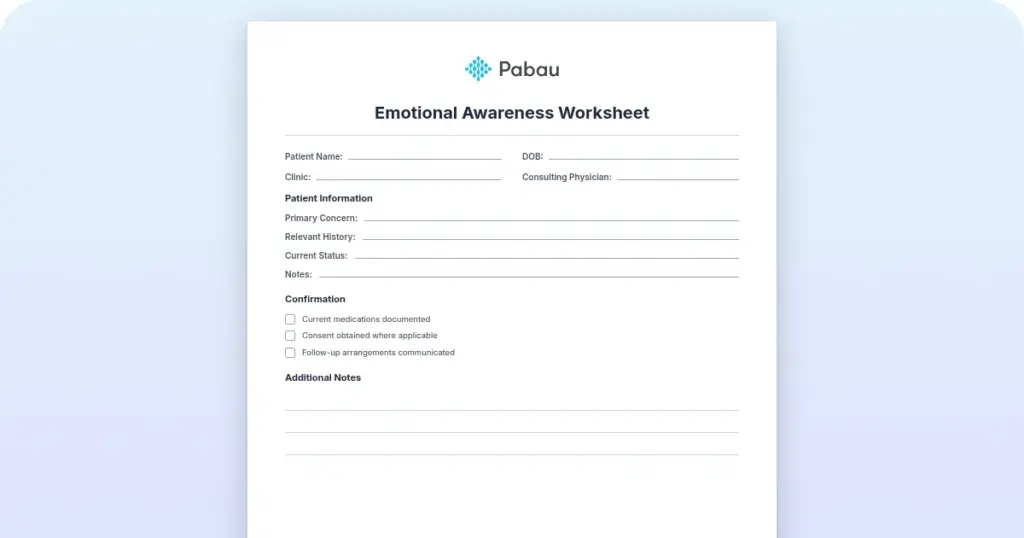
Emotional awareness worksheet
An emotional awareness worksheet is a structured psychoeducational tool that hel...

2
Last Updated: Oct 16, 2026

The alexithymia test is a standardized self-report measure assessing difficulty identifying, describing, and processing emotions.
The most widely used validated instrument is the Toronto Alexithymia Scale (TAS-20), a 20-item questionnaire with three clinical subscales measuring emotional awareness.
Alexithymia screening helps clinicians identify emotion-processing difficulties that underlie anxiety, depression, somatic complaints, and interpersonal conflict.
Practice management software like Pabau lets clinicians send structured intake questionnaires, capture responses in the patient record, and fold the findings into care planning.
A standardized psychological assessment tool evaluating an individual’s ability to identify, understand, and express emotions. Includes 20-item format with three subscales measuring difficulty identifying feelings, difficulty describing feelings, and externally oriented thinking.
Download templateAn alexithymia test is a short self-report questionnaire that measures how much difficulty someone has identifying, describing, and processing emotions. This guide covers how to run one in your mental health practice, how to score the most-used version (the Toronto Alexithymia Scale, TAS-20), and how to turn the result into a treatment plan. You can download the free test above and hand it to patients at intake.
Alexithymia literally means “without words for emotion.” It describes a profile marked by difficulty identifying feelings, reduced ability to describe emotional states, and an externally focused thinking style. The alexithymia test is a standardized self-report instrument that measures these three dimensions.
The most widely used tool is the Toronto Alexithymia Scale (TAS-20), developed by Bagby, Parker, and Taylor at the University of Toronto. It comprises 20 items rated on a 5-point Likert scale, generating a total score and three subscale scores: Difficulty Identifying Feelings (DIF), Difficulty Describing Feelings (DDF), and Externally Oriented Thinking (EOT).
The Perth Alexithymia Questionnaire (PAQ) is a validated 24-item measure that scores positive and negative emotions separately. The 37-item Online Alexithymia Questionnaire (OAQ-G2) is popular for self-screening online, though it is less formally validated than the TAS-20 or PAQ. Each has distinct psychometric properties and clinical uses.
Deploying an alexithymia test in your practice follows a structured five-step workflow:
In practice management software like Pabau, patients complete the questionnaire as a digital intake form that saves straight to their record. That takes the manual data entry off your team.
The alexithymia test benefits clinicians across multiple mental health and medical specialties:
With a tool that tracks clinical measurements, baseline and follow-up scores sit side by side in the patient record.
Systematic alexithymia screening strengthens clinical outcomes and practice efficiency.
Early identification: Detecting alexithymia traits during intake reveals hidden barriers to therapeutic engagement. Patients with high alexithymia may struggle to report mood shifts or connect emotions to bodily sensations. Knowing this upfront shapes how you approach the work.
Personalized treatment. Subscale patterns guide the intervention. High DIF (difficulty identifying feelings) points to emotion-labeling exercises. High DDF (difficulty describing feelings) responds to narrative therapy or somatic work. High EOT (externally oriented thinking) suggests mindfulness training. A negative emotions list gives patients the precise words emotion-labeling exercises ask them to use.
Objective tracking. Serial alexithymia testing across therapy episodes documents emotional awareness improvement.
Compliance and risk reduction.
Pair alexithymia screening with somatic assessment tools (body sensation checklists, interoception exercises) to build patients’ awareness of emotion-sensation links. This dual approach accelerates emotional literacy development and improves therapeutic alliance.
A common clinical question: Is alexithymia autism? The short answer is no, though the two frequently co-occur.
Alexithymia is a specific difficulty with emotion identification and expression. Autism is a neurodevelopmental condition affecting communication, social interaction, and sensory processing. An autistic person may have typical emotional awareness but express it differently, through literal speech or unconventional timing. A non-autistic person, by contrast, may have profound alexithymia with a typical social presentation. Scores recorded at each session are only useful when they sit in one place, which is what psychology practice software does.
Research suggests alexithymia is more common in autistic adults, possibly because autism involves reduced interoceptive feedback or different emotion-processing neurology. Running the test with neurodivergent patients clarifies whether the difficulty stems from autism, co-occurring alexithymia, or both, which shapes the support you offer.
TAS-20 interpretation follows clinical thresholds developed across normative samples:
Subscale analysis reveals specific deficits. A patient with high DIF but low DDF identifies feelings poorly yet can articulate them once named. The reverse pattern, high DDF with low DIF, shows intact feeling recognition but poor verbal expression.
Clinical note: The alexithymia test is a screening tool, not a diagnostic instrument. Elevated scores warrant further assessment (clinical interview, standardized measures of emotion regulation, neurodevelopmental screening) before treatment planning.
The alexithymia test is an efficient screening tool that surfaces emotion-processing barriers early in care. Built into routine intake, it gives you objective baseline data to personalize treatment, track progress, and show improvement over time. Book a demo to see how Pabau turns intake questionnaires into documented results inside the patient record.

Screening adult clients for autism spectrum traits? RAADS-R test is a validated tool assessing sensory, social, and interest-based domains in adults.
Helping clients accept what they cannot change? Radical acceptance worksheet template guides clients through evidence-based acceptance exercises instead of changing thoughts or emotions directly.
Working with clients who deny a drinking problem? Readiness to Change Questionnaire scores 12 items across three subscales for addiction and alcohol-use treatment settings.
An alexithymia test is a standardized self-report questionnaire measuring difficulty identifying, describing, and processing emotions. The Toronto Alexithymia Scale (TAS-20) is the most validated instrument, comprising 20 items scored to yield a total alexithymia score and three subscale scores.
Most patients complete the TAS-20 in 5-10 minutes. The longer OAQ-G2 (37 items) requires 10-15 minutes. Time varies based on reading speed and reflection depth.
No. The alexithymia test measures emotion-identification difficulty, not autism. Alexithymia and autism are distinct but may co-occur. Autism diagnosis requires formal developmental history, communication assessment, and specialist evaluation.
Yes. Evidence-based interventions include emotion-labeling exercises, somatic therapy, mindfulness, and narrative approaches. Serial testing tracks improvement in emotional awareness over therapy episodes.
Clinicians often distinguish primary (trait) alexithymia, a stable feature likely rooted in development or neurobiology, from secondary (state) alexithymia, which is acquired in response to trauma, chronic illness, or acute stress and can ease as the underlying cause is treated.
Depression is a mood disorder with low mood, anhedonia, and hopelessness. Alexithymia is a difficulty processing emotions independent of mood state. Alexithymia often co-occurs with depression and complicates treatment engagement.
The clearest first step is to complete a validated test for alexithymia, most often the 20-item Toronto Alexithymia Scale. A total score of 61 or higher points to clinically significant alexithymia, and 52 to 60 is borderline. Because the questionnaire is a screen rather than a diagnosis, discuss an elevated score with a mental health clinician who can confirm it alongside a clinical interview.
Yes. Alexithymia is difficulty identifying and describing emotions, not an absence of emotion or physical responses. Someone with alexithymia can cry, laugh, or feel physiological arousal, yet struggle to name what they are feeling or link it to a cause. That gap between a bodily reaction and an emotional label is what the assessment measures.
Alexithymia is a well-researched, widely accepted construct, even though it is not a standalone diagnosis in the DSM-5. It is measured with validated instruments like the TAS-20 and studied across depression, anxiety, autism, and somatic conditions, so clinicians treat it as a meaningful trait that shapes how a patient engages with care.