GLP-1 diet plan
A GLP-1 diet plan is a structured eating framework for patients taking semagluti...

2
Last Updated: Oct 13, 2026

The Allen test is a bedside vascular assessment procedure that evaluates collateral blood circulation to the hand via the radial and ulnar arteries.
Normal color return occurs within 5-7 seconds; delayed return (>7 seconds) suggests inadequate ulnar circulation and may contraindicate radial artery intervention.
The modified Allen test using pulse oximetry is WHO-recommended before arterial blood gas sampling and is now preferred over the original test in many clinical settings.
Pabau’s digital forms and client records help clinicians capture, store, and retrieve Allen test results within structured pre-procedure documentation workflows.
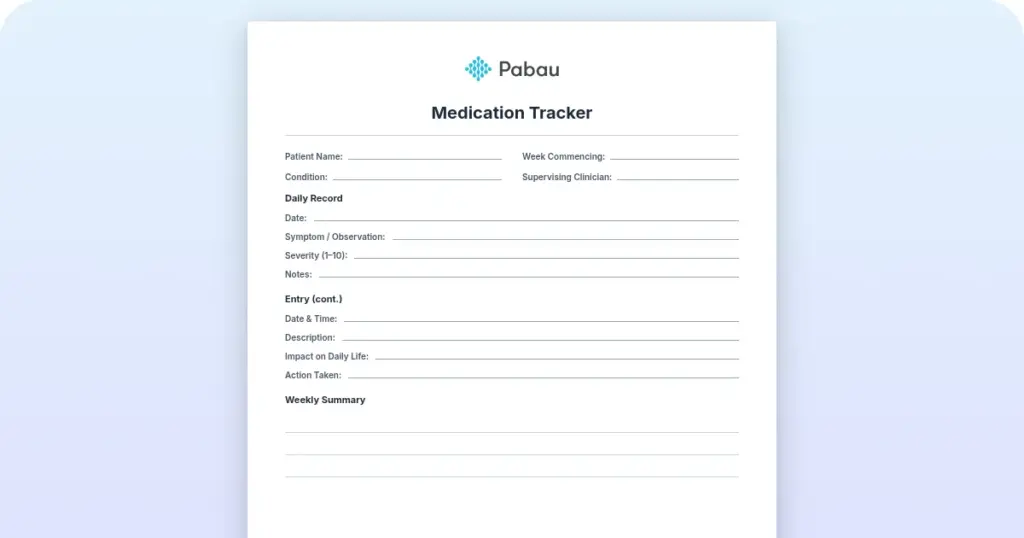
A ready-to-use clinical assessment form capturing the Allen test procedure steps, hand blanching assessment, color return timing, and clinical interpretation for radial artery patency determination.
Download templateBefore any procedure involving the radial artery — arterial blood gas sampling, radial artery cannulation, or radial artery harvesting — healthcare professionals must first confirm the hand has adequate collateral circulation. The Allen test is the standard bedside screening tool used to make that call.
This guide gives you a downloadable documentation form and a step-by-step procedural reference for capturing Allen test results in your clinical workflow. Practice management software like Pabau can hold those results in the patient record, so the pre-procedure check sits alongside the rest of a patient’s file instead of on a loose sheet of paper.
The Allen test is a clinical examination procedure designed to assess collateral circulation in the hand. It evaluates whether both the radial artery and ulnar artery are patent (open) and capable of delivering adequate blood supply to the hand via the palmar arch.
The hand normally has a dual blood supply. The radial and ulnar arteries feed the superficial and deep palmar arches, so if one artery is compromised, the other can often keep the hand perfused. The purpose of the Allen test is to confirm that this backup exists before you interrupt flow through the radial artery.
The procedure was first described in 1929 by Dr. Edgar Van Nuys Allen, a Mayo Clinic physician, as a method to identify patients at risk of hand ischemia following radial artery intervention.
The test works by occluding (compressing) both the radial and ulnar arteries while the patient makes a fist to empty blood from the hand. When the patient then opens their hand, the clinician releases pressure from the ulnar artery and observes how quickly color returns to the palm.
A brisk return of normal skin color indicates adequate ulnar circulation and suggests the hand will continue to receive blood flow if the radial artery is cannulated or harvested.
According to NCBI StatPearls, the Allen test is the first-line bedside screening tool used before radial artery puncture, arterial line placement, or radial artery graft harvesting. The procedure is non-invasive, requires no equipment beyond a clinician’s hands, and takes less than one minute to perform, making it a practical assessment for any clinical setting.
The Allen test procedure consists of five key steps. This sequence ensures consistent assessment and reliable interpretation of hand perfusion status. Use the downloadable template below to record results during the procedure. Our guide on digital forms for clinical intake describes how structured templates help capture this data directly into patient records.

The modified Allen test, recommended by the WHO Guidelines on Drawing Blood, uses pulse oximetry placed on a fingertip instead of visual observation. The signal disappears during arterial compression and returns when one artery is released. This objective measurement reduces observer variability and is increasingly preferred.
When color is hard to read, such as with cool hands, poor lighting, or darker skin tones, some clinicians add Doppler ultrasound or plethysmography to confirm the finding.
Test interpretation hinges on the color return time and the clinical context. Results fall into three categories: normal, delayed, and absent return. Document the exact return time (in seconds) and the clinician’s assessment on your template form.
The words “positive” and “negative” cause more confusion here than the test itself, because sources use them in opposite ways. Some clinicians call a brisk, normal color return a positive Allen test (collateral supply is present), while others reserve “positive” for a delayed or absent return (something abnormal was detected). The same split applies to a negative Allen test.
To sidestep the ambiguity, record the color return time in seconds and the category (normal, delayed, or absent) rather than only “positive” or “negative.” If your team does use those labels, define them once on the documentation form so every clinician reads a result the same way.
A clear entry reads: “Modified Allen test, right hand: palm blanched with dual compression; color returned in 6 seconds after ulnar release with the radial artery still compressed.” That phrasing lets anyone interpret the result months later, which a bare “normal” cannot.
Important caveat: LITFL’s clinical reference notes that the Allen test has limitations in sensitivity and specificity. A negative (normal) Allen test does not guarantee that radial artery intervention is completely safe, nor does a delayed result always contraindicate the procedure.
Clinical judgment, patient history, and institutional protocols must guide the final decision. Many practices now combine the Allen test with additional vascular imaging (ultrasound) before high-risk interventions.
In software built for occupational therapy practices, scores from scales like this feed straight into progress notes.

Pabau’s digital forms and client records help you capture, store, and retrieve Allen test results and other pre-procedure documentation directly within your practice workflow.

The Allen test is performed immediately before any planned radial artery intervention. Common clinical scenarios include:
The test should be performed on the side of the wrist where intervention is planned. If the dominant side shows an abnormal result, the contralateral (opposite) wrist can be tested to identify a suitable alternative site. The modified Allen test is recommended by WHO as standard practice before radial arterial puncture.
Any healthcare setting where radial artery access is planned should have a standardized Allen test documentation protocol. Relevant roles and specialties include:
Having a downloadable, printable Allen test form ensures that all clinicians follow the same assessment protocol, document results consistently, and create an audit trail for clinical governance. Using structured client records to capture these assessments means the data is immediately available for clinical review, quality auditing, and patient safety tracking.

A formal, standardized Allen test documentation form provides several clinical and operational benefits:
Many practices now embed the Allen test assessment as a mandatory step in their pre-procedure automated workflows. When a clinician initiates a radial artery procedure order, the system prompts them to complete the Allen test form before the procedure can proceed. This workflow automation reduces missed assessments, ensures compliance, and guarantees that every patient file contains a documented pre-procedure vascular screen.
The original Allen test, described by Dr. Allen in 1929, relies entirely on visual observation of color return in the hand. A clinician watches the palm and notes the time when pink color reappears after releasing the ulnar artery. This method is simple, free, and requires no equipment. Those advantages have kept it in use for nearly a century.
The modified Allen test uses pulse oximetry, typically applied to the index or middle finger. As the radial and ulnar arteries are occluded, the pulse oximetry signal disappears. When the clinician releases the ulnar artery, the signal returns (or a waveform reappears).
The time from signal loss to signal return is recorded. This objective measurement eliminates observer bias, works better in patients with poor skin perfusion or darkly pigmented skin, and is easier to document accurately.
Current clinical guidance favors the modified test. The WHO Guidelines on Drawing Blood recommend pulse oximetry-based assessment before arterial sampling. If your practice has pulse oximetry equipment, the modified approach is the preferred standard.
A related pulse oximetry method, the Barbeau test, grades the waveform response from A to D as the radial artery is compressed. Some interventional teams prefer it before transradial access because it captures the borderline results a yes-or-no Allen test can miss.
The downloadable template can document either method. Select the measurement type and record the result.
While the Allen test is widely used, it has important limitations that clinicians must understand. Research has shown that the test’s sensitivity and specificity for predicting hand ischemia are not as high as historically assumed. StatPearls cites a sensitivity around 73.2% and a specificity around 97.1% before radial artery harvest, and studies report only modest agreement between examiners grading the same hand.
Some patients with abnormal Allen test results never develop hand complications, while others with normal results occasionally experience problems. Anatomical variations (incomplete palmar arch, anomalous arterial anatomy) account for some of this variability.
Additionally, the definition of an abnormal return time varies across literature and institutions. Some guidelines cite 5-7 seconds as the threshold, others use 10-15 seconds. Your institution’s protocol should define these cutoffs clearly and should be included on your Allen test documentation form.
Modern practice often combines the Allen test with supplementary vascular assessment. Before high-risk procedures (such as radial artery harvest), many surgeons now order duplex ultrasound imaging to assess radial and ulnar artery diameter, patency, and flow velocity. This multimodal approach provides additional confidence and reduces the risk of post-operative hand complications.
The name causes one more point of confusion worth clearing up. The Allen test for thoracic outlet syndrome is a separate maneuver that has nothing to do with radial artery access. For that version, the patient sits with the arm abducted to 90 degrees, the elbow flexed, and the shoulder externally rotated, then turns the head to the opposite side. The examiner palpates the radial pulse throughout.
A diminished or absent radial pulse, or reproduction of the patient’s arm symptoms, points to neurovascular compression at the thoracic outlet. Document which test you performed, since a note reading only “Allen test positive” is ambiguous when two unrelated exams share the name. The template above records the hand and radial artery version described throughout this guide.
Moving from paper-based Allen test forms to digital documentation offers substantial workflow and compliance benefits. Digital forms can be completed on tablets or computers at the bedside, reducing transcription errors and ensuring real-time data capture. Results are immediately stored in the patient record, visible to all team members, and automatically included in pre-operative summaries or procedure reports.
When selecting a practice management system, confirm that it supports customizable assessment forms, captures timestamps and clinician signatures, and integrates vascular assessment results with your broader clinical documentation. Systems with automated reminders ensure the Allen test is performed and documented before any scheduled radial artery procedure, supporting patient safety and regulatory compliance.
The Allen test remains an essential bedside screening tool before any radial artery intervention. A standardized documentation template ensures consistent assessment, clear record-keeping, and reliable clinical decision-making across your team. Download the template above, print it for your procedures, or integrate it into your practice workflow using Pabau. Book a demo to see Pabau’s automated medical form workflows in action.
Whether you use the original visual method or the modern pulse oximetry-based approach, a formal Allen test record is fundamental to safe vascular access practice.

Preparing your practice for a CQC inspection? CQC inspection checklist walks general practices through 15 steps covering quality statements, registration, and the two-week countdown to inspection day.
Need a sheet to log vital signs? Vital sign sheets let practices monitor and document key physiological measurements over time, supporting patient safety.
Need reference ranges for troponin results? Troponin levels chart gives normal ranges for Troponin I, Troponin T, and high-sensitivity assays to track patient results.
It checks whether the hand has adequate collateral circulation from both the radial and ulnar arteries. Confirming that the ulnar side can perfuse the hand on its own tells you it is safe to interrupt flow through the radial artery for cannulation, blood gas sampling, or graft harvest.
The label is used inconsistently, which is why documenting the timed result matters. Some clinicians call brisk color return (adequate collateral supply) a positive result, while others reserve “positive” for a delayed or absent return that flags compromised ulnar flow. To avoid confusion, record the return time in seconds and the category (normal, delayed, or absent) rather than the word alone.
An arterial blood gas (ABG) sample is drawn by puncturing the radial artery. The Allen test confirms the ulnar artery can supply the hand on its own, so if the puncture causes spasm or a clot, the hand still receives blood. Skipping it risks compromised perfusion in a patient with incomplete collateral flow.
Record four things: the method (standard or modified), which hand you tested, the timed color return in seconds, and your interpretation (normal, delayed, or absent). Capturing the seconds and method, rather than only “normal,” lets any clinician read the result the same way and creates a defensible pre-procedure record.
Release the ulnar artery first while keeping the radial artery compressed. That checks whether the ulnar side alone can perfuse the hand, which is the circulation you rely on if the radial artery is punctured or harvested. Releasing the radial artery afterward (the reverse maneuver) confirms radial perfusion as an optional second step.
The entire procedure takes less than 1 minute. Arterial occlusion and fist-clenching takes 10-15 seconds, hand opening takes 5 seconds, and color return observation takes 5-15 seconds depending on the speed of reperfusion. The modified Allen test (using pulse oximetry) typically completes in 1-2 minutes.
The Allen test is a screening tool, not a definitive predictor. Some patients with abnormal tests never develop ischemia, while some with normal tests rarely do experience complications. Modern practice often combines the Allen test with duplex ultrasound or other vascular imaging for high-risk procedures to improve predictive accuracy.
The modified Allen test using pulse oximetry is now recommended by WHO and major surgical societies. It provides objective, observer-independent measurement and works reliably in patients with poor skin perfusion or dark skin tone. If your clinic has pulse oximetry available, the modified approach is preferred as the standard method.
An abnormal result warrants further vascular assessment before proceeding. Options include: test the contralateral (opposite) wrist to find an alternative cannulation site, order duplex ultrasound imaging to assess radial/ulnar artery diameter and flow, or consult your institution’s vascular surgery team. Clinical judgment and institutional protocols guide the final decision on whether to proceed or select an alternative access route.