GLP-1 diet plan
A GLP-1 diet plan is a structured eating framework for patients taking semagluti...

2
Last Updated: Oct 13, 2026

A visual spatial test measures how well someone sees, analyzes, and mentally manipulates visual and spatial information.
The WAIS-IV Visual Spatial Index, the Rey-Osterrieth Complex Figure, and the Benton Visual Retention Test do most of the clinical work.
Sloppy setup, motor problems, and uncorrected vision produce more low scores than spatial deficits do.
A low score carries weight when it sits well below the patient’s other index scores.
Practice management software like Pabau keeps scores, notes, and the next appointment in one client record.
A patient copies the Rey-Osterrieth figure and the drawing comes back crowded into one corner. Is that a spatial processing problem, a hand tremor, or a test that was set up badly?
A visual spatial test answers that question only when you run and score it to the letter.
Each one takes 10 to 20 minutes, and each is sensitive to right-hemisphere damage. They are also easy to spoil, since a bright window, a paraphrased instruction, or a stopwatch started two seconds late will all move the score.
A visual spatial test is a standardized assessment of how a person perceives, analyzes, and mentally manipulates visual information.
The family covers several tasks, so patients might rotate shapes in their head, judge how objects sit in space, copy geometric figures, or track patterns. Psychologists, occupational physicians, and pediatric teams all use them, though not always under the same name.
Spatial reasoning is the broad category, and visual-spatial ability sits inside it as the narrower term for perception and construction.
Howard Gardner’s visual-spatial intelligence is a separate idea again, drawn from his theory of multiple intelligences. Clinically, visual-spatial ability is the term worth keeping, because that is what validated instruments score.
Spatial ability is also one of the most studied cognitive domains. The American Psychological Association points to well-documented links between spatial skill and achievement in science and math.
Clinical interest is narrower, and it comes down to localization, because these tests pick up right-hemisphere and parietal lobe problems. That is why they sit in almost every neuropsychological battery.
Spatial ability splits into four sub-skills, and each has its own tasks and its own diagnostic meaning. A patient can fail one and pass the other three, so the sub-skill often tells you more than the total does.
Mental rotation shows the largest and most consistent sex difference in population studies, so normative comparisons need care there.
Spatial visualization loads heavily on the right parietal lobe, which is why it fades early in posterior cortical atrophy. Spatial orientation tasks, by contrast, fall apart in unilateral neglect after a right-hemisphere stroke.
Instruments differ in what they score, who they were normed on, and how long they take, so the choice is rarely a matter of preference.
A psychiatric evaluation template usually names which ones to include for each referral reason. The table below covers the tools most neuropsychology services keep on the shelf.
The VSI rests on two subtests. Block Design has the patient rebuild a two-color pattern with blocks against the clock, which taps construction. Visual Puzzles then asks which three pieces make the finished shape, tapping analysis and rotation.
Together, the two subtests produce a composite with a mean of 100 and a standard deviation of 15, per the WAIS-IV technical manual.
Choosing between them gets easier once you start from the question in the referral letter.
Standardized administration decides whether the number means anything at all. The protocol below applies to paper-and-pencil instruments such as the ROCF and the BVRT, with notes where WAIS-IV administration differs.
Flag motor performance separately from spatial cognition in your notes. A patient with essential tremor can produce an impaired ROCF copy score that reflects hand control, not spatial processing. Note that distinction and you avoid coding a deficit that was never there.
Disputed scores usually trace back to four habits.
Index scores use a mean of 100 and a standard deviation of 15. Individual subtests are scaled differently, at a mean of 10 and a standard deviation of 3, so the two sets of numbers are not interchangeable.
The bands below follow the descriptive classifications published with the WAIS-IV.
On its own, a low score diagnoses nothing. Three explanations account for most of them, and all three are cheap to check.
An isolated low score is weak evidence, while a split between indexes is much stronger. Take a patient with a Verbal Comprehension Index of 115 and a VSI of 72.
That 43-point difference is the finding, and it points toward a posterior or right-hemisphere problem. The National Institute of Neurological Disorders and Stroke, or NINDS, treats an uneven cognitive profile as a reason to keep looking.
Spatial deficits appear across neurological and neurodevelopmental conditions, and the pattern differs from one condition to the next. That pattern decides which instrument to lead with and how to word the referral.
The contrasts can be stark, so practitioners planning ADHD therapy activities should remember that ADHD looks nothing like an acquired spatial deficit.
Yes. Training improves spatial performance, and the gains show up on tasks the patient never practiced. Even so, frame that carefully with anyone who has an acquired deficit, because a population effect is not a personal promise.
A 2013 meta-analysis by Uttal and colleagues pooled 217 studies of spatial training. It found reliable improvement that transferred across task types and held up over time. That average effect was moderate, a Hedges’s g of 0.47, which is still worth having in rehabilitation.
Feng and colleagues had already shown in 2007 that 10 hours of action game play narrowed the sex difference in mental rotation. In practice, treat games as a training tool that sits alongside rehabilitation, rather than a substitute for it.
The work does not stop when the score is calculated, because somebody still has to file the raw sheet and log the observations. Then the retest needs booking at the right interval, and the result has to reach the care plan. In busy psychology practices, that chain runs through a paper folder and one person’s memory.
Practice management software like Pabau closes that loop, working as a mental health EMR and a booking system at once. The assessment, the note, and the next appointment then sit in the same client record.
Pabau’s client records hold index scores against the patient’s file, with dates attached. Six months later, the previous VSI, your observations, and the referral letter are on one screen. Outcome tracking goes further and plots score changes over time, so you can show a referring physician improvement or decline at a glance.
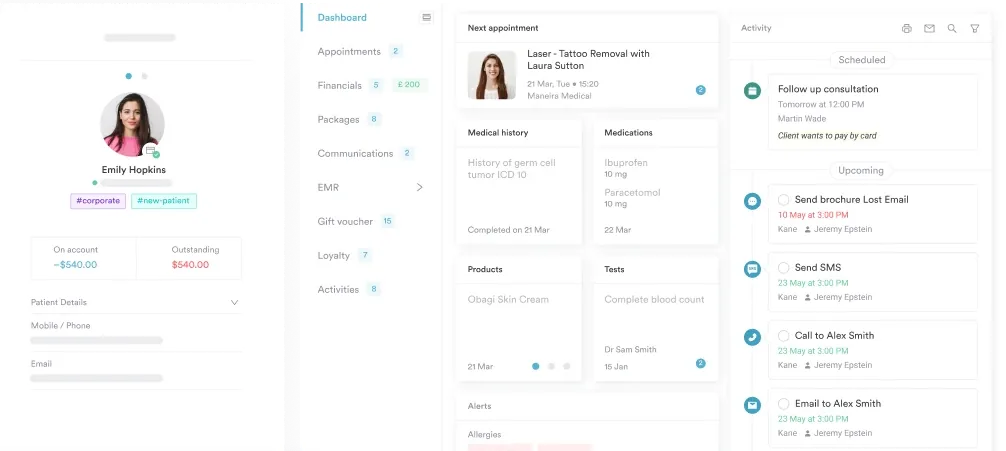
Forms help before the session too. Health history collected ahead of the visit means you arrive already knowing about the new medication, the cataract surgery, or last night’s migraine. That preparation protects the score, and it leaves an audit trail if anyone questions the result later.


Pabau brings scheduling, clinical notes, outcome tracking, and client records into one system. Scores stay attached to the patient, so a follow-up assessment never starts from scratch.

A visual spatial test earns its place in a battery because it catches problems that language-based testing walks straight past. It is also unusually easy to spoil. Standard instructions, an honest look at vision and hand function, and the right norm table protect a result better than any clever interpretation can.
So treat the score as one line in a profile, not a verdict. Set it against the patient’s other indexes, write down what you watched them do, and agree the retest interval before they leave the room.
Keeping all of that in one place is the easy part to fix. Book a demo to see how Pabau ties assessment scores, clinical notes, and follow-up appointments into a single client record.

Client stalling on their between-session homework? Procrastination worksheets cover trigger identification, cycle mapping, behavioral activation scheduling, and an action plan.
Discharging a teenager after a crisis assessment? Safety plan for teenagers helps a young person build a personalized plan before they leave your care.
Documenting a nursing care plan for psychosis? Schizophrenia nursing care plan lists the current NANDA diagnoses plus the interventions and monitoring that hold up.
Gauging a client’s readiness to change? Stages of change worksheet covers all six stages with reflection prompts and a decisional balance exercise.
Building a fuller clinical history? Life events timeline helps you map the events that shape a patient’s current presentation.
A licensed psychologist or neuropsychologist usually administers and interprets these instruments. Trained assistants and occupational therapists can run some tasks under supervision, depending on the publisher’s qualification level and local rules. Interpretation is the restricted part. Most spatial batteries sit at a level that expects graduate training in psychological assessment.
Not for clinical use. A free online spatial test has no supervised setup, no age-matched norms, and no control over timing or screen size. It can spark curiosity or work as a classroom exercise. Repeat the assessment with a normed instrument before anything goes in the chart.
Most clinicians wait six to 12 months. Patients remember figures and block patterns, so an early retest inflates the score through practice effects. When a faster recheck is unavoidable, use an alternate form or another instrument that taps the same sub-skill. Record the interval either way.
It can, though the pattern is uneven. Reading is not required for most spatial tasks, so many dyslexic patients score in the average range. Slower visual processing and weaker working memory can still pull down timed items. Score the untimed trials separately before blaming spatial ability.
No. A spatial test covers one domain, while an IQ battery samples several and returns a full-scale score. The WAIS-IV index sits inside that wider battery. Standalone tools such as the ROCF give no IQ estimate.