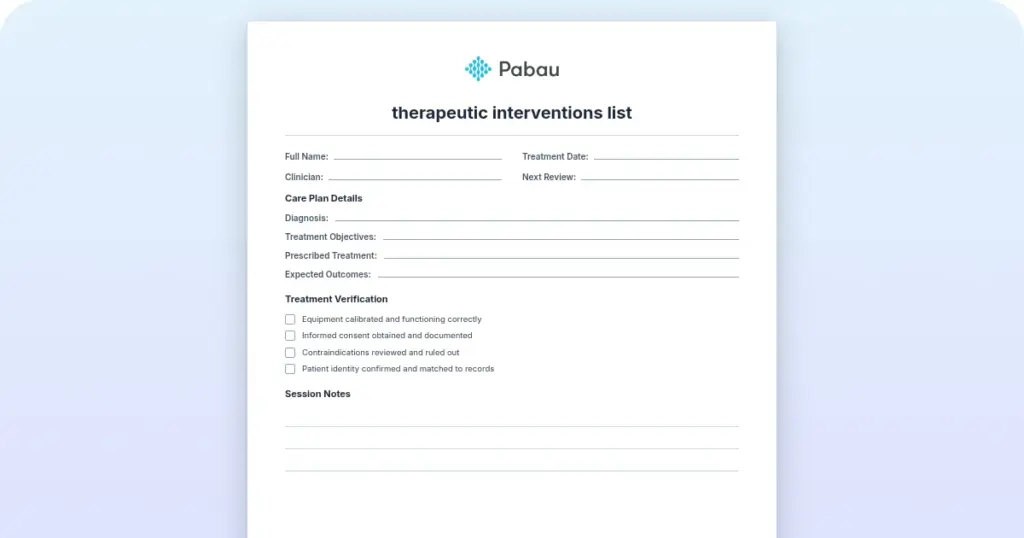
Therapeutic interventions list
A therapeutic interventions list is a reference of evidence-based treatment tech...

1
Last Updated: Oct 13, 2026

The adult biopsychosocial intake combines three assessment domains-biological, psychological, and social-to create a complete clinical picture for diagnosis and treatment planning.
This form type gathers medical history, medications, substance use, mental health symptoms, coping strategies, family dynamics, and environmental stressors in one structured assessment.
A biopsychosocial assessment provides deeper clinical integration than a standard intake, capturing interconnected factors that influence mental health and treatment outcomes.
Pabau’s digital forms builder lets clinicians send customizable biopsychosocial intakes to clients before appointments, streamlining data collection and feeding directly into client records.
A comprehensive assessment form capturing biological factors (medical history, medications, substance use), psychological factors (mental health history, symptoms, coping), and social factors (family, support systems, environmental stressors) for complete clinical understanding and treatment planning.
Download templateThe adult biopsychosocial intake form is a cornerstone assessment tool for mental health clinicians. This three-domain framework-biological, psychological, and social-allows therapists, counselors, psychiatrists, and social workers to understand clients holistically and inform evidence-based treatment planning.
Most practices that transition from basic intake forms to biopsychosocial assessments report deeper clinical insight and more personalized treatment outcomes. The structured format captures essential medical history, psychiatric symptoms, coping mechanisms, family dynamics, and environmental factors in one organized document.
This guide explains what belongs in each domain, how to guide clients through completion, why this assessment type differs from standard intakes, and how mental health EMR systems can digitize the entire workflow.
An adult biopsychosocial intake form is a comprehensive assessment document that evaluates three interconnected domains of a client’s presentation: biological (physical and medical), psychological (mental health and emotional), and social (relationships, environment, stressors).
This model originated from George Engel’s 1977 biopsychosocial framework, which argued that understanding human health requires examining biology, psychology, and social context together-not in isolation. A client’s anxiety cannot be fully assessed without knowing their medical history, trauma exposure, family relationships, and current life stressors simultaneously.
The form structure typically includes three main sections, each capturing critical information:
Together.
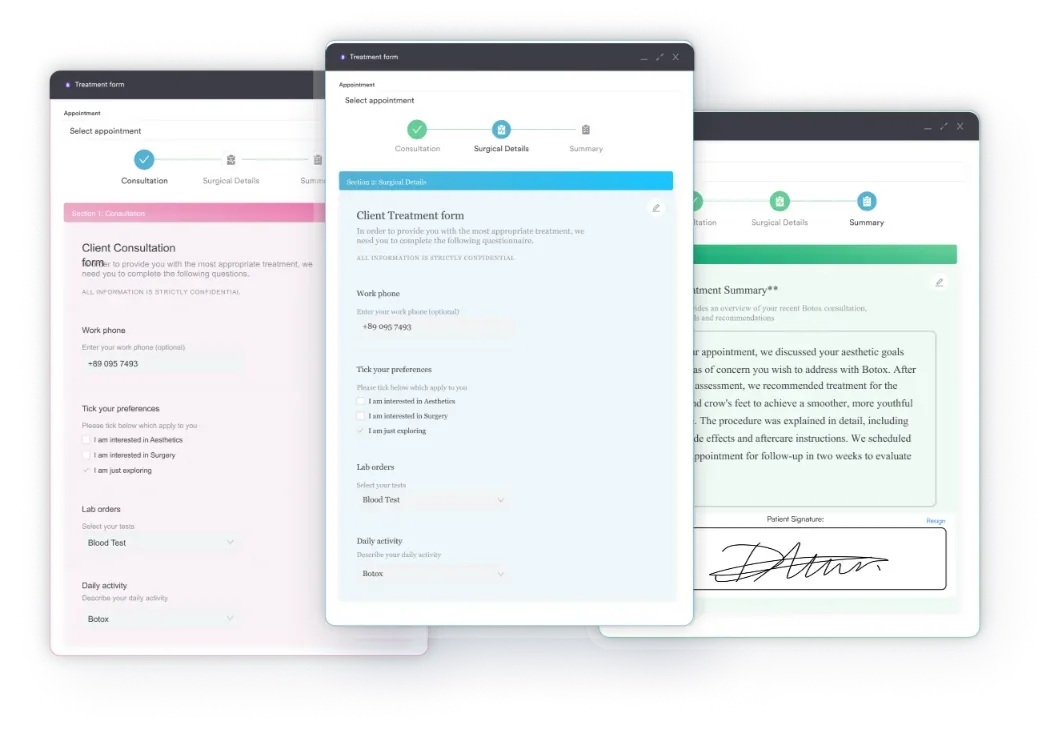
A complete adult biopsychosocial intake covers specific information categories across each domain. While forms vary by specialty and clinical setting, the standard framework includes:
Medical history (surgeries, chronic conditions, recent hospitalizations), current medications and dosages, allergies, family medical history (especially mental health conditions), substance use history (alcohol, cannabis, opioids, stimulants), sleep quality and patterns, diet and exercise, and reproductive/sexual health where relevant.
Presenting problem and symptoms, onset and timeline, past mental health treatment (therapy, medication, hospitalizations), childhood emotional development, trauma history, current mood and anxiety levels, suicidality and self-harm screening, cognitive functioning, coping mechanisms, strengths and resilience factors, and current stressors.
Family composition and relationships, quality of current relationships, social support systems (friends, community), employment or school status, financial stability and housing, cultural and spiritual background, legal history if relevant, and current psychosocial stressors.
Completing a biopsychosocial intake typically unfolds across a structured interview or written questionnaire. Here are the five operational steps clinicians follow:
Practices using therapy practice management software can automate steps 1-3 by sending digital intakes directly to clients and importing responses into their comprehensive client records, reducing manual data entry and speeding up session start time.
Estimated time to complete: 15-25 minutes for the client to fill out; 10-15 minutes for the clinician to review and interview.
A standard intake form gathers basic demographic and presenting-problem information quickly. A biopsychosocial assessment goes deeper, integrating medical, psychological, and social factors to explain the whole person.
Many practices use both: a brief standard intake for initial contact, followed by a full biopsychosocial assessment at the first clinical session.

Send biopsychosocial assessments directly to clients, auto-populate responses into their record, and start sessions with complete information.

Any mental health or integrated care practice working with adults benefits from biopsychosocial assessment:
Clinicians who adopt this assessment type report immediate gains in clinical accuracy and workflow efficiency.
Diagnostic clarity: Understanding how medical, psychological, and social factors interact prevents misdiagnosis. A client’s “depression” may have roots in untreated hypothyroidism (biological), grief over a recent loss (psychological), and social isolation (social).
Better treatment planning: You develop interventions addressing root causes, not just symptoms. A treatment plan incorporates medication coordination, therapy, and environmental changes-all informed by the full assessment.
Compliance and liability protection: Standard biopsychosocial documentation meets clinical standards set by SAMHSA, the American Psychological Association, and the National Association of Social Workers. It demonstrates due diligence in your clinical record.
Patient engagement: When clients see you asking about their whole life-not just symptoms-they feel understood and are more likely to commit to treatment.
Time savings with client management systems: Digital forms reduce transcription errors and allow data to flow automatically into medical records, appointment notes, and treatment plan documentation.
Customize your biopsychosocial form to match your specialty. A substance use disorder treatment program should expand the substance use section; a primary care practice may add more questions about medical complexity and medication interactions. Tailor, don’t simply copy-paste.
The true power of biopsychosocial assessment emerges when it feeds directly into your practice’s documentation and psychology practice software workflows.
Practices using practice management systems can: send the assessment form through the client portal before appointment, automatically populate client records with responses, reference the complete assessment during clinical note-writing, and extract key biopsychosocial details for treatment planning and progress monitoring.
This workflow-assessment, documentation, treatment planning, and outcome tracking-all in one place-represents the integration many clinicians seek but struggle to build across fragmented tools.
The adult biopsychosocial intake form is the clinical standard for comprehensive mental health assessment. By capturing biological, psychological, and social domains in one structured document, you gain the full picture needed for accurate diagnosis and effective treatment planning.
Download the template above, customize it to your practice. Your clients will feel more deeply understood, and your clinical team will spend less time on administrative work and more time on healing.

Need a framework for documenting mental health sessions? SOAP notes for social work walks through writing clinical documentation that builds directly on your intake.
Helping a client turn hope into action? Intention setting worksheet turns a vague hope into a written intention with weekly action steps.
Working with a couple on communication? Love language test template helps couples identify their core preferences to strengthen communication and connection.
A biopsychosocial assessment is a structured clinical evaluation that examines a person’s biological health (medical history, medications, substance use), psychological well-being (mental health symptoms, trauma, coping strategies), and social context (relationships, support systems, stressors) to develop a comprehensive understanding for diagnosis and treatment planning.
Mental health professionals including therapists, counselors, clinical social workers, psychiatrists, psychiatric nurse practitioners, and psychologists conduct biopsychosocial assessments. Primary care physicians and substance use disorder specialists also use this framework for integrated care.
Clients typically need 15-25 minutes to complete the written form. The clinician requires 10-15 minutes to review responses and conduct the clinical interview during the initial session.
A standard intake gathers basic demographic and presenting-problem information in 5-10 minutes. A biopsychosocial assessment takes 15-25 minutes and provides deeper clinical integration across medical, psychological, and social factors, enabling more accurate diagnosis and treatment planning.
The assessment form itself is not inherently compliant-it depends on how you store, transmit, and access it. Digital forms sent through secure client portals or encrypted email, and stored in HIPAA-compliant practice management systems, maintain compliance. Paper forms in locked cabinets also meet requirements.
Yes. Tailor the template to your specialty. A substance use disorder practice might expand the substance use section. A geriatric practice might add age-specific medical and cognitive questions. The three-domain structure remains, but content adapts to your client population and clinical focus.