Monika Lazarevska
Ethical consent form: free template and what to add
An ethical consent form is a written record that a patient or participant agreed...

2
Last Updated: Oct 26, 2026
Free PDF 1 page, print-ready Clinician-reviewed
Every counseling consent form has two jobs to do at once: protect you legally and give your client a clear, honest picture of what therapy involves before they agree to it. The template above does both, and it’s built to adapt whether you practice under US HIPAA rules or UK BACP and GDPR standards.
Below, you’ll find what each section of the form covers, how to tailor the confidentiality and mandatory-reporting language to your jurisdiction, and how to collect a signed form digitally before the first session.
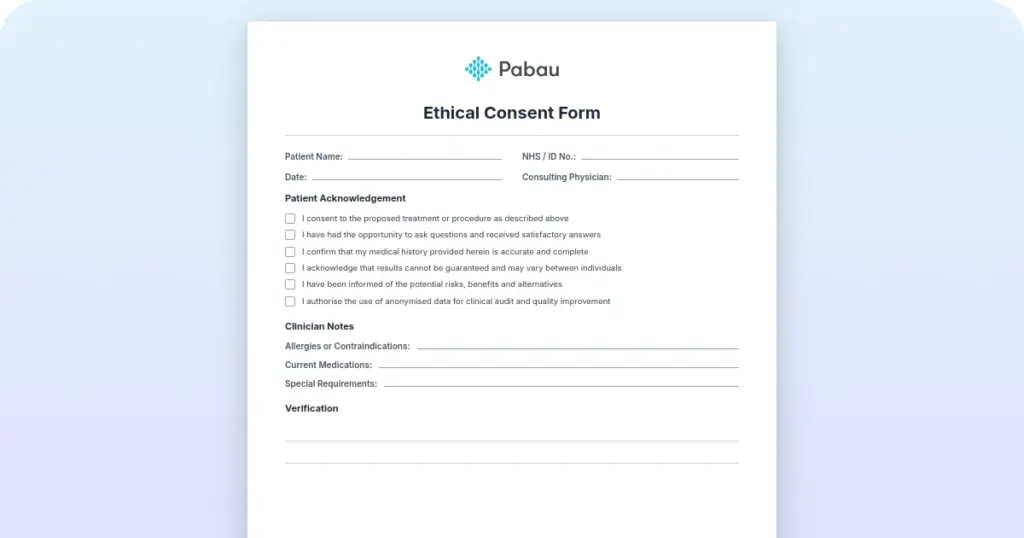
A ready-to-use consent form covering client details, therapist credentials, informed consent principles, confidentiality disclosures, limits of liability, session fees, cancellation policy, the right to withdraw consent, and signature blocks for both therapist and client.
Upload this PDF, or any form you already use, and Pabau's AI Form rebuilds it with tick boxes, text fields and a signature. Attach it to the treatment once, and every patient gets it on time.
AI Form rebuilds the consent, history and aftercare forms you already use. You review each one, then publish.
Patients complete forms on their phone before they arrive, so the front desk stops retyping paper.
Every signed form is versioned and attached to the treatment record, ready when you need it.
Set how long a consent stays valid. Returning patients skip forms they have already signed.
Supports HIPAA and GDPR compliance AES-256 encryption 4.8 on G2 4.7 on Capterra Trusted by 4,000+ practices worldwide

A counseling consent form is a legal document that establishes informed consent between an adult client and their therapist before treatment begins.
The form must disclose confidentiality limits, mandatory reporting obligations, fees, cancellation policy, and the client’s right to withdraw consent at any time.
Signed paper and electronic signatures are both legally valid in most US and UK jurisdictions, but verify your local requirements before you implement one.
Practice management software like Pabau, through its digital forms and client portal, can automate consent collection, signing, and secure storage, cutting paperwork and keeping your compliance documentation in one place.
A counseling consent form is a legal document that establishes informed consent between a therapist and an adult client before counseling begins. Sometimes called a therapist consent form or an informed consent form, it confirms that the client understands the nature of therapy and the benefits and potential risks.
It also documents the therapist’s qualifications and approach, the confidentiality terms, and the circumstances under which those boundaries may need to be crossed for safety or legal reasons.
The form serves two purposes: legal protection for the therapist (documenting that consent was obtained and understood) and client autonomy (making sure the client has the information they need to make an informed decision about treatment). Managing consent digitally through a patient portal streamlines this, letting clients review, sign, and return the form before their first appointment.
Informed consent is both an ethical obligation and a legal requirement in mental health practice. The American Psychological Association (APA) Ethics Code Section 3.10 requires psychologists to obtain informed consent before providing therapy in any psychology practice.
The British Association for Counselling and Psychotherapy, or BACP, similarly treats explicit consent as a foundation of the therapeutic relationship. A counseling informed consent form is how you document that agreement.
Without documented consent, therapists are exposed to complaints, disciplinary action, and malpractice claims if a client later disputes the nature or scope of treatment. Informed consent in counseling also respects client autonomy, because the therapeutic relationship depends on the client’s voluntary, educated participation from the first session.
A comprehensive form covers the information clients need to make an informed decision. The BACP and APA set the ethical frameworks. Licensing boards and insurance bodies add specific requirements. Below is a checklist of the essential and recommended sections.
Confidentiality is the cornerstone of the therapeutic relationship, but it is not absolute. The form must explain clearly what confidentiality means and which situations override it. Consent forms and session records need the same confidentiality protections whether they’re on paper or stored electronically .
Confidentiality means: the therapist will not share client information with anyone outside the therapeutic relationship without the client’s written permission. In the US, this is reinforced by psychotherapist-patient privilege, which is recognized in federal courts and most states, though it isn’t absolute (see the exceptions below).
The UK has no equivalent legal privilege — confidentiality there is protected through BACP’s ethical framework and UK GDPR obligations instead.
Limits of confidentiality apply when:
The specific triggers and procedures for mandatory reporting vary by state and country. Always customize this section to match your jurisdiction’s laws and licensing requirements.
In the United States, if a therapist accepts health insurance payments or stores patient health information electronically, HIPAA (the Health Insurance Portability and Accountability Act) applies. A counseling consent form is separate from a HIPAA Notice of Privacy Practices, but the two complement each other.
The key requirement: under HIPAA, general PHI can be used for treatment, payment, and operations without additional client consent, since a Notice of Privacy Practices already covers this. But if you keep separate psychotherapy notes, you generally need the client’s written authorization before using or disclosing them for any purpose, including sharing them with other providers or insurers. Software built for therapy practices treats the session note, not the invoice, as the center of the record.
Always confirm your specific obligations with a healthcare attorney in your state.
A digital consent form is legally valid in both the US (under the ESIGN Act 2000) and the UK (under the Electronic Communications Act 2000). Many therapists now collect consent electronically to cut paperwork and speed up intake.
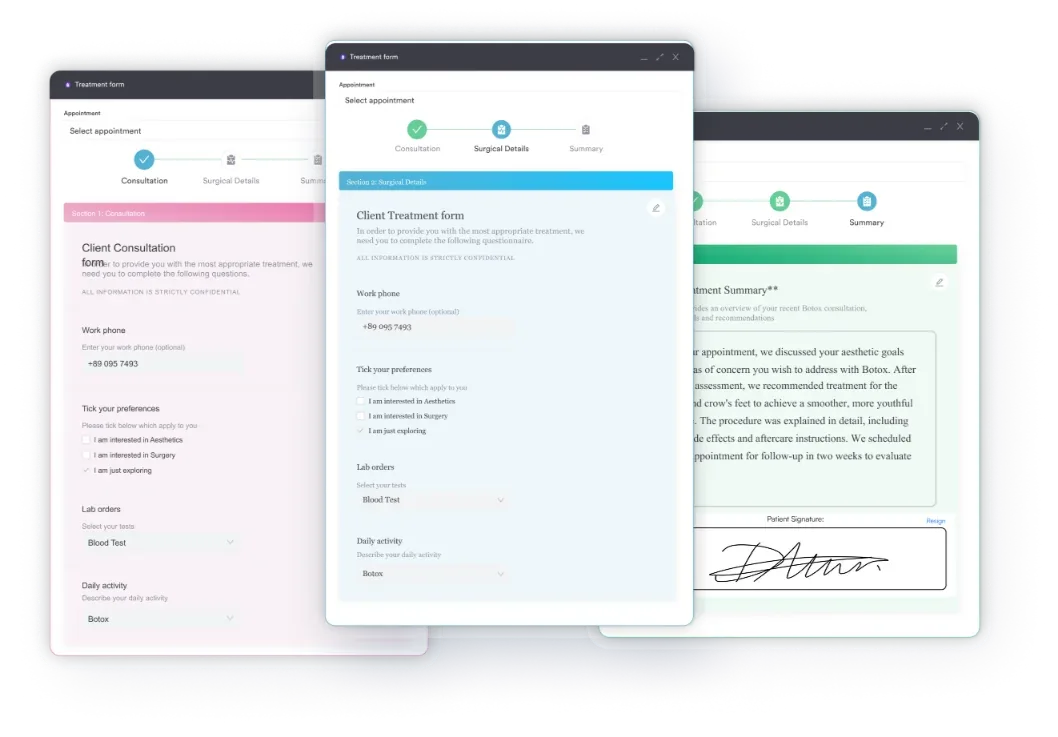
Steps to sign consent forms digitally:
The downloadable template above is ready to customize. Follow these five steps to put it to work in your practice.
Once signed, the consent form becomes part of the client’s clinical record alongside other intake paperwork. A completed self-awareness worksheet is filed the same way, which gives you a dated baseline of functioning at the start of treatment.
The same rules apply to a signed consent to treatment form or any release you keep on file.
Retention periods vary. In the UK, BACP guidance recommends keeping consent forms and clinical notes for a minimum of 7 years after treatment ends. In the US, requirements differ by state and licensing body, with some requiring 5 years and others 7 or more. Check your state licensing board and insurance company requirements.
Storage security matters. Whether records live in paper files or a digital system, signed consents must be kept in a locked cabinet or a password-protected system.
If you see clients across multiple states or countries, the law changes underneath you. A form that meets UK GDPR and BACP standards may not satisfy US state licensing requirements or HIPAA, and the reverse is just as true.
Where the differences bite. US states set different mandatory reporting thresholds, so some require reporting of suicidal ideation while others do not. The UK requires GDPR compliance for processing special category data, which mental health information falls under, so a UK mental health consent form has to address lawful basis and data retention explicitly.
Canada adds provincial variations on top. Consult a healthcare attorney in each jurisdiction where you practice before you finalize your form language.

Automate consent form distribution, digital signing, and secure storage in one integrated platform. Reduce paperwork and ensure compliance.

Beyond the template itself, how you administer consent shapes how well it works.
The same medical forms best practices apply to your counseling forms .
A counseling consent form protects both you and your clients by setting clear expectations, documenting informed consent, and spelling out confidentiality boundaries. The template above covers every essential element and can be tailored to your jurisdiction, practice model, and client population. Customizing it is straightforward.
What matters most is reviewing it with a healthcare attorney so it meets your state or country’s legal requirements and your professional liability insurance terms. Once it’s in use, store signed forms securely and keep them for the period your licensing body requires, typically 7 years or longer.
Book a demo to see how Pabau’s digital forms and client portal can automate consent collection, signing, and secure storage from intake through years of record-keeping.

Need another structured personality assessment form? Machiavellianism test template gives you all 20 MACH-IV items on a 7-point scale, with a total score field and sign-off space.
Screening for maladaptive daydreaming in a client? Maladaptive daydreaming test scores the 16-item MDS-16 scale from 0 to 100, with 40 or higher flagging clinical-level daydreaming.
Need a structured way to assess mental status? Mental status exam template gives you a standardized framework to evaluate psychological and cognitive functioning during an evaluation.
A complete form includes therapist credentials, client details, scope of services, fees and cancellation policy, confidentiality disclosures, limits of confidentiality (mandatory reporting, duty to warn), telehealth terms if applicable, right to withdraw consent, and signature blocks for both parties.
Informed consent in counseling is the client’s voluntary agreement to begin therapy after the therapist discloses what treatment involves, its risks and benefits, fees, and the limits of confidentiality. A counseling informed consent form is the document that records this agreement before the first session.
Yes. Ethical codes from the APA, BACP, and most licensing bodies require informed consent before therapy begins. Proceeding without documented consent exposes therapists to complaints, disciplinary action, and malpractice claims.
Yes. Clients have the absolute right to end therapy and withdraw consent at any time, and the form must state this clearly. Withdrawal doesn’t invalidate the consent that was in effect beforehand, but it ends future treatment.
Retention periods vary by jurisdiction. BACP guidance suggests 7 years post-treatment in the UK. US requirements differ by state and licensing board, typically 5 to 7 years. Verify your state licensing body and professional liability insurance requirements.
Yes, in both the US (ESIGN Act 2000) and the UK (Electronic Communications Act 2000). Electronic signatures are legally equivalent to handwritten ones, provided the system creates an audit trail and the client knowingly agreed to sign electronically.
Informed consent is the ethical and legal process of obtaining voluntary agreement after disclosing relevant information. A consent to treatment form is the document that records this process. The form is the evidence that informed consent was obtained.