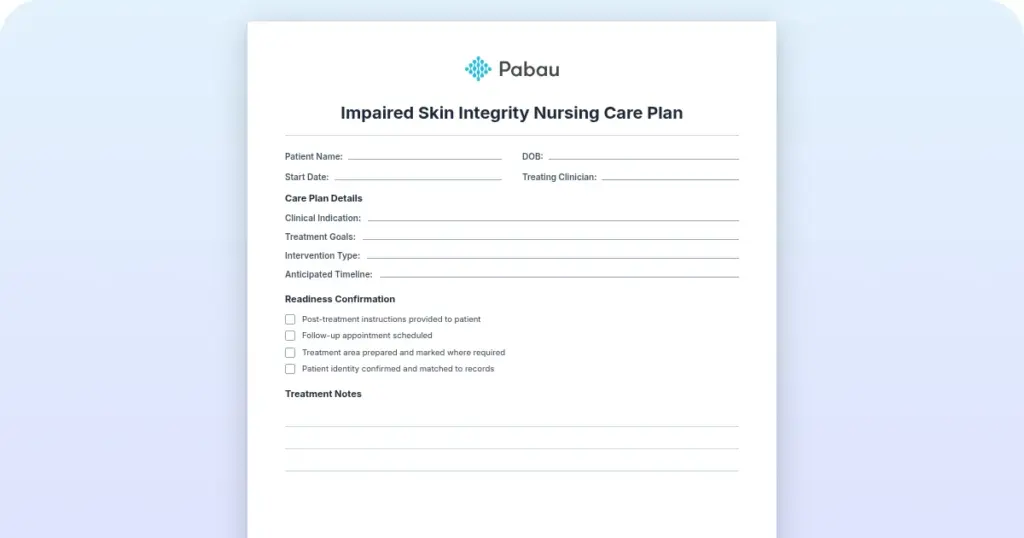
Impaired skin integrity nursing care plan
An impaired skin integrity nursing care plan is a structured document that recor...

1
Last Updated: Oct 16, 2026

AA Step 2 focuses on belief in a power greater than yourself that can restore sanity — a cornerstone spiritual principle in recovery.
The worksheet includes guided reflection questions on higher power concepts, personal beliefs about sanity, and how this step applies daily.
Clinicians and sponsors use this worksheet to help clients process Step 2 work safely, tracked within HIPAA-compliant clinical records.
Pabau’s digital forms and client portal allow therapists to administer this worksheet electronically and securely archive responses.
A structured reflection tool designed to support individuals, sponsors, and clinicians working through the second step of Alcoholics Anonymous — covering belief in a higher power, the meaning of sanity, and practical recovery commitments.
Download templateAn AA Step 2 worksheet gives structure to the second of the 12 steps: “Came to believe that a Power greater than ourselves could restore us to sanity.” It turns an abstract spiritual idea into written prompts on higher power, sanity, and daily practice, so individuals, sponsors, and clinicians can work the step deliberately and keep a record of it.
An AA Step 2 worksheet is a guided therapeutic tool that helps individuals in recovery explore the second step of Alcoholics Anonymous: “Came to believe that a Power greater than ourselves could restore us to sanity.” Delivered on paper or through practice management software like Pabau, it turns the emotional and spiritual work of the step into written prompts a person can answer at their own pace. Inside a mental health EMR, those answers stay tied to the client record.
The Big Book of Alcoholics Anonymous (officially titled “Alcoholics Anonymous”) introduced Step 2 as a critical transition from admitting powerlessness (Step 1) to developing faith in recovery. Many practitioners find this step challenging because it asks individuals to define their own “higher power” — whether that’s God, nature, community, or an abstract spiritual principle. A worksheet grounds that abstract work in writing.
In clinical settings, therapists use this worksheet alongside 12-step facilitation therapy, an evidence-based treatment model developed through the NIAAA’s Project MATCH trials. It complements medication-assisted treatment and individual counseling. The worksheet itself is a supportive tool, not a substitute for professional care.
Working Step 2 with a structured worksheet follows a five-step clinical process:
For sponsors, the worksheet prevents vague step work. Instead of asking “What do you think about Step 2?” a sponsor can hand over the worksheet and say, “Let’s walk through this together — there’s no right answer, just honest answers.”
The worksheet organizes its prompts into four themes. The examples below show the kind of questions it asks, and a sponsor or clinician can reword any of them to suit the person working the step.
Belief and a higher power
Sanity and insanity
Coming to believe
Daily practice and commitment
Writing the answers down is what separates this from a conversation. A person can return to their own words weeks later, and a clinician can see exactly how the step was worked.

Pabau’s digital forms and client portal make it easy to administer worksheets, track step progress, and maintain HIPAA-compliant records — all in one integrated platform.

This tool serves multiple recovery communities and clinical roles:
Clarity and intentionality: Writing forces thought. Someone may “believe” something in conversation but discovering what they actually believe through writing is revelatory. The worksheet captures that honest moment.
Inclusivity for agnostic and atheist clients: The worksheet’s language (“a power greater than ourselves”) is deliberately broad. It does not require theistic belief. Agnostic and atheist clients often identify that power as their recovery community, nature, or scientific truth, so the worksheet fits secular and faith-based recovery alike.
Documentation for clinicians: In outpatient or intensive outpatient programs (IOP), the worksheet becomes part of the treatment record.
Accountability and relapse prevention: When the individual writes their commitment to daily practices, it becomes harder to dismiss. During a relapse risk, therapists can refer back to the worksheet: “You wrote that attending meetings reconnects you to your higher power. What happened to that commitment?”
Unstructured step work risks becoming therapeutic avoidance. A client may spend hours in discussion without ever writing, thinking, or committing. The worksheet creates productive friction. It forces specificity and leaves a retrievable record of progress. Therapy sessions build a picture over months, and the record is what makes that picture readable.
Document Step 2 work in the clinical note with a summary sentence: ‘Client completed AA Step 2 worksheet, identifying [higher power concept] and committing to [daily practices]. Worksheet archived in client record for relapse prevention planning.’ This ties step work to clinical outcomes and demonstrates treatment engagement to insurance reviewers.
Step 2’s core promise — that “a Power greater than ourselves could restore us to sanity” — presumes the individual’s addiction created insanity. The worksheet asks: What does that look like for you? How did addiction distort your thinking, choices, and relationships? What would sanity feel like?
For many, the higher power begins as intellectually shaky. “I don’t know if I believe this.” The worksheet acknowledges that: “You don’t have to believe right now. The step says ‘came to believe’ — belief can develop.” This softening language helps agnostic and atheist clients who resist prescriptive spirituality.
In clinical practice, the higher power concept works as a protective factor. Recovery research links strong social support, spiritual practice, and community connection to more sustained sobriety, and Step 2 is where many people start building that connection.
Rereading their own words about belief, sanity, and commitment often surprises them: “I wrote this. I meant it then. It’s still true.” That reinforcement is powerful.
Different practices adapt the worksheet slightly:
Pabau’s digital forms are designed for exactly this use case.
The AA Step 2 worksheet transforms abstract spiritual work into concrete, documented recovery action. Whether you’re a sponsor walking someone through the steps, a therapist integrating 12-step facilitation into treatment, or an individual in recovery seeking clarity, this worksheet provides the structure recovery deserves. Combine it with a structured group counseling plan to keep the powerful work of Step 2 part of a person’s lasting recovery record.

Building a structured intake process? psychiatric evaluation template This guide walks through every component of a thorough mental health assessment.
Evaluating a new tic disorder client? CBIT initial evaluation template This free intake form covers tic history, severity scales, and co-occurring conditions.
Examining your own biases as a clinician? am I homophobic quiz This validated 25-item questionnaire scores attitudes toward LGBTQ+ people across three dimensions.
AA Step 2 states: “Came to believe that a Power greater than ourselves could restore us to sanity.” It is the second of the 12 steps, following Step 1 (admitting powerlessness). Step 2 introduces belief in a higher power, defined by each individual, as essential to recovery.
Yes. The Step 2 wording is consistent across AA, NA, CoDA, Al-Anon, and other fellowships. The worksheet is applicable to all 12-step programs. The principles of belief and sanity translate directly.
Absolutely. The phrase “a Power greater than ourselves” is intentionally broad. Clients define this as community, nature, science, or service to others, not necessarily God. The worksheet respects diverse spiritual frameworks.
Individuals working AA or NA steps, sponsors guiding sponsees, addiction counselors and therapists, and residential/outpatient treatment programs all use this worksheet. It serves anyone working through structured step-based recovery.
Document with a summary note linking step work to clinical outcomes: “Client completed AA Step 2 worksheet, identifying [higher power] and committing to [recovery practices]. Progress supports relapse prevention goals.” Archive the worksheet securely in the client record.
When stored digitally within a HIPAA-compliant practice management system, yes. Paper worksheets must be kept in locked files. Digital systems like Pabau encrypt data and limit access, ensuring privacy and compliance.