Free model waiver form + what it is and when your practice needs one
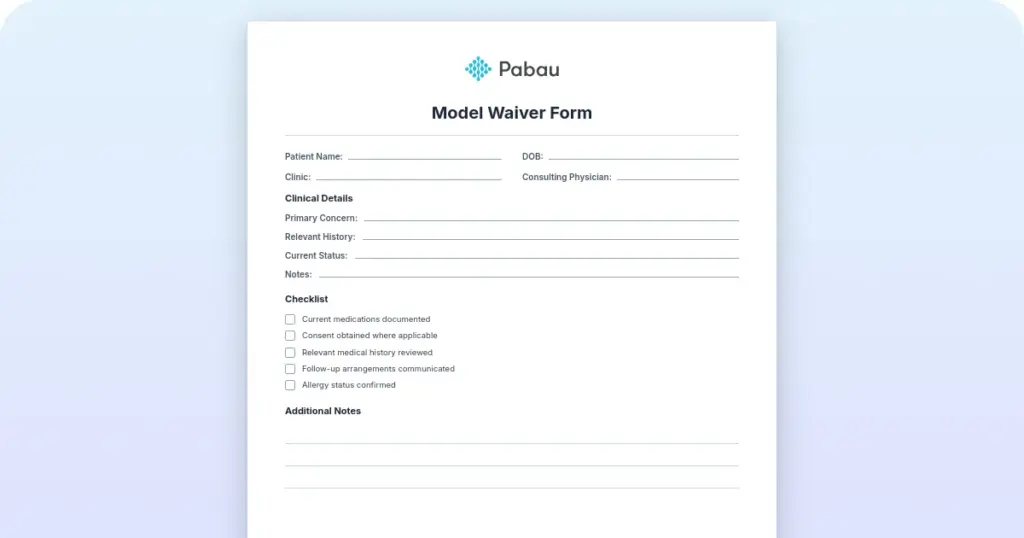
A model waiver form is a signed document that lets a healthcare practice use a p...

5
Last Updated: Sep 29, 2026

A microblading consent form records that the client understood the procedure, its risks, and their aftercare duties before any pigment went in.
California treats microblading as body art, so the wording on the form is set by state health law, not by the cosmetology board.
The free template covers client details, four medical history questions, five named risks, a consent statement, and two signature lines.
Digital forms with e-signature capture go out before the appointment and file themselves in the client record with a timestamp.
A one-page consent form covering client details, four medical history questions, and a plain-language list of risks. It closes with a consent statement and signature lines for both the client and the technician.
Download templateMicroblading puts pigment under the skin, and it stays there for a year or more. So the conversation you have before the first stroke matters as much as your technique, and a consent form is where that conversation gets written down. For brow studios that also offer injectables or laser, a shortlist can start with our comparison of the best medical spa software.
Plenty of brow studios work from a form they picked up during training. It lists a few risks, collects a signature, and stops there, but six weeks later, when pigment heals patchy and the client is upset, that page has to hold up.
So it pays to know exactly what belongs on the page, and what your state expects you to say on it.
A microblading consent form proves three things:
Microblading is a semi-permanent tattoo, so the client is agreeing to something they cannot wash off. Insurers, licensing officers and courts all read the form as evidence of what you said.
Healing takes four to eight weeks, results shift with skin type, and a touch-up is usually needed, so someone who reads that up front is far less likely to feel misled later.
Inspections are the other reason to keep the paperwork tidy. Local health departments in the US and environmental health officers in the UK both expect signed consent on file for every client.
A form that holds up covers seven areas:
The top of the page records who the client is and how to reach them. The downloadable template asks for the following:
Date of birth does more work than it looks. It documents that the client is old enough for body art, which for tattooing means 18 or over in most states.
Two fields are worth adding by hand. An emergency contact helps if something happens mid-appointment. The appointment date, written next to the signature, stops any argument about when consent was given.
The template keeps this part short. Four yes or no questions cover the ground that matters most:
Treat every “yes” as a prompt to ask a follow-up out loud. Write the answer on the form while the client is still in front of you.
Some conditions need more than a check mark. Blood thinners raise bleeding risk, poorly controlled diabetes slows healing, and a keloid history changes the scarring conversation. To screen for those, add extra lines or pair the consent with a fuller med spa consultation form.
Pregnancy is the answer most technicians treat as an automatic defer. For anything else that gives you pause, ask for a letter from their doctor before you confirm the booking.
Where a client lists several prescriptions, ask them to bring a written medication schedule. It is faster than working through a phone gallery of pill packets at the door.
Write the risks the way you would say them to someone’s face. The template names five:
Three more are worth writing in. Asymmetry, a color that heals warmer than expected, and the cost of correction are the outcomes clients tend to raise afterwards.
Then comes the consent statement, the part that carries the legal weight. In the template, the client confirms that they:
The consent form needs to record that the client agreed to follow aftercare. It does not have to contain the aftercare itself.
That is how the template handles it, with a single line committing the client to the instructions you provide. Keeping the instructions on their own sheet makes them easier to update, and easier for the client to stick on the fridge.
Hand that sheet over before they leave. A short patient discharge form does the job, and a standard microblading version covers:
The template does not include a photography section, so add one if you post before-and-afters. Keep it as its own opt-in, with one box to agree and one to decline.
Say where the photos will appear, whether that is an in-house portfolio, your website, or social media. Never make the treatment conditional on saying yes.
Here is the honest inventory, so you know what you are printing before a client sees it.
Every field you add is a field somebody has to fill in. Add the ones you will use, and leave the rest off.
In California, microblading is not regulated by the Board of Barbering and Cosmetology. It sits on the board’s own list of services outside its jurisdiction. Cosmetic tattooing falls under body art law instead, enforced by county environmental health departments.
That changes who you register with. Body art practitioners register with the local enforcement agency in their county. Registration means proof of age, hepatitis B vaccination evidence, and bloodborne pathogen training.
It changes the form as well. The Safe Body Art Act sets a floor for what the consent has to say. A generic download will not meet it on its own.
Rules vary. Some states treat microblading as tattooing and license it through a health department. Others fold it into esthetics or permanent cosmetics licensing, and a few barely regulate it at all.
Call the agency that issues your permit before you print anything. Ask what wording is required, and how long you have to keep signed copies.
In the UK, microblading is licensed by the local council’s environmental health team. The consent form is one of the records an officer will ask to see.
Health answers count as special category data under UK GDPR, so a GDPR checklist is worth running over your storage and retention rules.
Both carry the same legal weight. Electronic signatures are valid in the US under the federal ESIGN Act, short for the Electronic Signatures in Global and National Commerce Act. The UK equivalent is the Electronic Communications Act 2000.
The difference shows up afterwards. A paper form gets filed, and then somebody has to find it again. A digital form lands in the client record with a date and time attached, and it is searchable in seconds.
Going paperless also removes the two failure points that surface at inspection. One is a form nobody can locate. The other is handwriting nobody can read.
Most salon and spa software will already store a signed PDF against the client profile. Check what yours does before you buy anything new.
Run through this once, and the version you print will fit your practice rather than a generic one:
Two mistakes are worth calling out. A form signed after the treatment proves nothing about what the client knew beforehand. And a form last reviewed three years ago will not match how you work today.
In the US, the medical answers count as protected health information under the Health Insurance Portability and Accountability Act, or HIPAA. A HIPAA compliance checklist is a sensible cross-check on how you store and share them.
The usual setup is to email a PDF and then chase it. The client forgets, turns up ten minutes early, and fills it in on a clipboard while you set up your station. Signed copies end up in a folder, or as a photo on someone’s phone.
Practice management software like Pabau moves that work to before the appointment. When a client books microblading, the consent form goes out automatically by email or text. They complete it on their phone, sign with a finger, and the signed version files itself in their record with a timestamp. A med spa running microblading alongside other treatments gets the same automated consent flow for every service.
You get three things on the day. Consent is already on file, check-in takes seconds, and every form is searchable when an inspector asks.
Digital intake forms work the same way for consultations and medical clearance, so one workflow covers the whole client journey. Practices running everything in skin clinic software can attach the right form to the right service, so it sends itself.
Skin with Bea Esthetics runs a solo practice this way, with automated emails and forms handling the admin between appointments.
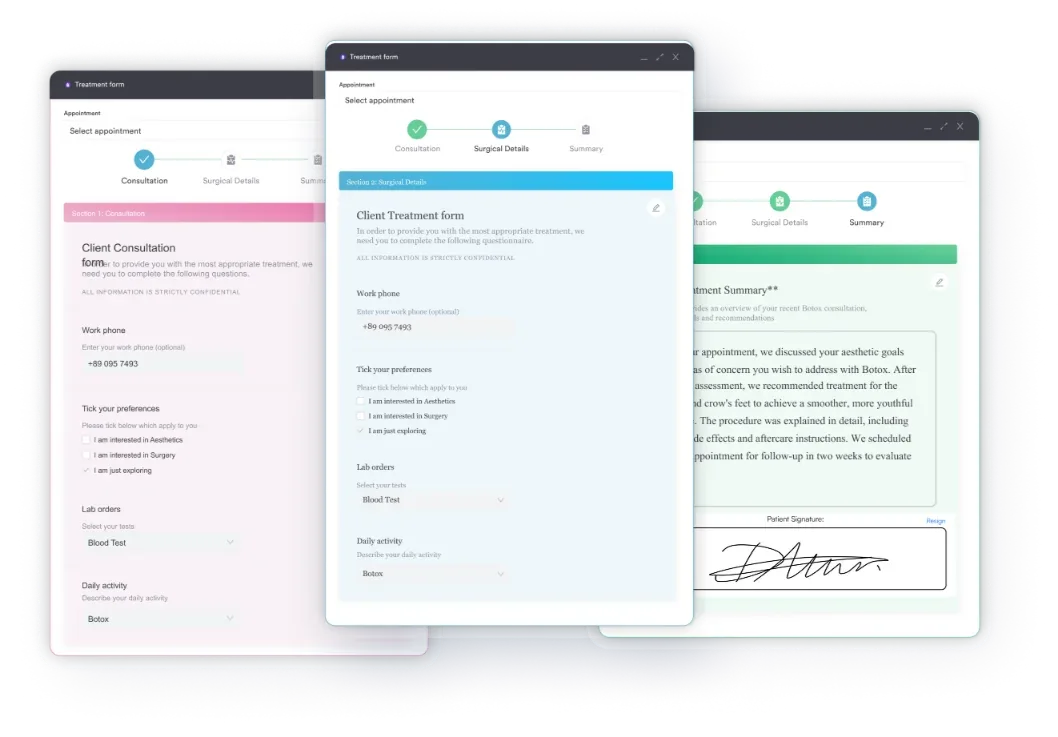

Pabau’s digital forms send consent documents ahead of every appointment and store the signed copy in the client’s record. Your front desk stops chasing paperwork at the door.

A consent form is the cheapest protection in a brow studio, and the easiest one to get wrong. The template on this page gives you a working base. What makes it hold up is the wording you add for your state, plus the habit of getting it signed first.
Get that right and the paperwork stops feeling like a chore. It becomes the record that settles a disagreement in one search, months after the appointment.
Chasing signatures should not eat your morning. Book a demo to see how Pabau sends microblading consent forms ahead of the appointment and files them automatically.

Offering eMatrix treatments too? eMatrix treatment aftercare protocol covers patient education, downtime expectations, skincare restrictions, and follow-up scheduling after eMatrix sublative RF treatment.
Adding Emtone to your menu? Emtone aftercare instructions covers post-treatment care, activity restrictions, hydration guidance, and result expectations for Emtone skin-tightening treatments.
Adding laser treatments to the menu? Our Pixel laser guide sets out the risks and aftercare you will need to document separately.
Offering body treatments as well as brows? The nonsurgical breast lift page explains why each procedure needs its own consent wording.
Also offering Kybella treatments? Kybella consent form template documents patient understanding of material risks, including marginal mandibular nerve injury, before treatment.
Yes. Consent can be withdrawn at any point, including partway through the appointment. Stop, note the time and the reason in the client record, and keep the signed form on file.
Many technicians run a pigment patch test 24 to 48 hours ahead, especially for clients with known allergies. It is not required everywhere, so check your insurer’s terms. Record the result alongside the consent.
Retention is set locally, so there is no single answer. Ask the agency that issues your permit, then apply one policy to every client file rather than deciding case by case.
Usually not. Many states ban tattooing and permanent makeup on under-18s, even with a parent’s signature. Others allow it only with a parent present. Check the rule where you practice before you take the booking.
Usually yes, provided the form covers the full treatment plan including the touch-up. Many practices still ask the client to initial and date it again at the second visit.