CPT code 93503: Swan-Ganz catheter billing and modifiers
CPT code 93503: Official descriptor and procedure overview In the AMA CPT code s...

Last Updated: Oct 23, 2026
V5266 is the HCPCS Level II code for a battery for use in a hearing device. It is billed per battery, supplied separately from the hearing aid, and sits in the V5008-V5364 hearing services range.
Original Medicare excludes hearing aids and their supplies by statute, so Part B does not cover V5266. Medicare Advantage, Medicaid and commercial plans set their own coverage and quantity limits.
Let Pabau's smart automation suggest the right codes, reduce claim denials, and keep your practice compliant—effortlessly.
Automate repetitive tasks and focus on what matters most—your patients.
Reduce coding errors and ensure compliance with the latest regulations.
Clean claims, fewer denials, and faster reimbursements.
Powerful insights and reporting to help your practice thrive.
HIPAA compliant SOC 2 certified GDPR-compliant Trusted by 4,000+ clinics worldwide

V5266 is an HCPCS Level II supply code, not a CPT code, and it covers one battery for a hearing device per unit.
Original Medicare excludes hearing device batteries by statute, while Medicare Advantage, Medicaid and commercial coverage varies by plan.
Missing written orders and the wrong code set (CPT instead of HCPCS) are the two most common denial drivers for V5266 claims.
Pabau’s claims management software can flag a missing written order before submission and route denied V5266 claims back for rework.
HCPCS code V5266 describes a single battery for use in a hearing device. It is billed as a supply item under HCPCS Level II rather than as a procedure. The CMS HCPCS Level II code set keeps hearing and vision services in its V-series. V5266 sits in the V5008-V5364 hearing services range, alongside hearing aids, ear molds and assistive listening devices.
V5266 covers a battery supplied separately for any FDA-regulated hearing device, billed per unit at the time of supply. A patient fitted with a digital binaural pair under V5258 wears two devices, so battery units accumulate twice as fast. The code does not bundle the fitting, dispensing, or adjustment service. Those services have their own HCPCS codes.
Covered under V5266:
Excluded from V5266:
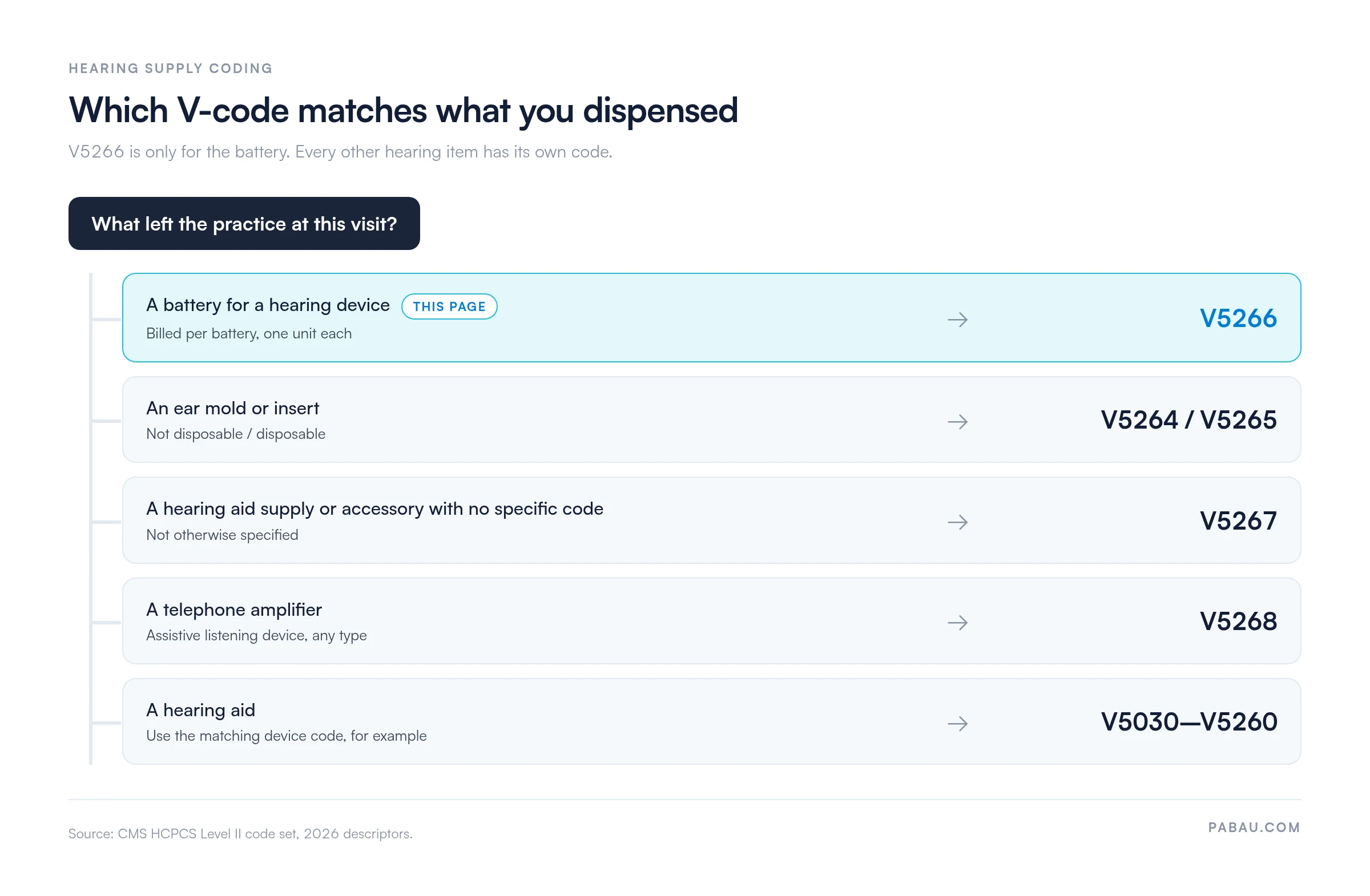
V5267 is the adjacent code most commonly confused with V5266. It covers hearing aid or assistive listening device supplies and accessories, not otherwise specified. A battery already has its own specific code, so billing V5267 for one is a coding error that invites a denial.
The decision rule is short, and the chart below maps it item by item. If the encounter produced only a battery, use V5266. If it produced a hearing aid, use the appropriate hearing aid code (for example V5030-V5260). A single digital aid worn completely in the canal bills as V5254. Ear molds take V5264, or V5265 when they are disposable.
No CPT code exists for supplying a battery for a hearing device. CPT codes, maintained by the American Medical Association, cover procedures and professional services. HCPCS Level II V-codes cover hearing-related supply items, and durable medical equipment, prosthetics and orthotics sit elsewhere in HCPCS. A search for a “CPT code for hearing aid battery” is looking in the wrong code set.
Submitting any CPT code for a hearing device battery supply results in a code-type mismatch denial at the clearinghouse or payer level. The AAPC HCPCS Level II code lookup confirms V5266 as the appropriate reference. There is no CPT crosswalk, because no CPT equivalent exists. Audiologists and DME suppliers billing for batteries must use HCPCS Level II on the CMS-1500 claim form, Box 24D.
Medicare Part B does not cover routine hearing aid batteries under its statutory benefit framework. The Medicare exclusion for hearing aids and related supplies makes V5266 non-covered for the vast majority of standard Medicare beneficiaries. Billing it to Medicare as a covered service produces a CO-96 (non-covered charge) denial. Verifying patient eligibility before the encounter tells you which payer rules apply.
Exceptions and adjacent coverage situations to be aware of:
Where coverage is uncertain, have the patient sign an advance beneficiary notice (ABN) or the payer’s equivalent waiver before dispensing. The cost can then be collected from the patient if the claim is denied.
Insufficient documentation is the single most correctable denial driver for V5266 claims. A superbill for hearing services captures most of these elements, but the underlying record must support every field. Standard CMS documentation rules for DME supply codes apply to V5266 and require the following elements before submission.
Billing compliance for supply codes also means retaining documentation for the payer’s audit lookback period, typically seven years for Medicare.
Medicare publishes no national fee schedule amount for V5266, because the code is non-covered under Original Medicare’s statutory exclusion. What a practice is paid comes from Medicaid fee schedules and payer contracts instead. Use the CMS DMEPOS fee schedule files to confirm Medicare’s pricing status for supply codes, and the PGM Billing HCPCS lookup as a cross-reference.
Check the patient’s plan before billing V5266. Original Medicare excludes it by statute, while Medicare Advantage, Medicaid and commercial plans each set their own coverage and battery limits. Run eligibility before every supply visit.
Most V5266 denials fall into a short list of root causes. Identify which one applies first, so the corrective action is targeted rather than generic. Each root cause appears on the explanation of benefits as one of the medical billing denial codes listed below.
After a denial arrives, read the electronic remittance advice for its claim adjustment reason codes (CARCs) and remittance advice remark codes (RARCs). Those codes decide whether the fix is a resubmission, an appeal, or patient billing. Sending a clean claim the first time, with documentation attached, is always faster than working a denial queue.
A code reference tells coders what V5266 means. It can’t spot the missing written order that turns into a denial three weeks later. Software built for cleaner claims management catches it sooner, because code selection, the documentation checklist and claim submission sit in one workflow.
Pabau’s billing tools can enforce V5266-specific rules at the point of care. A coder can map the code to the patient encounter, and the system can flag a missing written order before the claim leaves the practice. Quantity limits can be set by payer, so the billing team is alerted before a claim exceeds a plan’s annual battery allowance.
Denied V5266 claims route back for rework automatically, with the CARC code visible alongside the original claim. That keeps battery supply claims from sitting unpaid while the team works out what went wrong.
For audiology practices with a high volume of battery supply claims, pre-submission checks add up to fewer denials and shorter payment cycles. Staff also spend less time in the rework queue. Pabau’s superbill workflow captures V5266 alongside the encounter documentation, so the clinical note and the claim always match.

Pabau’s claims management software tracks HCPCS codes, flags missing documentation before submission, and routes denied claims back for rework automatically. See how it works for audiology practices.

V5266 is easy to assign and easy to lose money on. The code rarely causes the denial. The payer does, because Original Medicare won’t pay for batteries and every other plan sets its own limits.
So the work happens before the battery leaves the practice. Confirm the plan’s hearing benefit, get the written order on file, and have the patient sign a waiver wherever coverage is in doubt.
Do that, and a V5266 claim either pays on first submission or goes to the patient by design. Book a demo to see how Pabau keeps hearing supply claims like V5266 clean from order to payment.

Need a deeper look at denial prevention? Denial management in healthcare covers the workflows that stop denials before they compound.
Want to understand the full billing picture? Revenue cycle management explained shows how HCPCS supply code billing fits into overall practice cash flow.
Billing compliance questions? Medical billing compliance outlines the documentation retention and audit-readiness standards that apply to DME supply codes.
Seeing the patient before the fitting? HCPCS code V5010 covers the hearing aid assessment that comes before any device or supply claim.
Billing the hearing aid itself? HCPCS code V5030 covers a monaural, body-worn, air conduction hearing aid.
HCPCS code V5266 is the HCPCS Level II supply code for a battery for use in a hearing device. It is billed per battery when batteries are dispensed separately from the hearing device itself. CMS maintains it within the V-series range covering hearing-related supplies.
No, Original Medicare Part B does not cover V5266 under its statutory benefit exclusion for hearing aids and related supplies. Medicare Advantage plans may cover hearing device batteries as a supplemental benefit. Confirm coverage with the individual plan before billing.
V5266 covers a battery (a supply item) for use in a hearing device. V5267 covers hearing aid or assistive listening device supplies and accessories, not otherwise specified. Billing V5267 for a battery uses an unspecified code where a specific one exists, which can lead to a denial.
No. No CPT code exists for hearing device battery supply. CPT codes cover professional procedures and services, while HCPCS Level II V-codes cover hearing-related supply items. Submitting a CPT code for a battery produces a code-type mismatch denial at the clearinghouse.
You need a signed written order from the treating practitioner and confirmation that the patient’s device is an FDA-regulated hearing aid. Record the quantity dispensed, the date of service, the billing provider NPI, and the correct place of service code. Missing written orders are the most common documentation denial driver.
The most common reasons are a non-covered benefit under Original Medicare (CO-96), a CPT code submitted instead of HCPCS V5266, and a missing written order. Quantities over the payer’s annual limit and an incorrect place of service also cause denials. Each reason maps to a distinct corrective action rather than a generic resubmission.