CPT code 93503: Swan-Ganz catheter billing and modifiers
CPT code 93503: Official descriptor and procedure overview In the AMA CPT code s...

Last Updated: Oct 23, 2026
36000 is the CPT code for introduction of needle or intracatheter, vein. It covers placing a needle or short catheter into a peripheral vein, while the infusion, IV push, or blood draw that follows is billed separately.
Most denials on this code trace back to one of three causes: Bundling with infusion codes, missing medical necessity documentation, or a wrong place-of-service designation.
Let Pabau's smart automation suggest the right codes, reduce claim denials, and keep your practice compliant—effortlessly.
Automate repetitive tasks and focus on what matters most—your patients.
Reduce coding errors and ensure compliance with the latest regulations.
Clean claims, fewer denials, and faster reimbursements.
Powerful insights and reporting to help your practice thrive.
HIPAA compliant SOC 2 certified GDPR-compliant Trusted by 4,000+ clinics worldwide

CPT code 36000 covers introduction of a needle or intracatheter into a vein, which is peripheral IV placement. Routine blood specimen collection is billed under 36415 instead.
NCCI edits bundle 36000 with 96360 and 96374 in most scenarios. Modifier 59 or XU may unbundle it when the access was a genuinely distinct service.
Medicare pays different rates for facility and non-facility places of service. Check the CMS MPFS Look-Up Tool for current locality-adjusted amounts.
Pabau’s claims management software captures the documentation elements and modifier flags needed to submit 36000 cleanly on the first pass.
CPT code 36000 is the code for placing a needle or short catheter into a peripheral vein. The American Medical Association gives it the official descriptor “Introduction of needle or intracatheter, vein.” It sits within the Surgery / Cardiovascular System / Vascular Injection Procedures subsection of the CPT code set.
Clinically, the code captures the act of gaining peripheral venous access. The clinician inserts a needle or short catheter into a peripheral vein so later procedures can follow. Those include drug infusion, IV push, hydration, or blood sampling. The code describes only the access placement, never those later procedures.
A common source of confusion: 36000 is frequently cited as the code for phlebotomy. It is not the right code for routine blood specimen collection, which is billed as CPT 36415. The 36000 code is appropriate when venous access is placed for a therapeutic or administrative purpose beyond specimen collection alone.
Bill CPT 36000 when a clinician places peripheral IV access as a standalone act that is not already captured by an infusion or administration code. The clearest covered scenarios are below.
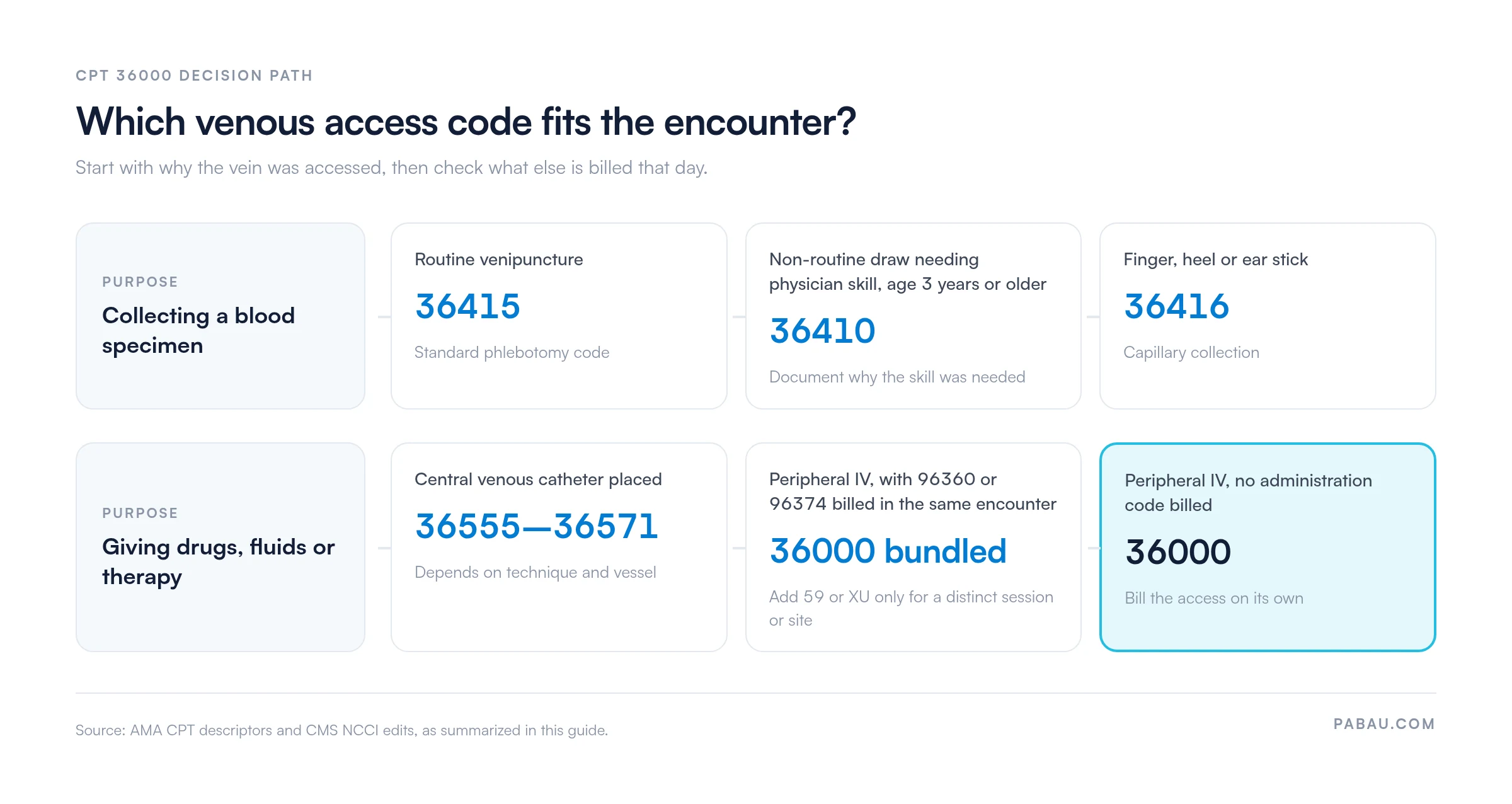
What 36000 does not cover: It should not be reported for routine specimen collection (use 36415) or for finger, heel or ear stick collection (36416). Central venous catheter placement uses codes 36555-36571, depending on technique and vessel. Access placed to inject contrast for extremity venography is reported with CPT code 36005, whose descriptor includes the needle or intracatheter.
Three codes cover different points on the venous access spectrum, and picking the wrong one is the fastest path to a denial. Two questions settle the choice: Why the vein was accessed, and whether an administration code is billed in the same encounter.
Therapeutic phlebotomy: Neither 36000 nor 36415 is definitionally correct for therapeutic phlebotomy (removal of blood to treat hemochromatosis or polycythemia vera). Some payers accept 36415 or 36000 for this purpose; others require 99195 (therapeutic phlebotomy). Always check the applicable CMS Physician Fee Schedule lookup and the payer’s local coverage determination (LCD) before billing therapeutic phlebotomy under 36000.
The National Correct Coding Initiative (NCCI) bundles 36000 with several administration codes, including the IV infusion code 96360. The pair cannot be billed together on the same date unless specific conditions are met. That makes this edit the first check on any 36000 claim.
Modifier 59 (or its more specific X-modifier variants XU, XE, XS, XP) signals that the procedure was a distinct service. But payer acceptance varies. Applying modifier 59 to 36000 when it is not genuinely distinct from the infusion constitutes improper unbundling and carries compliance risk. Always verify the current NCCI edit status using the quarterly-updated CMS tables before submitting.
When peripheral IV access is placed and IV fluids are administered, the fluid supply codes below are typically billed alongside 36000 and the administration code. Acceptance varies by payer.
Medicare and most commercial payers accept these HCPCS supply codes in conjunction with the appropriate administration code. Verify payer-specific policies before billing supply codes, because some payers bundle supplies into the administration payment.
Run a quarterly audit of your 36000 bundling pairs. Pull every claim where 36000 appeared with 96360 or 96374 in the same encounter. For each, document whether a modifier was used and whether it was accepted. A run of denials without a modifier usually points to how the access is documented, so start by fixing the note template.
A 36000 claim that lacks procedure-level documentation is the most preventable denial. The medical record must establish medical necessity and capture the procedural specifics before the claim is submitted. In Pabau’s claims management software, these elements are captured in the clinical note at the point of care. The coder then has them when the claim is built.
If the access was attempted but unsuccessful, document the attempt including site, gauge, and reason for failure. Some payers will reimburse a failed attempt under 36000; others will not. Check the applicable medical billing policy before submitting.
Medicare reimburses CPT 36000 under the Medicare Physician Fee Schedule (MPFS) at rates that differ by place of service. Facility rates apply when the service is delivered in a hospital outpatient department, ambulatory surgical center, or skilled nursing facility. Non-facility rates apply in physician office settings.
Specific dollar amounts change annually and are locality-adjusted. Always retrieve current rates from the CMS MPFS Look-Up Tool rather than relying on figures published in reference guides.
CPT 36000 is not treated identically across payers. Understanding how major payer categories handle this code prevents preventable write-offs.
IV therapy practices and infusion centers billing 36000 alongside 96360 and 96374 at volume need a payer-specific bundling policy in their charge capture workflow. Sorting your electronic remittance advice by payer shows which carriers deny the pair, so the policy reflects what each one pays.
Denials on CPT 36000 cluster around a predictable set of causes. Each one has a corresponding workflow fix.
Build a payer-specific 36000 rule sheet. For your top five payers, document whether 36000 is separately payable and which modifier (if any) is accepted with infusion codes. Also note whether the payer requires additional diagnosis codes to support medical necessity. Review and update this sheet quarterly against current NCCI tables.
Without a connected system, a coder rebuilds the access site and indication from free-text notes and checks NCCI pairs by hand. A rejected modifier then surfaces weeks later on the remittance.
Pabau records the IV access details in the procedure note at the point of care, so the claim is built from the same record. The clean claim checklist in the submission workflow flags modifier and POS mismatches before the claim leaves the practice. Claims then go through Claim.MD, our clearinghouse partner for the United States, with real-time eligibility checks first.
When a payer still denies a 36000 line, Pabau’s denial management reporting reads the reason codes returned through electronic remittance advice. Recurring patterns show up at the practice level, so you can update your payer rule sheet before the next batch goes out.

Pabau captures IV access documentation at the point of care and flags modifier requirements. Claims route through Claim.MD for electronic submission to thousands of US payers.

Treat 36000 as an access-only code. Bill it when the IV placement stands alone. Expect it to fold into 96360 or 96374 whenever an administration code sits on the same claim.
Two questions decide whether the line gets paid: Was the access a distinct service, and does this payer accept 59 or XU for the pair? A quarterly payer rule sheet answers the second question once. Clean procedure documentation answers the first on every claim.
Pabau’s integrated billing workflow captures IV access documentation at the point of care, with built-in CPT and ICD-10 catalogs. Claims then route through Claim.MD to thousands of US payers. If your practice bills 36000 regularly, book a demo to see how the claims management workflow cuts first-pass denials.

Want to understand how clearinghouse submission works? Medical claims clearinghouse guide explains how electronic claims move from practice to payer and where they get rejected.
Need to track down an ERA after a denial? Electronic remittance advice covers how to read 835 transactions and reconcile payment variances.
Billing a difficult blood draw instead? CPT code 36410: Venipuncture requiring physician skill explains when a non-routine draw needs its own code.
Pushing a drug through the new line? CPT code 96374: IV push billing guide covers the modifiers and documentation for the push itself.
Weighing up a clearinghouse? Claim.MD clearinghouse review walks through what Claim.MD does and how US claims move through it.
CPT code 36000 is the billing code for introduction of a needle or intracatheter into a vein. It covers peripheral IV access placement for medication administration, hydration, or therapeutic purposes. It does not cover the subsequent drug administration or infusion service itself.
CPT 36000 covers peripheral IV catheter placement for therapeutic or administrative purposes. CPT 36410 covers non-routine venipuncture in patients age 3 years or older that requires physician skill for diagnostic or therapeutic purposes. Use 36410 when a difficult blood draw requires physician-level skill. Use 36000 when IV access is being placed for drug administration or hydration.
Usually not without a modifier. NCCI edits bundle 36000 with 96360 (IV infusion) and 96374 (IV push) in most scenarios. Billing both in the same encounter triggers a denial unless modifier 59 or XU shows the access was a genuinely distinct service. Payer acceptance of the modifier varies, so verify before submitting.
Medicare rates for CPT 36000 differ between facility and non-facility settings and are adjusted annually by locality. Use the CMS MPFS Look-Up Tool to retrieve the current rate for your geographic area, since published figures may be out of date.
Some payers accept CPT 36000 for therapeutic phlebotomy (e.g. for hemochromatosis or polycythemia vera). Others require CPT 99195 or apply a specific local coverage determination. Verify the applicable payer’s LCD and billing manual before using 36000 for therapeutic phlebotomy, as coverage is not universal.
The most frequent denial on CPT 36000 is an NCCI bundling edit when the code is billed with 96360 or 96374 without a modifier. Missing medical necessity documentation, incorrect place of service, and unrecognized provider types follow.