CPT code 93503: Swan-Ganz catheter billing and modifiers
CPT code 93503: Official descriptor and procedure overview In the AMA CPT code s...

Last Updated: Oct 23, 2026
A4612 is the HCPCS Level II code for battery cables; replacement for patient-owned ventilator. It covers only the cables that link a ventilator the patient owns to its external battery.
Medicare treats A4612 as non-covered by statute, because a rented ventilator's monthly payment already includes its batteries and cables. Medicaid and commercial plans set their own coverage rules.
Let Pabau's smart automation suggest the right codes, reduce claim denials, and keep your practice compliant—effortlessly.
Automate repetitive tasks and focus on what matters most—your patients.
Reduce coding errors and ensure compliance with the latest regulations.
Clean claims, fewer denials, and faster reimbursements.
Powerful insights and reporting to help your practice thrive.
HIPAA compliant SOC 2 certified GDPR-compliant Trusted by 4,000+ clinics worldwide

HCPCS Code A4612 covers replacement battery cables for a ventilator the patient already owns, not the battery or the charger.
Medicare assigns A4612 coverage code S, so the cables are non-covered by statute and are not separately priced under Part B.
A4611 is the heavy-duty battery and A4613 is the battery charger, both for the same patient-owned ventilator.
On a rented ventilator, the monthly rental already includes batteries and cables, so A4612 is never billed alongside it.
Medicaid and commercial plans set their own rules, so verify coverage and prior authorization before the cables ship.
HCPCS Code A4612 is the Level II code for “Battery cables; replacement for patient-owned ventilator.”
It describes the cables that connect a ventilator to its external battery, supplied as a replacement when the patient owns the ventilator.
The code has been listed among HCPCS codes since January 1, 1990, and its descriptor has not changed in the current file. Its Medicare indicators tell a biller most of what they need before a claim is built.
The descriptors and indicators above follow the 2026 CMS HCPCS file, as published by AAPC Codify. The payment category comes from the CGS DME MAC Appendix A (Summer 2026), which warns that a listed code is not necessarily covered by Medicare.
A4612 covers the cable set only. It applies when the cables linking a home ventilator to its battery wear out, break or go missing. The ventilator must belong to the patient.
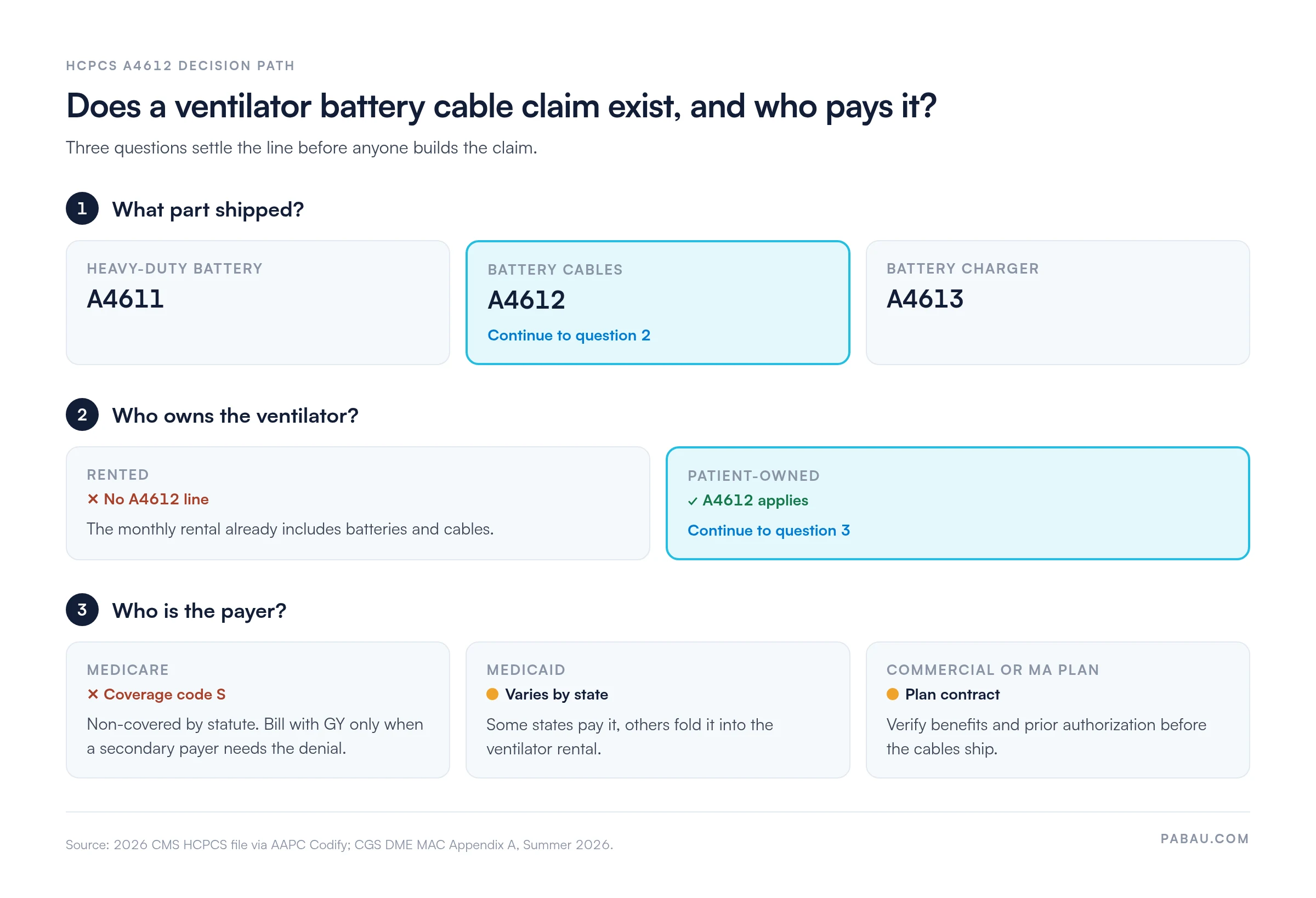
The phrase “patient-owned” does most of the work in this descriptor. Before choosing A4612, confirm who owns the ventilator, because that single fact decides whether a separate line exists. The decision path below runs from the part that shipped to the payer who receives the claim.
A4611, A4612 and A4613 form a three-code set for powering a patient-owned ventilator away from the wall. Each one names a different part, and none of them is an oxygen supply code.
All three share coverage code S, pricing indicator 00 and type of service P in the Medicare file. When a supplier ships a battery, cables and a charger together, each part gets its own line.
A4615 sits a few numbers away but describes a nasal cannula. It has no connection to ventilator power, so a nearby code number is no guide to a related item.
Who owns the equipment matters for oxygen accessories too, but the answer points the other way. HCPCS Code A4619, the face tent, is bundled when the oxygen equipment is rented and denied once the patient owns it.
Medicare does not cover HCPCS Code A4612. CMS assigns it coverage code S, which means the item is non-covered by statute. Its pricing indicator is 00, so Part B sets no fee schedule amount for it.
The reason sits in how Medicare pays for ventilators. Section 1834(a)(3) of the Social Security Act places ventilators in the frequent and substantial servicing category, which Medicare pays as a continuous monthly rental.
The DME MAC ventilator coding guidance describes that rental as all-inclusive. Accessories, supplies, servicing and replacement parts are part of the monthly payment, so Medicare makes no separate payment for them.
Ask for proof of ventilator ownership at intake. If the device turns out to be a rental, the rental supplier owes the patient the replacement cables. No A4612 claim should be created.
A statutorily excluded item still sometimes needs a Medicare claim. A secondary payer such as Medicaid may require a Medicare denial before it pays, and the GY modifier produces that denial cleanly.
An Advance Beneficiary Notice (ABN) is not required for a statutorily excluded item. Many suppliers still give a voluntary written notice, so the patient knows before delivery that Medicare will not pay.
Coverage outside traditional Medicare varies widely. Some state Medicaid programs list A4612 on their DME fee schedules, while others treat ventilator batteries and cables as part of the ventilator rental.
South Dakota Medicaid, for example, states that ventilator supplies billed as A4611 through A4613 are included in the rental fee. A state that pays separately may also limit how often the cables can be replaced, so check the frequency rule before each claim.
The file for an A4612 claim has to prove two facts: the patient owns the ventilator, and the cables were needed and delivered. Building the checklist into intake, as part of routine medical billing compliance, avoids rebuilding it after a denial.
Keep the records for at least seven years from the date of service. Some state Medicaid programs require longer, so confirm the retention period with the state agency.
Most A4612 denials trace back to the ownership question or to the wrong part code. Strong denial management in healthcare puts those checks before the claim is built, so fewer lines ever reach the appeal stage.
A4612 claims go to the payer on a CMS-1500 or the 837P electronic format. Medicare claims route to the DME MAC for the patient’s state, not to the Part B contractor for physician services.
For the wider workflow, medical billing fundamentals cover how a DME claim moves through the revenue cycle. The guide to a clean claim explains which fields payers check first.
On a low-value supply code like A4612, the risk sits in the paperwork. Teams often confirm ventilator ownership by phone, keep the order in one folder and the delivery slip in another, then code the claim from memory.
Pabau, the practice management and billing platform we build, keeps those pieces on the patient record. The ownership statement, order and signed delivery form sit beside the claim. The team then bills from claims management software that tracks each line and its modifiers.
The result is fewer claims built for the wrong payer or the wrong part. When a Medicare denial is needed for Medicaid, the GY claim and its follow-up stay linked to the same patient.

Pabau keeps orders, delivery records and claims on one patient record. Your team bills DME supplies like A4612 to the right payer the first time.

A4612 is a code where the coding decision comes before the billing one. Settle who owns the ventilator first. A rented device leaves nothing to bill, while a patient-owned one sends the claim to Medicaid or a commercial plan.
Treat the Medicare claim as a route to a clean GY denial, and the secondary payer has what it needs. Book a demo to see how Pabau keeps DME supply orders, delivery records and claims together.

Need a guide to the claims submission process? What is medical billing covers the end-to-end revenue cycle workflow for DME and specialty practices.
Dealing with repeated claim rejections? Denial codes in medical billing breaks down the most common CARC and RARC denial codes and how to respond to each.
Want to tighten your billing compliance program? Medical billing compliance outlines the documentation and audit-readiness standards that protect DMEPOS suppliers during post-payment reviews.
Supplying the charger too? HCPCS Code A4613 explains how to bill the replacement battery charger for a patient-owned ventilator.
Billing the ventilator itself? HCPCS Code E0466 covers billing for a home ventilator used with a noninvasive interface, such as a mask.
HCPCS Code A4612 covers replacement battery cables for a ventilator the patient owns. It does not cover the battery (A4611), the charger (A4613) or the ventilator itself.
No. CMS gives A4612 coverage code S, which means it is non-covered by Medicare statute. On a rented ventilator, the monthly rental payment already includes the battery cables.
All three are replacement parts for a patient-owned ventilator. A4611 is the heavy-duty battery, A4612 is the battery cables, and A4613 is the battery charger.
Use GY when you submit A4612 to Medicare to obtain a denial for a secondary payer. GY tells Medicare the item is statutorily excluded, so KX and GA do not apply.
Medicare has no prior authorization for A4612 because it does not cover the code. Medicaid and commercial plans set their own rules, so check each plan before delivery.
No. A rented ventilator is paid as an all-inclusive monthly rental that covers accessories and replacement parts. The rental supplier replaces the cables at no separate charge.
No. A4612 is a ventilator battery code. Oxygen accessories such as a nasal cannula use their own codes, like A4615, and follow separate oxygen coverage rules.