CPT code 93503: Swan-Ganz catheter billing and modifiers
CPT code 93503: Official descriptor and procedure overview In the AMA CPT code s...

Last Updated: Oct 23, 2026
V5030 is the HCPCS Level II code for hearing aid, monaural, body worn, air conduction.
Let Pabau's smart automation suggest the right codes, reduce claim denials, and keep your practice compliant—effortlessly.
Automate repetitive tasks and focus on what matters most—your patients.
Reduce coding errors and ensure compliance with the latest regulations.
Clean claims, fewer denials, and faster reimbursements.
Powerful insights and reporting to help your practice thrive.
HIPAA compliant SOC 2 certified GDPR-compliant Trusted by 4,000+ clinics worldwide

HCPCS Code V5030 describes a hearing aid that fits one ear, is worn on the body, and works by air conduction.
Medicare Part B excludes hearing aids by statute, so V5030 is never payable under traditional Medicare.
Some Medicare Advantage plans add supplemental hearing benefits, so verify V5030 with the individual plan first.
Medicaid hearing aid coverage is an optional benefit that varies by state, including age limits and prior authorization.
Practice management software like Pabau structures the fitting documentation and diagnosis coding a V5030 claim depends on.
HCPCS Code V5030 is a Level II alphanumeric code maintained by the Centers for Medicare and Medicaid Services (CMS). Its official long description is: Hearing aid, monaural, body worn, air conduction.
The V-code series covers hearing aid services and related items. Audiologists, hearing aid dispensers, and otolaryngologists reach for V5030 when a device meets all three descriptor criteria. The assessment visit that precedes the fitting bills separately under V5010, so confirm each element before you select either code.
V5030 covers one device configuration and nothing else. Each word in the descriptor carries clinical weight, so confirm all three characteristics before you bill.
A monaural fitting assumes the aided ear can still use amplification. Where it cannot, the signal is routed to the better ear, an in-the-ear BICROS fitting that V5210 covered until CMS deleted it in 2019. A glasses-mounted CROS aid, for a patient whose better ear hears normally, bills as V5190.
Body-worn aids are dispensed far less often than BTE or ITE models today. They still suit patients with severe-to-profound hearing loss, unusual ear anatomy, or dexterity limits that rule out smaller devices. Dispensers working with older patients are the most likely to see a V5030 fitting.
Traditional Medicare Part B excludes hearing aids by statute. The exclusion sits in Section 1862(a)(7) of the Social Security Act, so it is not a carrier or local coverage decision. V5030 is non-covered under Part B no matter how thoroughly medical necessity is documented.
Medicare Advantage plans may offer supplemental benefits beyond traditional Medicare, and some include hearing aids. Coverage terms, prior authorization rules, and allowable amounts vary by plan and contract year. The statutory exclusion already settles Part B, so there is no Medicare fee schedule entry to look up. Verify V5030 with the patient’s own plan before you dispense. An out-of-network claim rests on the paperwork the practice hands over, so what a superbill includes matters.
Solid practice management software for medical teams means every miscellaneous code carries the notes a payer will ask for.
Medicaid hearing aid coverage is an optional benefit, so each state decides independently whether to cover V5030. Coverage rules, age limits, prior authorization thresholds, and reimbursement rates all differ by program.
Verify coverage with the specific state program rather than by analogy to a neighboring state. The American Speech-Language-Hearing Association (ASHA) keeps audiology billing resources that track state Medicaid updates. Hearing services without a specific V-code fall to V5299, which most programs price case by case.
Medicare publishes no allowable amount for V5030, because the item is excluded rather than priced. What you collect depends entirely on the payer. Related hearing services such as V5020 sit on the same payer fee schedules, so pull them together when you check rates.
Use the AAPC Codify HCPCS lookup to confirm the code is still active and to catch annual descriptor changes. State Medicaid programs and Medicare Advantage plans reset rates every year, so check your figures before the new plan year starts.
Check your Medicaid managed care contracts separately from the state fee-for-service schedule. Managed care organizations often set their own hearing aid rates, and those can differ from the published state fee schedule. Request the current contracted rate from every organization you are credentialed with.
Any licensed professional whom state law allows to dispense hearing aids can bill V5030. Non-licensed personnel cannot. Billing authority tracks the dispensing provider’s license and the scope-of-practice rules in their state.
The billing provider’s NPI has to carry the taxonomy code for the dispensing specialty. Audiologists use 231H00000X. Licensed dispensers who are not audiologists use 237700000X, the hearing instrument specialist taxonomy. Check both against the National Plan and Provider Enumeration System (NPPES) before claims go out.
State scope-of-practice rules also decide who signs the fitting note. In combined speech and hearing practices, the dispensing license belongs to a named individual rather than the business, so the claim carries that person’s NPI.
Medical necessity documentation is required on every V5030 claim, including claims to non-Medicare payers. Thin documentation is one of the most common reasons hearing aid claims are denied or clawed back after payment.
Some Medicaid programs and Medicare Advantage plans require prior authorization before the claim goes in, so check policy before you dispense. Orders arriving from a referring primary care practice often skip laterality, so code from the audiogram rather than the referral letter.
The fitting and orientation visit is a separate service under V5011, and it needs a note of its own. Keep audiological records in a system that meets HIPAA requirements, since audiograms and device serial numbers are protected health information.
Every V5030 claim needs an ICD-10 diagnosis code that supports the medical necessity of amplification. The record has to document hearing loss, not a patient preference for a hearing aid. The H90 and H91 families do most of the work here.
Code to the highest level of specificity the audiogram supports. Lateralized codes beat bilateral codes on a monaural fitting. Mismatched laterality between the diagnosis and the fitted ear is a denial trigger reviewers flag in post-payment audits.
V5030 goes on the CMS-1500 claim form for outpatient dispensing. Place of service is usually 11 for an office setting, and units of service are one per device. The basic code needs no modifier, though payer policy may add one for a replacement device or an upgrade.
Track denial reasons at the code level. A run of V5030 denials from one payer usually points at a documentation problem or a coverage policy that changed quietly.
Build a V5030 checklist into your fitting workflow. Confirm the device is body-worn, document laterality on the audiogram, lateralize the ICD-10 code, obtain prior authorization where required, and record the serial number. Running that list before submission clears the most common denial reasons for this code.
The V5030 to V5060 range covers the core monaural hearing aid types, split by form factor and transmission method. Picking the right code means knowing how the device is worn and how it moves sound. For binaural options and other Level II lookups, the NLM Clinical Table Search API answers keyword queries programmatically.
A monaural device once billed under the deleted code V5000 now falls into this same range.
The most common selection error is billing a BTE device as V5030. BTE is the most dispensed style worldwide, and it maps to V5060. Supplies and accessories never bundle into the device code either. For a bilateral fitting, use V5100 rather than two V5030 claims.
V5100 only covers a body-worn pair, so form factor still decides the binaural code. An analog pair sitting in the canal opening bills as V5249 instead.
Most hearing care practices assemble a V5030 claim from three or four places. The audiogram sits in the testing software and the order arrives as a scanned PDF. The serial number goes on a paper fitting sheet, and the diagnosis code gets typed from memory at the billing desk.
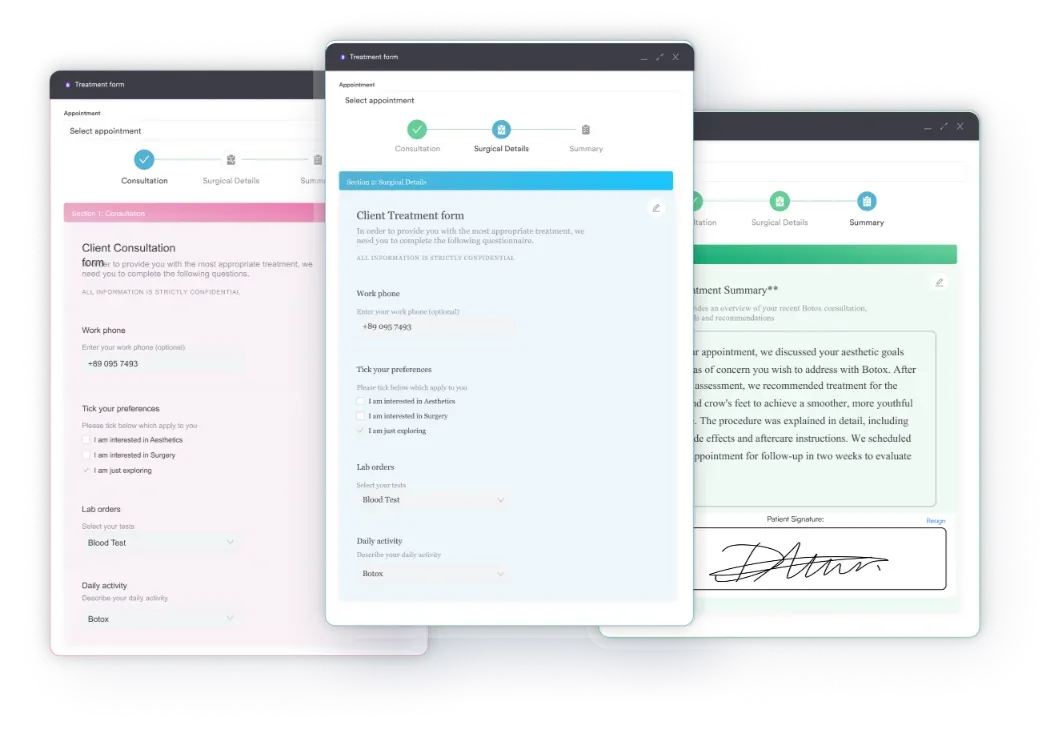
Practice management software like Pabau keeps all of it in one patient record. Intake and consent forms collect the audiological detail before the appointment. Treatment notes hold the make, model, and serial number against the visit that dispensed the device. Nobody has to reassemble the file later.
That structure is where coding accuracy comes from. When the fitted ear, the device style, and the diagnosis sit in one record, coding becomes a reading exercise. The person choosing between V5030, V5050, and V5060 has the chart in front of them. Your billing service still submits the claim, working from a file that is already complete.

Pabau’s intake forms and treatment notes capture the audiogram, device details, and diagnosis in the patient record. Your claims then go out from a complete file.

V5030 is a narrow code, and that narrowness is the whole risk. A body-worn air conduction aid for one ear is the only device it fits. The code you choose is a factual claim about the hardware you handed the patient, and reviewers treat it that way.
Practices that stop losing hearing aid claims decide the code at the fitting chair rather than the billing desk. Confirm the form factor, lateralize the diagnosis, and record the serial number while the patient is still in the room. Book a demo to see how Pabau structures fitting documentation so V5030 claims leave your practice complete.

Comparing analog hearing aid codes? V5248 covers the analog completely-in-canal option and explains where it separates from the body-worn codes.
Billing replacement batteries and supplies? A4234 shows how supply codes are documented and why they never bundle into the device code.
Working out how a state Medicaid program handles a code? H0002 walks through coverage that changes from one state program to the next.
Dealing with codes Medicare never pays? S0265 covers a commercial-payer code and the documentation those plans expect.
Coding anesthesia for an obstetric procedure? CPT Code 01965 guide CPT Code 01965 covers anesthesia for a spontaneous incomplete or missed abortion, distinct from induced abortion coding.
HCPCS Code V5030 is a Level II alphanumeric code for a hearing aid that fits one ear. The device is worn on the body rather than behind or in the ear. It amplifies sound through the ear canal by air conduction. Audiologists and licensed dispensers use the code when they bill for that configuration.
No. Medicare Part B excludes hearing aids by statute, so V5030 is not payable under traditional Medicare. Medical necessity documentation does not change that. Some Medicare Advantage plans add supplemental hearing benefits that may cover V5030. Coverage terms vary by plan, so verify before you dispense.
You need a comprehensive audiogram supporting the hearing loss diagnosis and a written order dated before the service date. Add a medical necessity statement for a body-worn air conduction device. Record the make, model, and serial number, plus the fitting notes. The claim also needs a lateralized ICD-10 code, and some payers require prior authorization.
Licensed audiologists and state-licensed hearing aid dispensers are the primary eligible billing providers. Otolaryngologists may also dispense where state law permits, usually through licensed dispensing staff. Non-licensed personnel cannot bill the code. The billing provider needs an NPI carrying the taxonomy code for their dispensing specialty.