CPT code 93503: Swan-Ganz catheter billing and modifiers
CPT code 93503: Official descriptor and procedure overview In the AMA CPT code s...

Last Updated: Oct 23, 2026
A4625 is the HCPCS Level II code for a tracheostomy care kit for a new tracheostomy. It covers the starter kit supplied in the first two postoperative weeks after an open surgical tracheostomy, and A4629 takes over from week three.
Medicare Part B pays for the kit under the DMEPOS benefit, through the DME MAC for the beneficiary's home address. No Certificate of Medical Necessity is required, but a Standard Written Order must reach the supplier before the claim is submitted.
Let Pabau's smart automation suggest the right codes, reduce claim denials, and keep your practice compliant—effortlessly.
Automate repetitive tasks and focus on what matters most—your patients.
Reduce coding errors and ensure compliance with the latest regulations.
Clean claims, fewer denials, and faster reimbursements.
Powerful insights and reporting to help your practice thrive.
HIPAA compliant SOC 2 certified GDPR-compliant Trusted by 4,000+ clinics worldwide

HCPCS Code A4625 is the tracheostomy care kit for a new tracheostomy, billed only in the first two postoperative weeks after an open surgical tracheostomy.
From the third postoperative week onward, bill A4629, the care kit for an established tracheostomy. The two codes never share a date of service.
No Certificate of Medical Necessity (CMN) is required. A Standard Written Order (SWO) must reach the supplier before the claim is submitted, and proof of delivery is needed.
Claims management software such as Pabau keeps each claim beside the patient record. The billing team can check the procedure date before a kit claim goes out.
HCPCS Code A4625 is the Level II code for a tracheostomy care kit for a new tracheostomy. CMS describes it as a starter kit.
It covers the cleaning supplies a patient needs in the first two postoperative weeks after an open surgical tracheostomy.
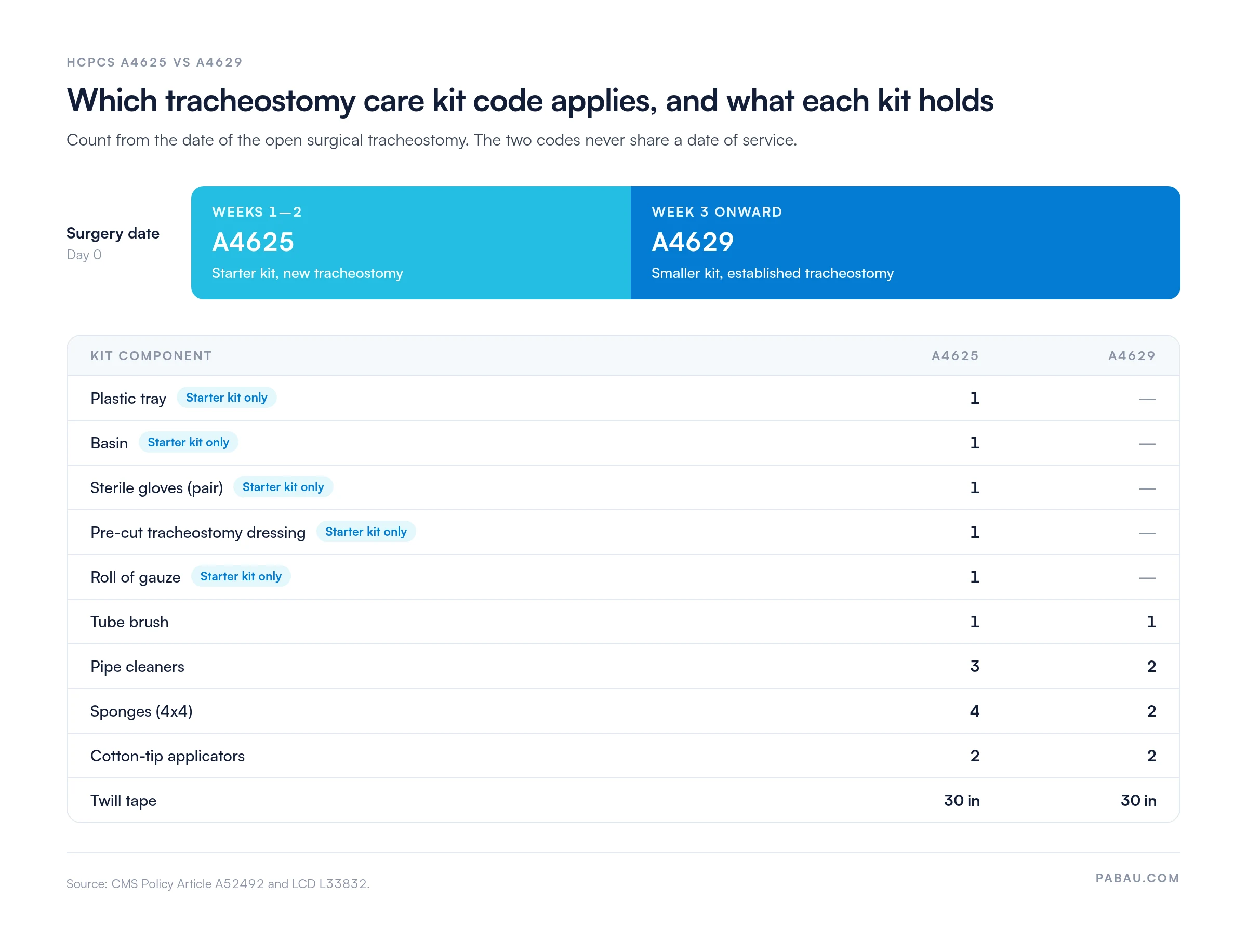
The word “new” in the descriptor sets a hard time limit. CMS Policy Article A52492 codes any care kit supplied in the first two postoperative weeks as A4625. From the third week onward, the kit is billed as A4629, the care kit for an established tracheostomy.
The Local Coverage Determination (LCD) for tracheostomy care supplies, L33832, states that A4625 is no longer medically necessary beginning two weeks after surgery. A4625 therefore covers a short starter phase, and ongoing kit supply moves to A4629.
CMS Policy Article A52492 lists the contents of an A4625 starter kit. The kit is billed as one unit, and its components are not billed separately.
The established-tracheostomy kit, A4629, is smaller. It holds a tube brush, two pipe cleaners, two cotton-tip applicators, 30 inches of twill tape, and two 4×4 sponges. The tray, basin, sterile gloves, dressing, and gauze roll come only in the starter kit.
Suction catheters, inner cannulas, and tracheostomy tubes sit outside both kits. Bill them under their own codes, such as A4624 for a tracheal suction catheter or A4623 for an inner cannula.
A4625 and A4629 describe the same kind of item, and timing alone decides which code applies. The patient’s clinical stability doesn’t change the code. Count from the date of the open surgical tracheostomy.
Record the tracheostomy procedure date in the patient file before the first kit ships. An A4625 claim for a kit supplied after week two risks a medical necessity denial. An A4629 claim inside the window fails the same way. The chart below maps both codes to the postoperative calendar, with what each kit holds.
For the rules that apply from week three, see our guide to HCPCS Code A4629.
Medicare Part B covers A4625 under the DMEPOS benefit after an open surgical tracheostomy. LCD L33832 requires that the tracheostomy has been open, or is expected to remain open, for at least three months.
Coverage of the starter kit ends two weeks after surgery. Policy Article A52492 also requires a diagnosis code that justifies the kit on each claim. DME MACs can add local requirements, so check your contractor’s guidance before billing.
Coverage rules differ by payer type.
When Medicare and a secondary payer are both active, knowing the payer order prevents duplicate billing. Our guide to medical billing covers that in more depth.
Every A4625 claim needs an ICD-10-CM code that justifies the kit. The table below lists codes named in Policy Article A52492.
The policy article also covers the specific tracheostomy complication codes J95.01 through J95.04. Verify the diagnosis against the current LCD and policy article before billing. Both are revised periodically, and a code that supported a claim last year may need more documentation now.
Billing A4625 correctly takes five steps, in order. Skipping one is the most direct path to a denial or audit exposure.
Pabau, the practice management platform we build, includes claims management software for HCPCS supply billing. It helps practices track documentation status, manage payer-specific rules, and catch claim errors before submission.
Modifier rules for A4625 come from your DME MAC and general DMEPOS billing rules. The four modifiers below appear most often on supply claims.
A kit supplied after week two should be billed as A4629, not as A4625 with a GA or GZ modifier. Confirm your DME MAC’s current modifier guidance before submitting.
Medicare pays A4625 under the DMEPOS fee schedule, which CMS updates each year. Rates vary by state, so a single national figure won’t match your allowable.
Check the current amount in the CMS DMEPOS fee schedule files or your DME MAC’s fee schedule portal. Treat figures from third-party aggregators as estimates, since they can lag behind CMS updates.
Incomplete documentation drives many A4625 post-payment audits. DME MACs can recoup payments made without supporting records. Assemble the file before the kit ships, not after a request for additional documentation arrives.
No Certificate of Medical Necessity (CMN) is required for A4625. The file needs these records instead.
Keep these records where an auditor can reach them quickly. Good medical billing compliance means storing the order, procedure date, and delivery receipt as one linked file for each kit.
Run a quarterly internal audit of A4625 files. Pull five random claims and check three records in each. Look for a Standard Written Order on file before claim submission, a procedure date inside the two-week window, and a signed delivery receipt. Additional documentation requests often target exactly these points.
Tracheostomy supply codes share similar descriptors and serve the same patients, so picking the wrong one is a common billing error. The table below shows when A4625 applies and when a neighboring code does.
Bundling rules decide which codes can share a date of service. A4625 and A4629 never appear together for the same patient on the same date. Billing kit components such as gauze or twill tape alongside A4625 counts as unbundling. Check current edits in the CMS HCPCS overview resources and your DME MAC’s guidance before co-billing.
A4625 denials follow predictable patterns. Use our denial codes reference to match remittance codes to the resolution steps below.
Effective denial management in healthcare for DMEPOS claims means tracking each A4625 denial by reason code. Recurring patterns then show up at a glance rather than claim by claim.
Build a denial log for A4625 claims that records the beneficiary ID, service date, denial reason code, and resolution. After 90 days, sort by reason code. Repeated CO-50 denials on late kits point to an intake workflow that doesn’t capture the procedure date.
Most A4625 errors start with a date nobody checked. The surgery date sits in a discharge note, the order arrives separately, and the claim gets built in a billing tool that sees neither.
Pabau holds patient records, digital forms, and invoicing in one system. The billing team can see the procedure date and the signed order on the patient file before a kit claim goes out.
Reporting then shows which claims denied and why. A run of late starter-kit claims gets fixed at intake, instead of one appeal at a time.

Pabau helps practices manage HCPCS supply code claims, track documentation requirements, and reduce denials with built-in billing workflow support.

A4625 is a two-week code, and every rule around it follows from the procedure date. The starter kit covers weeks one and two, A4629 takes over from week three, and the two never share a date.
Capture that date before the first kit ships, and get the Standard Written Order on file before the claim goes out. With the date, the order and a signed delivery receipt in place, the claim holds up to review. The switch to A4629 then happens on schedule.
Book a demo to see how Pabau keeps the procedure date, the order, and the claim together for tracheostomy supply billing.

Billing the kit from week three? HCPCS Code A4629 covers the established-tracheostomy kit, its contents and its documentation rules.
Supplying a cleaning brush on its own? HCPCS Code A4626 explains when a tracheostomy cleaning brush is billed as a separate item.
Need to understand how denials are categorized across claim types? Denial codes in medical billing breaks down the most common remittance advice reason codes and corrective actions.
Want to reduce claim errors before submission? Submitting a clean claim covers the field-level requirements that prevent the most frequent DMEPOS rejections.
Looking to build a stronger billing compliance program? Medical billing compliance outlines the documentation and audit-readiness standards that apply across supply code billing.
HCPCS Code A4625 is the Level II code for a tracheostomy care kit for a new tracheostomy. It covers the starter kit supplied in the first two postoperative weeks after an open surgical tracheostomy. Medicare Part B pays it under the DMEPOS benefit through the DME MAC for the beneficiary’s home state.
Bill A4625 on a CMS-1500 or 837P claim to the DME MAC for the beneficiary’s home address. Confirm the kit falls in the first two postoperative weeks, link a supporting ICD-10-CM code, and keep a signed proof of delivery. From week three onward, bill A4629 instead.
Yes. Medicare Part B covers A4625 after an open surgical tracheostomy that has been open, or is expected to remain open, for at least three months. Coverage of the starter kit ends two weeks after surgery, under LCD L33832.
No Certificate of Medical Necessity is required. The file needs a Standard Written Order, received before the claim is submitted. It also needs the tracheostomy procedure date, a supporting diagnosis code and signed proof of delivery.
The most common is billing A4625 after the first two postoperative weeks, when A4629 applies. Others include thin medical necessity documentation, a missing Standard Written Order, an unsupported diagnosis code, and missing proof of delivery.
A4625 is the starter kit for a new tracheostomy, billed only in the first two postoperative weeks. A4629 is the smaller kit for an established tracheostomy, billed from the third week onward. The two codes are mutually exclusive on dates of service.