CCSD Code J5520: Total pancreatectomy billing guide
CCSD Code J5520: Definition and procedure scope CCSD Code J5520 describes a tota...

Last Updated: Oct 20, 2026
V5263 is the HCPCS Level II code for hearing aid, disposable, any type, binaural. It covers a matched pair of disposable hearing aids, in any style, fitted to both ears at one dispensing visit.
V5263 is billed as one unit for the pair, with no LT or RT modifier, and needs a bilateral hearing loss diagnosis. A one-ear fitting uses V5262 instead, and traditional Medicare Part B excludes hearing aids by statute.
Let Pabau's smart automation suggest the right codes, reduce claim denials, and keep your practice compliant—effortlessly.
Automate repetitive tasks and focus on what matters most—your patients.
Reduce coding errors and ensure compliance with the latest regulations.
Clean claims, fewer denials, and faster reimbursements.
Powerful insights and reporting to help your practice thrive.
HIPAA compliant SOC 2 certified GDPR-compliant Trusted by 4,000+ clinics worldwide

HCPCS Code V5263 covers a pair of disposable hearing aids of any style (BTE, ITE, ITC or CIC) fitted to both ears at one visit.
Bill 1 unit for the binaural pair, not 2, and leave off LT and RT modifiers.
Pair V5263 with a bilateral hearing loss diagnosis such as H90.3, never a one-ear code.
Traditional Medicare Part B excludes hearing aids by statute, while Medicare Advantage and state Medicaid coverage varies by plan and state.
A one-ear disposable fitting is V5262, and non-disposable digital aids use V5254 through V5261.
HCPCS Code V5263 is the Level II code for a pair of disposable hearing aids fitted to both ears. Its official descriptor from the Centers for Medicare and Medicaid Services (CMS) reads: Hearing aid, disposable, any type, binaural.
Each word in that descriptor narrows the claim. “Disposable” rules out rechargeable and conventional reusable aids, which have their own V-codes. “Any type” means style doesn’t matter: behind-the-ear (BTE), in-the-ear (ITE), in-the-canal (ITC) and completely-in-canal (CIC) disposable aids all qualify.
“Binaural” is the qualifier that decides most claims. Both ears must be fitted at the same dispensing visit. Fitting one ear now and the second at a follow-up does not support a binaural claim.
The code sits in the V-code series of HCPCS codes, which covers vision, hearing and speech-language services. Its closest neighbors in the hearing aid range are V5262 (disposable, one ear) and V5261 (digital, binaural, BTE).
V5263 and V5262 share a descriptor except for one word: V5263 is binaural (both ears), V5262 is monaural (one ear). That single difference changes the unit convention, modifier rules, and the ICD-10 codes required to support the claim.
Coders often ask whether two units of V5262 equal one unit of V5263. They don’t. Payers that cover binaural disposable aids expect V5263 for a bilateral fitting. Splitting it into two monaural claims risks unbundling edits and can look like an attempt to exceed benefit limits.
V5263 sits in a tightly structured range. Knowing its neighbors prevents crossover errors when the device or the fitting pattern doesn’t match the disposable binaural descriptor.
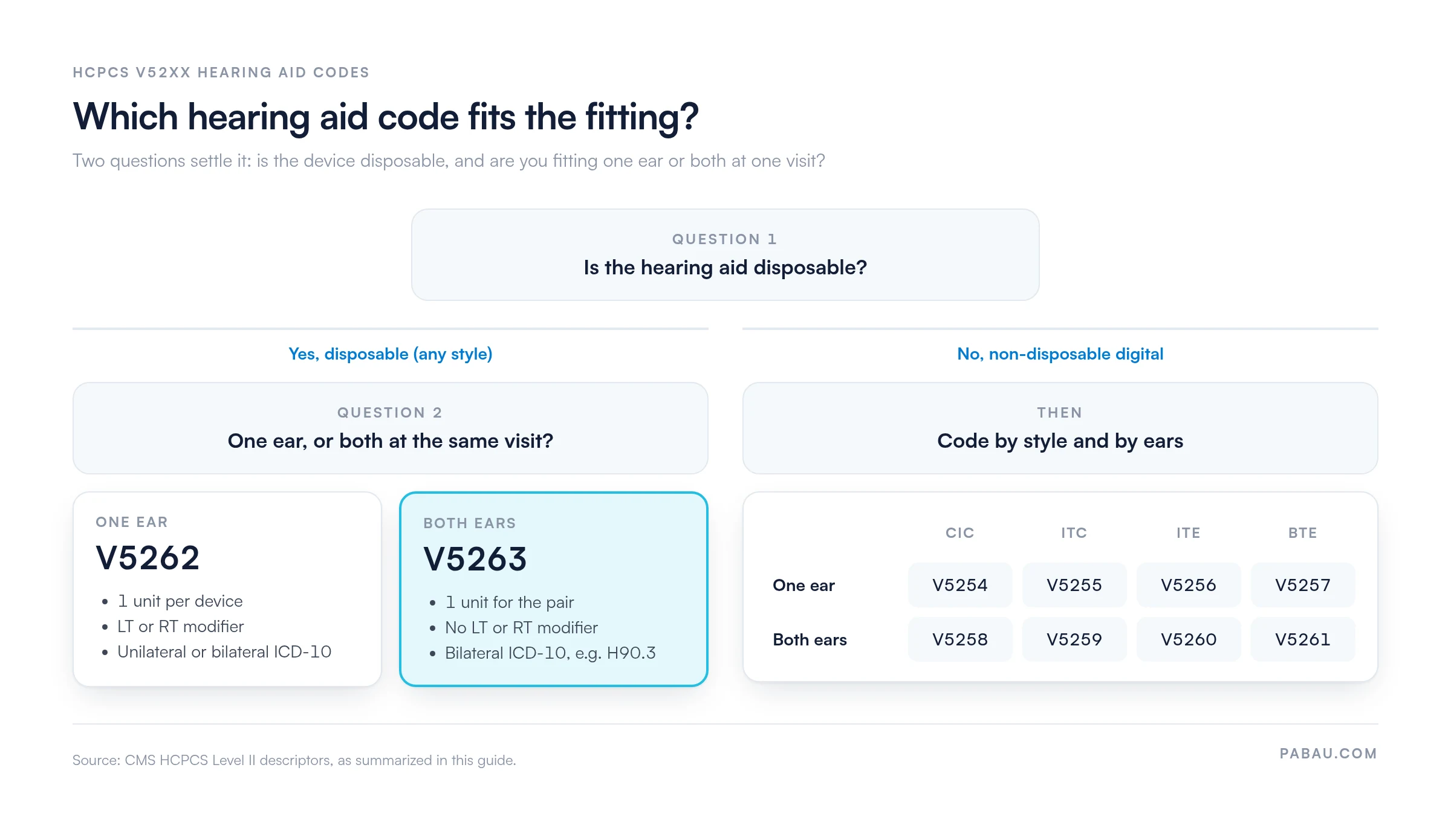
Non-disposable digital aids are coded by style and by ears. V5254 through V5257 cover one ear (CIC, ITC, ITE and BTE), and V5258 through V5261 cover both. If the dispensed aid is rechargeable or reusable, one of those codes applies instead of V5263, and the chart below walks through the choice.
Eligible providers include audiologists, hearing instrument specialists (HIS), and dispensing physicians. State licensure rules govern which credentials qualify to dispense hearing aids, so confirm state-specific scope before billing.
Place of service code 11 (office) is the most common setting for V5263 claims. Some state Medicaid programs accept POS 12 (home) for patients receiving mobile audiology services, but verify with the specific plan before submitting.
Coverage for HCPCS Code V5263 varies significantly by payer. Confirming insurance eligibility and hearing aid benefits before the fitting prevents the most common denial. That’s billing a payer with no hearing aid benefit at all.
Traditional Medicare has no allowed amount for V5263 because the benefit is excluded by statute. Payers that do cover disposable binaural aids set their own rates, so there’s no single national table.
The CMS Physician Fee Schedule lookup won’t list a Medicare rate for the code. Ask each state Medicaid program or private payer for its current allowed amount instead.
For descriptor and code-range lookups, the AAPC Codify HCPCS tool and PGM Billing’s HCPCS lookup are quick references. Rates change every plan year, so check the payer’s current schedule before you quote a patient.
Many state Medicaid programs and Medicare Advantage plans require prior authorization (PA) before a disposable binaural hearing aid is dispensed. Billing V5263 without an approved PA, where one is required, is a leading cause of denials.
Typical PA criteria include:
Submit PA requests with the audiogram, the prescriber’s order and device details (make, model and disposable classification). Keep the approved PA reference number and add it to the claim. Approvals often carry an expiry date, so dispensing after it lapses usually needs a new PA.
Incomplete records are a frequent denial trigger for HCPCS Code V5263. Every claim needs a record that would survive a post-payment audit, which means the six items below.
Two rules govern a V5263 claim line, and both catch out coders who are new to hearing aid claims.
Units: bill 1 unit. The binaural descriptor means the code already covers both ears as a matched pair. Billing 2 units implies two binaural pairs (four devices), which is not what happened. This is the standard convention, but check each payer’s billing manual before submitting.
Modifiers: do not append LT or RT. Those modifiers indicate laterality on a monaural service. A binaural code covers both sides by definition, so adding LT or RT contradicts the descriptor and often triggers an automatic edit. The one exception is GY, used only when billing traditional Medicare for a denial that a secondary payer needs.
A clean V5263 claim line looks like this:
A clean claim for hearing aids also needs a superbill that lists device serial numbers and uses the dispensing date as the date of service. Payers frequently reject V5263 claims where the date of service does not match the documented dispensing date.
A binaural claim requires a bilateral hearing loss diagnosis code. Billing V5263 with a unilateral ICD-10 code is a direct contradiction, and most payers auto-deny it. The code must reflect the finding documented in the audiogram.
Unilateral codes (H90.11, H90.12, H90.41, H90.42) must never be paired with V5263. The mismatch between a binaural code and a one-ear diagnosis is an automatic edit trigger in most claim-scrubbing systems. Sound medical billing compliance starts with matching the diagnosis code to what the audiogram documents.
Run a five-point check on every V5263 claim before it goes out. Confirm a bilateral ICD-10 code, 1 unit, and no LT or RT modifier. Then check that the dispensing date matches the date of service and the PA reference number is attached where required.
Effective denial management for V5263 starts with understanding why these claims fail. Most denials fall into a small set of predictable categories.
For denials that aren’t administrative corrections, the appeal letter should cite the specific payer policy and include the audiogram as an exhibit. Follow the documentation checklist above. Tracking V5263 denials by reason code, as part of revenue cycle management, shows which root cause to fix first.
Most V5263 denials trace back to checks done by hand: the unit count, the modifier, the bilateral diagnosis, the PA number and the dispensing record. When a claim is built from memory on a busy day, one of those slips.
Pabau, the practice management platform we build, keeps the audiogram, prescriber order and fitting notes on the patient record. Its claims management software lets you attach those documents to each claim before submission, so the evidence travels with the claim.
Authorization status and denials are tracked by code, so you can see whether V5263 claims fail on units, modifiers or missing PAs. That tells you which step of your intake and dispensing workflow to fix.

Pabau helps audiology practices manage patient records, attach dispensing documentation, and submit clean hearing aid claims without the back-and-forth. See how it works.

V5263 claims succeed or fail before they’re coded. Verify the hearing aid benefit and any PA first, then fit both ears at one visit and document it against a bilateral audiogram.
Get that sequence right and the claim line is simple: 1 unit, no LT or RT, and a bilateral ICD-10 code. The trade-off is upfront admin, which costs far less than reworking a denied pair of devices.
Book a demo to see how Pabau keeps hearing aid documentation and claims in step for your audiology practice.

Fitting only one ear? HCPCS Code V5262 covers the monaural disposable code, its LT and RT modifiers, and the diagnosis codes that support it.
Dispensing a rechargeable behind-the-ear pair instead? HCPCS Code V5261 explains billing for digital binaural BTE hearing aids.
Wondering how to structure your audiology billing workflow end to end? What is medical billing explains the full revenue cycle from patient encounter to payment posting.
HCPCS Code V5263 is the Level II code for a pair of disposable hearing aids, in any style, fitted to both ears at one visit. CMS maintains it in the V-code series. It differs from V5262, which covers a single disposable aid for one ear.
Bill 1 unit. The binaural descriptor already covers both ears as a pair. Billing 2 units implies two pairs and typically triggers a payer edit or denial. Check any payer-specific billing manual before submitting.
V5263 covers a disposable pair for both ears, and V5262 covers one disposable aid for one ear. V5263 bills as 1 unit with no LT or RT modifier and needs a bilateral ICD-10 code. V5262 bills 1 unit per ear, takes LT or RT, and can pair with a unilateral or bilateral code.
No. Traditional Medicare Part B excludes hearing aids by statute, so claims are denied whatever the medical necessity documentation shows. Medicare Advantage plans may cover V5263, but coverage and benefit caps vary by plan. Verify them every year before dispensing.
No. LT and RT indicate which side of the body a service was performed on. V5263 already covers both ears, so either modifier contradicts the descriptor and often triggers an automatic edit. If you’re fitting only one ear, use V5262 with LT or RT instead.
The most frequent are a Medicare Part B benefit exclusion, a missing prior authorization, and 2 units billed instead of 1. An LT or RT modifier on a binaural code is another. So are a unilateral ICD-10 code and untimely filing. Administrative errors are corrected and resubmitted, while a benefit exclusion means collecting from the patient rather than appealing.