

CPT Code 30801: Superficial turbinate ablation billing guide
CPT Code 30801: Official descriptor and procedure overview The American Medical ...

Last Updated: Nov 27, 2026
V5251 is the HCPCS Level II code for a hearing aid, digitally programmable analog, binaural, ITC. It reports a matched pair of in-the-canal aids, one per ear, billed as one unit.
Code choice turns on style (CIC, ITC, ITE or BTE), technology (analog, programmable analog or digital) and one ear or two. Original Medicare excludes hearing aids by statute, so payment comes from Medicaid, Medicare Advantage or commercial plans.
Let Pabau's smart automation suggest the right codes, reduce claim denials, and keep your practice compliant—effortlessly.
Automate repetitive tasks and focus on what matters most—your patients.
Reduce coding errors and ensure compliance with the latest regulations.
Clean claims, fewer denials, and faster reimbursements.
Powerful insights and reporting to help your practice thrive.
HIPAA compliant SOC 2 certified GDPR-compliant Trusted by 4,000+ clinics worldwide

HCPCS Code V5251 reports a binaural pair of in-the-canal (ITC) hearing aids with digitally programmable analog circuitry, billed as one unit.
A programmable analog CIC pair is V5250, a fully digital ITC pair is V5259, and a programmable ITE pair is V5252.
Original Medicare excludes hearing aids by statute, so V5251 carries CMS coverage code S and has no Medicare fee schedule amount.
Medicare Advantage supplemental benefits, state Medicaid programs, commercial plans, and self-pay are the routes that can pay for the pair.
Report RA and LA only where a payer asks for ear laterality. Modifier 50 does not belong on V5251.
V5251 is an active Level II HCPCS code that CMS maintains. Its official descriptor in the CMS alpha-numeric HCPCS file reads: hearing aid, digitally programmable analog, binaural, ITC. That means one matched pair of in-the-canal aids, one for each ear, built on programmable analog circuitry.
The code sits in the V5000 to V5999 block, which covers hearing and speech-language pathology services. Vision codes live in a separate part of the V series. CMS added V5251 on January 1, 2002, and it remains active in the October 2026 file.
Because the descriptor already says binaural, one claim line with one unit reports both aids. Billing two lines of V5251 for the two ears double-counts the pair.
The V5242 to V5261 codes split hearing aids on three questions. Answer all three before you pick a code, because two of them are easy to miss.
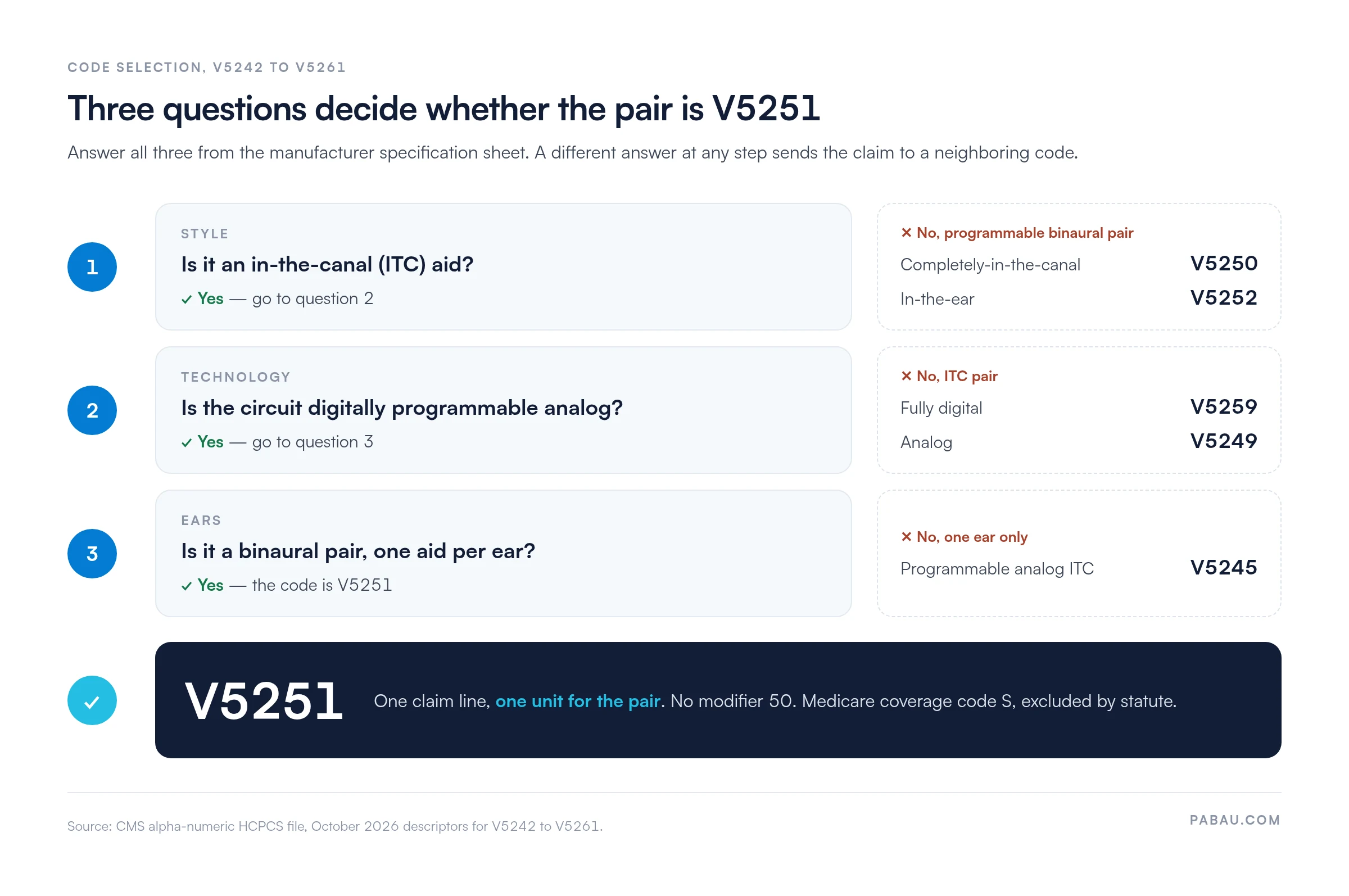
Most aids dispensed today are fully digital. A digital ITC pair is V5259, not V5251. A programmable analog pair that sits deeper in the canal is V5250. Check the manufacturer specification sheet for the circuit type before you code the pair.
Two traps recur on this range. No HCPCS code is specific to open-fit or receiver-in-canal (RIC) aids, so code those by style and technology like any other aid. And a single programmable analog ITC aid is V5245, the monaural counterpart to V5251. The in-the-ear version for one ear is the V5246 code.
V5251 reports the devices only. Services and supplies around the fitting carry their own codes, and folding them into the device line understates the claim.
Original Medicare does not pay for hearing aids. The exclusion is statutory. Social Security Act section 1862(a)(7) and 42 CFR 411.15(d) bar payment for hearing aids and the exams to fit them. CMS records this in the HCPCS file as coverage code S.
A statutory exclusion behaves differently from a medical necessity denial. No local coverage determination applies, no documentation turns the claim into a paid one, and an appeal will not change the result.
Before you file V5251 to original Medicare, ask why. If no secondary payer needs a denial on file, skip the claim and collect from the patient or the covering plan. A GY claim filed for no reason only adds a remittance to post.
The Medicare exclusion leaves four routes open. Each one sets its own allowed amount, frequency limit, and authorization rules.
Run insurance eligibility verification at scheduling, not at delivery. Custom ITC shells are made to the ear impression, so a benefit you discover late is expensive.
V5251 is binaural by definition, so Medicare needs no modifier to show that two ears were fitted. Modifiers on this code do two jobs: show ear laterality where a payer asks, and explain an expected Medicare denial.
Do not append modifier 50 to V5251, because the descriptor already reports both ears.
Payers that cover the pair ask for a consistent record. Build it before the ear impressions go out, because a custom ITC pair cannot be restocked.
The device record does double duty. It shows the pair was programmable analog ITC rather than digital ITC, which is the most common reason the wrong code is billed. Keep it with the claim for the payer audit window, as part of routine medical billing compliance.
A diagnosis code will not make original Medicare pay for V5251. Covering payers still expect the diagnosis to support a bilateral fitting. The codes below are common examples, not a coverage list.
Pick a bilateral code for a binaural fitting. A unilateral hearing loss code on a binaural claim invites a CO-11 denial.
Medicare Advantage plans that use a hearing vendor network may only pay network providers. Confirm your participation before you dispense under that benefit.
Most V5251 denials come from the wrong payer, a missing document, or a code that does not match the device. The denial codes in medical billing guide covers CARC and RARC reading in more detail.
Wrong-code denials need a corrected claim, not an appeal. If the device was a digital ITC pair, rebill it as V5259. Tracking these patterns with a denial management routine stops the same error recurring.
Pull a month of V5251 claims and compare each one with the device record. If the serial numbers belong to digital aids, every one of those claims carries the wrong code. A template fix stops it at the source.
A hearing aid claim depends on records that pile up across several visits: the audiogram, the authorization, the device record, and the delivery sign-off. In Pabau, a practice management platform, all four sit on the same patient record.
Pabau records the prior authorization on the case and shows a warning when one is missing, before the pair is ordered. Pabau’s claims management software submits claims through Claim.MD, so the team tracks each claim from the same record.
Self-pay balances close at checkout. That matters on V5251, where original Medicare leaves the full charge with the patient.

Pabau records the prior authorization on the case, warns your team when one is missing, and submits claims through Claim.MD. Audiograms, delivery records, and payments stay with the patient.

V5251 is a narrow code: a binaural pair of programmable analog ITC aids, and nothing else. Most errors on it are code-selection errors, so the device record is the first thing to check. A binaural system that routes sound from a poorer ear to a better one uses the routing codes instead, such as V5230 for glasses.
The payer question comes next. Original Medicare excludes the pair by statute, so verify the Medicare Advantage, Medicaid, or commercial benefit before you order. Put any patient balance in writing first.
Book a demo to see how Pabau keeps authorizations, claims, and payments on one patient record.

Fitting a programmable analog CIC pair instead? HCPCS Code V5250 covers the completely-in-the-canal version of the same technology.
Dispensing a fully digital ITC pair? HCPCS Code V5259 is the code for most in-the-canal aids sold today.
Seeing recurring denials you cannot trace? Denial codes in medical billing explains how to read CARC and RARC combinations.
Want the billing cycle from authorization to payment? What is revenue cycle management walks through each stage.
Comparing V5251 with the in-the-ear version? HCPCS Code V5252 covers a digitally programmable binaural ITE pair.
HCPCS Code V5251 is the Level II code for a hearing aid, digitally programmable analog, binaural, ITC. It reports a matched pair of in-the-canal aids, one per ear, billed as one unit. It sits in the V5000 to V5999 hearing and speech-language pathology block.
No. Original Medicare excludes hearing aids by statute under Social Security Act section 1862(a)(7) and 42 CFR 411.15(d). CMS lists V5251 with coverage code S. Some Medicare Advantage plans, state Medicaid programs, and commercial plans do cover hearing aids.
V5251 is a programmable analog binaural pair in the in-the-canal (ITC) style. V5252 is a digitally programmable binaural pair in the in-the-ear (ITE) style. Neither code is a body-worn aid.
No modifier is needed to show two ears, because the descriptor is binaural. Report RA and LA only where a payer asks for laterality. On an original Medicare claim filed for a denial, use GY, plus GX for a voluntary ABN. Modifier 50 and KX do not belong on V5251.
The usual causes are billing original Medicare and expecting payment (CO-96) and missing information such as proof of delivery (CO-16). A missing authorization (CO-15) and modifier errors (CO-4) follow. Coding a digital ITC pair as V5251 instead of V5259 is another frequent error.




