CPT Code 62284: Injection procedure for myelography
CPT Code 62284: official descriptor and procedure overview The American Medical ...

Last Updated: Oct 19, 2026
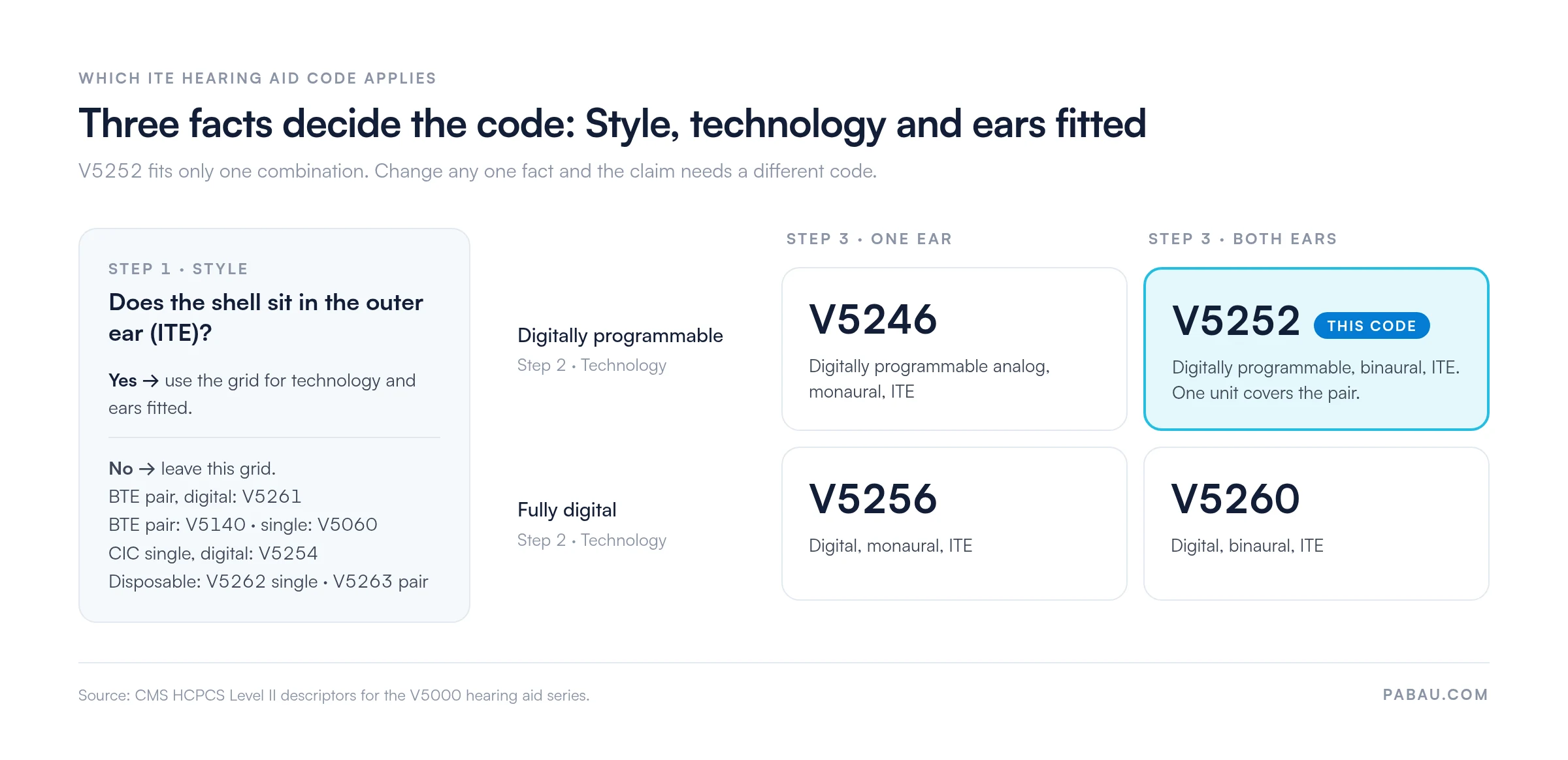
V5252 is the HCPCS Level II code for a hearing aid, digitally programmable, binaural, ITE. One unit covers the pair of in-the-ear devices dispensed to one patient. A single-ear fitting takes V5246 or V5256 instead. Most denials on this code trace back to that mix-up, to billing two units, or to a missing prior authorization.
Traditional Medicare Parts A and B exclude hearing aids under Social Security Act Section 1862(a)(7). Medicaid is the main payer, especially for children under its EPSDT benefit. Medicare Advantage and commercial plans vary, and state fee schedules set the Medicaid rates.
Let Pabau's smart automation suggest the right codes, reduce claim denials, and keep your practice compliant—effortlessly.
Automate repetitive tasks and focus on what matters most—your patients.
Reduce coding errors and ensure compliance with the latest regulations.
Clean claims, fewer denials, and faster reimbursements.
Powerful insights and reporting to help your practice thrive.
HIPAA compliant SOC 2 certified GDPR-compliant Trusted by 4,000+ clinics worldwide

V5252 is one binaural code for a pair of digitally programmable ITE hearing aids, billed as one unit on one line.
A single digital ITE aid is V5256, and a single digitally programmable ITE aid is V5246, never half of V5252.
Traditional Medicare Parts A and B do not cover hearing aids, so Medicaid and Medicare Advantage are the main payers.
Most payers require prior authorization and a recent audiological evaluation before the claim is submitted.
Practice management software like Pabau checks that authorization codes and required fields are complete before a claim is submitted.
HCPCS code V5252 describes a hearing aid, digitally programmable, binaural, in-the-ear (ITE). It is one complete code for the pair, so both devices go on a single claim line as one unit.
“Digitally programmable” means the aid is adjusted by computer, which separates V5252 from the fully digital ITE codes. A binaural fitting billed as two V5252 units, or as two monaural lines, overstates the service and invites a denial.
The ITE style includes full-shell devices that fill the concha bowl and smaller half-shell versions. In-the-canal (ITC) and completely-in-canal (CIC) aids have their own codes, and so do fully digital aids. Picking the wrong style or technology is among the most common reasons V5252 claims are miscoded.
Knowing what falls inside and outside V5252 prevents the majority of coding errors before the claim is built. The code is device-specific and fitting-context-specific.
A patient fitted in one ear only never gets V5252. Billing the binaural code for a single aid misrepresents the service, and payer edits usually catch it.
The V5000 series sorts hearing aids by technology, style, and laterality. Style means ITE, ITC, CIC, or BTE, and laterality means one ear or both. An older code, V5130, covers a binaural ITE pair without naming the technology. Most V5252 coding errors come from mixing up the codes below.
The practical rule: Confirm three facts from the manufacturer’s documentation before selecting a code. Check whether the aid is digitally programmable or fully digital, and whether the shell sits in the outer ear, the canal, or behind the ear. Then confirm whether one ear or both were fitted. The grid below turns those three facts into a code.
Every V5252 claim must carry at least one supporting diagnosis from the ICD-10-CM code set that establishes medical necessity for bilateral amplification. A claim without an accepted diagnosis is denied for lack of medical necessity.
Not every H90 or H91 subcode is accepted by every payer. Some Medicaid plans publish coverage policies that limit covered diagnoses to specific H90 codes. Most binaural fittings rest on H90.3, so confirm the audiogram documents sensorineural loss in both ears. Record the laterality exactly, because it is what supports a binaural code.
A V5252 claim is only as strong as the file behind it. Each item below ties to a specific denial risk if it’s missing.
A complete documentation checklist protects against both initial denials and post-payment audits. Every document listed above should be in the file before the claim goes out, not assembled after a denial arrives.
Prior authorization for hearing aid claims is not universal, but most major payers covering V5252 require it. A claim sent without a required authorization draws a CO-197 denial, which is hard to appeal after the fact.
PA requirements change with annual payer policy updates. Verify the patient’s eligibility and benefits at every episode of care. Then pull the current PA requirements from the payer portal before you schedule the fitting.
Run your PA request at least 10 business days before the scheduled fitting. Most Medicaid plans processing V5252 authorizations take five to seven business days, and a denied authorization cannot be corrected retroactively once the device is dispensed.
A complete V5252 claim moves through six distinct steps. Skipping or rushing any one of them is where most billing errors enter the process.
Bill V5252 as one unit, whatever the payer’s line layout. The descriptor already covers both ears, so most payers do not expect LT or RT on this code. A few Medicaid programs ask for them anyway, so check the provider manual before the first claim.
The device and the dispensing service are billed separately. Report the binaural dispensing fee with V5160, not the monaural fee code V5241. Earmolds, batteries, and the hearing evaluation each go on their own lines. The battery code is V5266, and earmolds use V5264 or V5265.
Reimbursement for HCPCS code V5252 varies significantly by payer, state, and plan type. No single national fee schedule applies to hearing aid codes the way the Medicare Physician Fee Schedule applies to CPT codes.
Mississippi Medicaid publishes a hearing fee schedule on medicaid.ms.gov that includes V-series codes with state-specific allowable amounts as of its most recent update (February 2021). TMHP publishes hearing service rates within its CSHCN Provider Manual.
Always pull the most current version directly from the state Medicaid source. Fee schedules update at least annually and sometimes mid-year. The CMS Physician Fee Schedule lookup tool does not cover V5252, because traditional Medicare excludes hearing aids. It is still useful for confirming which HCPCS codes have a Medicare payment status.
The AAPC Codify HCPCS lookup provides quick access to code descriptions and cross-references when verifying V-code assignments.
Tracking the electronic remittance advice (ERA) for each V5252 claim shows billing staff patterns in allowable amounts. They can spot underpayments against contracted rates and appeal adjustments before the filing deadline.
Denial patterns on V5252 are consistent across payer types. The same seven issues account for most rejections, and each has a clear corrective action.
A structured denial workflow for hearing aid claims shortens the time between a denial notice and a corrected resubmission. Group the claim adjustment reason codes (CARCs) on each 835 ERA by category. The pattern shows whether the problem sits in the PA process, in code selection, or in eligibility checks. Each one needs a different operational fix.
Create a pre-submission checklist for every hearing aid claim. Confirm the audiogram date is within limits and the PA number is on file. Check the style and technology against the manufacturer spec sheet. Make sure both ears were fitted, the claim shows 1 unit, and the ICD-10-CM code is bilateral.
Hearing aid claims stall on paperwork more often than on coding. Billers chase PA numbers across payer portals, check audiogram dates by hand, and find a missing serial number only after a denial.
Practice management software like Pabau keeps that work in one place. Its claims management software checks that authorization codes and other required details are filled in before a claim can go out. Staff then follow each claim from pending to paid on a single dashboard.
In the US, real-time eligibility checks through Claim.MD confirm coverage before the fitting, and ERA posting matches each payment to its invoice. The result is fewer claims sent back for a missing PA number, and less time spent rebuilding files after a denial.
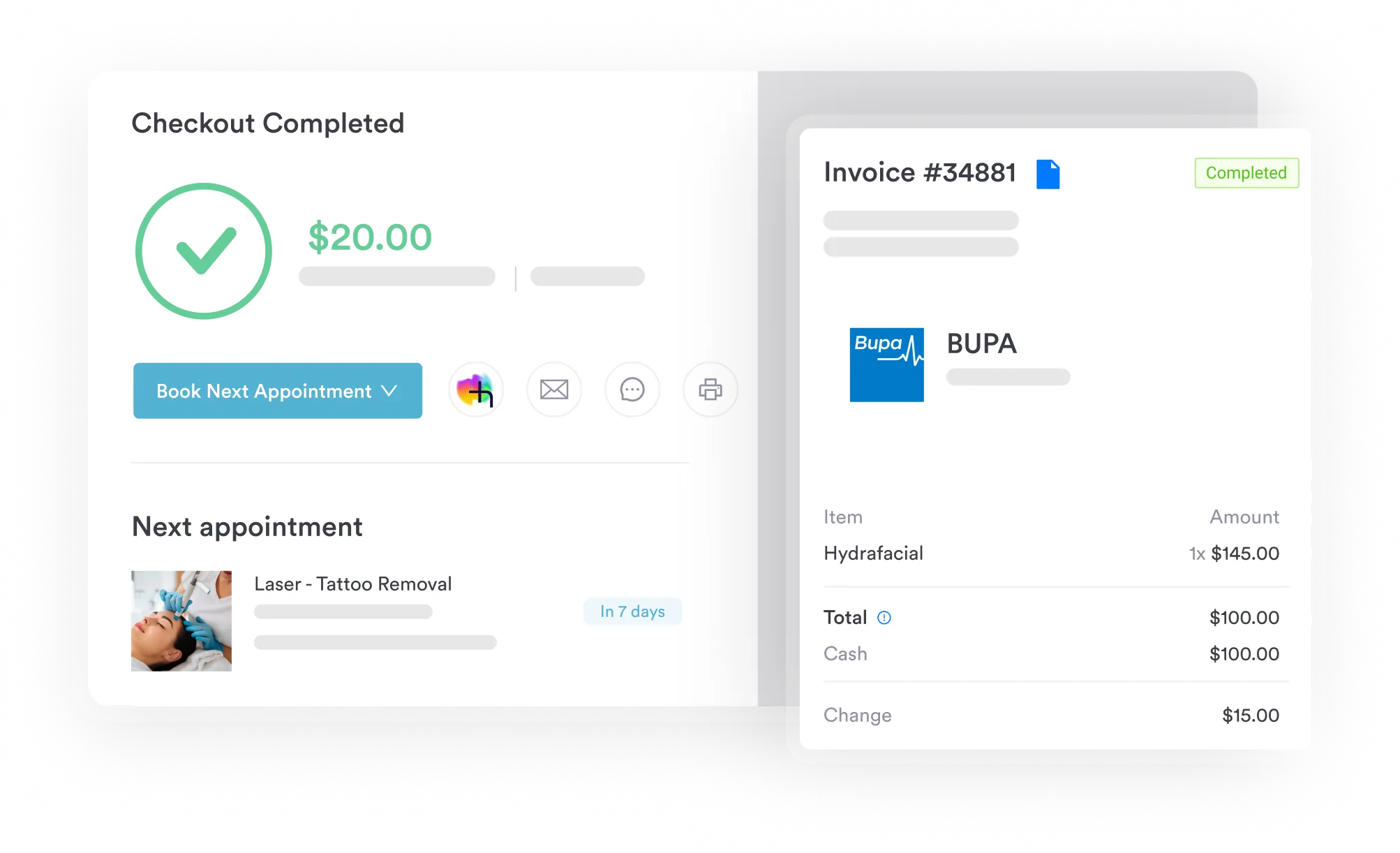

Pabau checks that authorization codes and required fields are complete before claims go out, then tracks each one to payment. Your team catches errors at the source instead of after a denial.

HCPCS code V5252 pays cleanly when the claim matches the device in the patient’s ears. That means a digitally programmable ITE pair, reported once, with prior authorization in place before dispensing. A bilateral hearing loss code backed by a recent audiogram completes the claim.
Treat one ear, fully digital technology, or a different shell style as a signal to change codes. Catching that before submission costs minutes, while a denial can take weeks and sometimes cannot be appealed.
Pabau checks authorization codes and required claim fields before submission, so a V5252 pair goes out complete the first time. To see how it handles audiology billing, book a demo with our team.

Need to understand how clearinghouse submissions work for V-codes? Medical claims clearinghouse guide explains the electronic submission pathway from biller to payer.
Want a reference for the 837P file format used in HCPCS submissions? 837 file explained covers how HCPCS claims are structured in the EDI transaction set.
Dealing with repeated denials across multiple code types? Denial codes in medical billing maps the most common CARC codes to their corrective actions.
Want fewer V-code claims sent back for missing fields? What is a clean claim lists the fields payers check before they process a claim.
Setting up a superbill for hearing aid fittings? Superbill guide shows how to map codes, units and diagnoses onto one form.
HCPCS code V5252 is the Level II code for a hearing aid, digitally programmable, binaural, in-the-ear (ITE). It covers a pair of ITE aids fitted to both ears, billed as one unit on one claim line.
V5252 is a digitally programmable ITE pair, while V5254 is a single digital completely-in-canal (CIC) aid. They differ in technology, style, and laterality. For a single ITE aid, use V5256 if it is digital or V5246 if it is digitally programmable.
No. Traditional Medicare Parts A and B do not cover hearing aids, which are a statutory exclusion under Social Security Act Section 1862(a)(7). Some Medicare Advantage plans include hearing aid benefits. Coverage and PA requirements vary by plan, so verify each one individually.
Yes, in most states, particularly for pediatric patients under EPSDT and CHIP. Reimbursement rates, documentation requirements, and frequency limitations vary by state. Texas, Mississippi, and Louisiana Medicaid programs all cover V5252-series codes with prior authorization. Always verify current state fee schedules and payer policy before submitting.
Most Medicaid plans and many commercial plans require prior authorization before dispensing ITE binaural hearing aids. BCBSND, TMHP, Mississippi Medicaid, UHC Community Plan, and Ambetter Louisiana all require prior auth. Submit your authorization request before the fitting appointment, not after the device is dispensed.
There is no single national reimbursement rate for V5252. Traditional Medicare does not pay for it. Each state Medicaid program sets its own rates, and Mississippi and Texas publish theirs on their Medicaid agency websites. Medicare Advantage and commercial plan rates are set by individual contracts. Verify the current rate directly from your payer’s fee schedule or provider portal before determining patient financial responsibility.
The most commonly accepted ICD-10-CM codes with V5252 are H90.0 (bilateral conductive hearing loss), H90.3 (bilateral sensorineural hearing loss), and H90.6 (bilateral mixed hearing loss). H91.93 (bilateral unspecified hearing loss) is accepted by some payers. Use the code that most precisely matches the audiogram findings and verify it against your payer’s coverage policy.