CPT code 88361: Computer-assisted IHC morphometric analysis
CPT code 88361 pays for IHC that software scores CPT code 88361 reports morphome...

Last Updated: Nov 19, 2026
V5230 is the HCPCS Level II code for a hearing aid, contralateral routing system, binaural, glasses. It covers a two-sided CROS or BiCROS system built into eyeglass frames, which sends sound from the poorer ear to the better one.
Use it only when the routing parts are mounted in glasses. Ear-level routing systems bill under V5211 to V5221, and standard binaural aids under their own codes. Original Medicare excludes hearing aids by statute.
Let Pabau's smart automation suggest the right codes, reduce claim denials, and keep your practice compliant—effortlessly.
Automate repetitive tasks and focus on what matters most—your patients.
Reduce coding errors and ensure compliance with the latest regulations.
Clean claims, fewer denials, and faster reimbursements.
Powerful insights and reporting to help your practice thrive.
HIPAA compliant SOC 2 certified GDPR-compliant Trusted by 4,000+ clinics worldwide

HCPCS code V5230 is a hearing aid, contralateral routing system, binaural, glasses, so the CROS or BiCROS parts are built into eyeglass frames.
Ear-level CROS systems bill under V5211 to V5221, and binaural CIC aids bill under V5248 or V5250, never V5230.
The descriptor was reworded on January 1, 2019, when the old CROS and BiCROS codes V5170, V5180, V5210 and V5220 were deleted.
Original Medicare excludes hearing aids by statute, so V5230 is billed to Medicaid, commercial plans or Medicare Advantage hearing benefits.
Before billing, confirm the system is glasses-mounted, the plan covers routing systems and the diagnosis shows one ear much worse than the other.
HCPCS code V5230 is the Level II code for a hearing aid, contralateral routing system, binaural, glasses. CMS carries that exact wording in its quarterly HCPCS code file, and the AAPC V5230 listing matches it. In plain terms, it bills a two-sided CROS or BiCROS system whose parts are mounted in eyeglass frames.
Three words in that descriptor decide the code. “Contralateral routing” means sound is sent across the head to the other ear. “Binaural” means the system has parts on both sides. “Glasses” means those parts sit in the frames rather than in or behind the ears.
A routing system helps a patient with one ear that a standard hearing aid can’t help. A microphone on the poorer side picks up sound and sends it to a receiver on the better ear. The patient then hears that side of the room through the ear that still works.
On a V5230 system, both pieces live in the temples of a pair of glasses. That’s uncommon now, because most CROS and BiCROS fittings use ear-level devices. So when V5230 shows up on a charge sheet, confirm the frames before you confirm the code.
V5230 isn’t new. It was long listed as a BiCROS glasses code, and CMS reworded it to the current “contralateral routing system, binaural, glasses” on January 1, 2019. Its meaning stayed in the routing family.
The same update deleted the old ear-level CROS and BiCROS codes, V5170, V5180, V5210 and V5220. CMS added new routing codes by style instead: V5171, V5172 and V5181 for single devices, and V5211 to V5215 plus V5221 for two-sided systems. Our V5170 guide covers the deleted ITE code in more detail.
V5230 didn’t replace any of those deleted codes. It kept its glasses-only scope, which is why it still sits beside V5190, the single-side glasses code.
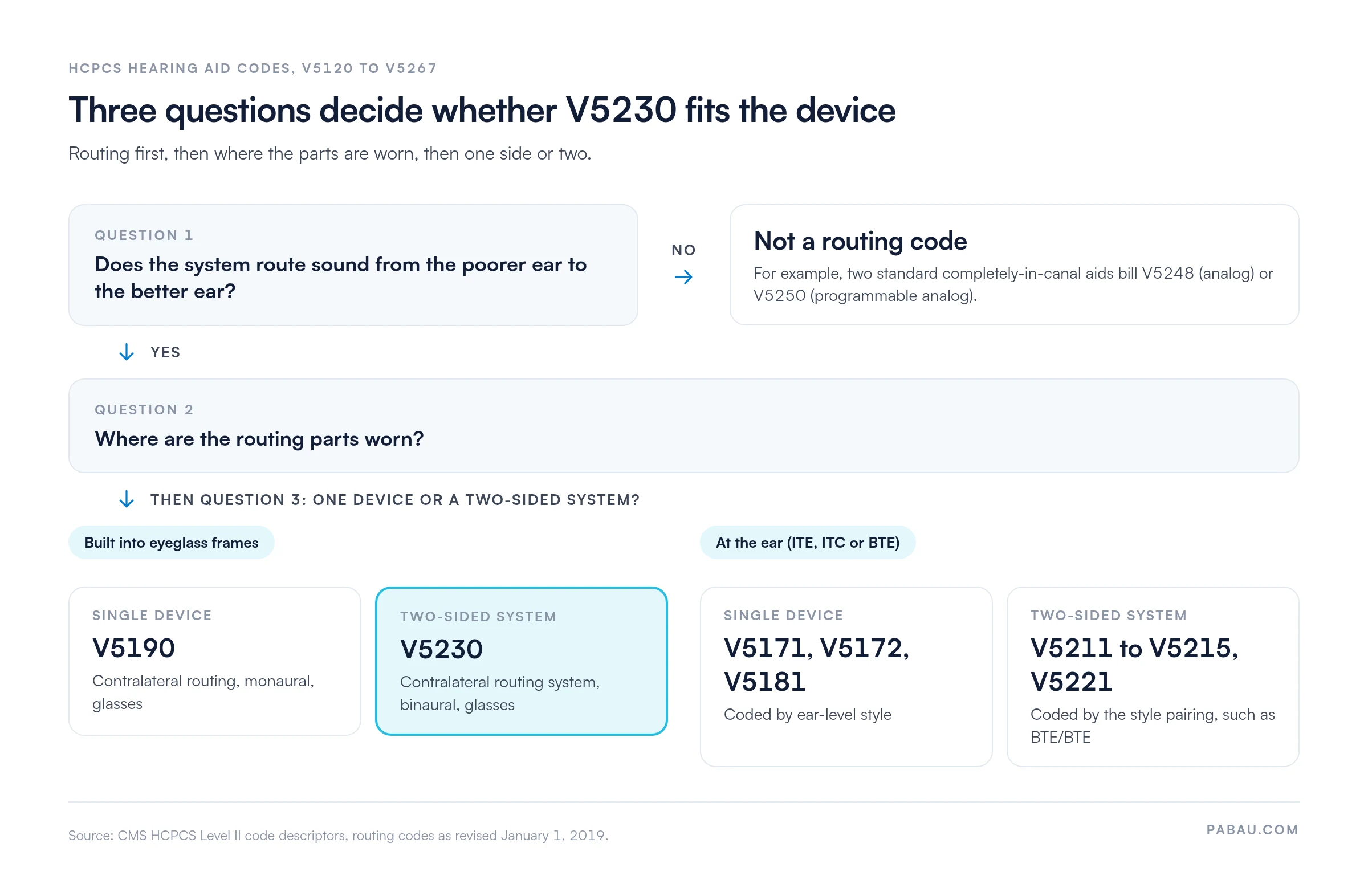
Code choice in this range comes down to two questions. Where are the parts worn, and is it a single device or a two-sided system? Descriptors below are from the current HCPCS Level II file.
No routing means you’re out of this family altogether. Routing plus frames means V5230 or V5190, and routing worn at the ear means a code from V5171 to V5221. The decision tree below runs those three questions in order.
Original Medicare doesn’t cover V5230. Section 1862(a)(7) of the Social Security Act and 42 CFR 411.15(d) exclude hearing aids and the exams to fit them. The Medicare Benefit Policy Manual, chapter 16, section 100 repeats that exclusion.
Because the exclusion is statutory, an Advance Beneficiary Notice isn’t required. Many practices still hand patients a voluntary notice so the cost is clear before the order goes in. Other payers work differently.
Need a Medicare denial so a secondary plan will pay? Add the GY modifier, which flags an item as statutorily excluded. That gets you a fast denial to forward with the secondary claim.
A routing system only makes sense when one ear is much worse than the other. A bilateral hearing loss code alone doesn’t tell that story. Pick the ICD-10-CM code that matches the audiogram’s picture of each ear.
Code the diagnosis from the audiogram and chart, never from the device. If the chart doesn’t support one unaidable ear, the routing system itself is the question to raise with the audiologist.
Here’s the path a clean V5230 claim usually takes in a dispensing practice. Payer rules shift the details, so treat each step as a checkpoint rather than a script.
Getting it right the first time matters on a device claim this size. A clean claim skips the resubmission loop, and a superbill with routing codes preloaded stops a rushed coder from defaulting to a standard aid.
Take an illustrative patient with a profound loss in the right ear and a mild loss on the left. The audiogram shows the right ear can’t benefit from amplification. The audiologist recommends BiCROS, and the patient wants it built into the glasses they already wear daily.
The coder lands on V5230, one unit, with H90.A21 as the diagnosis. The plan pays dispensing separately, so V5240 goes on a second line. Had the patient picked two behind-the-ear pieces instead, the same claim would carry V5221.
Most V5230 problems start at code selection. These are the ones that come back most often, and each one has a simple fix in the chart or on the charge line. Denial management that tracks them by cause stops the same error from repeating.
When a claim does come back, the denial codes on the remittance tell you which of these mistakes caused it. Each one also leaves a trail in the record, which matters at audit time. Our guide to medical billing compliance covers how to keep that trail audit-ready.
In many hearing practices, the fitting note lives in one system and the claim in another. Serial numbers get retyped, and the benefit check sits in someone’s inbox. That’s where V5230 claims slip.
Pabau’s claims management software builds each claim from the patient record, where the fitting note and the diagnosis already sit. Nobody has to retype the V5230 details into a separate billing tool.
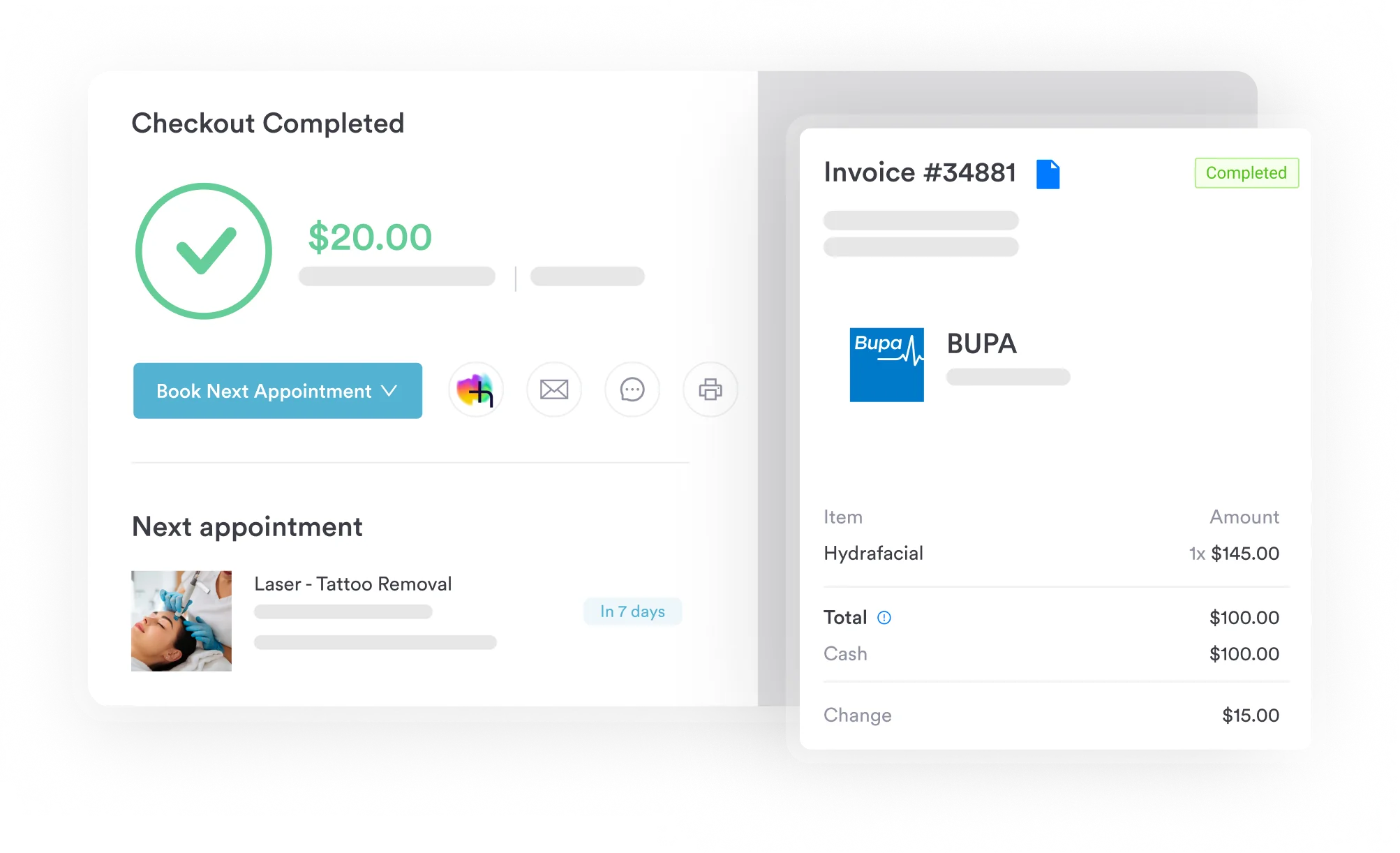
In the US, Pabau sends claims through Claim.MD as CMS-1500 or 837P submissions, and the same connection runs eligibility checks and receives ERA remittances. Where a Medicaid or commercial plan wants prior approval, the auth code, dates and sessions are tracked on the patient’s case. A warning shows when one is missing.

Pabau builds each claim from the patient record and sends US claims through Claim.MD, with eligibility checks and ERA remittances. Prior authorizations are tracked on the patient’s case.

V5230 is a narrow code, and that’s what makes it easy to get wrong. It fits one device type, a two-sided routing system in glasses. CIC aids and ear-level routing systems have codes of their own.
Confirm the frames, the routing and the payer before the order goes in. Do that, and a code that rarely appears on your charge sheet stops being the one that comes back denied.
Book a demo to see how Pabau keeps hearing aid claims tied to the fitting record, from benefit check to remittance.

Need a framework for reducing billing denials across your practice? Denial management in healthcare covers root-cause workflows and rework reduction for specialty practices.
Want to understand what a fully clean claim looks like before submission? Clean claim submission guidelines outlines field requirements and common first-pass failure points.
Looking to benchmark your billing compliance posture? Medical billing compliance gives a practical overview of audit readiness and documentation standards.
Billing a single glasses-mounted routing device instead? HCPCS code V5190 covers the monaural glasses code that sits beside V5230.
Yes. V5230 is active in the HCPCS Level II file, with its current wording in effect since January 1, 2019.
It isn’t billed as a hearing aid. An auditory osseointegrated device uses L8690, and Medicare treats osseointegrated implants as prosthetic devices rather than excluded hearing aids.
GY tells Medicare the item is statutorily excluded. The claim denies quickly, which gives you the denial a secondary payer may need before it pays.
Yes, in most cases. The IRS counts hearing aids as a qualifying medical expense, so HSA and FSA funds can usually cover the patient’s share.
No. A single glasses-mounted routing device bills under V5190. V5230 is only for a two-sided system.