CCSD Code V1730: Extraoral fixation of mandible
What is CCSD code V1730? CCSD code V1730 is the UK private medical insurance cod...

Last Updated: Nov 24, 2026
V5245 is the HCPCS Level II code for hearing aid, digitally programmable analog, monaural, ITC (in the canal). It covers one aid worn in the ear canal and fitted to a single ear, whose analog sound processing is adjusted by computer programming.
The code turns on ear count, technology and style. Each aid bills as one unit with the RT or LT modifier. A binaural fitting of the same device can bill as V5251, depending on the payer, while a fully digital monaural ITC aid bills as V5255.
Let Pabau's smart automation suggest the right codes, reduce claim denials, and keep your practice compliant—effortlessly.
Automate repetitive tasks and focus on what matters most—your patients.
Reduce coding errors and ensure compliance with the latest regulations.
Clean claims, fewer denials, and faster reimbursements.
Powerful insights and reporting to help your practice thrive.
HIPAA compliant SOC 2 certified GDPR-compliant Trusted by 4,000+ clinics worldwide

HCPCS code V5245 covers one digitally programmable analog hearing aid worn in the canal (ITC) and fitted to a single ear.
V5245 is a monaural code, billed one unit per aid with the RT or LT modifier. A matched pair follows the payer’s convention, either two V5245 units or binaural code V5251.
A fully digital ITC aid is not V5245. It bills as V5255 for one ear or V5259 for both ears.
Medicare Part B excludes hearing aids under Section 1862(a)(7) of the Social Security Act, so payment comes from Medicaid, Medicare Advantage or commercial plans.
Pabau, the practice management platform we build, keeps the audiogram, device specification and ear fitted on one patient record. Each V5245 claim then carries the right modifier.
HCPCS code V5245 is the Level II code for a single digitally programmable analog hearing aid worn in the ear canal (ITC). It sits in the V5120-V5267 hearing aid range of the code set maintained by the Centers for Medicare and Medicaid Services (CMS). ASHA’s list of HCPCS audiology codes gives the descriptor as Hearing aid, digitally programmable analog, monaural, ITC.
Each part of that descriptor narrows the code. Digitally programmable analog means the aid processes sound through analog circuitry, while an audiologist adjusts its settings by computer. Monaural means one aid for one ear. ITC means a custom shell that sits in the outer part of the ear canal. It is smaller than an in-the-ear (ITE) aid and larger than a completely-in-canal (CIC) aid. The programmable ITE version for one ear bills as code V5246.
The table below lists the attributes billers need to confirm before submitting a claim.
V5245 applies when an audiologist or hearing instrument specialist dispenses one ITC aid with digitally programmable analog circuitry to one ear. Three facts must all be true: one ear, ITC style and digitally programmable analog technology. If any of them changes, the code changes too.
Analog circuitry alone does not make a claim V5245, because the aid must also be digitally programmable. A conventional analog ITC aid with no programming capability bills as V5243 instead.
Clinical situations that typically support a monaural V5245 fitting include:
These scenarios fall outside V5245 and need a different code:
The circuitry inside the aid decides the code. A fully digital aid is also programmed by computer, but its digital sound processing places it under V5255 for one ITC aid.
The costliest V5245 errors come from picking a code one attribute away. The usual swaps are the binaural code, the fully digital code or the wrong style. The table below maps the neighbors coders most often confuse with V5245, with descriptors from the CMS code set.
Check the technology before the ear count. Most hearing aids dispensed today are fully digital, so confirm the circuitry before reaching for V5245. The manufacturer’s specification sheet states whether sound processing is digital or programmable analog. Keep that sheet with the fitting record. The decision path below runs all three checks in that order.
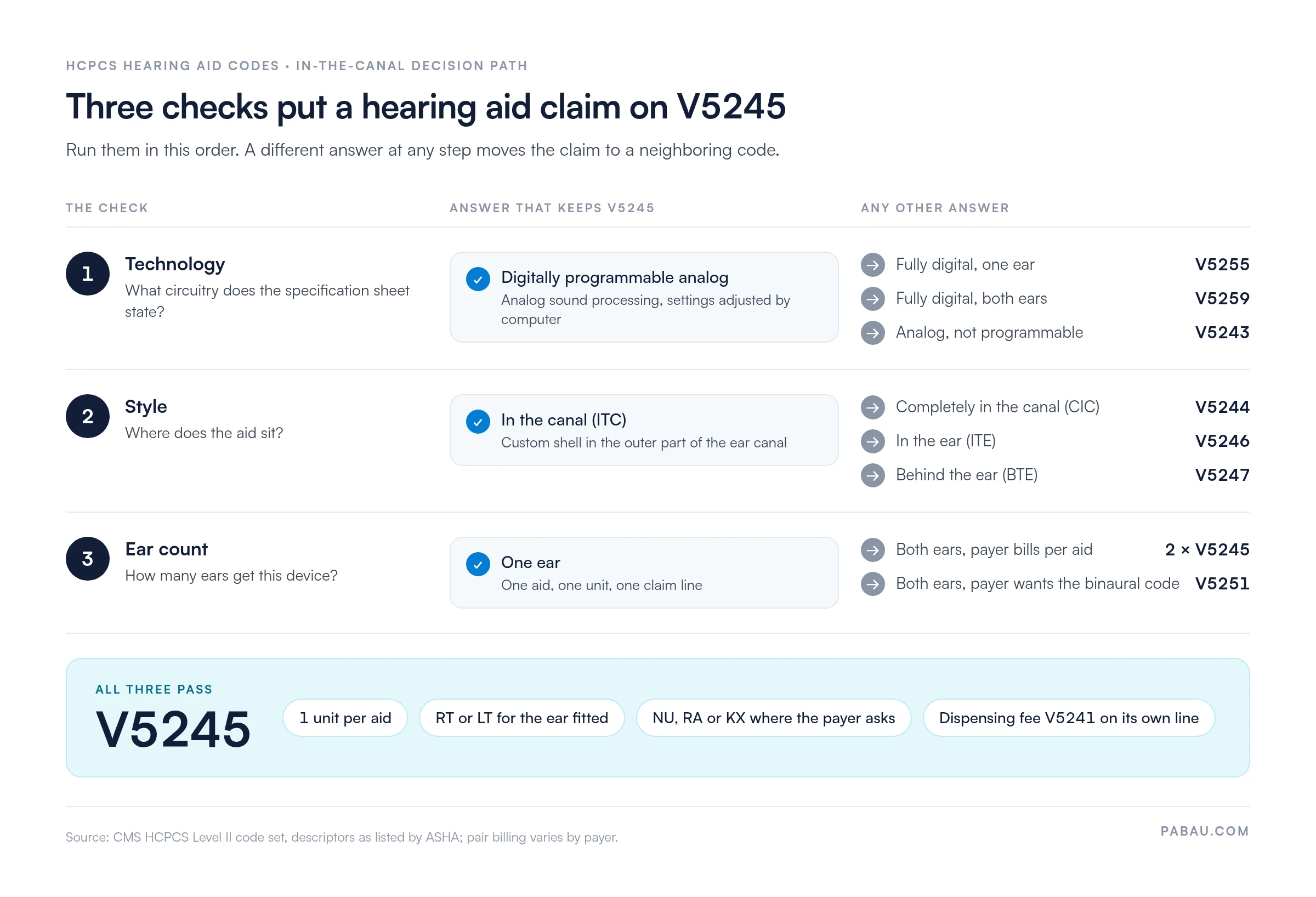
Whether V5245 gets paid depends on the payer type, so verify current plan benefits before dispensing.
A V5245 claim sent to Original Medicare is denied as non-covered, however complete the chart is. The statutory exclusion covers hearing aids and the exams for prescribing or fitting them. Bone-anchored and cochlear implant systems are handled as prosthetic devices, and a V5245 aid never falls into that group.
Per-ear caps matter more for V5245 than for a binaural code. When a plan pays a fixed amount per ear, a monaural claim draws on one ear’s allowance only. That leaves the other ear’s allowance available if the patient needs a second aid later.
Many state Medicaid programs and commercial plans require prior authorization (PA) before paying a V5245 claim. A missing PA number is one of the most preventable denials in hearing aid billing. Confirm eligibility and PA status before you book the fitting appointment.
Typical PA criteria include:
State the ear, the style and the technology in the PA request itself, for example “one digitally programmable analog ITC aid, right ear.” An authorization issued for a binaural, ITE or fully digital fitting will not match a V5245-RT claim line.
Every V5245 claim needs a record that proves medical necessity and confirms the aid was dispensed. Work through this checklist at the fitting appointment, while the patient is still in the office.
A superbill built for audiology encounters helps staff capture these fields before the patient leaves. Add a required “ear fitted” field so laterality is never left to memory. Attach the audiogram and specification sheet to the claim record too, because some payers run pre-payment review on hearing aid codes.
V5245 needs an ICD-10-CM diagnosis that establishes hearing loss in the ear being fitted. Because the code covers one aid, the diagnosis has to agree with the RT or LT modifier on the claim line. A unilateral code for the opposite ear is a mismatch that payer edits catch.
Use the code that names the ear on the claim line wherever the audiogram supports it. When testing shows loss in both ears but only one is fitted, a bilateral code can still support the claim. The chart should then explain why the other ear was not aided.
Laterality comes first. V5245 describes one aid, so payers expect RT or LT on the line, matching the ear named in the chart and the diagnosis. Transaction modifiers then describe whether the aid is new, a replacement or a rental.
For a matched pair, each payer sets its own convention. Some want two V5245 units split across an RT line and an LT line. Others want the binaural code V5251 on a single line. Confirm the rule in the payer’s hearing aid billing policy before the first claim.
V5245 is billed as one unit per aid, on its own claim line, with the RT or LT modifier. Follow these steps for a clean claim on the first submission.
Audiology claims management software that checks modifiers and units before submission catches setup errors before the payer does.

V5245 denials follow predictable patterns. Good denial management workflows map each remittance remark code to a root cause and a corrective action before the appeal window closes.
Run a quarterly audit of V5245 claims by remittance remark code. A denial reason that keeps coming back points to one step in the workflow. Fix it at the documentation or prior authorization stage, and the appeals for that reason stop.
Replacement rules decide how often a patient can receive a new aid under their coverage. Because V5245 covers one ear, the benefit clock usually runs per ear, not per pair. Replacing one lost aid from a pair bills as V5245 with that ear’s modifier, not as a binaural code.
For an early replacement, the record must state the clinical reason and the ear affected. A new audiogram showing a threshold shift carries far more weight than a chart note saying the aid was lost. For theft, attach the police report.
V5245 is active for 2026. It has been in the HCPCS code set since January 1, 2002, and the hearing aid V-codes carry no 2026 changes. Medicare Part B publishes no allowable for V5245, because the code is excluded from that benefit.
Reimbursement is set payer by payer and changes at least once a year. Pull current amounts from each payer’s published fee schedule rather than relying on last year’s figures.
The CMS HCPCS overview links to the annual code files, but state Medicaid rates are maintained separately by each state agency. The AAPC HCPCS code lookup and PGM Billing’s HCPCS tool confirm that V5245 is active. The NLM HCPCS API offers programmatic lookups for practices that connect billing data to their own systems.
Many patients pay for a V5245 aid out of pocket, because their primary insurer does not cover hearing aids. Share a written cost estimate before dispensing, which reduces disputes after the fitting.
A V5245 claim depends on details that often sit in different places. The ear fitted is in the chart notes, the device specification is in a supplier email and the PA number is in a payer portal. When one of them is missing, the claim goes out with the wrong modifier or the wrong code.
Pabau keeps those details on one patient record. Digital forms capture the order, the device details and the ear fitted before the appointment ends. The audiogram and PA approval are stored against the same record, so staff can find them when the claim is built.
Pabau’s claims management then submits the claim electronically and tracks its status. Your billing team can see where each V5245 claim sits and follow up on a denial before the appeal window closes.

Pabau keeps the audiogram, device details and PA number on the patient record. It then submits and tracks each hearing aid claim, so denials get caught early.

V5245 is only the right code when three facts line up: one ear, an ITC aid and digitally programmable analog circuitry. Confirm all three from the specification sheet at the fitting, and most wrong-code denials disappear.
The ear is the detail that trips teams up most. Record it in the chart, put it in the PA request and carry it onto the claim as RT or LT. When both ears get the same device, bill the pair the way the payer’s manual asks, as two V5245 units or one line of V5251.
If your team still matches fitting notes to payer rules by hand, one patient record removes that step. Pabau’s medical billing workflows keep hearing aid documentation and claims together. Book a demo to see how it works for your audiology practice.

Need a claims management system built for specialty practices? Pabau claims management software covers HCPCS submission, payer tracking, and denial resolution in one platform.
Confused about what makes a clean claim? What is a clean claim breaks down every element payers check before processing, and what trips claims at the edit stage.
Want to reduce denials systematically? Denial management in healthcare covers how to categorize, appeal, and prevent the most common rejection patterns.
HCPCS code V5245 is the Level II code for one digitally programmable analog hearing aid worn in the ear canal (ITC). It is a monaural code, so it covers a single aid fitted to one ear. Fitting services, accessories and batteries are reported separately.
V5245 is billed per ear, one unit per aid, with the RT or LT modifier. For a matched pair, follow the payer’s convention. Some want two V5245 units marked RT and LT, and others want one line of binaural code V5251.
Both codes cover digitally programmable analog aids worn in the canal. V5245 is monaural and covers one aid for one ear. V5251 is the binaural code for the same device type fitted to both ears.
Both codes cover one in-the-canal aid for one ear. V5245 is for digitally programmable analog circuitry, while V5255 is for a fully digital aid. Check the manufacturer’s specification sheet, because most aids dispensed today are fully digital.
No. Original Medicare Part B excludes hearing aids under Section 1862(a)(7) of the Social Security Act, so V5245 claims are denied as non-covered. Some Medicare Advantage plans cover hearing aids as a supplemental benefit.
RT or LT identifies the ear fitted and belongs on the V5245 line. NU marks a new aid, RA a replacement and RR a rental. Some Medicaid and commercial payers also require KX to attest that their benefit criteria are met.
Use an ICD-10-CM code that names the fitted ear, such as H90.41 or H90.42 for unilateral sensorineural loss. A bilateral code such as H90.3 can support a one-ear fitting when the chart explains why only one ear was aided.
A monaural fitting usually pairs V5245 with V5241, the dispensing fee for a monaural hearing aid of any type. Check whether the payer pays the fee separately or bundles it into the device allowance.